

1. Introduction
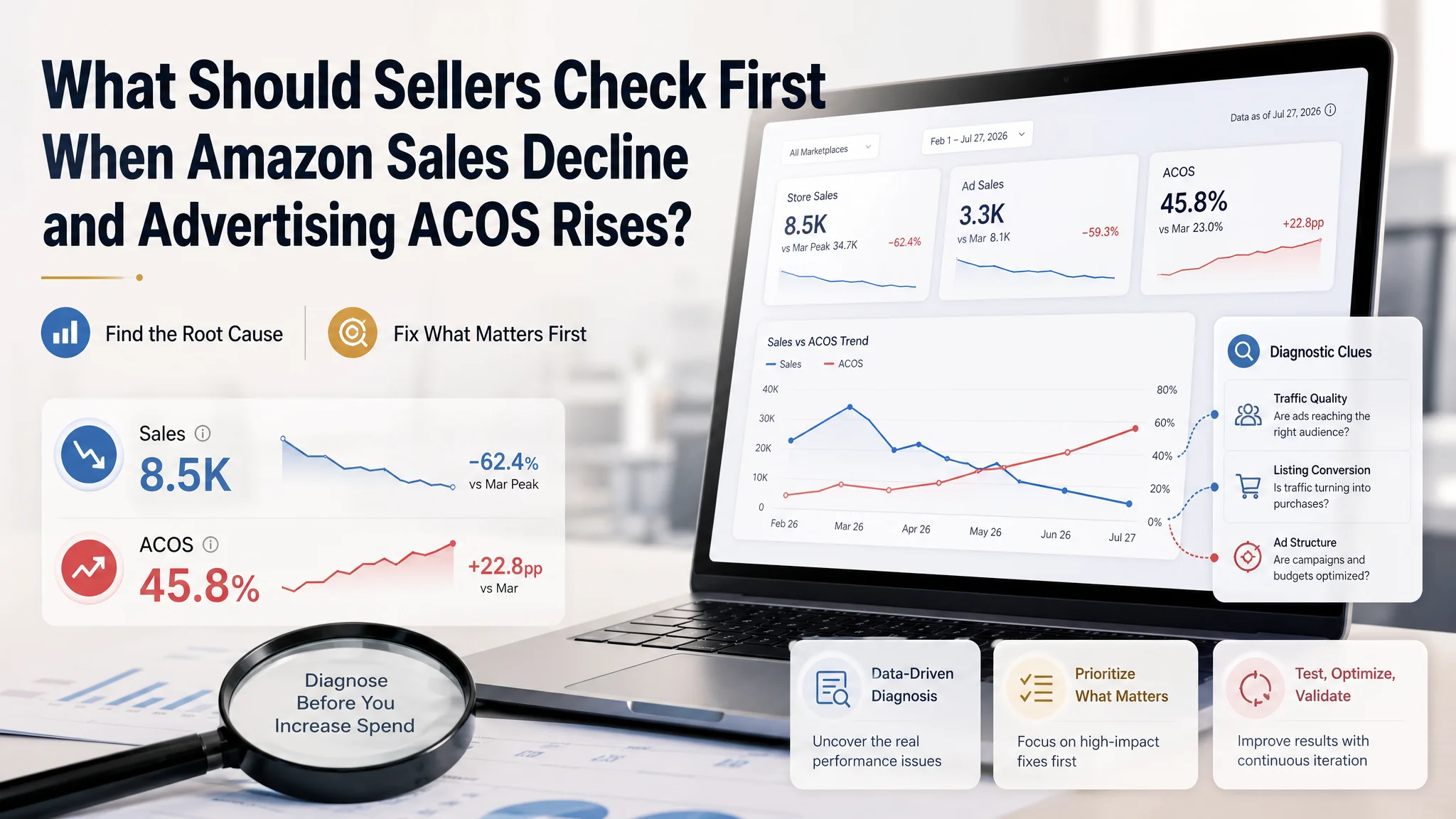
When Amazon sales continue to decline from a periodic peak and advertising ACOS keeps rising, the problem may not simply be that “advertising performance has deteriorated.” A U.S. marketplace seller of mobile phones and consumer electronics manages approximately 9 product Listings. In March 2026, store sales were approximately 3.47万, sales generated by smart advertising were approximately 8077, and smart advertising ACOS was 23.0%; by July 27, 2026, store sales had fallen to approximately 8467, overall advertising ACOS had risen to 45.8%, and smart advertising ACOS had also increased to 39.5%. During this process, some advertising campaigns were paused or archived, while some Listings also lacked sufficient capacity to convert incoming traffic. Using this periodical diagnostic case as its background, this article explains which issues sellers should check first when facing high amazon ACOS, declining advertising sales, or advertising that becomes increasingly unprofitable. It should be noted that this case is still in the risk-warning and validation-pending stage. Therefore, the subsequent plan cannot yet be described as having restored sales.
2. Customer Background
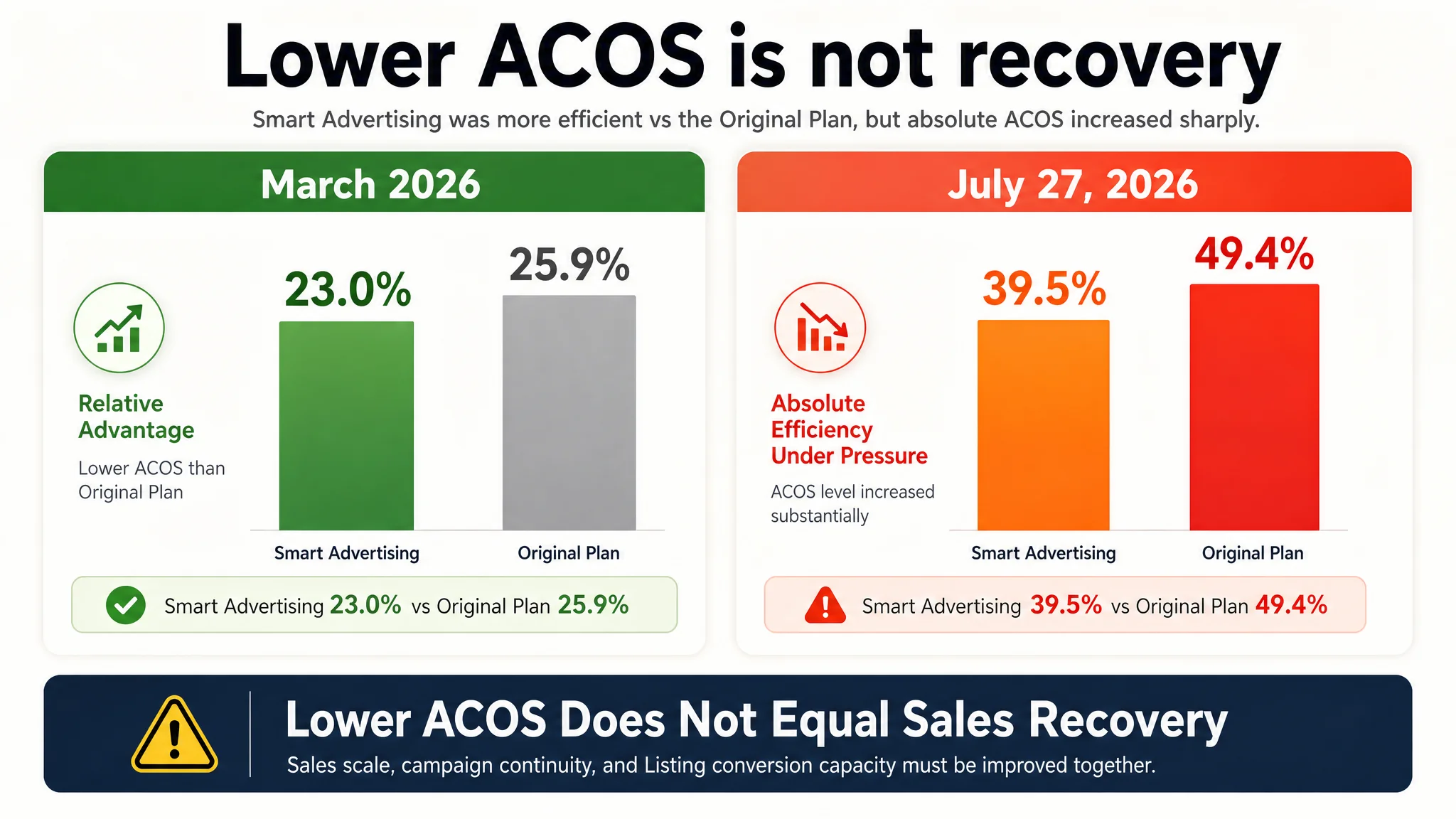
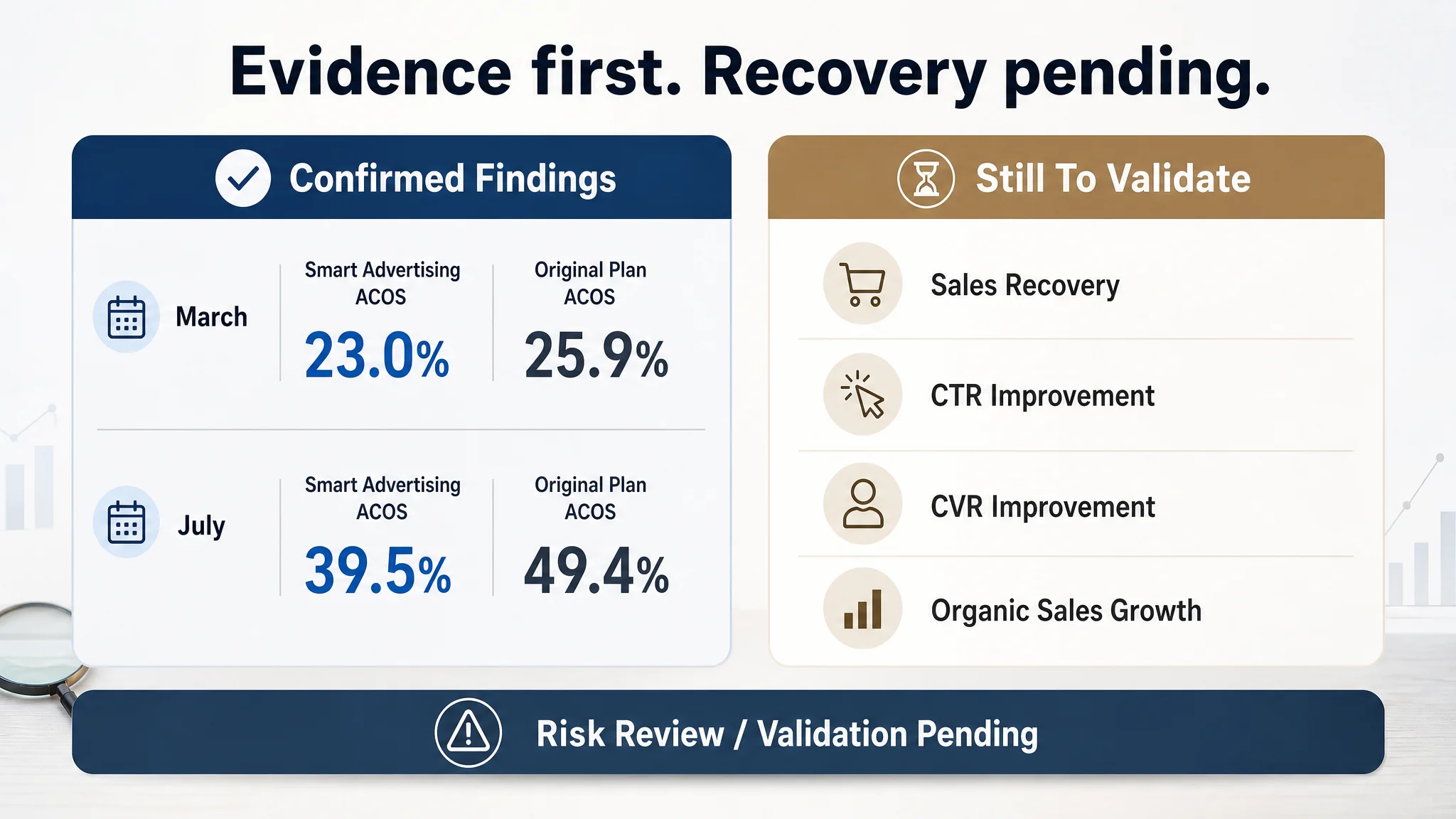
The seller operates on the U.S. marketplace and mainly sells mobile phone and consumer electronics products, with approximately 9 product Listings in the store. The seller began using a smart advertising system in February 2026. During the initial validation stage, advertising efficiency was relatively strong: in March 2026, total store sales reached approximately 3.47万, sales generated by smart advertising were approximately 8077, and smart advertising ACOS was 23.0%, lower than the 25.9% of the original advertising plan.
However, after reaching a periodical peak in March, store sales continued to decline. By July 27, 2026, store sales were approximately 8467, and overall advertising ACOS had risen to 45.8%. Smart advertising ACOS was 39.5%, still lower than the 49.4% of the original advertising plan during the same period. However, in terms of absolute efficiency and the ability to scale sales, overall operations were already under pressure.
Therefore, the seller was not facing a single advertising issue, but rather a comprehensive problem requiring simultaneous checks of advertising, Listings, and the return on operating investment: Were advertising costs still generating effective sales? Had previously well-performing campaigns been interrupted? Could product pages effectively convert traffic generated by advertising? Were the key Listings ready for further scaling?
3. The Problem
Sales Decline and Rising ACOS Occurred Simultaneously
This type of problem typically first appears through two signals: declining sales and a rising advertising cost ratio. For sellers, the most direct experience is that the advertising budget continues to be spent, but orders and sales do not grow accordingly. In some cases, there may be “advertising clicks and advertising spend, but overall sales still fail to increase.”
In this case, store sales declined from approximately 3.47万 in March 2026 to approximately 8467 as of July 27, 2026. At the same time, overall advertising ACOS rose from a relatively manageable level during the earlier period to 45.8%. This means the seller could not look only at whether an individual advertising campaign had generated orders. Instead, the seller needed to reassess whether overall advertising investment was still aligned with the current sales scale.
Smart Advertising Was Relatively More Efficient, but This Did Not Mean Sales Had Recovered
Smart advertising had a lower ACOS than the original advertising plan across multiple periods. In March, smart advertising ACOS was 23.0%, compared with 25.9% for the original advertising plan. By July 27, smart advertising ACOS was 39.5%, compared with 49.4% for the original plan. These comparisons indicate that smart advertising still had a certain advantage in controlling ACOS.
However, “ACOS is lower than the original plan” and “store sales have recovered” are two different conclusions. In July, overall sales were still only approximately 8467, while the absolute ACOS of smart advertising had already risen to 39.5%. If the seller concluded that store operations had improved simply because smart advertising was relatively more cost-efficient, it would be easy to overlook insufficient sales scale, incomplete advertising campaigns, and insufficient Listing conversion capacity.
Campaign Status and Listing Capacity Began to Affect the Assessment
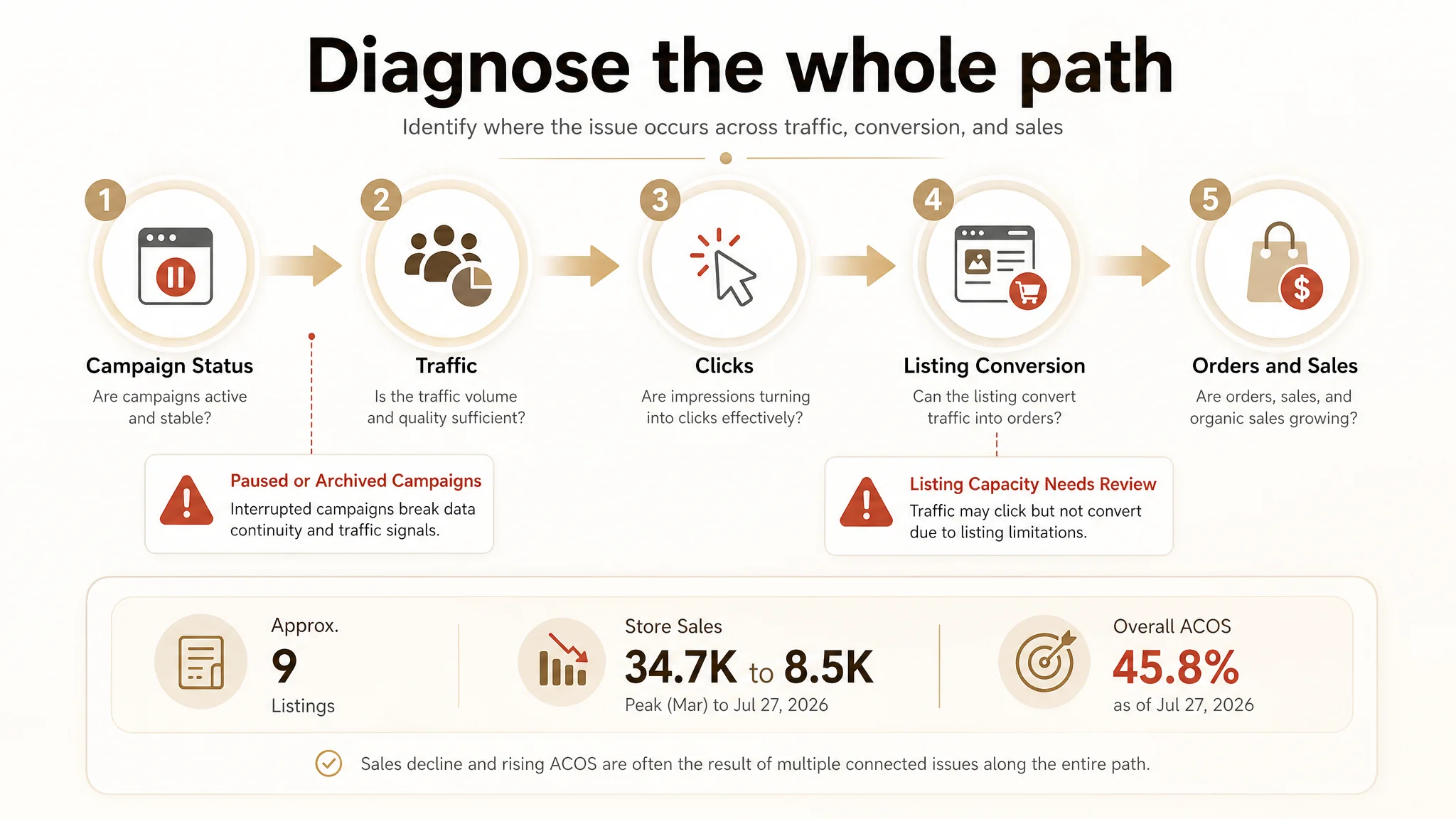
The review also found that some previously better-performing advertising campaigns had been manually paused or archived. Once a campaign is interrupted, the continuity of the data and high-quality traffic signals available to the system may be affected. Subsequent optimization and scaling may also need to be rebuilt.
At the same time, some product Listings lacked sufficient capacity to convert incoming traffic. Advertising can generate impressions and visits, but if the title, bullet points, main image, detail page, or review content cannot adequately address consumers’ purchase concerns, traffic may stop at the click stage instead of converting into orders. In this situation, simply increasing the budget may further amplify advertising losses.
4. How DeepBI Diagnosed
When facing declining sales and high amazon ACOS, DeepBI did not immediately attribute the cause to “declining advertising system performance.” Instead, it conducted a step-by-step review of overall store performance, advertising plans, campaign status, product Listings, and Listing conversion capacity.
1. First, compare changes in store sales and advertising efficiency. Place the March periodical peak and the data through July 27 within the same analytical framework to confirm the direction of changes in sales scale, smart advertising sales, overall advertising ACOS, and the ACOS of the original advertising plan. This helps distinguish between fluctuations in an individual advertising campaign and pressure on the store’s overall operations.
2. Next, compare smart advertising with the original plan. In March, smart advertising ACOS was 23.0%, lower than the original plan’s 25.9%; in July, smart advertising ACOS was 39.5%, lower than the original plan’s 49.4%. This step confirmed that smart advertising had a relative advantage in controlling ACOS, but also showed that the absolute efficiency of both types of advertising plans was deteriorating. Relative rankings alone were not sufficient.
3. Check whether advertising campaigns were running completely. During the review, DeepBI identified that some better-performing advertising campaigns had previously been manually paused or archived. It was therefore necessary to further confirm when the campaigns were interrupted, their sales and cost performance before interruption, and whether stopping them affected the continued accumulation of effective traffic.
4. Review the Listing conversion capacity of product pages. For some Listings, DeepBI generated scoring and optimization reports covering the title, bullet points, main image, detail page, and reviews. These reports were used to determine whether the product pages had basic issues affecting conversion. The scoring reports were diagnostic tools; they did not mean that Listing optimization had already been completed, nor could they be directly equated with sales results.
5. Finally, distinguish confirmed facts from judgments pending validation. Confirmed facts included declining sales, rising ACOS, some campaigns being paused or archived, and insufficient conversion capacity on some Listings. Traffic quality, CTR, CVR, changes in organic sales, and the specific recovery potential of different Listings needed to be continuously observed in subsequent pilots and could not be concluded during the diagnostic stage.
5. The Real Problem
Problem 1: Incomplete Advertising Campaigns May Have Interrupted Effective Data and Traffic Accumulation
Cause: Some better-performing advertising campaigns had previously been manually paused or archived, interrupting advertising paths that could otherwise have been continuously monitored and optimized.
Impact: The system could not continue identifying high-quality traffic based on complete historical performance. The seller also had difficulty determining whether the sales decline resulted from market changes, changes in traffic quality, or the natural outcome of campaign interruption. After campaigns were restarted, additional data accumulation might also be required.
Evidence: The service review identified that some better-performing advertising campaigns had previously been paused or archived. The current materials do not prove that restoring these campaigns has already generated sales growth. Therefore, “restoring effective campaigns” can only be treated as an action pending validation.
Problem 2: Listings May Not Have Been Able to Fully Convert Advertising Traffic
Cause: Some product Listings had room for improvement in areas including the title, bullet points, main image, detail page, and reviews. After entering the page, consumers might not have been able to quickly understand the product’s value, use cases, and reasons to purchase.
Impact: Advertising could generate impressions or clicks, but when page conversion capacity was insufficient, advertising spend could increase first while orders did not necessarily grow at the same time. This is why “advertising has clicks but no orders” cannot be solved only by adjusting bids. Listing conversion must also be reviewed.
Evidence: DeepBI had generated scoring and optimization reports for some Listings covering multiple Listing dimensions, indicating that page conversion capacity needed to be included in the diagnosis. However, there was no complete pilot-period data on CTR, CVR, or sales recovery. Therefore, the Listing issue could not be described as the sole cause.
Problem 3: Scaling Key Listings Lacked a Validation Path Based on Overall Data
Cause: The seller wanted to scale key Listings in a controlled manner, but scaling could not simply mean continuously increasing the budget for one specified keyword or one Listing. The product’s historical sales, traffic quality, page conversion, and advertising costs all needed to be assessed together.
Impact: If scaling was forced before the Listing was ready, advertising campaigns were complete, or sufficient conversion data was available, the budget could increase without a corresponding improvement in sales, further increasing uncertainty regarding advertising returns.
Evidence: Both customer communications and the service review reflected concerns about scaling key Listings, advertising costs, and certainty regarding return on investment. The complete “Listing optimization + smart advertising adjustments” pilot had not yet been completed. Therefore, the true scaling capacity of the key Listings remained pending validation.
6. Optimization Plan
First Restore and Review Effective Advertising Campaigns
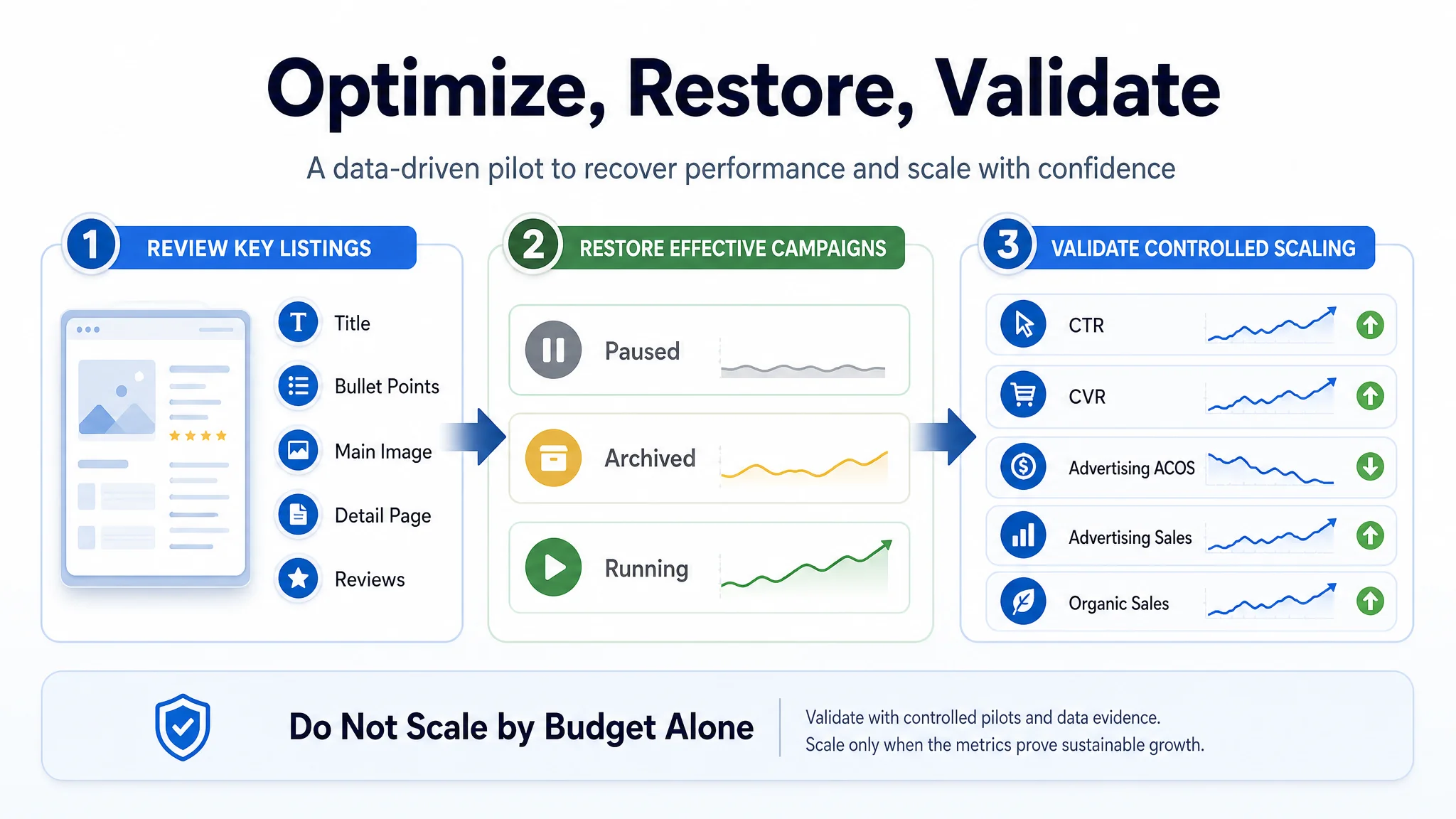
Review the status of previously better-performing advertising campaigns, distinguishing between paused, archived, and currently running campaigns. Avoid allowing effective advertising to remain interrupted for an extended period without a data-based reason. After restoring campaigns, continue monitoring advertising sales, advertising ACOS, and traffic quality rather than immediately increasing the budget.
Evaluate Listing Optimization for Key Listings
Select a small number of product Listings with sales potential, and first complete a Listing review and optimization prioritization based on dimensions including the title, bullet points, main image, detail page, and reviews. The goal of optimization is not simply to add more keywords, but to enable the page to convert advertising traffic more clearly and reduce the information gap between clicks and purchases.
Establish an Advertising and Listing Coordination Pilot
In the next stage, conduct a “Listing optimization + smart advertising adjustments” pilot around a small number of key Listings. First confirm the page’s basic conversion capacity, then restore effective advertising campaigns, and finally gradually validate scaling based on high-quality traffic and overall data. During scaling, do not directly promise that a single keyword or Listing will inevitably grow. Instead, dynamically determine budget and traffic allocation based on actual performance.
Use Complete Metrics to Validate Return on Investment
In addition to advertising ACOS, CTR, CVR, advertising sales, organic sales, and total store sales should be monitored simultaneously. Only when changes in traffic clicks, page conversion, advertising sales, and organic sales mutually reinforce one another can it be determined that optimization has genuinely improved operating results.
7. Results
This case has not yet reached the stage of completing recovery-effect validation. Therefore, it cannot be stated that DeepBI has already generated sales growth or restored the store. The following quantitative changes can be confirmed at this stage:
- In March 2026, total store sales were approximately 3.47万, and sales generated by smart advertising were approximately 8077.
- In March 2026, smart advertising ACOS was 23.0%, while the ACOS of the original advertising plan was 25.9%; smart advertising was lower by 2.9 percentage points.
- As of July 27, 2026, store sales were approximately 8467, and overall advertising ACOS had risen to 45.8%.
- As of July 27, 2026, smart advertising ACOS was 39.5%, while the ACOS of the original advertising plan was 49.4%; smart advertising was lower by 9.9 percentage points.
- From March to July 27, store sales declined from approximately 3.47万 to approximately 8467. During the same period, although smart advertising had an advantage in controlling ACOS relative to the original plan, its absolute ACOS and ability to scale sales remained under pressure.
Therefore, the most important result at this stage was not “how much growth had already been achieved,” but the clarification of the subsequent validation path: restore effective campaigns, optimize key Listings, and use CTR, CVR, advertising ACOS, advertising sales, and organic sales to verify whether sales can recover.
8. Case Summary
This case shows that when Amazon sales decline and advertising ACOS rises, the issues requiring investigation are usually not limited to advertising bids or budgets.
First, whether advertising campaigns are running completely affects the system’s ability to continuously identify high-quality traffic. Second, whether Listings have sufficient conversion capacity determines whether advertising clicks can be converted into orders. Third, scaling key Listings must be based on the joint validation of page, traffic, and cost data.
In this case, smart advertising had a lower ACOS than the original advertising plan in both March and July, but store sales did not automatically recover as a result. This shows that controlling ACOS is only one part of advertising optimization and cannot replace an overall assessment of sales scale, Listing conversion, and organic sales. The current plan remains in the risk-review and validation-pending stage. Subsequent small-scale pilots should be used, rather than immediately increasing investment, to validate whether coordinated advertising and Listing optimization can improve operating results.
9. Key Takeaways for Sellers
Takeaway 1: Do Not Ask Only Which Advertising Campaign Has Lower ACOS; Also Consider Sales Scale
Smart advertising ACOS being lower than the ACOS of the original advertising plan does not mean that the store has already returned to growth. Sellers should also review advertising sales, total store sales, and organic sales to determine whether the lower ACOS is supported by sufficient sales volume. If ACOS declines while sales remain near a low level, the problem may still lie in traffic scale or conversion.
Takeaway 2: When Advertising Has Clicks but No Orders, Check the Listing Before Increasing the Budget
When advertising generates traffic but no orders, the problem may lie in page conversion capacity. The title, bullet points, main image, detail page, and reviews collectively influence whether consumers continue toward purchase. Advertising optimization and Listing optimization should be carried out in coordination. Otherwise, increasing the budget may only increase ineffective clicks and advertising costs.
Takeaway 3: When amazon Advertising Performance Deteriorates, Establish Layered Diagnosis and Small-Scale Validation First
When sales decline, investigate in the following order: “store sales—advertising plan—campaign status—product Listing—Listing—organic sales.” For key Listings, complete basic optimization first, then restore effective campaigns, and finally use CTR, CVR, advertising ACOS, advertising sales, and organic sales to validate the results. Only after completing a full pilot cycle can sellers determine whether the problem is caused by advertising efficiency, Listing conversion, or a combination of traffic and product competitiveness.