


This case comes from an Amazon seller in the US wedding decor category. On the surface, the Listing looked fine: decent reviews, carefully shot images, and a clear “Mr & Mrs” fall wedding cake topper concept. Yet under continuous Amazon ads, ACOS was stubborn, and the team felt they were “feeding the traffic, not the orders.” They initially believed this was a pure advertising issue—bids, placements, and budgets—because traffic volume was already there.
Once DeepBI ran a full Listing diagnosis against a single benchmark competitor, a different picture appeared. Ads were doing their job; the Amazon product page was not. The core gap was not traffic volume, but the conversion logic embedded in the title, main images, bullets, and A+ content. The competitor’s page systematically turned a one-time cake decoration into a “wedding-to-home keepsake” story; the seller’s page stopped at “pretty topper for the cake.”
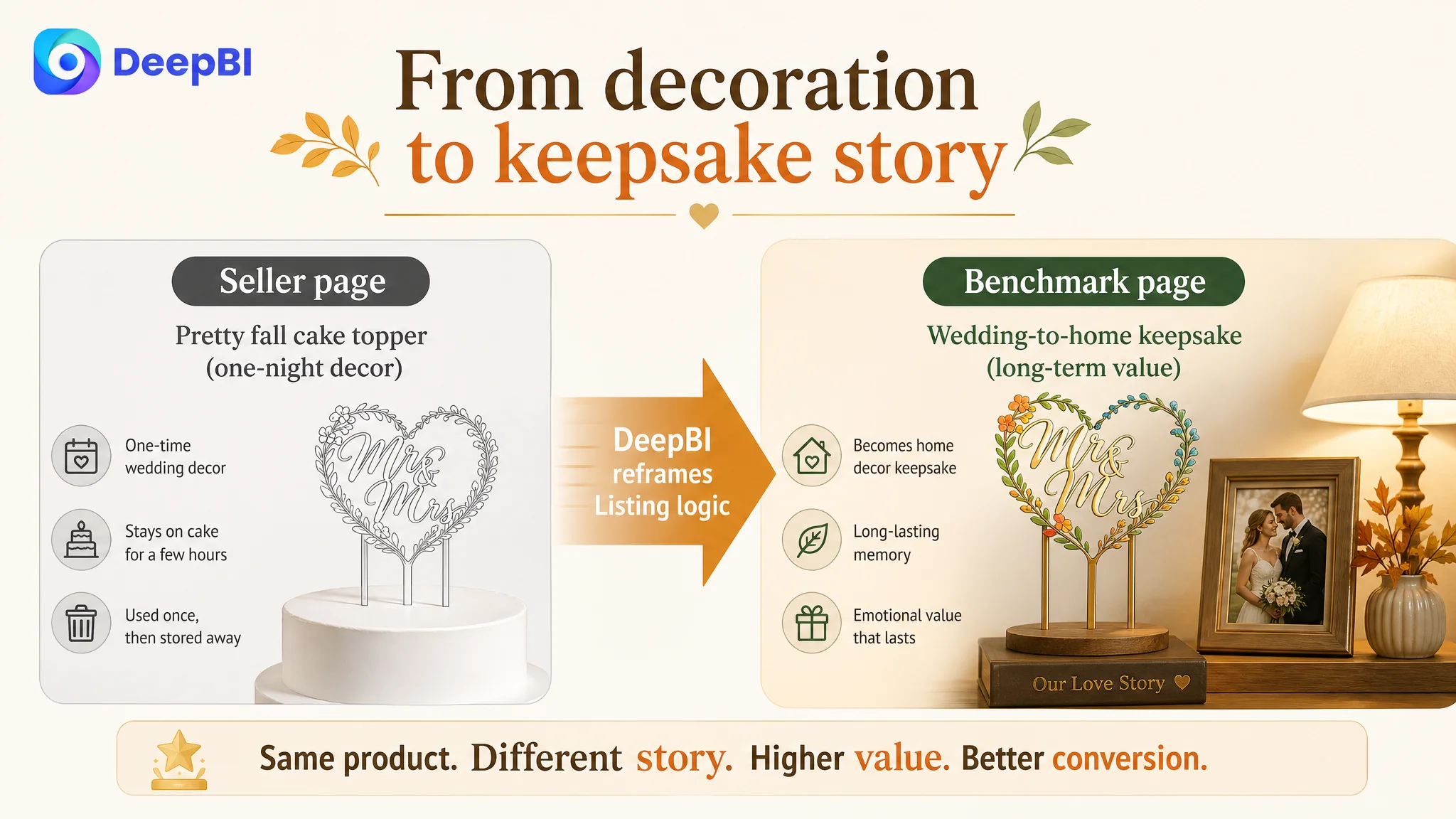
The later optimization work therefore did not start with more granular ad structures. It started with reframing the Listing: front-loading the right Amazon search terms in the title, tightening the main-image system around “fall rustic wedding” and trust-building details, and restructuring bullets and A+ modules around a clear journey from ceremony decor to long-term home decor keepsake. For other Amazon sellers, the lesson is straightforward but often overlooked: if your page treats the product as a disposable ornament while your best competitors sell a long-lived, emotionally anchored keepsake, no amount of ad tuning will stabilize ACOS.
The Seller’s View: “Our Reviews Are Better, So It Must Be an Ads Problem”
This Amazon seller operates in the wedding cake topper niche, focused on rustic autumn weddings.
From their perspective:
- They had more reviews and lower visible bad-review ratio than a leading competitor.
- Star rating was competitive (4.2 vs. 4.4).
- Ads were active and bringing impressions.
So when orders lagged behind expectations and ACOS felt hard to control, the internal conclusion was:
“Traffic is not the problem. We just need better ad optimization—keywords, bids, maybe more budget.”
Because the obvious trust signals (review count, rating) were stronger than the competitor’s, the team subconsciously ruled out the Listing as the bottleneck. The Listing was seen as “good enough,” and effort concentrated on the advertising console.
But in practice, ad spend was being poured into a page that converted worse than it should, especially against a smaller, younger competitor.
What the Data Actually Showed: The Page, Not the Ads, Was the Bottleneck
When DeepBI scored the Listing against a single benchmark competitor in the same Amazon subcategory, the numbers were clear:
- Overall Listing score:
- Seller: 70 / 100
- Benchmark: 83 / 100
- Gap: –13 points
Breaking it down by Amazon-page components:
- Title: Seller: 11/20, Benchmark: 15/20, Gap: -4
- Main Images: Seller: 24/30, Benchmark: 27/30, Gap: -3
- Bullets: Seller: 6/10, Benchmark: 8/10, Gap: -2
- A+ / Detail: Seller: 17/25, Benchmark: 23/25, Gap: -6
- Reviews: Seller: 12/15, Benchmark: 10/15, Gap: +2
Only one dimension clearly beat the competitor: reviews. Everywhere else, especially in A+ content, the Listing was systematically weaker.
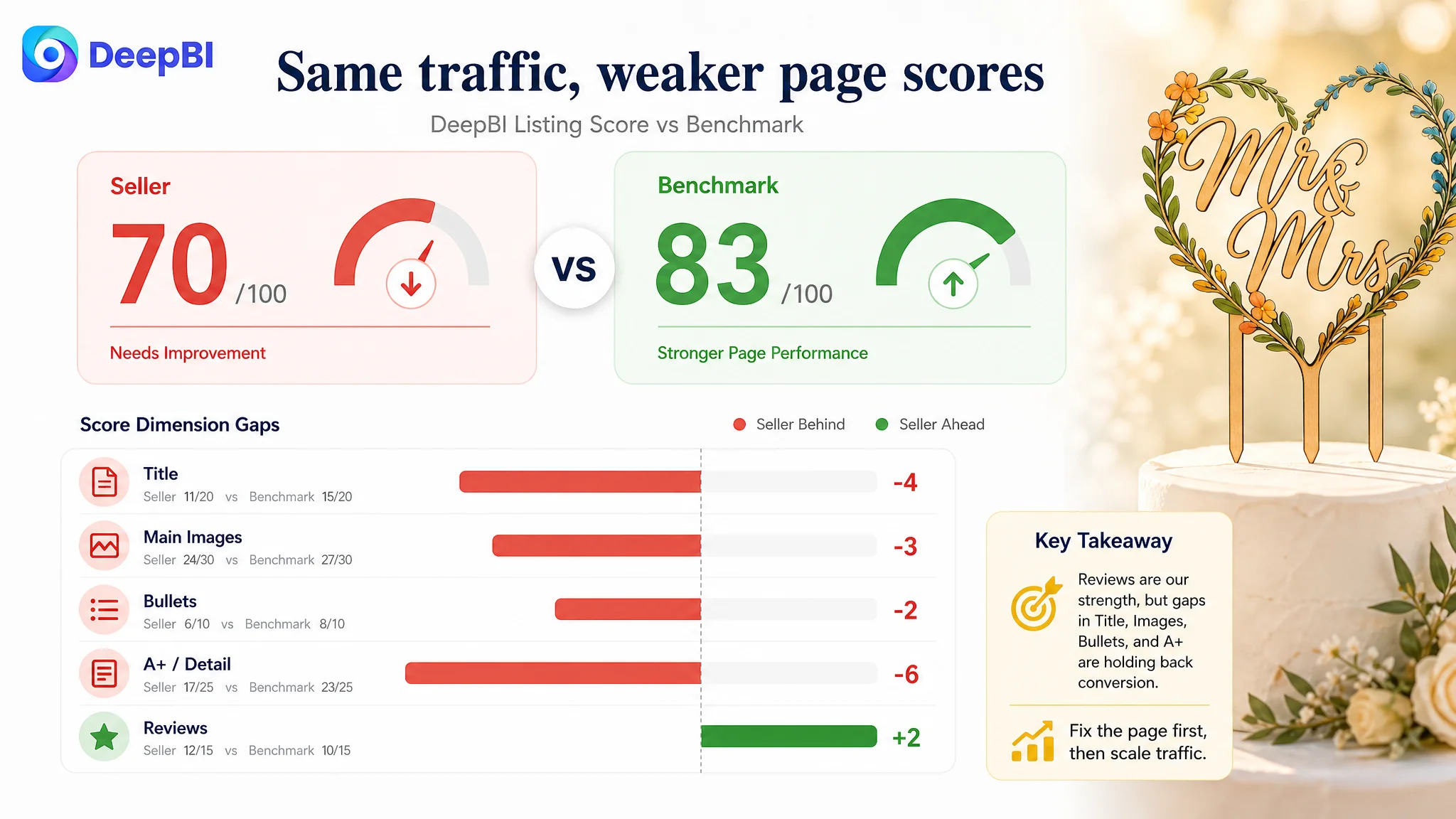
“The real problem was not that ads failed to bring traffic. It was that the page could not convert the traffic.”
This is the reversal that changed the entire optimization path.
The Real Constraint: Conversion Capacity of the Amazon Listing
1. Title: Narrow Entry, Weak Value Framing
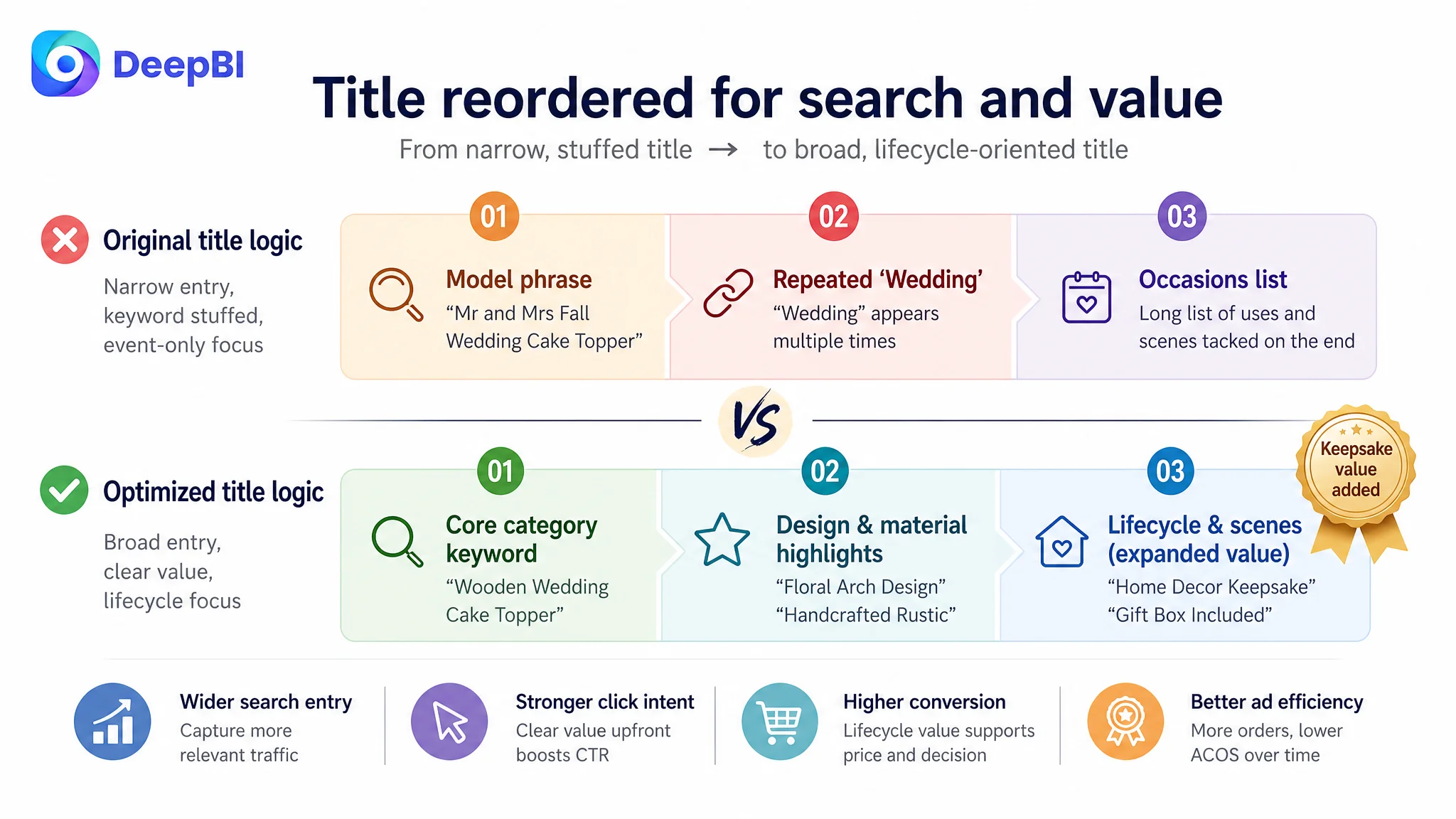
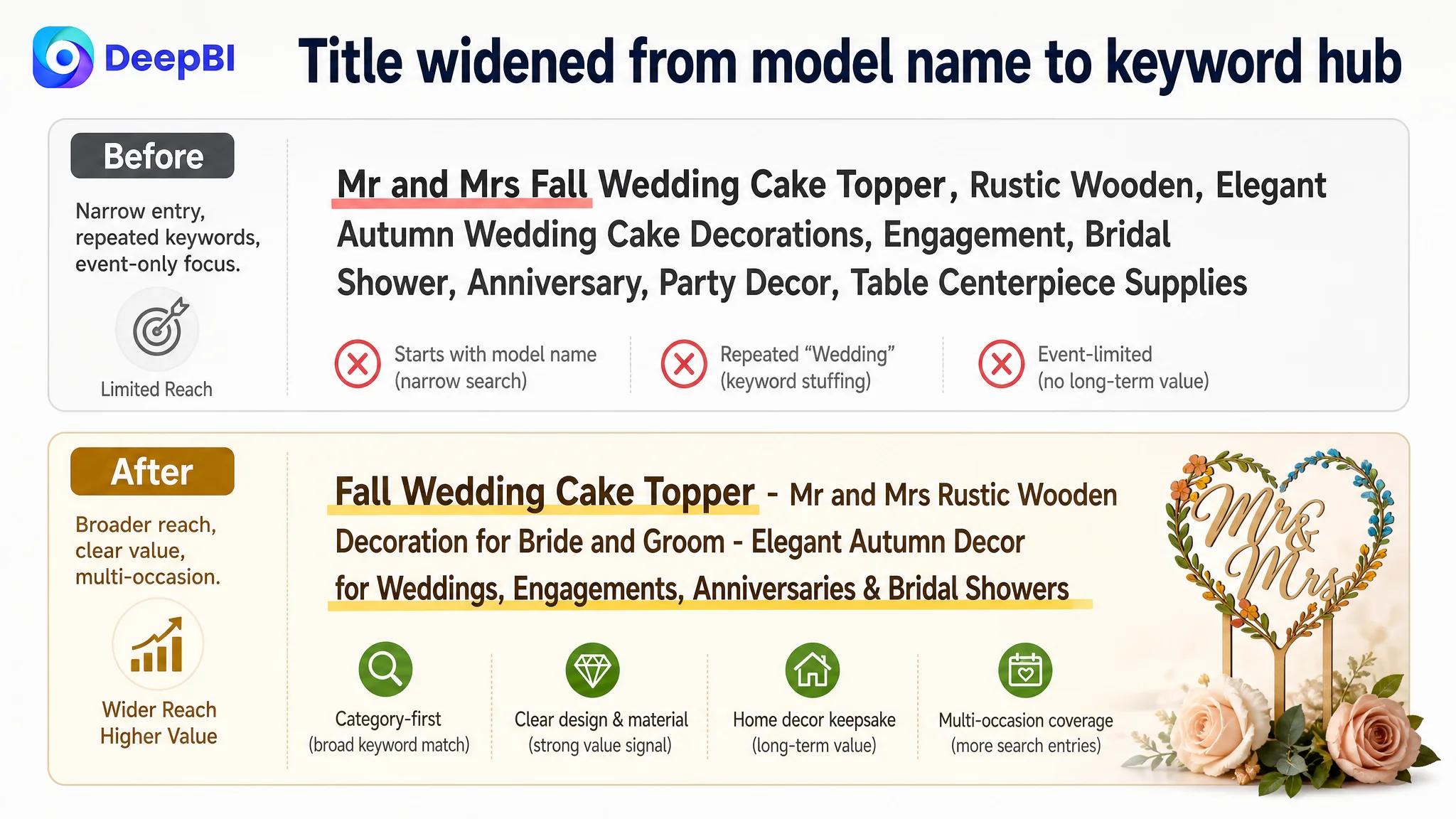
The seller’s original title led with a specific design label:
- Opening with a model-like phrase (“Mr and Mrs Fall Wedding Cake Topper”)
- Listing multiple use cases and scenes afterward
- Repeating “Wedding” several times, creating a keyword-stuffing feel
In contrast, the benchmark Listing led with the generic category term and clearer logic:
- “Wooden Wedding Cake Topper – Mr & Mrs Floral Arch Design – Handcrafted Rustic Cake Decoration & Home Decor Keepsake – Gift Box Included…”
Key differences:
- Search breadth:
The competitor put “Wooden Wedding Cake Topper” first—aligned with broad category searches and Amazon search-weight logic. The seller locked themselves into a narrower “Mr and Mrs fall” entry.
- Concrete selling points:
Competitor used specific descriptors like “Floral Arch Design” and “Handcrafted,” creating an immediate mental picture. The seller used “Rustic Wooden” and “Elegant Autumn,” which sound nice but remain abstract and generic.
- Lifecycle framing:
Competitor extended use into “& Home Decor Keepsake,” signaling post-wedding value directly in the title. The seller’s title stayed in the short, event-only window.
Result: the Listing entered the search results with less breadth and weaker promise of long-term value, lowering both click motivation and perceived value relative to price.
2. Main Images: Aesthetic but Not Fully Commercial
The seller’s image set was not “bad” in a visual sense. The issue was what the images actually helped the buyer decide:
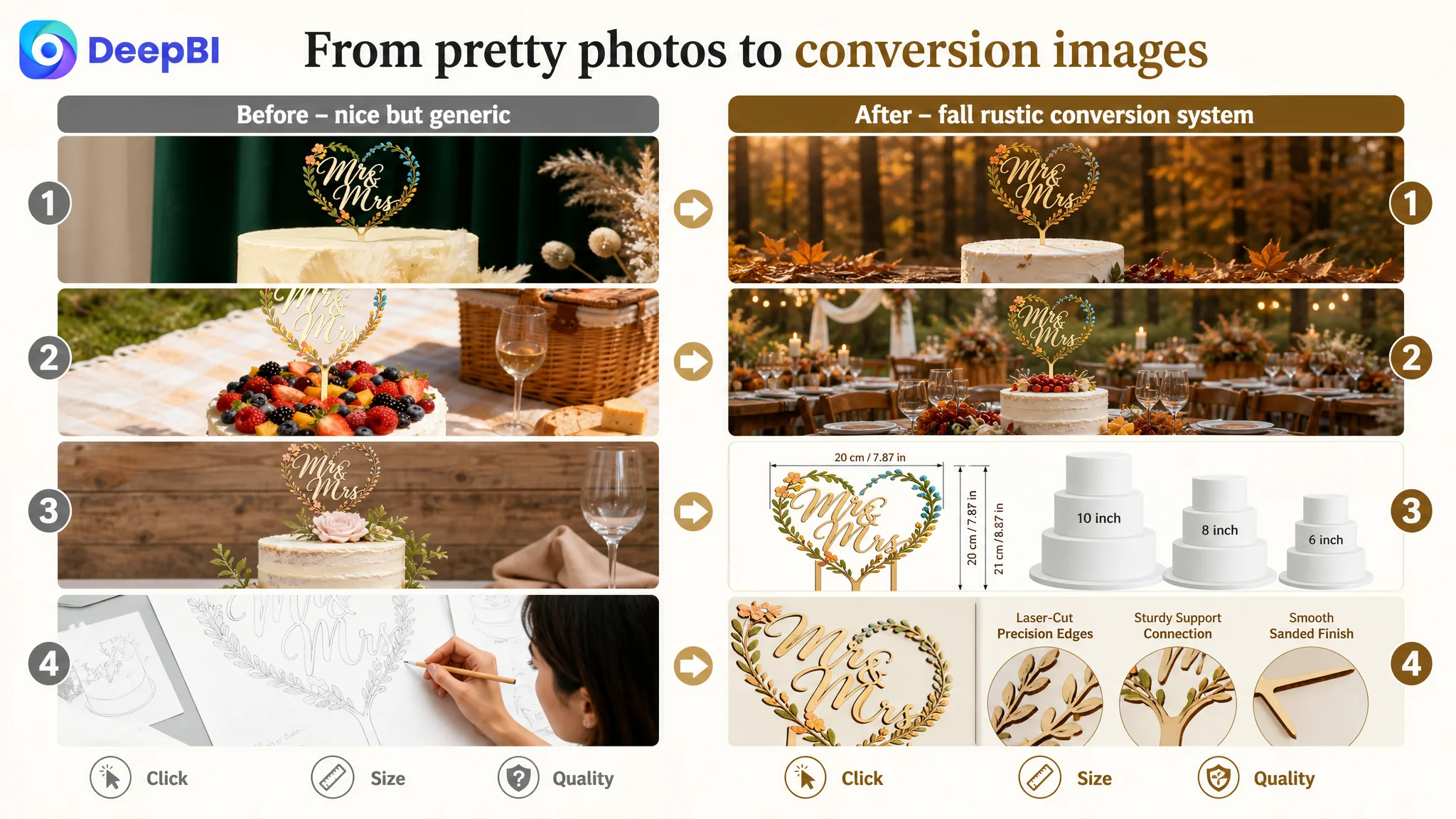
- Backgrounds leaned toward generic or mismatched (e.g., green-screen feel) rather than clearly autumn-wedding environments.
- Product shots were often static, soft-light compositions without a strong “why this topper” message.
- Size and stability were not quantified visually; there were comparisons but not anchored around “will this stand securely on my cake?”
- High-end ceremony scenes (e.g., banquet hall, chandeliers) were underused.
The competitor, by contrast, built a three-layer main-image logic:
1. Click driver: High-contrast, emotionally charged wedding scenes (warm light, chandeliers, fall foliage) that stood out in Amazon search results.
2. Decision helpers: Visualized dimensions, thickness (e.g., clearly showing 3mm wood), and statements like “50% thicker” to reduce uncertainty.
3. Trust reinforcement: Multiple scenes showing the topper in different cake and venue styles to prove versatility and quality.
So even if both Listings looked “nice,” the benchmark systematically addressed:
- “Will this look right on my cake?”
- “Is it sturdy or flimsy?”
- “Does it match my wedding style?”
The seller’s images leaned more toward generic romance; the competitor’s closed the decision loop.
Bullets and A+: The Story Stopped at “Decoration”
Bullets: Information Without a Buying Path
The seller’s bullet points were typical of many Amazon Listings:
- Listing dimensions, materials, and occasions (weddings, engagements, anniversaries, etc.).
- A line about durability and quality.
- Generic scene descriptions.
The benchmark’s bullets did something different: they created a journey from “decoration” to “keepsake.”
Example contrasts:
- Competitor’s first bullet: “RUSTIC ARTISAN ELEGANCE” + specific scenes (garden, barn, vintage weddings) → hits exact style searches and frames the product as a focal design element.
- Multiple bullets reinforced: not disposable, transitions into home decor, fits on bookshelves, mantels, entryway tables.
- Customization/interaction: mention of movable flowers or adaptable design, adding a sense of “make it yours.”
So while the seller’s bullets said:
“Here are the specs and where you can use it.”
The competitor’s bullets said:
“Here is how this topper becomes part of your story, during and after the wedding.”
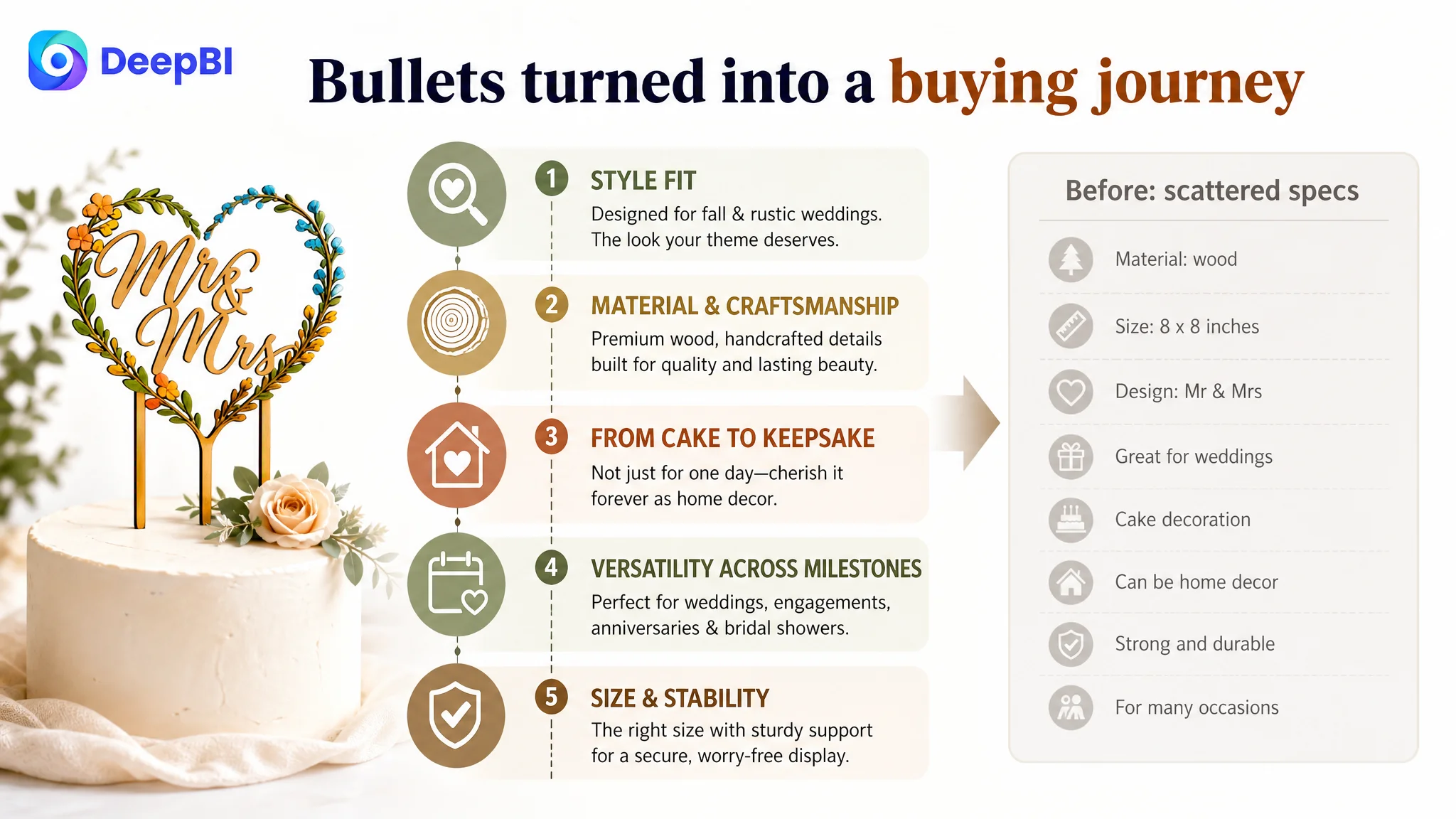
DeepBI’s recommendation for this Listing was to reframe bullets with a clear logic:
1. Visual fit and theme (rustic, fall, golden weddings)
2. Material and craftsmanship (premium wood, hand-finished details)
3. From cake to keepsake (transition into home decor)
4. Versatility across milestones (engagements, showers, anniversaries)
5. Size and stability (exact inches plus reassurance about fit on 6–10 inch cakes and secure display)
A+ Content: Missing the Keepsake and Versatility Story
The A+ comparison was even more revealing:
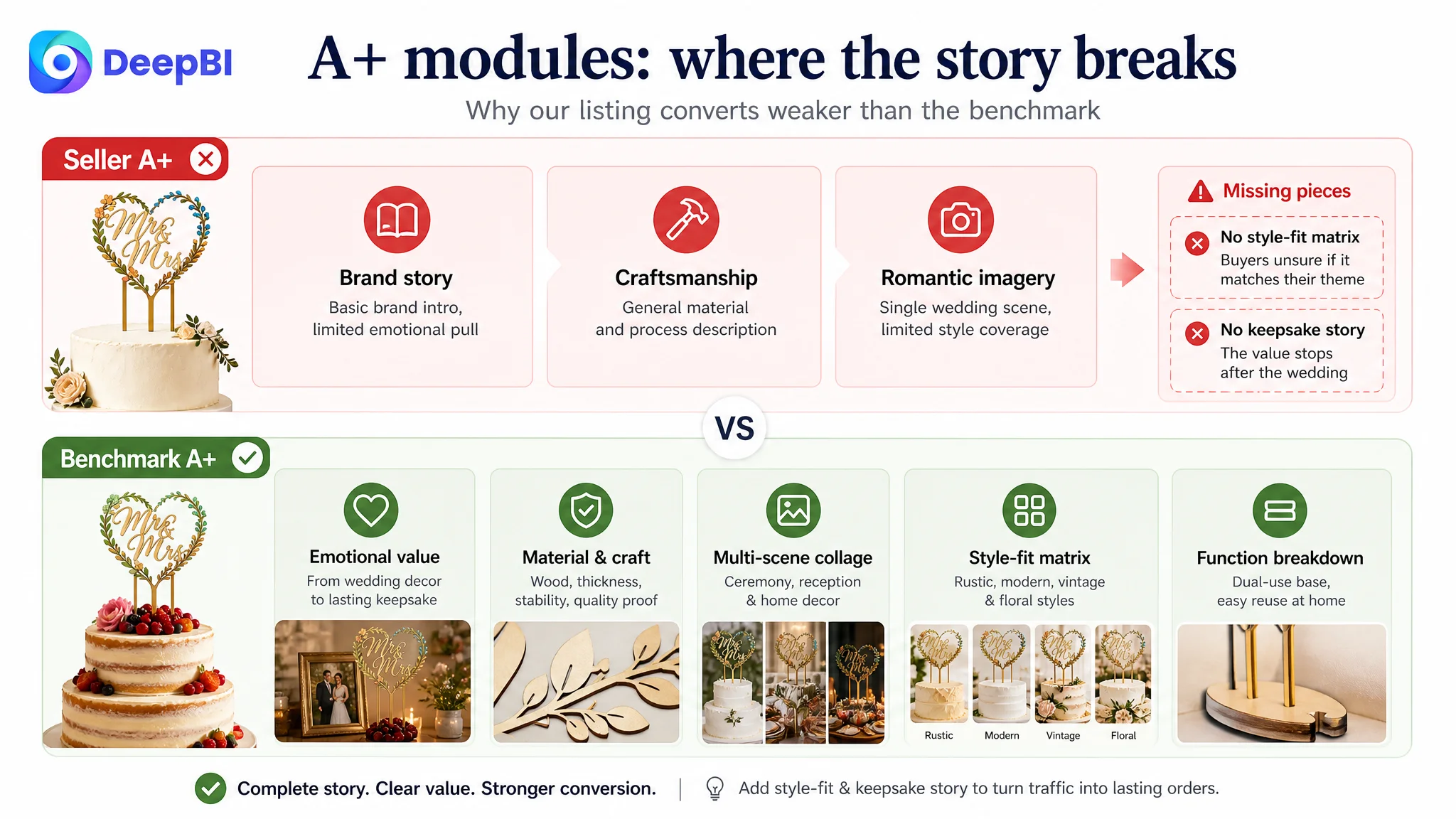
- Seller A+ modules:
- Brand story hero image
- Craftsmanship and design explanation
- Romantic emotional imagery
- Benchmark A+ modules:
- Emotional value statement
- Material and craftsmanship diagrams
- Multi-scene collage (various cake styles, rooms, and shelves)
- Style-fit matrix (Rustic / Modern / Vintage / Floral)
- Function breakdown (dual-use base, flexible vines, replaceable florals)
Three critical gaps:
1. Style coverage:
The seller showed essentially one romantic mood. The competitor showed multiple wedding styles, directly answering “Will this match my theme?”
2. Post-wedding life:
Competitor upgraded the product from “single-use cake decor” to “long-term home decor keepsake.” The seller talked about romance and craftsmanship, but did not concretely show where the topper lives after the cake is gone.
3. Real-world proof:
Competitor used high-resolution, full-frame real scenes with arrows and labels. The seller used more artistic compositions (e.g., lakeside silhouettes, static still-life) that look nice but do not answer:
- How big is it on the cake?
- How thick is the wood?
- How does it actually sit on real frosting?
This is where the –6 point gap in detail page / A+ came from. Combined with only minor differences in reviews, it meant:
“The competitor is winning because their page gives more reasons to believe and more use-cases, not because they have better social proof.”
Why DeepBI Did Not Recommend “More Ad Tuning” First
Facing high or unstable ACOS, the seller’s instinct was to:
- Split more campaigns
- Add more keywords
- Adjust bids and budgets
- Test new match types
DeepBI’s scoring and comparison made that path risky:
- The Listing score was materially lower than the benchmark’s.
- Reviews were already stronger. Social proof wasn’t the limiting factor.
- The biggest gaps sat in title, main images, and especially A+.
Continuing to scale ads with the page in this state would have meant:
- Paying to send more traffic into a weaker decision framework than a direct competitor.
- Letting ads magnify page-level weaknesses rather than strengths.
- Training Amazon’s algorithm on mediocre conversion signals, making it harder to win first-page organic real estate over time.
From a business-risk perspective, the priority had to switch:
1. Stabilize the Listing’s ability to convert both paid and organic traffic.
2. Only then re-evaluate ad scaling, knowing the page can carry the load.
How the Page Was Reframed: From “Fall Decor” to “Fall Keepsake”
DeepBI’s optimization work focused on rebuilding the Listing’s sales logic, not just polishing it.
1. Title Reorder: Lead With the Right Amazon Keyword Logic
Recommended title direction:
Fall Wedding Cake Topper – Mr and Mrs Rustic Wooden Decoration for Bride and Groom – Elegant Autumn Decor for Weddings, Engagements, Anniversaries & Bridal Showers
Key changes:
- Core keyword first:
“Fall Wedding Cake Topper” moved to the very front to align with Amazon’s search-weight logic and match how buyers actually search.
- Reduce repetitive wording:
Remove redundant “Wedding” repetitions; merge “Rustic Wooden” with the functional phrase to sound professional, not stuffed.
- Clarify multi-occasion usage:
Borrow the competitor’s lifecycle thinking, explicitly covering engagements, bridal showers, and anniversaries.
This improves both discoverability and perceived value breadth before the shopper even reaches the page.
2. Bullet Points: Build a Conversion Narrative, Not a Specs List
The recommended bullets followed a consistent decision path:
- BP #1 – Scene and style fit
“RUSTIC ELEGANCE FOR YOUR SPECIAL DAY” → autumn, rustic, golden-themed weddings, giving style confidence.
- BP #2 – Material and craftsmanship
Emphasize premium eco-friendly wood, artisan leaf detail, differentiating from plastic alternatives.
- BP #3 – From cake to keepsake
Explicitly reframe as a lasting memento that transitions to home decor.
- BP #4 – Versatility across milestones
Reusability across engagement parties, bridal showers, and anniversary celebrations.
- BP #5 – Size and stability
Concrete inches, fit for 6–10 inch cakes, and reassurance that it sits securely.
Instead of “five facts,” the bullets now walk the buyer from:
“Is this topper right for my wedding look?” → “Is it actually well-made?” → “Is it worth the price beyond one night?” → “Can I reuse it?” → “Will it physically fit and not fall over?”
Main Images: Turn Aesthetic Photos into Commercial Proof
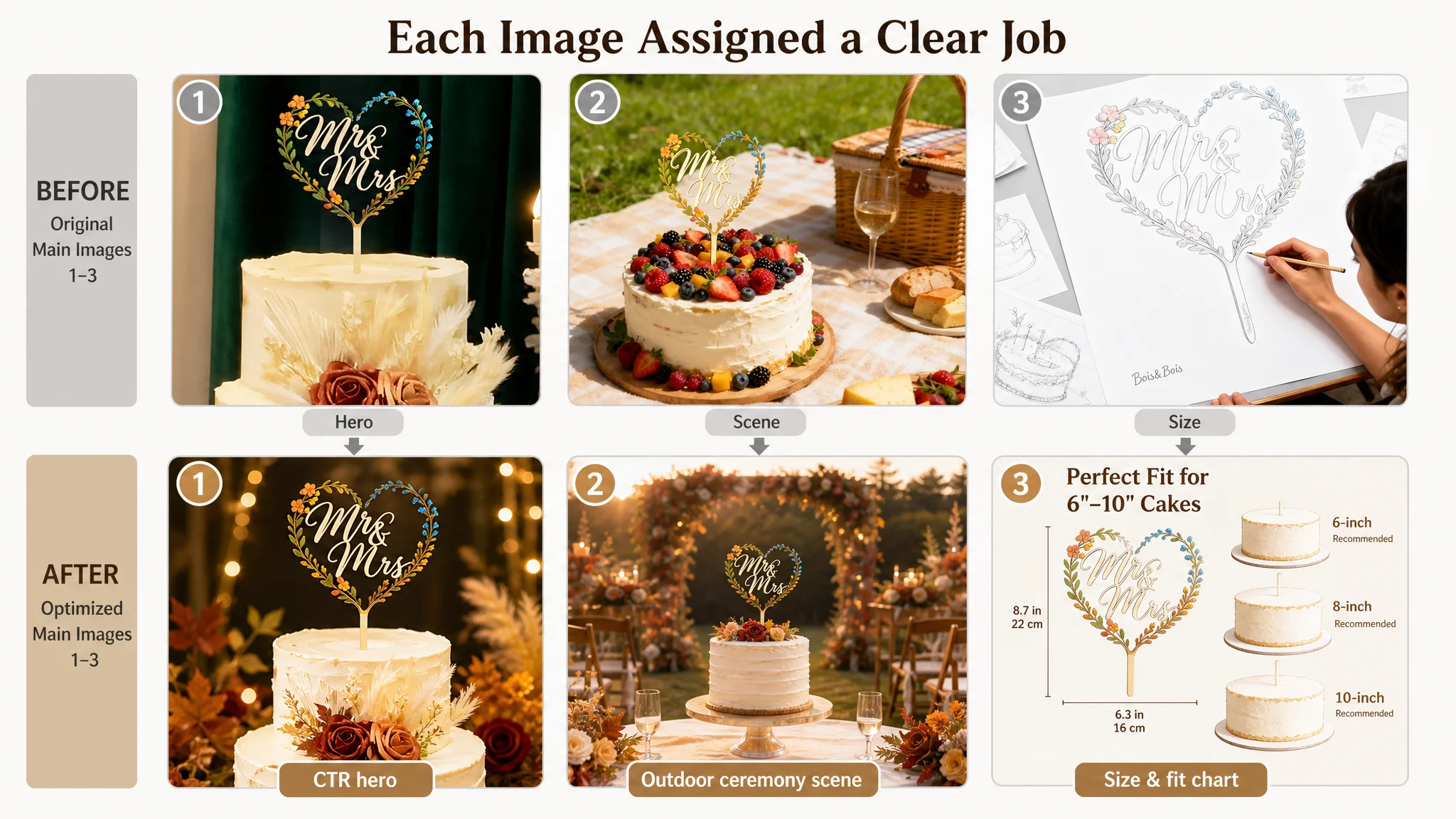
DeepBI did not treat the main image strip as five isolated pictures, but as a structured set of roles:
1. Primary hero for CTR:
- Topper centered, ~70% of frame.
- Warm autumn palette, blurred fall foliage or sunset behind.
- Clean white cake with subtle fall accents.
- Strong “fall rustic wedding” signal at a glance.
2. Core scene image:
- 45° side view on a cake, placed on a rustic wooden reception table.
- Warm golden morning light, sunflowers and autumn berries.
- Moves from generic picnic feel to professional outdoor wedding ceremony.
3. Size and fit visualization:
- Topper alongside 6", 8", and 10" cakes on pure white background.
- Clear measurement lines and both inch/cm labels in elegant serif font.
- Directly answers “Will this look too big or too small on my cake?”
4. Craftsmanship micro-detail:
- Macro shot of laser cut edges, painted details, leaf texture.
- Small inset circles highlighting “Laser-Cut Detailing” and “Hand-Finished Colorwork.”
- Replaces generic still-life props with specific quality proof.
5. High-end ceremony scene:
- Low-angle shot of topper on a tiered cake in an indoor banquet hall.
- Crystal chandeliers bokeh in background, candlelight on a fabric-draped table.
- Sells premium wedding positioning for higher-budget couples.
“Advertising does not only amplify advantages. It can also amplify a page’s existing defects.”
Here, the objective was to make sure traffic landed on a page where each image pushes buyers one step closer to “Add to Cart,” not just “That looks nice.”
A+ Content: Completing the “From Ceremony to Home” Arc
For the A+ section, DeepBI’s recommendations rebuilt the modules into a clear sequence:
1. Opening hero: the moment on the cake
- Three-tier floral cake at a lakeside evening wedding.
- Topper on the right, couple in soft-focus on the left, haloed backlight.
- The topper is visibly the “highlight moment” of the ceremony.
2. Craftsmanship and technology
- Workshop-style shot: topper on a dark workbench, laser head engraving the letters.
- Clear view of smooth wood edges.
- Positions “handcrafted with precision,” not generic “quality.”
3. Thickness and safety
- Clean, neutral composition with a 45° angle showing side thickness.
- On-image text: “3mm Thick Eco-Certified Wood” and “Food-Safe Standards.”
- Converts vague “high quality” into data-backed reassurance for typical wood-product concerns: breakage, splinters, and food contact.
4. Style adaptability grid
- Four squares: Rustic / Modern / Vintage / Floral.
- Topper on different cake designs and venues in each.
- Eliminates doubt about “Will this match my cake and venue?”
5. From cake to home keepsake
- Topper in a wooden stand on a nightstand or bookshelf next to a wedding photo.
- Warm household lighting, calm interior scene.
- Explicitly visualizes the product’s life after the event.
6. Quality inspection visual
- Main topper image plus three micro-close-ups: engraving, support rod, polished surface.
- On-image cues like “12-Point Quality Check.”
- Makes quality claims visible and believable.
7. Craftsman story
- Artisan hands, sawdust, finishing touches on the topper.
- Warm natural light, workshop background softly blurred.
- Gives emotional credibility to “handcrafted,” making the brand feel human and intentional.
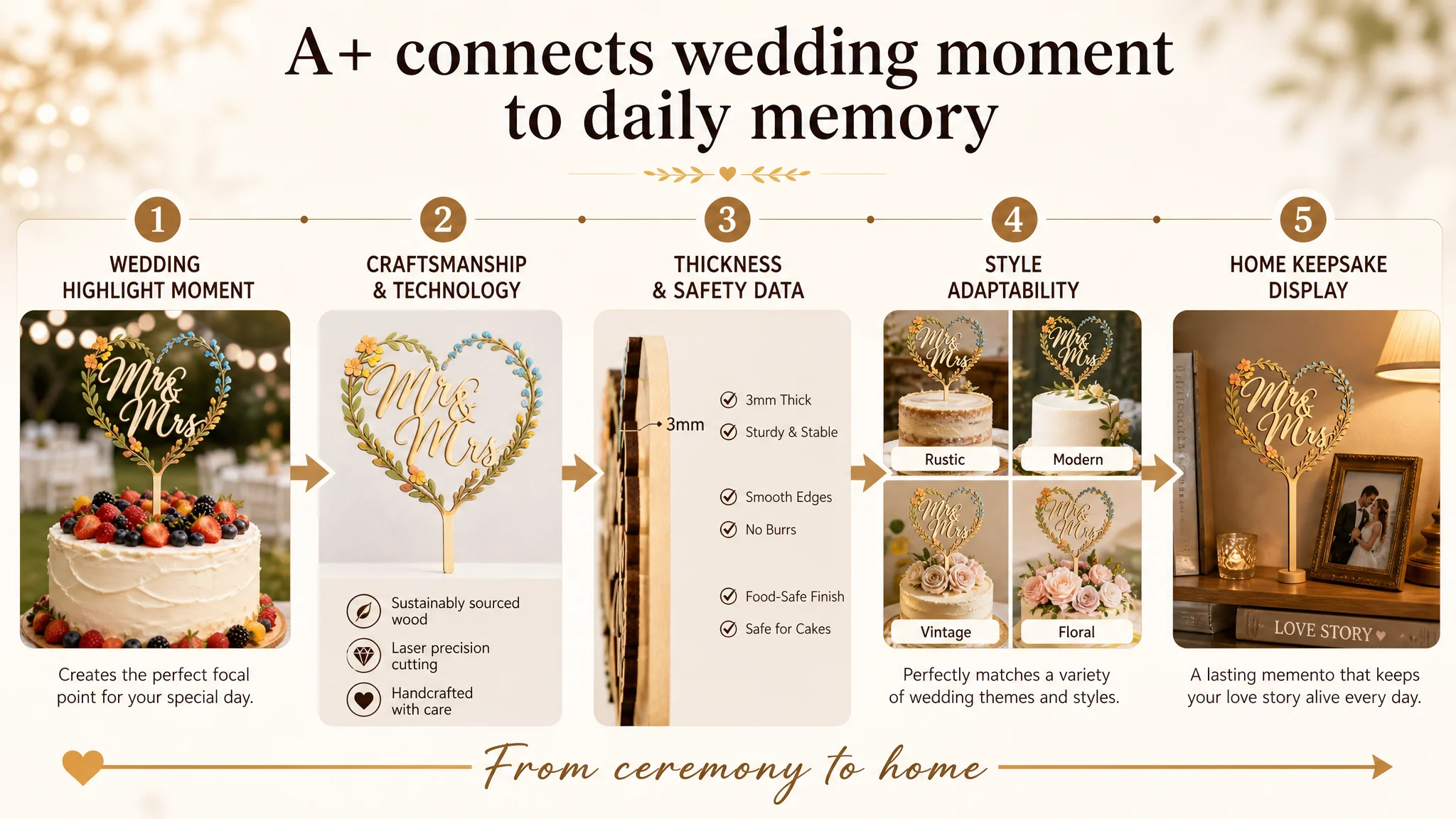
This A+ structure finally gives the Listing what it lacked:
- Concrete quality and safety proof
- Visual style-fit reassurance
- A longer product life narrative that ties into the emotional stakes of a wedding
What Changed in the Business Logic
Because the case material does not include post-optimization metrics, we will not invent numbers. What can be stated clearly is how the operating risk and decision framework shifted.
Before:
- Ads were treated as the primary lever to fix sales.
- Listing was assumed “good enough” because reviews were strong.
- ACOS pressure felt like a pure advertising problem.
After reframing with DeepBI’s diagnosis:
- The seller recognized the Listing conversion gap as the core bottleneck, despite stronger social proof.
- The team chose to repair the title, images, bullets, and A+ before pushing more ad budget.
- The product page began to:
- Answer style-fit, size, and stability questions visually.
- Communicate post-wedding keepsake value instead of a one-night decoration.
- Align search keywords and visual story around “fall rustic wedding” in a unified way.
Once the page logic was upgraded, ad traffic became strategically useful again:
- Each click had a higher chance of reaching a buyer who could see:
- Exactly how the topper would look on their cake, in their theme.
- Why the price reflects not just one evening but a long-term keepsake.
- Concrete reasons to trust the material and build.
Even without hard numbers, this change reduces:
- Dependency on ever-rising ad budgets.
- Risk that ads train Amazon’s algorithm on weak conversion data.
- Volatility in ACOS caused purely by an under-converting page.
And it improves:
- The Amazon Listing’s native ability to convert organic and paid traffic.
- The stability of the traffic structure over time.
- The seller’s confidence that scaling ads now “feeds a converting asset,” not a leaky funnel.
What Other Amazon Sellers Can Take from This Case
1. Do not let strong reviews blind you to Listing weaknesses.
A higher review count and similar star rating do not guarantee that your page structure competes with top Listings.
2. High ACOS is often a conversion problem wearing an ads costume.
If a competitor with fewer reviews and slightly better rating is out-selling you, check whether their page:
- Frames broader use-cases in the title
- Shows clearer visual proof (size, quality, stability)
- Builds a more complete “before, during, after” story
3. Title, main images, bullets, and A+ must tell one coherent story.
In this case, the winning story was not “fall cake decoration,” it was “fall wedding keepsake that lives in your home afterwards.”
4. Fix the Amazon product page before you push more traffic into it.
Ads amplify whatever is already there—strengths or weaknesses. Make sure the page deserves the traffic.
This is where DeepBI’s judgment matters: not as a list of features, but in its ability to pinpoint that in this Amazon wedding topper case, the limiting factor was Listing conversion capacity, not advertising sophistication.