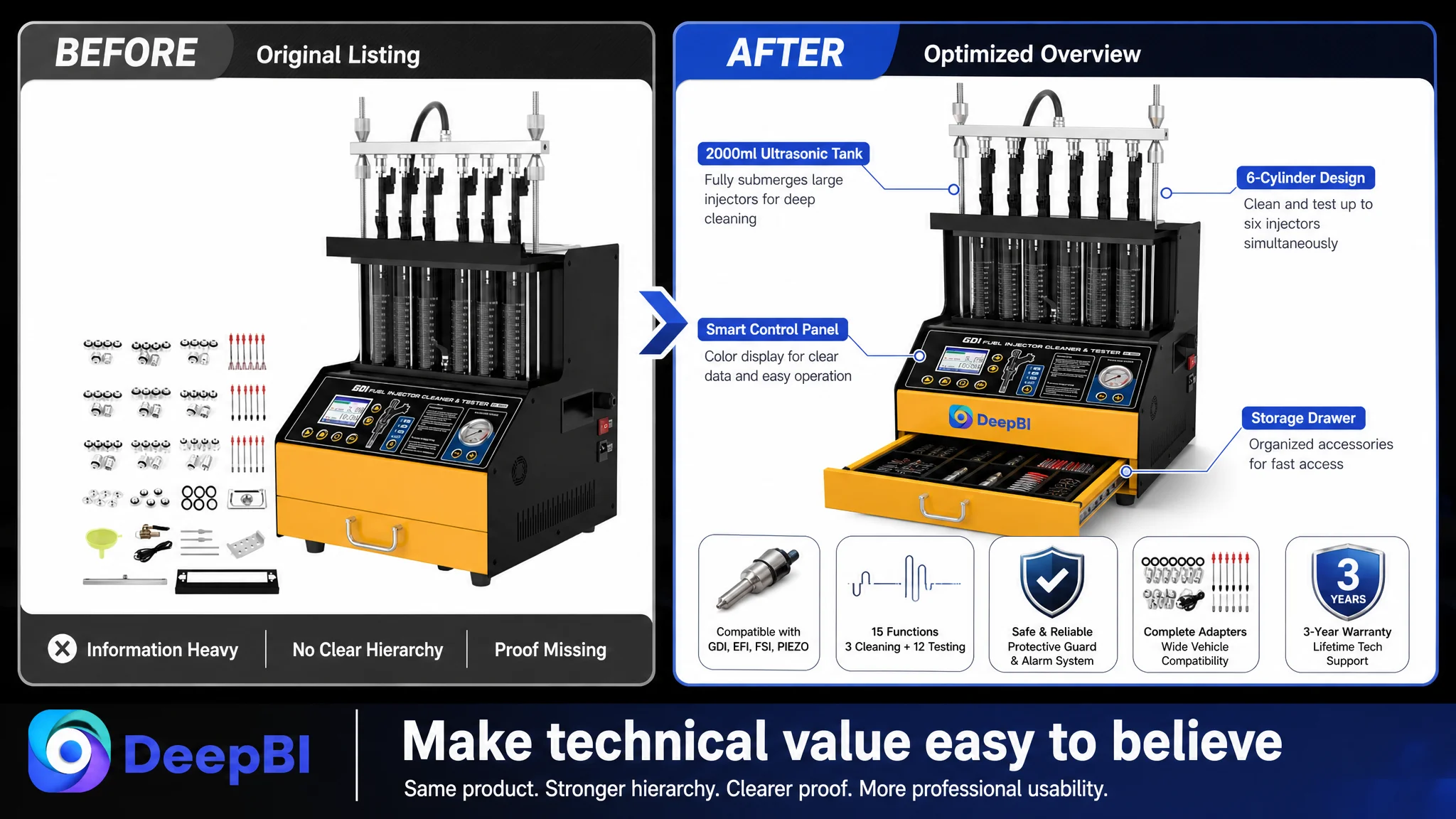
An Amazon seller in the automotive tools category was not facing a simple lack-of-information problem. Its fuel injector cleaner and tester Listing already contained extensive specifications, 15 functions, a six-cylinder design, a large ultrasonic tank, adjustable parameters, and compatibility details. Yet the page still remained behind a comparable high-performing Listing in overall competitiveness.
The customer’s initial direction was to emphasize even more technical capability: add specifications, preserve long-tail keywords, and present the machine’s functions in greater detail. DeepBI’s diagnosis pointed to a different constraint. The Listing was not failing because it lacked features; it was failing to turn those features into a clear sequence of trust, compatibility, proof, and purchase confidence.
That changed the optimization focus on the Amazon product page. Instead of adding more information first, the team needed to bring forward GDI compatibility, ultrasonic cleaning evidence, diagnostic proof, and safety reassurance, while reducing repetitive interface and capacity visuals. The case shows why Amazon sellers should judge whether a Listing can convert traffic before asking Amazon ads to scale it further.
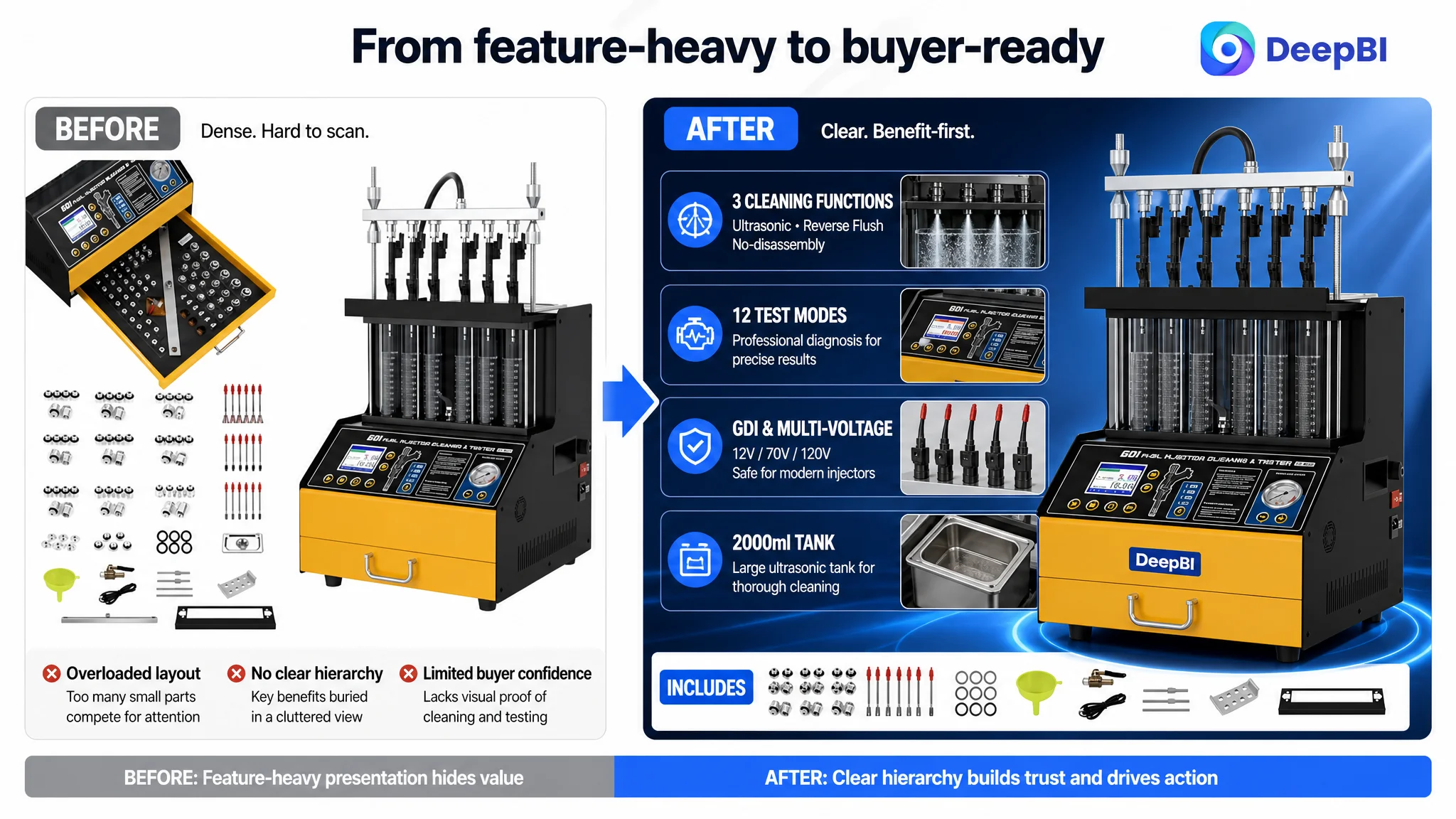
The Listing Had Capability. The Market Did Not See It Quickly Enough.
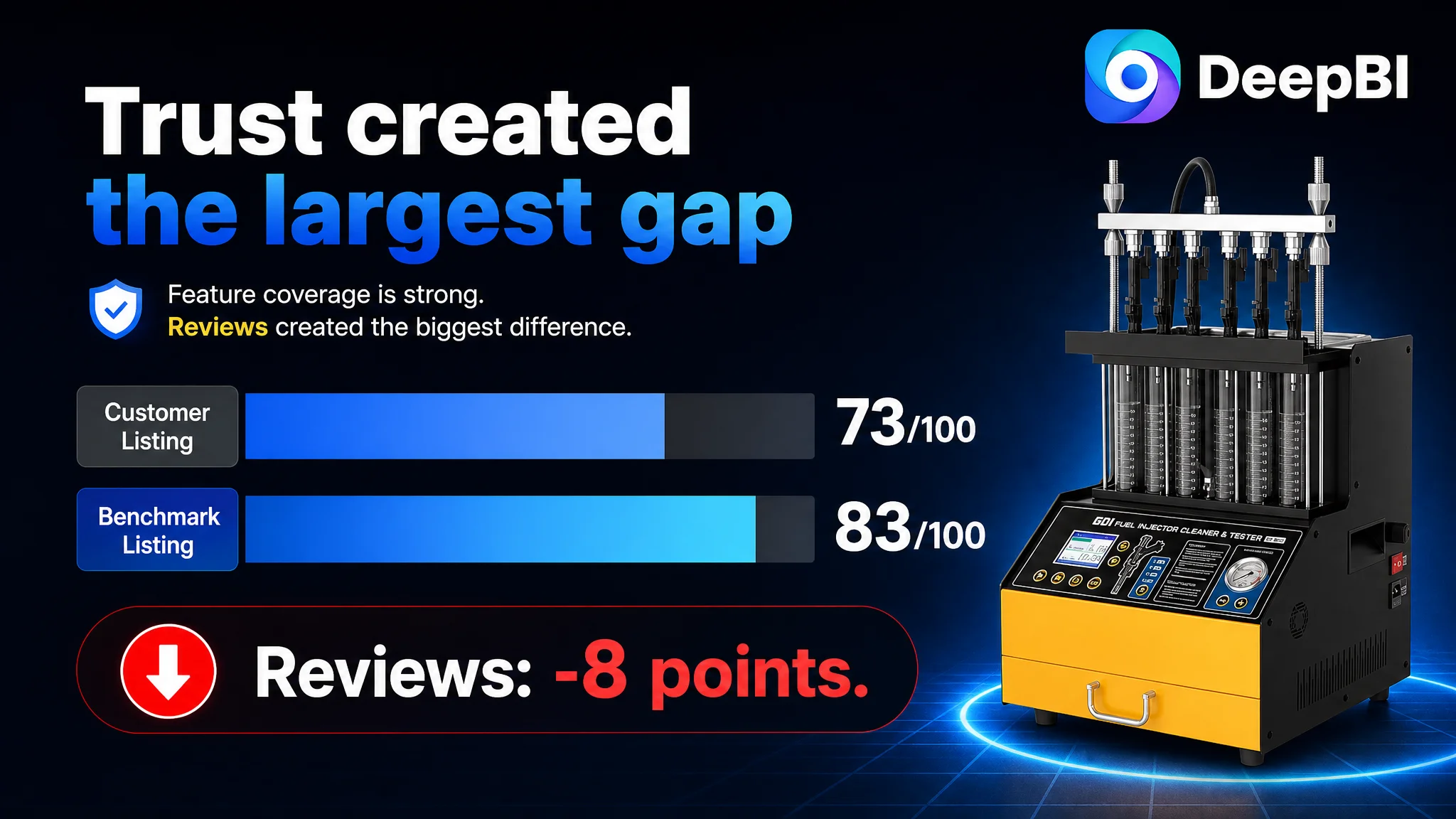
The customer’s Listing received a score of 73 out of 100, compared with 83 for the benchmark Listing.
The gap was not evenly distributed:
- Title: Customer Listing: 15/20, Benchmark Listing: 18/20, Gap: -3
- Main image: Customer Listing: 24/30, Benchmark Listing: 25/30, Gap: -1
- Bullet points: Customer Listing: 7/10, Benchmark Listing: 7/10, Gap: 0
- Detail page: Customer Listing: 22/25, Benchmark Listing: 20/25, Gap: +2
- Reviews: Customer Listing: 5/15, Benchmark Listing: 13/15, Gap: -8
- Total: Customer Listing: 73/100, Benchmark Listing: 83/100, Gap: -10
At first glance, this was not a weak Listing in every respect. The detail page even scored higher than the benchmark on the available assessment. The product also had several commercially meaningful strengths:
- 15 total functions, including three cleaning functions and 12 testing functions
- Six-cylinder testing and cleaning capability
- A 2,000 ml ultrasonic cleaning tank
- Support for GDI, PIEZO, EFI, and FSI injectors
- Selectable 12V, 70V, and 120V outputs
- Adjustable pulse width and operating parameters
- A protective guard, pressure gauge, storage drawer, and multiple connectors
- Three-year warranty and lifetime technical support
The problem was not that these selling points were absent.
The problem was that the Listing asked buyers to process technical detail before giving them enough reasons to trust the product.
For a professional buyer, such as an automotive technician or repair shop, the decision is not based on the number of specifications alone. The buyer needs to answer several questions in order:
1. Will this machine work with the injector type I need to service?
2. Can it actually clean and test the injector effectively?
3. Will the testing process provide useful diagnostic evidence?
4. Can I operate it without damaging a modern injector?
5. Does the product appear reliable enough to justify the purchase?
The customer’s page contained pieces of these answers, but the order was not strong enough.
The Original Diagnosis Focused on Technical Coverage
The Listing was built with a technically serious mindset.
Its title began with the model designation and included a large number of technical terms, such as PIEZO, FSI, adjustable pulse width, voltage options, tank capacity, and ultrasonic cleaning. Its bullet points described pressure monitoring, protective design, warranty coverage, compatibility, cleaning functions, and testing modes. Its A+ content presented a broad product overview, numbered functions, interface screenshots, structural diagrams, accessories, and specifications.
This approach created a reasonable internal assumption:
If the product has more functions and more technical detail than competing products, the Listing should become more persuasive.
That assumption was incomplete.
The customer was not necessarily optimizing the wrong facts. It was prioritizing the facts in the wrong order. The Listing communicated what the machine could do, but it did not consistently communicate why those capabilities mattered at the moment the buyer was deciding whether to click, continue reading, or purchase.
The title is a clear example. The benchmark Listing led with the category phrase “Fuel Injector Cleaner and Tester Machine,” then added visible and quantified selling points such as a color display, cleaning tank capacity, and three cleaning functions. The customer’s title led with the model name and placed several high-value terms later in a dense sequence.
The customer’s title did include more technical keywords. But a title that covers more terms is not automatically a title that communicates value more efficiently.
The title contained information, but not enough hierarchy
The title needed to make the product category and core use case immediately clear on Amazon search results. It also needed to present the most commercially meaningful differentiators earlier:
- Fuel injector cleaner and tester
- Ultrasonic cleaning
- Six-cylinder capability
- GDI, PIEZO, EFI, and FSI compatibility
- Multi-voltage support
- 15-function positioning
- 2,000 ml cleaning tank
The issue was therefore not simply keyword volume. It was keyword and benefit hierarchy.
The product’s technical depth had become a readability burden. Buyers could see that the machine was complex, but they had to work too hard to understand which part of that complexity solved their problem.
The main image sequence moved into detail before building confidence
The first image served a useful role by showing the product, capacity, and included accessories. That helped address initial compatibility and completeness concerns.
The following images were less efficient.
One image introduced a detailed list of capabilities too early. Another repeated basic capacity information. Several images showed interface or operating states in ways that overlapped with one another. These images were not necessarily inaccurate, but they consumed valuable positions without advancing the buyer’s decision.
The visual sequence moved roughly from general awareness into technical detail, then back toward repeated capacity and interface explanations. It did not create a clean progression from:
product identity → core problem solved → compatibility → proof → safe operation → detailed specifications
For an automotive diagnostic tool, this matters. A repair professional is not looking only for a machine that appears feature-rich. The buyer is evaluating whether the tool can support a real workshop task with predictable results.
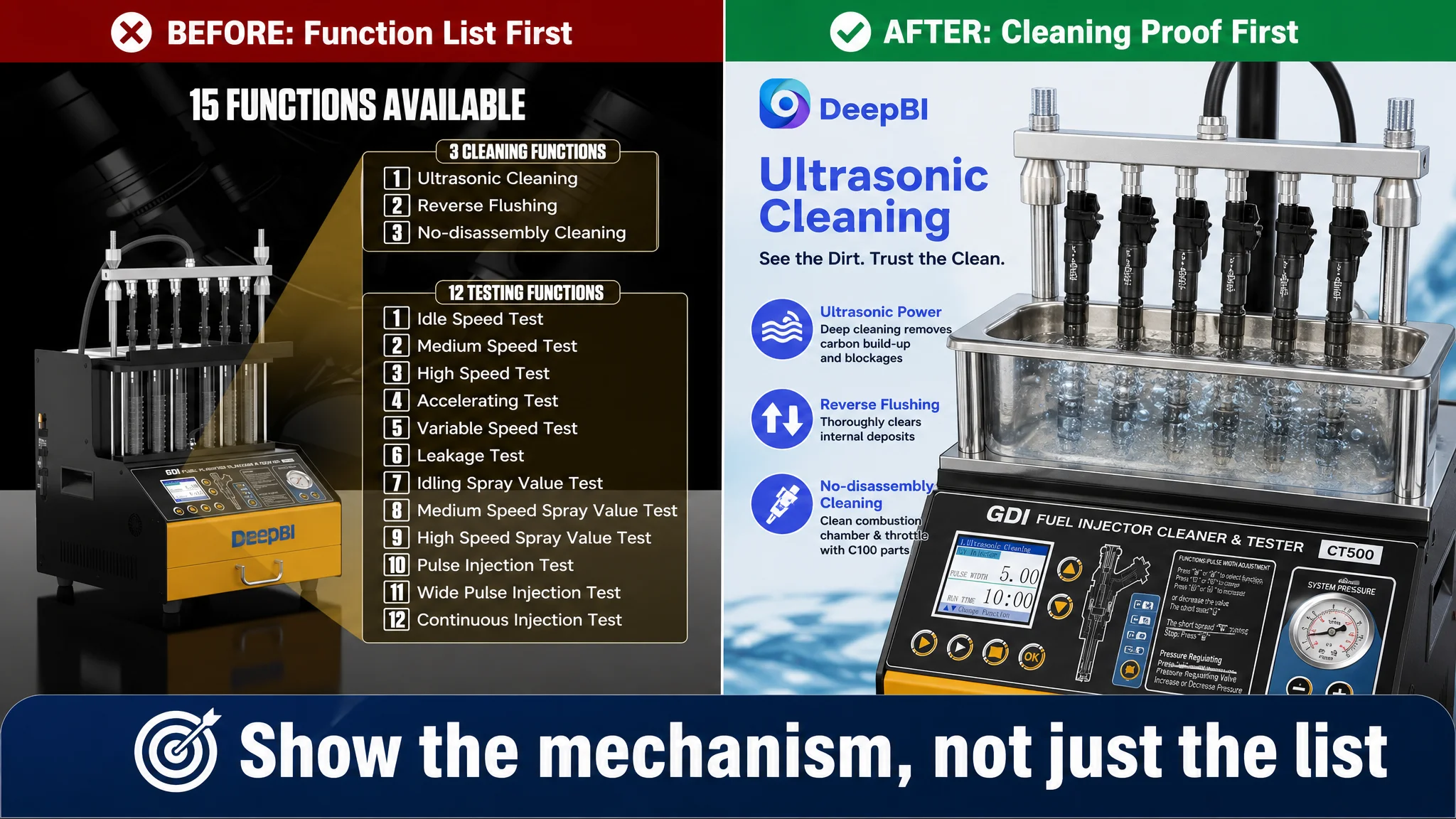
The A+ content emphasized machinery more than problem resolution
The A+ page was visually strong in several respects. Its red-and-black design created contrast, its modules were organized, and its 15-function overview provided substantial technical coverage. It also used warning elements around voltage matching and reverse flushing, which helped establish a degree of professional responsibility.
However, the content sequence still leaned toward mechanical design and feature inventory.
The page showed:
- Function summaries
- Six-cylinder construction
- Adjustable parameters
- Smart control panel
- Compatibility information
- Connector kits
- Large cleaning tank
- Drawer and protective guard
- Structural diagrams
- Specifications and accessories
What it did not emphasize early enough was the buyer’s central question:
How does this machine prove that an injector is being cleaned and tested correctly?
That question required more than a list of modes. It required visible evidence of the mechanism and the diagnostic outcome.
The Strongest Warning Signal Was Not a Missing Feature
The most significant score gap was in reviews.
The customer’s Listing had:
- 3.4 stars
- 7 total reviews
- 2 reviews visible on the first page
- One first-page review rated one star
The benchmark Listing had:
- 4.5 stars
- 76 total reviews
- 12 reviews visible on the first page
- A much stronger base of social proof
This created an eight-point gap in the review dimension, the largest gap in the comparison.
For a technical automotive tool, the review gap is especially important. Buyers may be purchasing for a workshop, a professional service environment, or a repeated diagnostic process. They need confidence not only in the advertised specifications, but also in the machine’s reliability, compatibility, operating experience, and support.
A detailed product page can reduce uncertainty. It cannot fully replace market validation.
This is where the diagnosis had to become more precise. The Listing’s conversion constraint was not just “weak images” or “insufficient keywords.” It was a broader trust and decision-sequencing problem:
- Reviews created a major trust deficit.
- The title did not surface the most important product identity and benefits quickly enough.
- The main images did not create a sufficiently strong proof sequence.
- The A+ content explained many components but did not lead with problem-solving evidence.
- Compatibility was described broadly, but not demonstrated with enough specificity.
- Technical details appeared before the buyer had established confidence in the product.
Advertising can bring a technical product into consideration. It cannot manufacture trust that the product page has not yet built.
DeepBI Reframed the Listing Around the Buyer’s Risk
DeepBI’s judgment was not based on a preference for fewer words or more attractive imagery. It came from comparing the Listing’s structure against the benchmark across multiple dimensions and asking what each module was doing in the buyer’s decision process.
The benchmark Listing did several things more efficiently:
- It placed the core category term near the beginning of the title.
- It used quantified benefits such as three cleaning functions and tank capacity.
- It made GDI, EFI, and FSI compatibility explicit.
- It linked compatibility to recognizable modern engine applications.
- It presented six-cylinder capacity and tank size as operational efficiency benefits.
- It used visual modules to show cleaning mechanisms, testing modes, and control behavior.
- It treated accessories and storage as part of professional usability rather than isolated inventory.
The customer’s Listing had some of these capabilities, and in certain areas it offered more detail. The gap was not a simple absence-versus-presence comparison.
It was a difference in persuasion logic.
The first priority was not adding another specification
The first priority was to make the Listing answer the highest-risk questions sooner:
- Compatibility with modern injector systems
- Evidence of ultrasonic cleaning
- Reverse flushing and no-disassembly cleaning
- Testing validity and observable results
- Voltage selection and operational safety
- Completeness of connectors and specialized cables
This is why DeepBI did not recommend keeping the page centered on repeated interface diagrams or general capacity statements. Those elements still had value, but they belonged later in the decision path, after the product had established relevance and credibility.
Main image optimization became a narrative problem
The main image sequence needed to do more than show the machine from different angles.
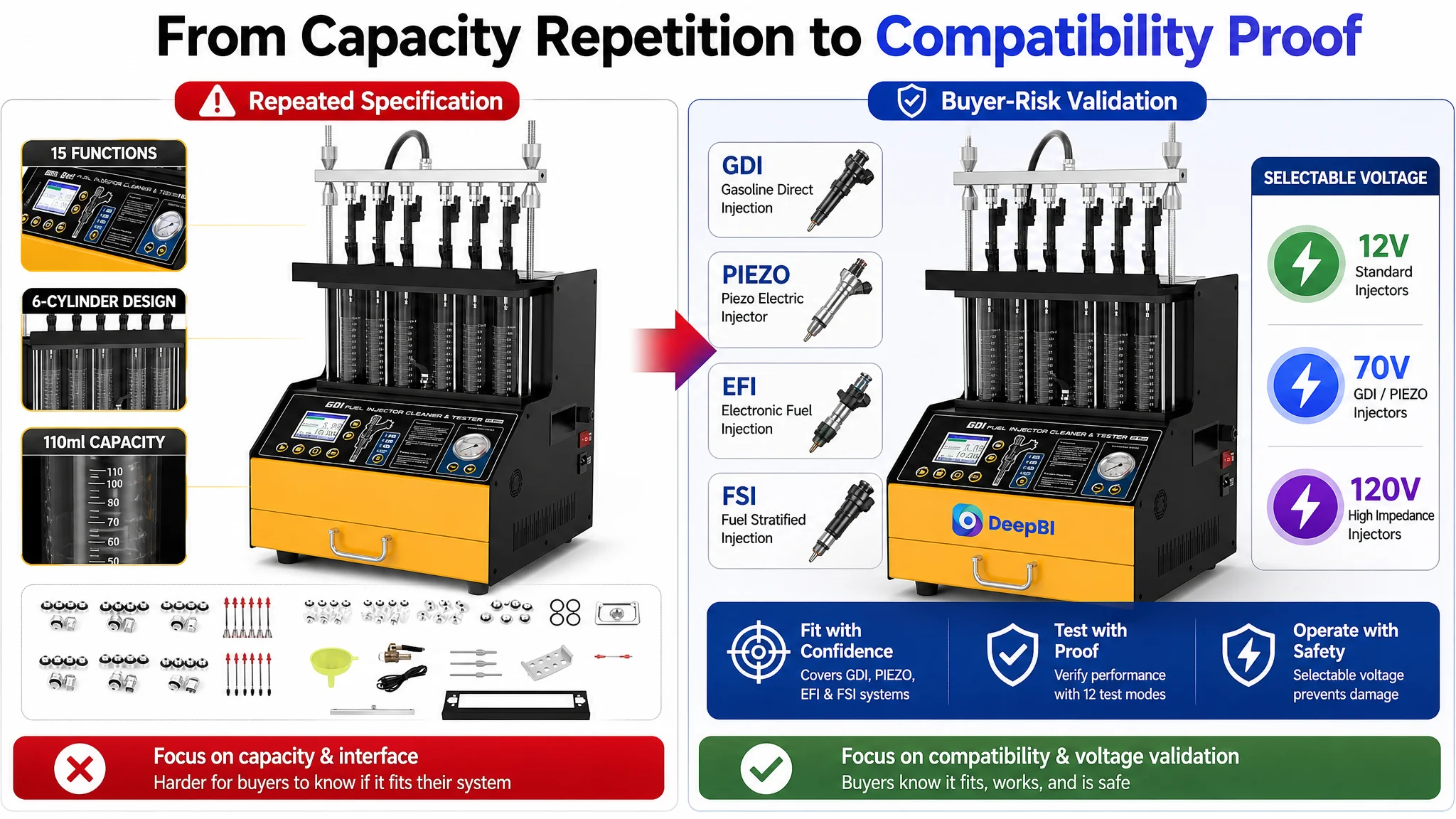
The revised direction was to:
1. Keep the opening product-and-accessory overview so buyers can assess completeness.
2. Move the detailed function list later.
3. Introduce ultrasonic cleaning as visible proof of the core mechanism.
4. Replace repetitive capacity and interface visuals with compatibility validation.
5. Show support for GDI, PIEZO, EFI, and FSI injectors more explicitly.
6. Consolidate overlapping interface information into one clearer diagram.
7. Use the recovered image positions to address high-value buyer concerns rather than repeat existing information.
This was a change from feature accumulation to decision progression.
Detail-page optimization had to prove operational value
The A+ content required a similar shift.
The recommended sequence was:
Capability validation first
The opening module should position the product as a professional fuel injector cleaner and tester for GDI, PIEZO, EFI, and FSI injectors. The goal was to connect the machine to the buyer’s specific application before presenting a broad list of functions.
Mechanism proof next
Ultrasonic cleaning and the 70W bath should appear earlier, showing how the machine addresses carbon deposits and internal blockages. Buyers should understand the cleaning method before being asked to evaluate tank capacity or control parameters.
Specialized cleaning solutions before technical complexity
Reverse flushing and no-disassembly cleaning should be presented as concrete solutions to specific maintenance situations. Adjustable pulse width, speed simulation, and working time could then be framed as precision controls that support professional testing, rather than as isolated technical variables.
Safety and risk reduction made explicit
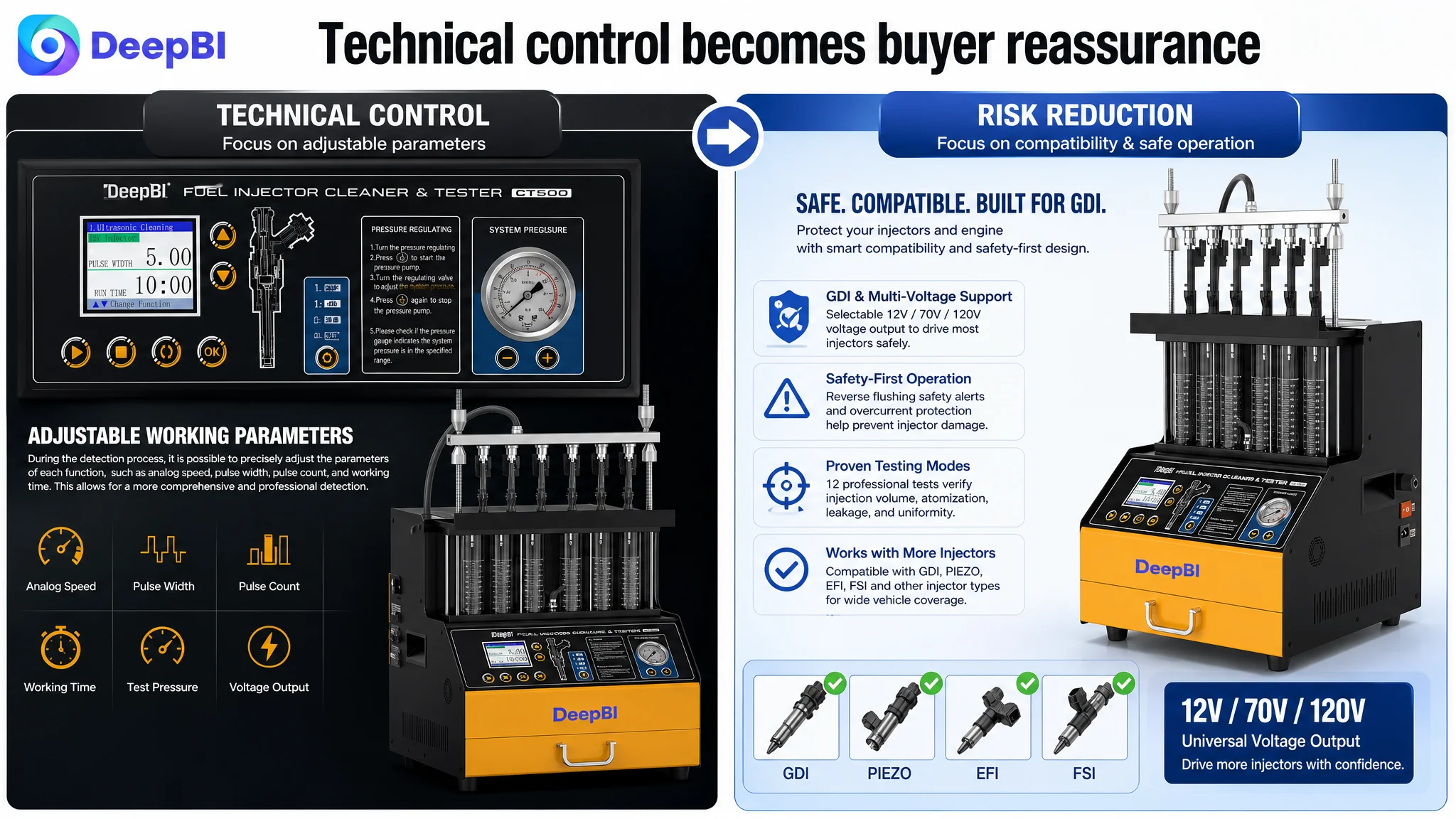
The selectable 12V, 70V, and 120V outputs, protective guard, and operating precautions should work together as a safety narrative. This was particularly important for GDI applications, where buyers may be concerned about incorrect voltage or improper operation.
Testing modes shown as diagnostic evidence
The page should visualize what the testing functions help evaluate:
- Injection volume
- Volume uniformity
- Atomization
- Tightness
- Dripping
- Idle, medium-speed, and high-speed tests
- Leakage and pulse tests
- Accelerating, variable-speed, wide-pulse, and continuous-injection tests
The purpose was not to make the list longer. It was to show that these modes produce useful diagnostic information.
Accessories converted into compatibility confirmation
Instead of showing a generic collection of connectors, the page should sort adapters by application and identify specialized cables where relevant. This would turn accessory coverage into rational proof that the machine is prepared for different injector setups.
Technical specifications left for the closing stage
The large tank, structural diagrams, and complete parameter table still mattered. But they were better used after cleaning capability, testing validity, compatibility, and safety had already been established.
Why the Team Should Not Keep Tuning Ads First
The case does not provide post-optimization advertising results, so it would be inappropriate to claim a specific ACOS decline, CVR increase, or organic-order recovery.
The business logic is nevertheless clear.
If an Amazon Listing has a major trust deficit and an unclear persuasion sequence, additional ad traffic can increase exposure without proportionally increasing orders. The seller may then interpret the outcome as:
- Poor keyword selection
- Weak bids
- Inaccurate targeting
- Insufficient campaign segmentation
- High advertising cost
Those factors may matter, but they are not the first constraint when the product page cannot convert qualified interest.
The customer’s review score and review volume were materially behind the benchmark. The product page also made buyers work through a dense technical presentation before seeing enough evidence of effectiveness and compatibility.
Under those conditions, continuous ad tuning risks amplifying the page’s existing weaknesses.
The question was not “How can the team buy more traffic?” It was “What would that traffic see when it arrived?”
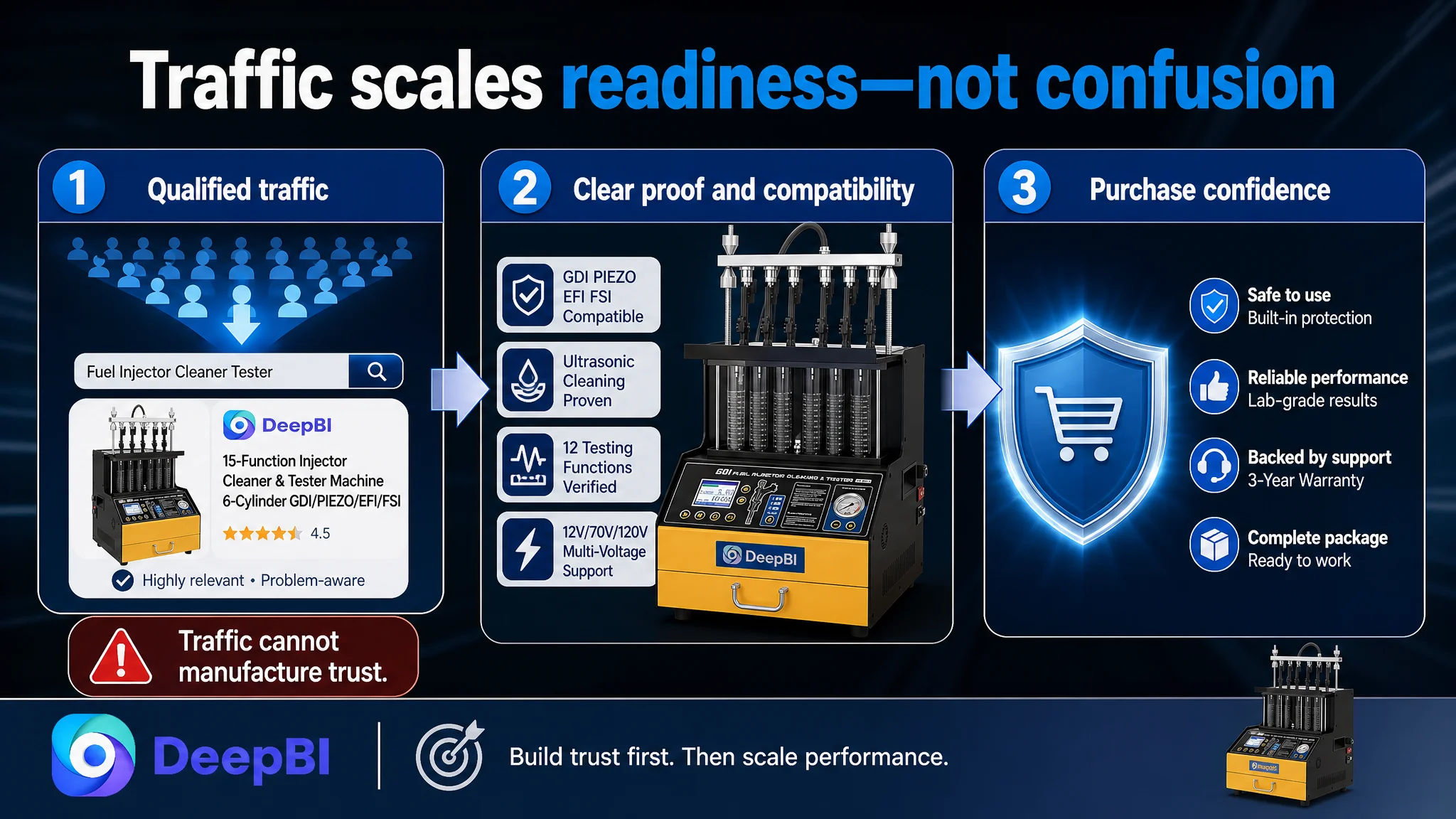
DeepBI’s decision order was therefore:
1. Identify the Listing-level conversion constraint.
2. Clarify the product’s most important buyer promises.
3. Reorder the title, images, bullets, and A+ content around those promises.
4. Use visual proof to reduce compatibility and performance uncertainty.
5. Preserve accurate specifications while moving them to the appropriate stage.
6. Reassess the value of paid traffic after the page has stronger conversion capacity.
This order protects the seller from treating advertising as a substitute for page-level trust.
The Bullet Points Needed Tighter Decision Logic
The bullet points scored equally to the benchmark, at 7 out of 10, but equal scores did not mean identical strengths.
The customer’s bullet points contained useful details, including pressure monitoring, protective design, broad compatibility, and warranty coverage. The issue was that the points were relatively loose in structure, and some of the strongest claims were not connected tightly enough to a buyer problem.
The revised direction concentrated each point around one decision:
- Three advanced cleaning functions: explain ultrasonic cleaning, reverse flushing, and no-disassembly cleaning together.
- Twelve testing functions: connect the test modes to injection volume, atomization, uniformity, tightness, and dripping.
- GDI, EFI, FSI, and multi-voltage compatibility: make modern injector support and voltage selection explicit.
- Six-cylinder efficiency and 2,000 ml tank: connect capacity to workshop productivity and large-injector cleaning.
- Intelligent control and organized storage: combine the TFT display, adjustable parameters, pressure gauge, connectors, and drawer into a professional workflow.
- Three-year warranty and lifetime support: present service assurance as the final confidence point.
The goal was not simply to rewrite English. It was to make every bullet answer a buyer’s next question.
The Review Gap Could Not Be Designed Away
The Listing content could be improved, but the review problem required a different understanding.
A 3.4-star rating with seven reviews creates a level of uncertainty that no title rewrite or A+ redesign can fully remove. The content strategy could make the product’s capabilities clearer and reduce avoidable doubts, but it could not substitute for genuine customer experience and sustained market validation.
This distinction matters for Amazon sellers because it prevents an unrealistic optimization loop. A seller may improve the page and still see limited conversion if the review profile remains weak. That does not invalidate the Listing diagnosis. It clarifies that content improvement and reputation development are separate but connected business tasks.
The page must become more persuasive, but the business also needs to build stronger evidence over time through reliable product performance, accurate expectations, responsive support, and legitimate customer feedback.
What Changed in the Business Understanding
The case did not end with a claim of guaranteed performance improvement. The material does not include post-change CTR, CVR, ACOS, TACOS, keyword ranking, or organic-order data.
What changed was the operating judgment.
The customer began with a capability-led view of the Listing: more functions, more parameters, and more technical terms should create stronger competitiveness.
DeepBI reframed the page around conversion capacity:
- A product with many features still needs a clear value hierarchy.
- A technical buyer needs proof of applicability before specifications.
- Compatibility claims are stronger when they are shown in a concrete visual context.
- Testing modes become persuasive when the page shows what they diagnose.
- Safety information is part of conversion, not merely compliance.
- Repetitive interface and capacity images can consume valuable persuasion space.
- A strong A+ page must prove problem-solving ability, not only document machinery.
- Reviews remain a major trust variable that content alone cannot replace.
- Amazon ads should scale a page that is ready to convert, not compensate for one that is not.
The product itself did not need to be presented as less technical. It needed to be presented in a way that allowed the buyer to understand its technical value without carrying the full burden of interpretation.
The Practical Lesson for Amazon Sellers
Many automotive tools, diagnostic devices, and workshop machines face the same temptation: add more specifications whenever conversion weakens.
That response is understandable. Technical detail feels objective and safe. But on an Amazon product page, information only creates value when it appears at the right point in the decision path.
For this fuel injector cleaner and tester Listing, the more effective direction was not to hide the 15 functions or remove the engineering detail. It was to give the page a stronger order:
relevance first, mechanism second, proof third, safety fourth, specifications last.
That order gives Amazon traffic a better chance of becoming meaningful buyer interest.
The deeper lesson is broader than this automotive category. Before changing bids, expanding campaigns, or adding more keywords, sellers should ask whether their Listing makes the product’s value easy to recognize and safe to believe.
When the answer is no, the first optimization problem may not be advertising efficiency.
It may be the page itself.