

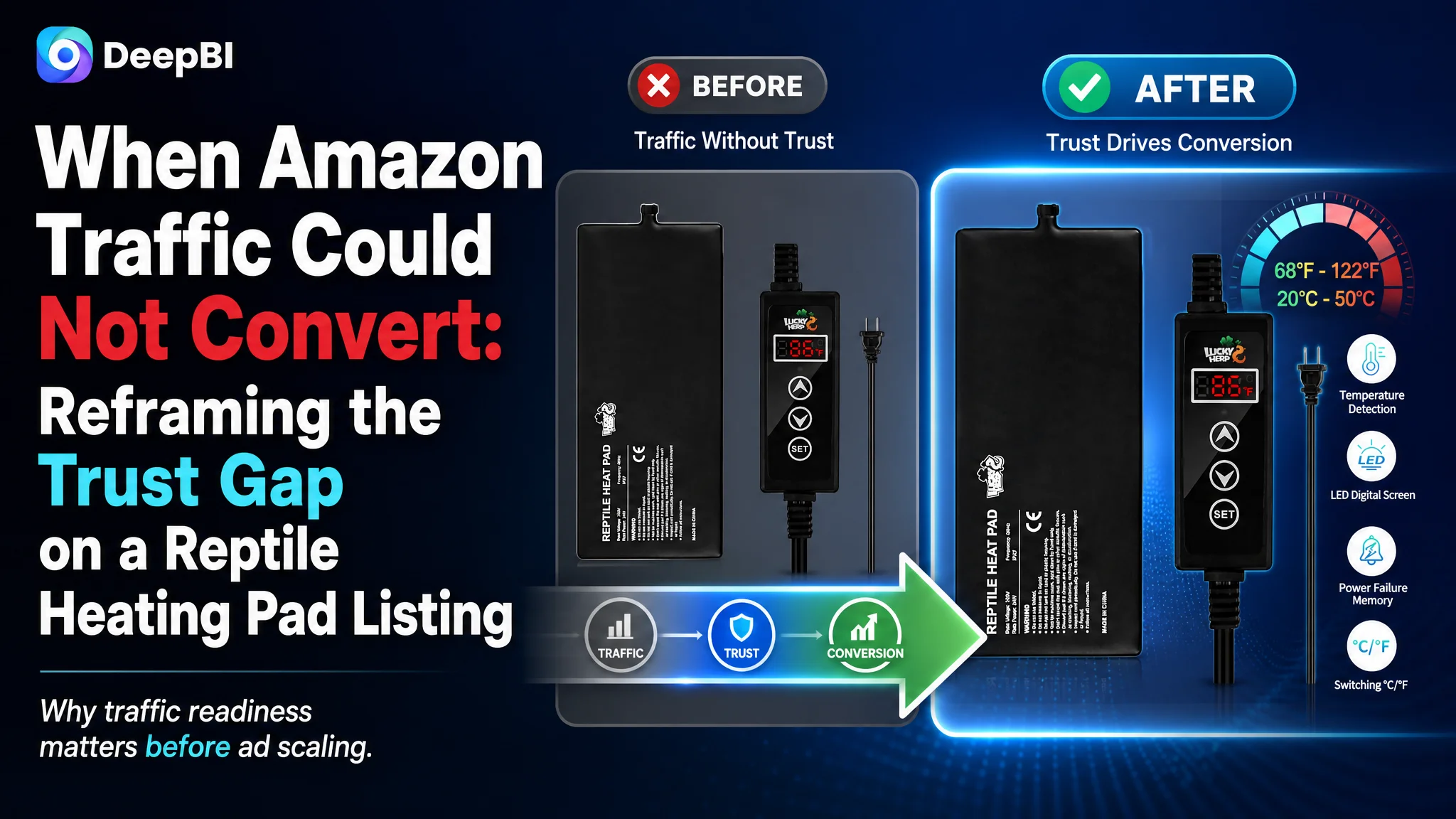
An Amazon seller in the US reptile-care category was facing a product-page problem that looked, at first, like a traffic and advertising issue. The listing offered a 24W heating pad with a digital thermostat, but its overall Listing score was 70/100, compared with 83/100 for a closely matched category benchmark. The gap was not caused by one isolated copy error. It appeared across the way the page created confidence.
The customer initially focused on the familiar levers: keywords, specifications, and product features. The title contained the core term “Reptile Heating Pad,” and the bullet points included temperature control, waterproof material, installation, and compatibility information. Yet this direction did not address the central question facing buyers on an Amazon product page: Can I trust this heating pad to provide reliable warmth without putting my reptile at risk?
DeepBI reframed the problem as a Listing conversion-capacity issue. The most important gaps were not the bullet-point score or keyword coverage alone, but the weaker main-image persuasion, thinner A+ evidence, and substantial review disadvantage. The later optimization therefore focused on safety reassurance, visible proof of even heating, clearer thermostat communication, stronger installation guidance, and species-specific confidence before asking Amazon ads to drive more traffic.
This case is worth studying because it shows why Amazon sellers should not automatically respond to weak sales efficiency by adjusting bids or campaign structure. When a product page does not resolve the buyer’s main concerns, more traffic can simply expose the same conversion leak at a larger scale.
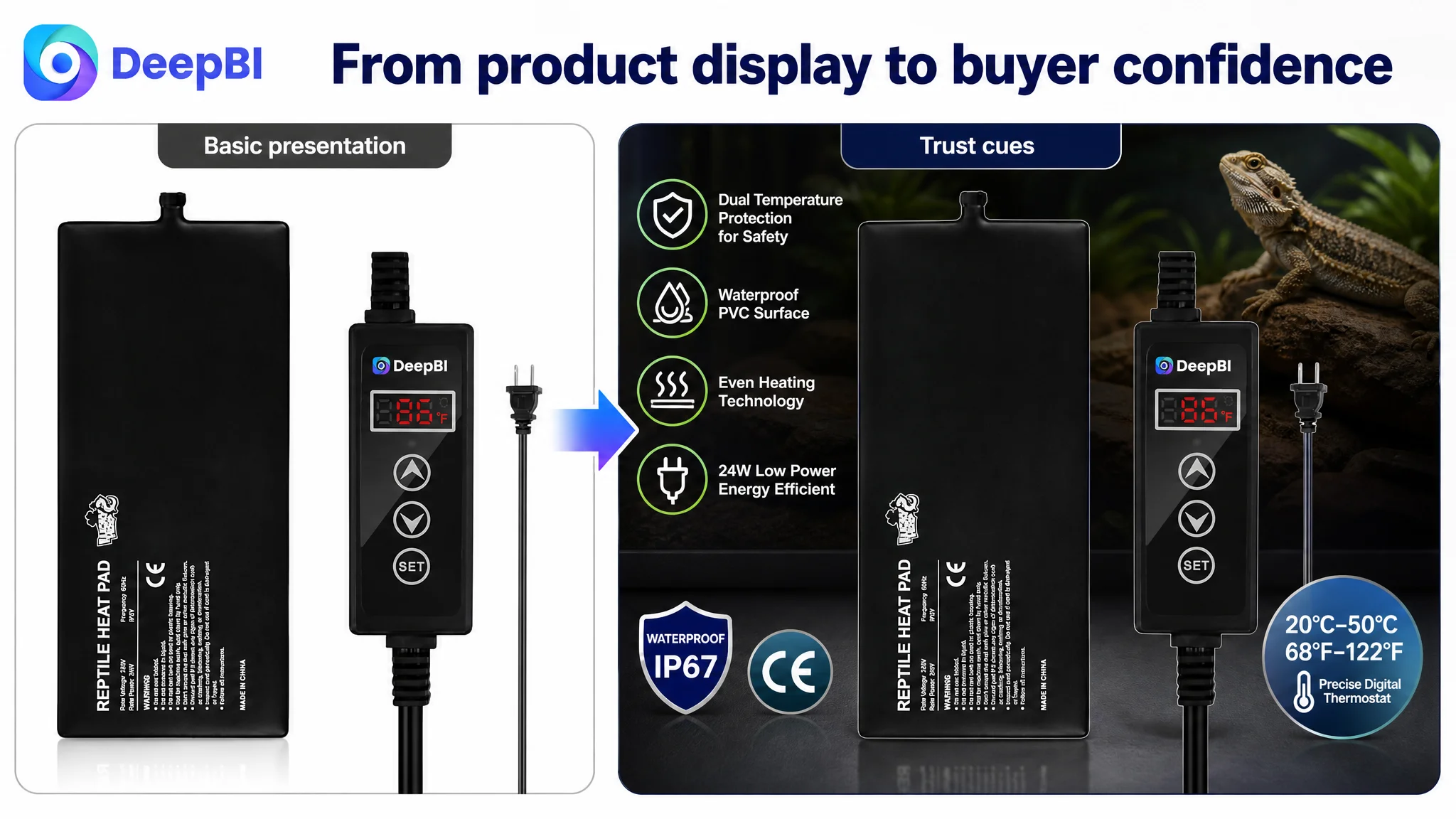
The listing had a product story. It did not yet have a complete trust story.
The customer’s Amazon Listing was not empty or obviously neglected. It included:
- A 24W reptile heating pad
- An integrated digital thermostat
- Temperature adjustment from 20°C to 50°C, or 68°F to 122°F
- A waterproof PVC surface
- Flexible installation
- Compatibility with reptiles, amphibians, and hermit crabs
- A+ modules covering heating, material, installation, and use cases
On paper, the page contained many of the expected selling points.
The problem was how those points were arranged and proven.
A reptile heating product is not purchased only for its wattage or dimensions. The buyer is also evaluating whether the heat will be stable, whether the temperature can be controlled precisely, whether the installation will hold, and whether the product is safe for an animal living in an enclosed terrarium.
The page communicated what the product had. It did not consistently demonstrate why the buyer should feel secure using it.
That distinction became visible in the comparative scoring.
- Title: Customer listing: 16/20, Category benchmark: 17/20, Gap: -1
- Main image: Customer listing: 23/30, Category benchmark: 26/30, Gap: -3
- Bullet points: Customer listing: 6/10, Category benchmark: 5/10, Gap: +1
- A+ detail content: Customer listing: 19/25, Category benchmark: 23/25, Gap: -4
- Reviews: Customer listing: 6/15, Category benchmark: 12/15, Gap: -6
- Total: Customer listing: 70/100, Category benchmark: 83/100, Gap: -13
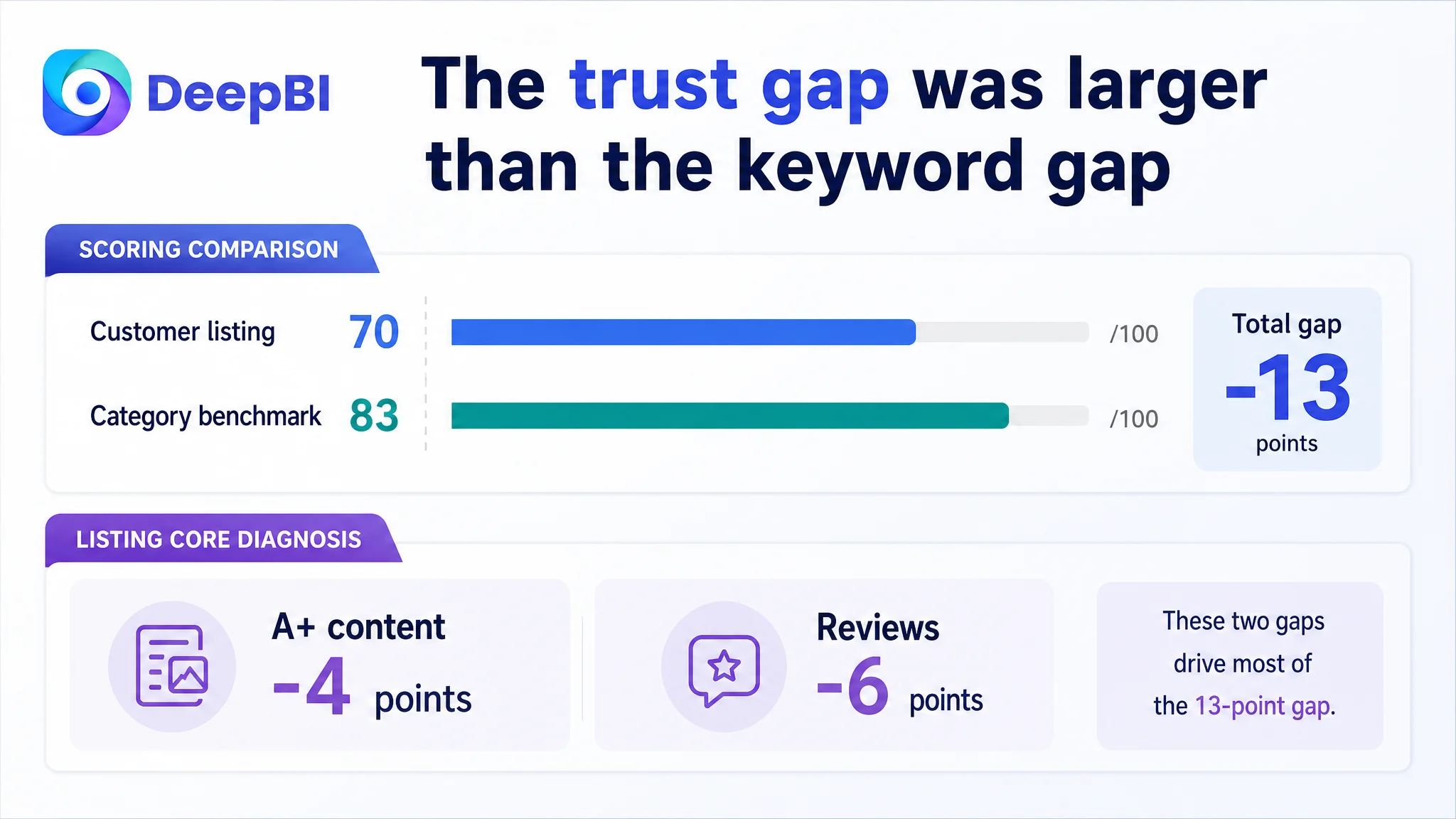
The first important judgment was therefore not “rewrite every section.” It was to identify which gaps were most likely to affect the buyer’s decision.
The original diagnosis stopped too close to keywords and specifications
The customer’s initial optimization direction was understandable. The title already contained important search language, but it was longer than the benchmark title and repeated related terms such as “Heating Pad” and “Heat Pad.” It also mentioned the thermostat and wattage without making the bundled value especially clear.
The proposed title structure moved toward:
- The core product phrase earlier in the title
- The 24W specification near the main keyword
- A clearer thermostat combination
- More orderly species coverage
- Less repetition between heating-pad terminology and controller wording
That was a useful correction, but it was not the main conversion answer.
The same pattern appeared in the bullet points. The customer listing actually scored slightly higher than the benchmark in this dimension, 6/10 versus 5/10. That mattered. It showed that the problem was not simply a lack of bullet-point content or a total failure of copywriting.
The bullets described:
- Durable and waterproof material
- PID temperature control
- Fast heating and energy efficiency
- Flexible installation and broad application
- Operation and maintenance
However, several points still read more like a product manual than a buying argument. “Easy to use” explained operation, but did not fully connect that operation to the buyer’s concern about maintaining a stable terrarium environment. Product parameters appeared, but the relationship between those parameters and pet safety was not always clear.
This is where the original diagnosis was incomplete.
The page did not primarily need more information. It needed a more persuasive order of information.
The customer was working on the parts of the Listing that were easiest to edit: keyword placement, specification wording, and feature descriptions. DeepBI’s comparison showed that the larger commercial risk was elsewhere. The page needed to answer the highest-anxiety questions earlier and with stronger evidence.
The largest gaps were not in the words alone
The customer listing’s main-image score was 23/30, only three points below the benchmark. That may appear modest, but the visual difference had an important consequence.
The current first impression showed the product and its components, but it did not create an immediate sense of professional control or animal safety. The benchmark listing used stronger category association, clearer visual hierarchy, and more direct performance cues. Its visual language made it easier for a buyer to recognize the product’s intended use and understand why it was trustworthy.
The customer’s main-image system faced several problems:
- The product was shown without a strong reptile-use context.
- Key safety and control information was not visually prominent.
- Product specifications competed with the central message.
- Even heating was described more than demonstrated.
- The page did not make the complete kit and thermostat relationship immediately obvious.
These issues affect different stages of the Amazon funnel.
A weak thumbnail can reduce the reason to click. A weak secondary image can fail to confirm the product’s fit. A weak A+ section can leave unresolved concerns after the buyer has already shown interest.
The A+ gap was more significant: 19/25 compared with 23/25 for the benchmark.
The benchmark used modules that converted technical claims into visible evidence, including:
- Heat-distribution comparisons
- Thermostat close-ups
- Installation details
- Species-oriented temperature guidance
- Third-party certification visuals
- A more consistent visual system
The customer page described uniform heating, safety, and durability, but it did not provide the same depth of visual proof. It also used mixed backgrounds, including natural greenery and wood textures, which made the page feel less unified and less technically focused.
The weakness was not that the product had no selling points. The weakness was that the page asked buyers to accept too many of them without enough visible support.
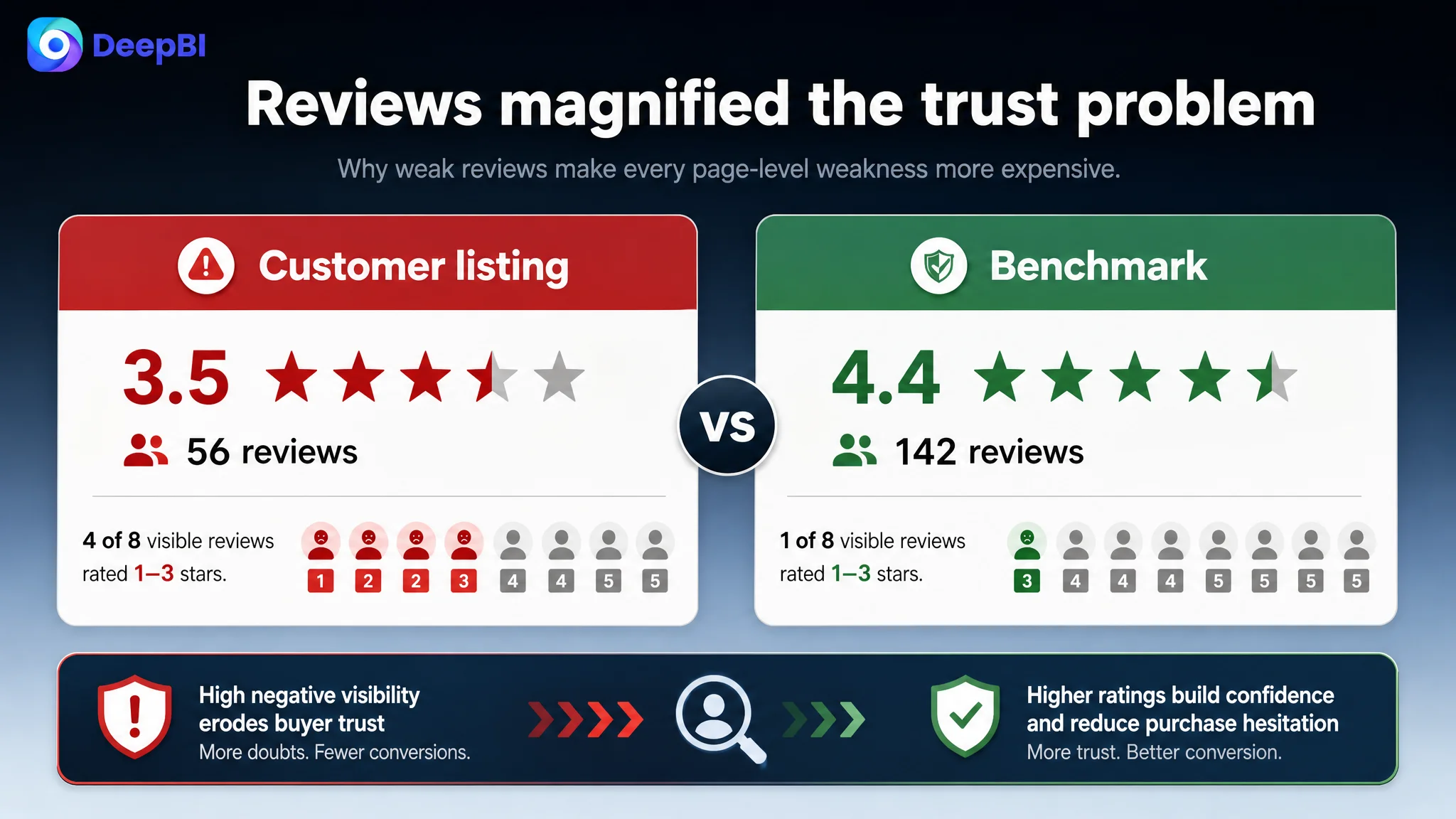
Reviews made every page-level weakness more expensive
The review score was the clearest trust gap in the comparison.
The customer listing had:
- 3.5 stars
- 56 total reviews
- 8 reviews visible on the first page
- Four of the eight visible reviews rated one to three stars
The benchmark had:
- 4.4 stars
- 142 total reviews
- A much smaller share of low-star reviews among the visible reviews
The customer’s low-star feedback focused on issues such as insufficient heating and weak adhesion. Those comments were especially damaging because they challenged the product’s core job, not an incidental convenience.
A buyer may tolerate uncertainty around color or packaging. They are much less likely to overlook doubts about whether a reptile heating pad produces enough heat or stays properly installed.
This review gap also changed how the visual and content optimization had to be approached. The page could not rely on design polish to erase negative feedback. Instead, the Listing needed to answer the same concerns directly and honestly:
- How is temperature controlled?
- How does the product distribute heat?
- How should it be installed?
- What does the waterproof surface mean in normal maintenance?
- Which reptile types and terrarium applications fit the product?
- What safety features are actually confirmed?
The role of the Listing was to make the product’s real operating logic easier to understand, not to make unsupported promises.
DeepBI’s diagnosis: the conversion bottleneck was trust and proof
The comparative score did not point to a single “bad image” or a single missing keyword. It showed a connected problem:
1. The title was serviceable but somewhat repetitive.
2. The main image did not create a strong first reason to click.
3. The bullet points contained useful information but lacked a clear pain-point sequence.
4. The A+ content described performance without enough technical visualization.
5. Reviews created a major credibility deficit, especially around heating and installation.
Together, these weaknesses reduced the Listing’s ability to convert both organic and paid traffic.
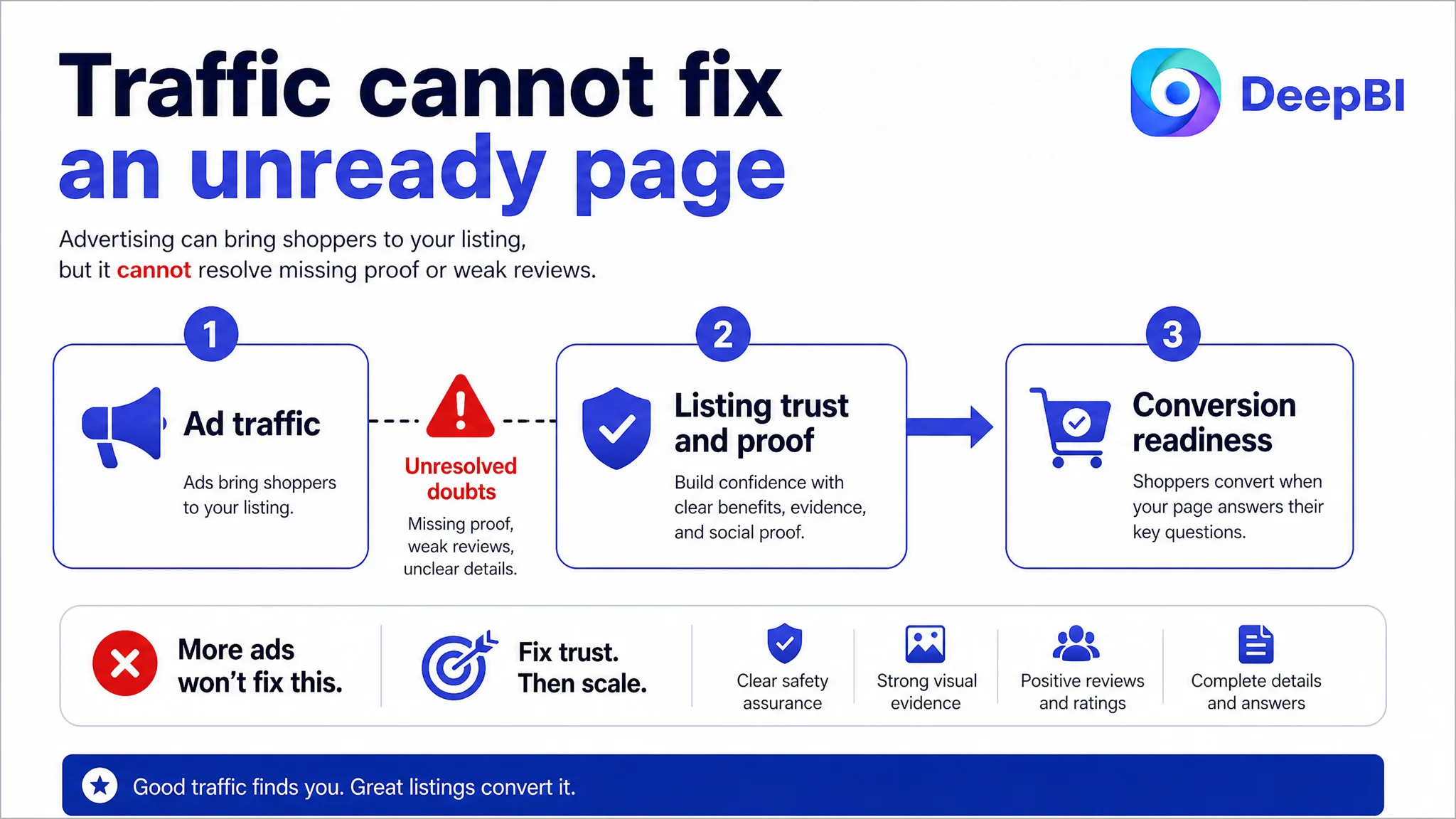
This was the point at which DeepBI separated traffic acquisition from traffic readiness.
Amazon ads can bring shoppers to the product page. They cannot make a 3.5-star rating look like a 4.4-star rating. They cannot turn a text-only claim about even heating into visible evidence. They cannot compensate for a page that makes pet owners work too hard to understand the safety logic.
Advertising can amplify a strong product page, but it can also amplify unresolved doubts.
That is why the Listing had to be addressed before treating advertising as the primary fix. Without improving the page’s trust structure, additional clicks would risk producing more sessions without a corresponding improvement in orders.
Why DeepBI did not prioritize more ad tuning first
The customer’s situation created a common operating temptation: keep adjusting search terms, bids, and campaign structure until the efficiency problem improves.
That approach would have been premature here.
The strongest evidence pointed to a page-level constraint rather than a simple traffic-generation failure. The total Listing score was 13 points below the benchmark, and the largest deficits were concentrated in A+ content and reviews, with a meaningful main-image gap as well.
The decision order was therefore:
First, make the product understandable at the click stage
The main image needed to clarify the complete kit, the thermostat, and the product’s intended use without overloading the frame with specifications.
The goal was not to imitate the benchmark’s design. It was to improve the customer listing’s own visual hierarchy while preserving the real product:
- Keep the actual pad, controller, and included components accurate.
- Make the complete setup easier to recognize.
- Give temperature control a more central role.
- Present dimensions and installation details where they help confirmation rather than distract from the first impression.
- Use confirmed product claims such as waterproof PVC material and the visible IPX7 marking only where supported.
Next, turn performance claims into visible evidence
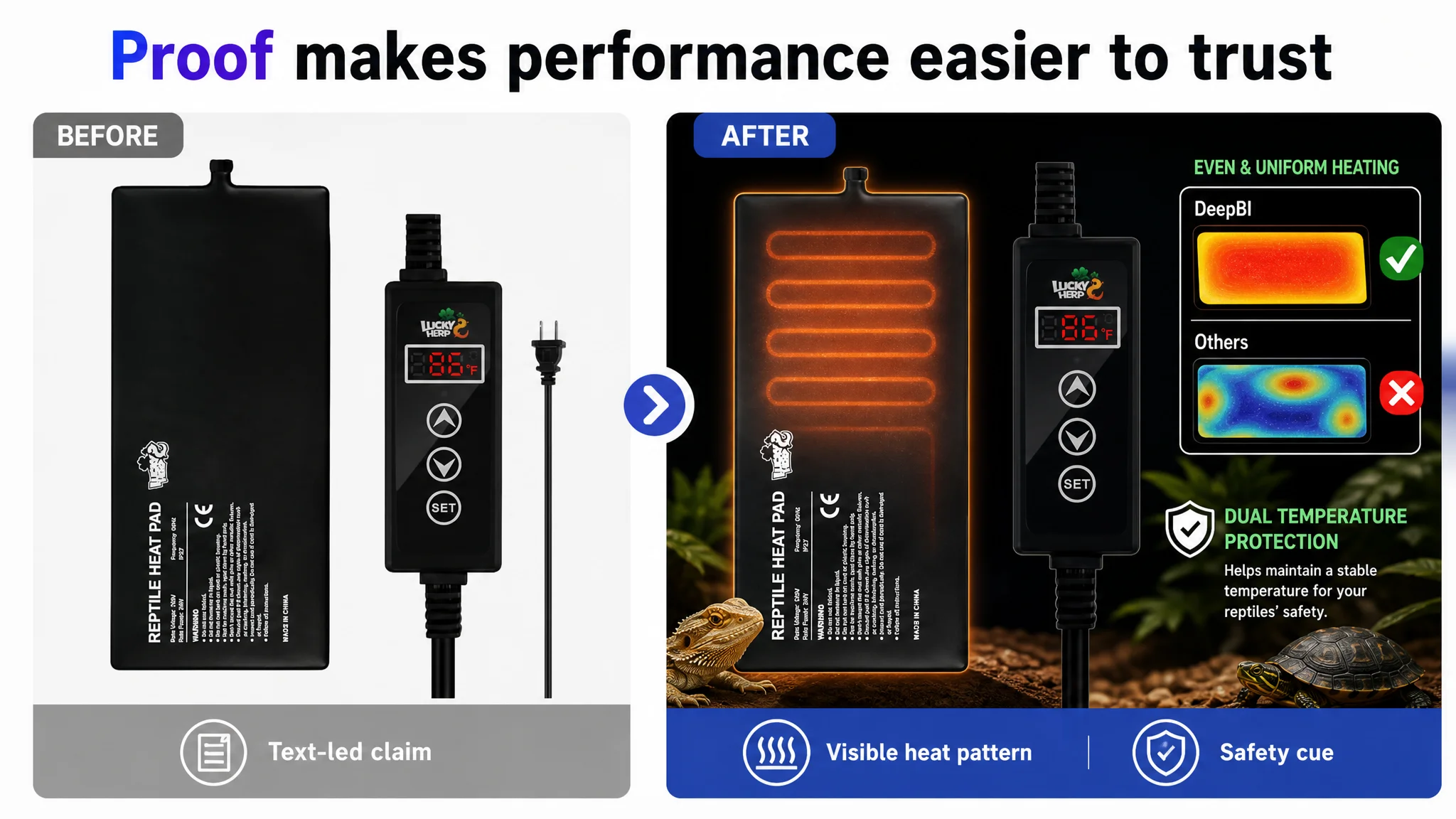
“Even heating” is a meaningful benefit, but it is weak when left as a sentence alone. The recommended direction was to use a clear heat-distribution visual or technical comparison that demonstrates the intended benefit without inventing test results.
Likewise, the dual temperature protection system could be used as a safety message because it was included in the product material. Unsupported claims such as automatic shutoff or overheat protection should not be added unless separately verified.
This distinction is commercially important. A stronger page must not create a new gap between the customer’s images and the product delivered.
Then, build a more direct safety sequence in A+
The A+ page needed to lead with the buyer’s primary concern: maintaining controlled warmth for a reptile in a terrarium.
A stronger sequence would be:
1. Thermostat control and temperature range
2. Even heat distribution
3. Dual temperature protection
4. Installation and connector reliability
5. Waterproof PVC surface and cleaning
6. Durable materials
7. Species and terrarium suitability
This sequence follows the buyer’s decision logic rather than the order in which the product happened to be designed.
Finally, use the page to support future advertising decisions
Only after the Listing better explains and substantiates the product should the team judge whether ad traffic is being converted efficiently.
At that point, advertising data can become more diagnostic:
- If CTR remains weak, the main-image promise may still be unclear.
- If CTR improves but CVR remains weak, the remaining issue may be trust, reviews, pricing, or product-market fit.
- If CVR begins to recover, ad traffic is no longer being sent to a page with the same level of avoidable friction.
The title needed clarity, not keyword accumulation
The title optimization was deliberately narrower than a full rewrite.
The recommended structure placed the core phrase and key specification closer together:
Reptile Heating Pad with Thermostat, 24W, 8x18 Inch Under Tank Heater and Terrarium Warmer with Digital Controller for Hermit Crabs, Turtles, Lizards, Frogs, and Snakes
The business logic was straightforward:
- Put the main product phrase where shoppers and Amazon’s search system can identify it quickly.
- Keep the thermostat combination clear.
- Retain the 24W and 8x18-inch specifications.
- Remove unnecessary repetition.
- Present species compatibility in a cleaner sequence.
- Make the bundled configuration easier to understand.
The title was not expected to solve the entire conversion problem. Its role was to improve search clarity and initial product comprehension so that the images and A+ content could carry the trust argument forward.
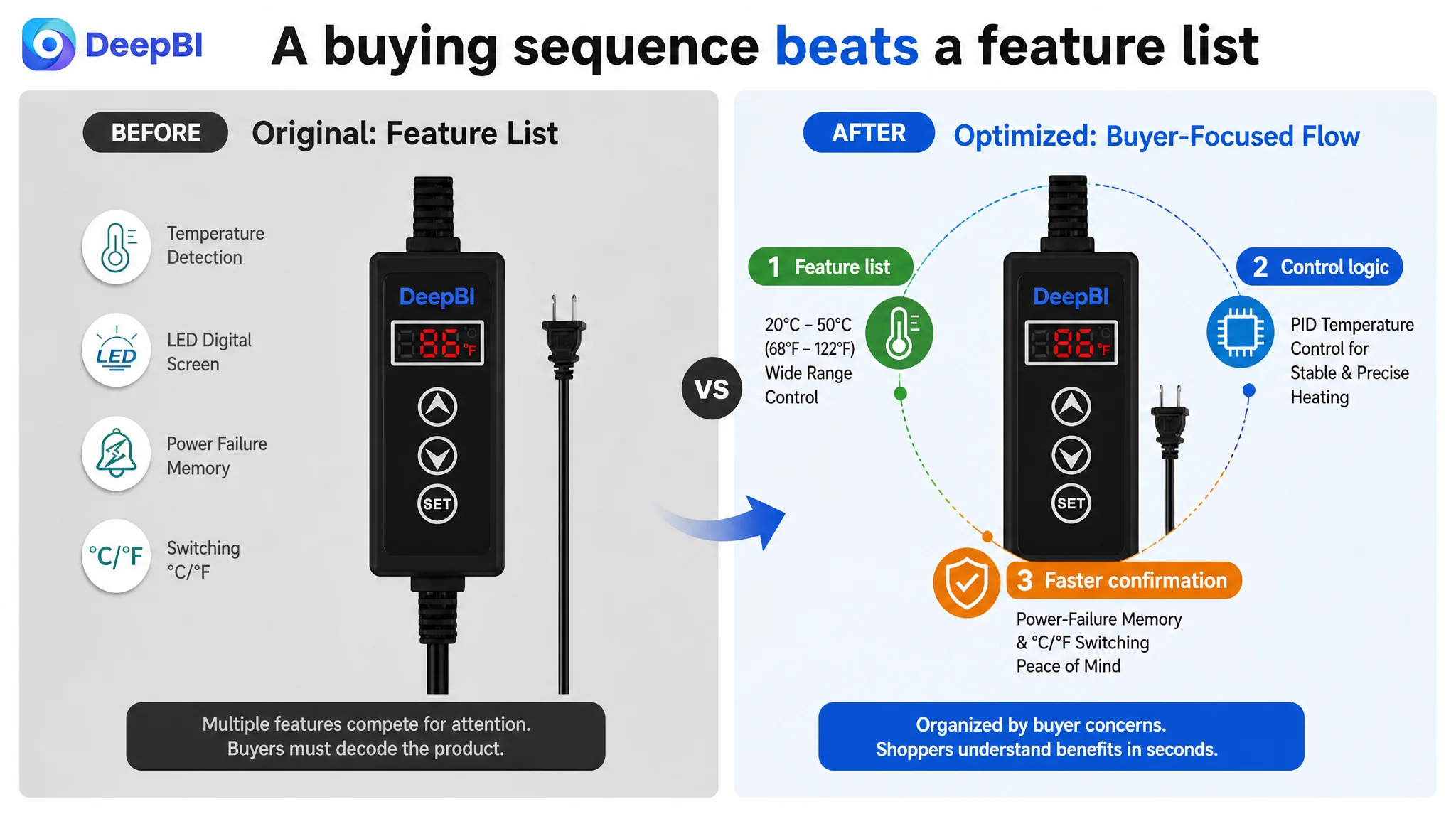
The bullet points needed a buying sequence
The revised bullet strategy moved away from operation-manual language and toward a sequence based on buyer concerns.
Safety and durability first
The opening point should connect waterproof PVC, durability, cleanability, and the confirmed dual temperature protection system. The purpose is not to stack claims, but to answer why the product can be used and maintained in a terrarium environment.
Precision temperature control second
The PID thermostat and 20°C to 50°C range should be presented as a way to manage different reptile temperature needs. The Celsius and Fahrenheit display options can support usability, but the main message should remain control.
Even heating and energy use third
The 24W design, rapid heating claim, and even heat distribution belong together when supported by the product material. This gives the buyer a reason to see the wattage as part of a use case rather than an isolated number.
Installation and application fourth
The flexible, foldable design and installation process should reduce uncertainty. The page should emphasize a strong and even bond and simple setup without introducing an unsupported adhesive brand or certification.
Operation and maintenance fifth
Simple temperature adjustment, a moisture-resistant surface, and easy cleaning can close the sequence. These are useful benefits, but they should not appear before the core safety and performance questions are answered.
The improvement was therefore structural: each bullet should move the buyer from concern to reassurance, not from feature to feature.
The main image had to earn the click before the A+ page could do its work
The recommended image direction treated each visual asset as a decision stage.
The first image: complete kit and immediate confidence
The first image should make the heating pad, controller, and included components easy to recognize. Safety-related marks or ratings should only be shown when they are verified and presented accurately. The image should reduce clutter rather than add every available specification.
The second image: installation and practical confirmation
This image should clarify dimensions, the reinforced connector, cable lengths, and the adhesive-backed installation mechanism as supported by the existing materials. It should not introduce a specific adhesive brand that the product documentation does not confirm.
The third image: control precision
The thermostat display should communicate the adjustable 68°F to 122°F range, Celsius/Fahrenheit switching, and power-failure memory. These are concrete convenience and control benefits that can be understood quickly.
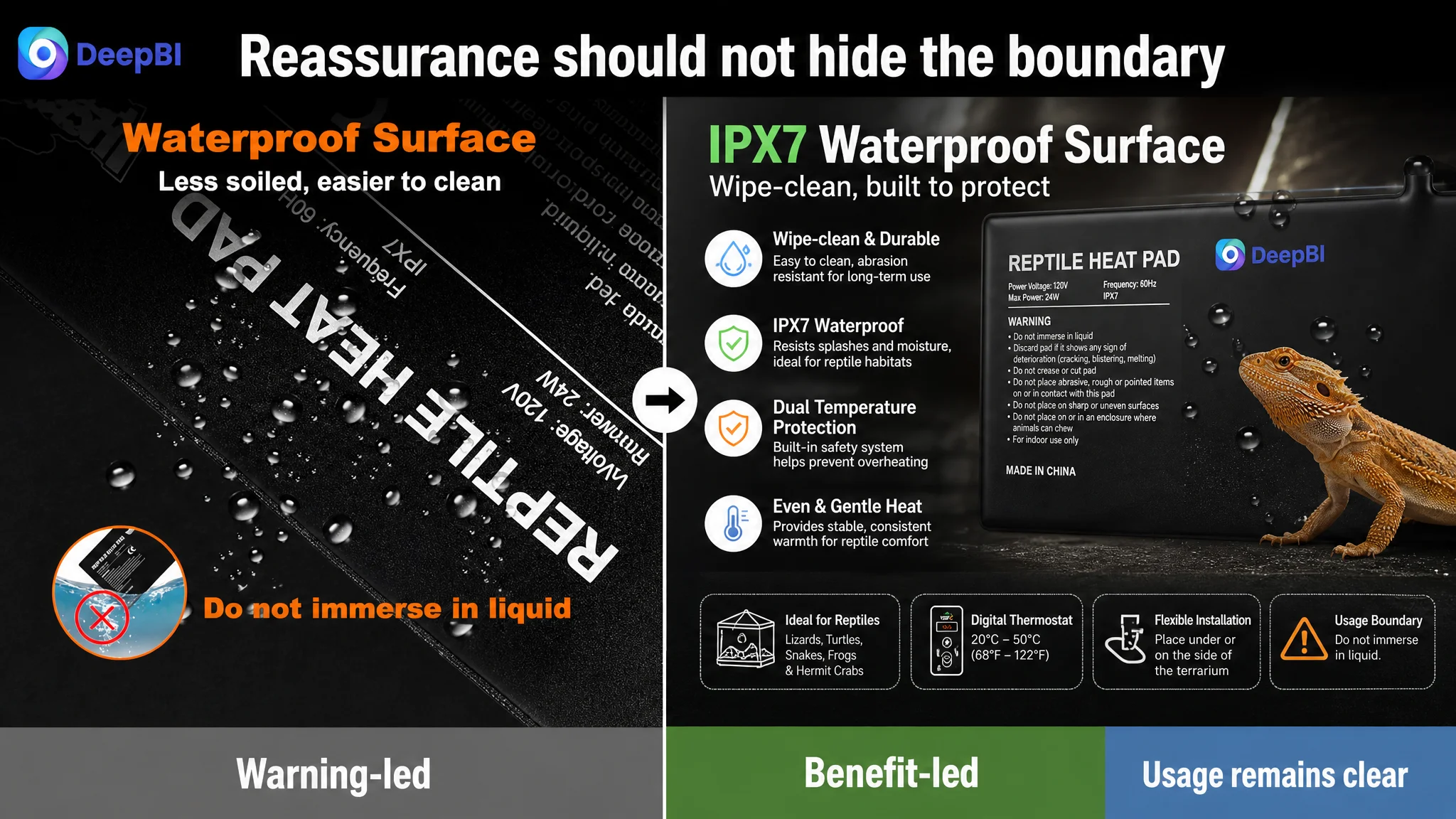
The fourth image: cleaning and durability
The waterproof PVC surface and IPX7 marking may be used only as supported by the existing product material. The message should focus on easy cleaning and long-term maintenance, while keeping usage limitations clear in an appropriate supporting context rather than making the main visual feel like a warning label.
The fifth image: even heat and pet suitability
The page should make even heat distribution more visible through a heatmap-style explanation or another supported technical visualization. The image can also show suitability for lizards, turtles, snakes, amphibians, and hermit crabs, provided the compatibility claim remains consistent with the product information.
The goal was not to add visual drama for its own sake. It was to ensure that each image answered a specific question in the buyer’s decision process.
A+ content needed to replace general reassurance with proof
The customer’s A+ content already covered several relevant themes, but the flow was too general. “Safe and reliable” is not strong enough when a category-leading comparison is using temperature displays, heat-distribution visuals, certification evidence, and species guidance.
The improved A+ direction centered on seven questions:
Can I control the temperature?
Show the thermostat clearly and state the supported temperature range.
Will the heat be distributed consistently?
Use a visual explanation of even heating. Avoid presenting unsupported laboratory comparisons or invented performance data.
What protects my pet from unsafe temperature changes?
Use the confirmed dual temperature protection system. Do not add separate automatic shutoff or overheat-protection claims without evidence.
Will installation be difficult?
Show the installation sequence, connector, cable structure, and flexible form. Focus on a strong and even bond without naming an unverified adhesive.
Can I keep the terrarium environment clean?
Explain the waterproof PVC surface, easy wiping, and maintenance benefits while presenting use limitations accurately.
Does this product appear professionally made for reptiles?
Reduce unrelated application expansion at the trust stage. Lead with reptile and terrarium competence rather than broad claims about plants or unrelated uses.
Is it suitable for my animal?
Provide clear examples of reptiles and amphibians, and connect the PID thermostat to different temperature requirements without presenting species-specific temperature values that were not supplied.
This approach made the A+ page less like a catalogue of modules and more like a controlled response to buyer anxiety.
What changed in the operating understanding
The supplied case material does not include post-optimization CTR, CVR, ACOS, TACOS, ranking, or organic-order data. It would therefore be misleading to claim a numerical business outcome.
What can be established is the change in operating logic.
Before the diagnosis, the customer was inclined to treat the Listing as a collection of editable assets: title, bullets, images, and specifications. After the comparison, the page was understood as a conversion system with a clear bottleneck.
The customer’s Listing did not simply need more traffic. It needed to become more capable of receiving traffic.
That changed the order of decisions:
- Do not treat a high-effort ad problem as an ad problem automatically.
- Do not assume a lower-performing title is the largest conversion constraint.
- Do not confuse a large amount of product information with strong persuasion.
- Do not use visual polish to replace missing proof.
- Do not introduce certifications, technical tests, adhesive brands, or safety functions that are not verified.
- Do not scale traffic aggressively before checking whether the product page resolves the buyer’s central concerns.
The practical question is not “How do we send more shoppers to this page?” It is “What will those shoppers believe when they arrive?”
For this Amazon reptile heating pad Listing, the answer had to become clearer: the product offers controllable warmth, even heating, practical installation, maintainable materials, and a defined use case for reptile owners. The page needed to communicate those points in the same order that buyers evaluate risk.
That is the deeper lesson for Amazon sellers. Advertising efficiency is often discussed as if it begins inside the campaign manager. In reality, it can begin much earlier—on the main image, in the title, inside the bullet-point sequence, in the A+ evidence, and in the credibility created by customer reviews.
Before Amazon ads can work harder, the Listing must be ready to convert the attention they buy.