


1. Introduction
For Amazon sellers operating in both the US and Canadian marketplaces while managing multiple ASINs, choosing an AI advertising tool involves more than comparing features and prices. The factors that truly influence renewal decisions are whether the trial scope is controllable, whether advertising results can be attributed, whether fees match expectations, and whether incremental improvements can be converted into verifiable profit growth.
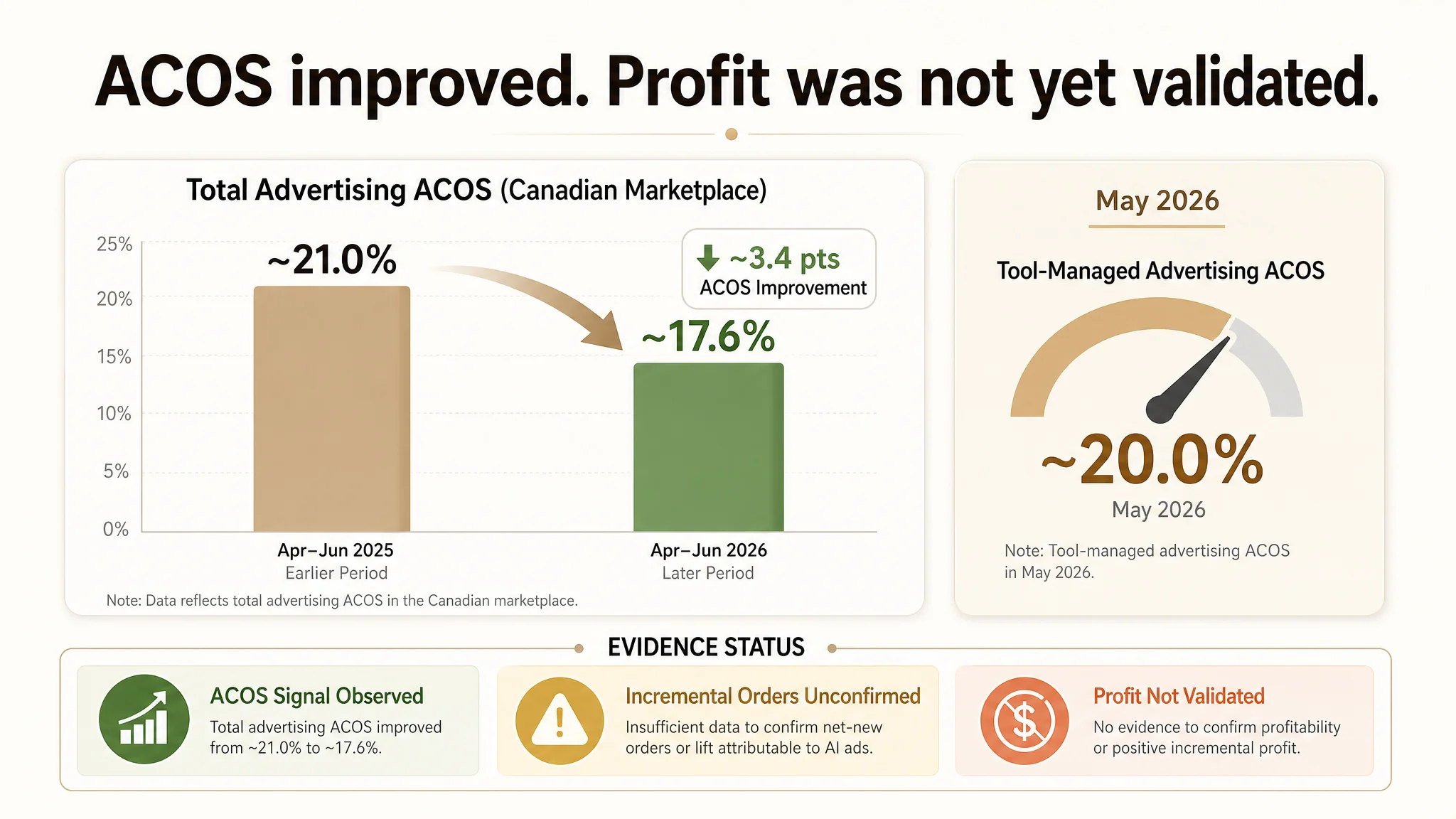
This article reviews the case of a seller managing approximately 35 ASINs across the US and Canadian marketplaces. During the trial, total advertising ACOS in the Canadian marketplace decreased from approximately 21.0% to 17.6%. Some review data also showed a decline in TACoS and an increase in the share of organic sales. However, because historical data had gaps and legacy advertising campaigns performed more steadily, the available evidence could not prove that AI advertising generated net-new orders or profit growth. Ultimately, the customer canceled authorization and paused renewal because of discrepancies between expectations and actual charges for multi-market usage, as well as the relatively high tool cost compared with the budget for a single marketplace.
This outcome does not mean that advertising tool trials have no value. Rather, it shows that the ROI of Amazon advertising tools must be defined before a trial begins, and that fees, authorization, data, and results validation must all be incorporated into the decision-making design.
2. Customer Background
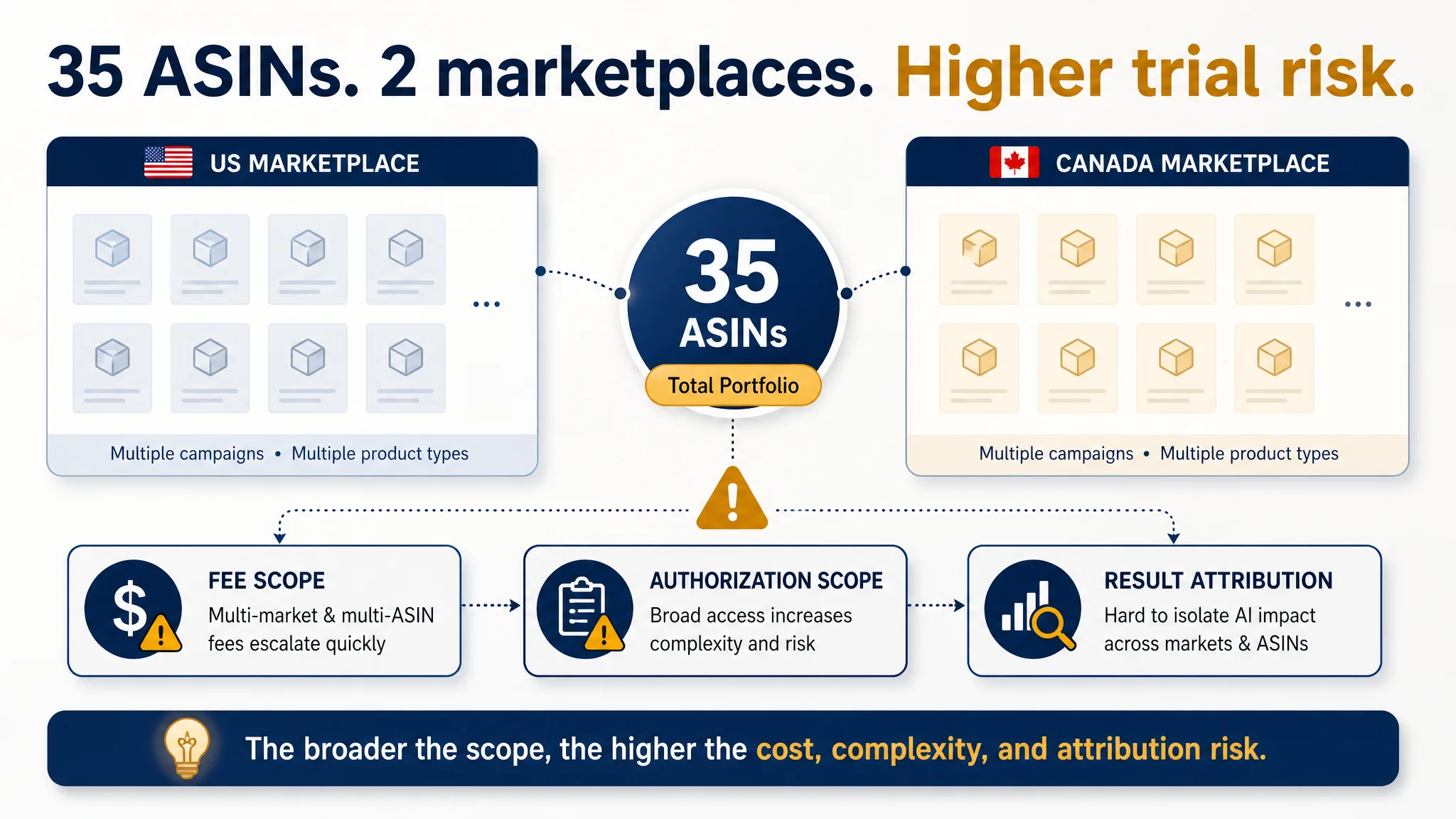
The customer was an Amazon seller operating in the US and Canadian marketplaces and managing approximately 35 ASINs. Because the business involved multiple marketplaces and a relatively large number of products, advertising management included not only daily bidding and budget adjustments, but also advertising structures, target ACOS, Listing status, and changes in organic sales across marketplaces.
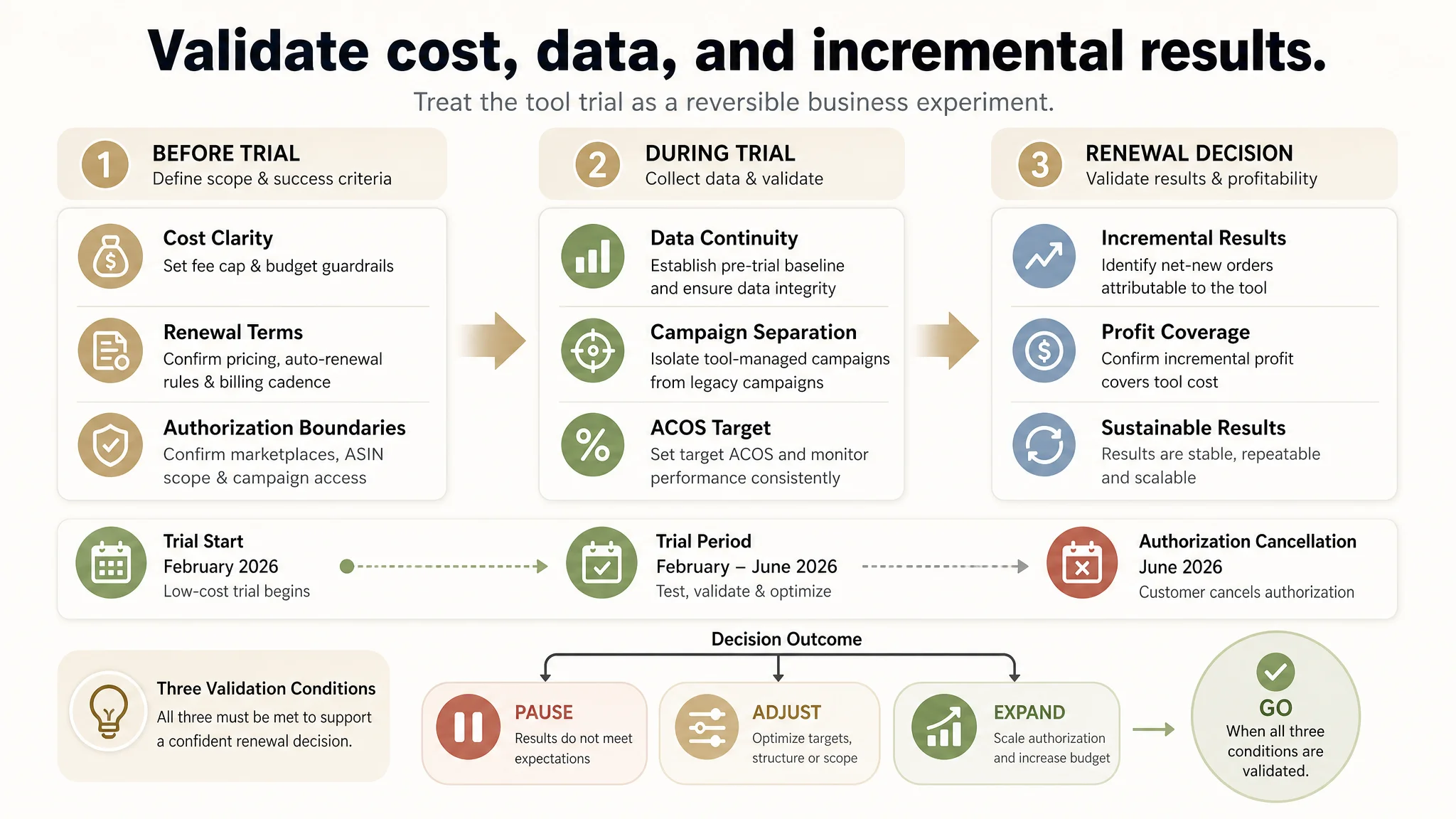
The customer began a low-cost trial of an advertising optimization tool in February 2026. The core objective was not simply to reduce advertising ACOS, but to verify whether AI PPC could generate attributable and profitable incremental growth at a controllable cost. In other words, the customer needed to answer three business questions:
- Did AI advertising truly generate new orders?
- Did sales generated by AI advertising merely replace orders that would have come from existing advertising or organic traffic?
- After the target ACOS was adjusted, could the overall business achieve profitability?
These objectives placed higher demands on the trial design. Observing only one advertising metric could not address all the decision-making risks involved in operating across multiple marketplaces and ASINs.
3. The Problem
3.1 A Trial Is Not as Simple as “Activate It and Monitor ACOS”
When choosing an Amazon advertising tool, many sellers first focus on automation capabilities, AI optimization capabilities, and trial pricing. However, once actual use begins, the questions often become: Which advertising campaigns does the tool manage? Which marketplace does it cover? How are fees calculated? Does the subscription renew automatically after the trial? If multiple marketplaces are authorized, how is the final bill calculated?
For a seller managing approximately 35 ASINs, if the marketplace, ASIN, and advertising campaign scope are not defined in advance, trial costs can quickly approach the cost of a formal purchase. At that point, even if advertising data shows a temporary improvement, it becomes difficult for the seller to determine whether the improvement is sufficient to cover the tool cost.
3.2 ACOS Declined, but It Could Not Directly Answer “Is Renewal Worth It?”
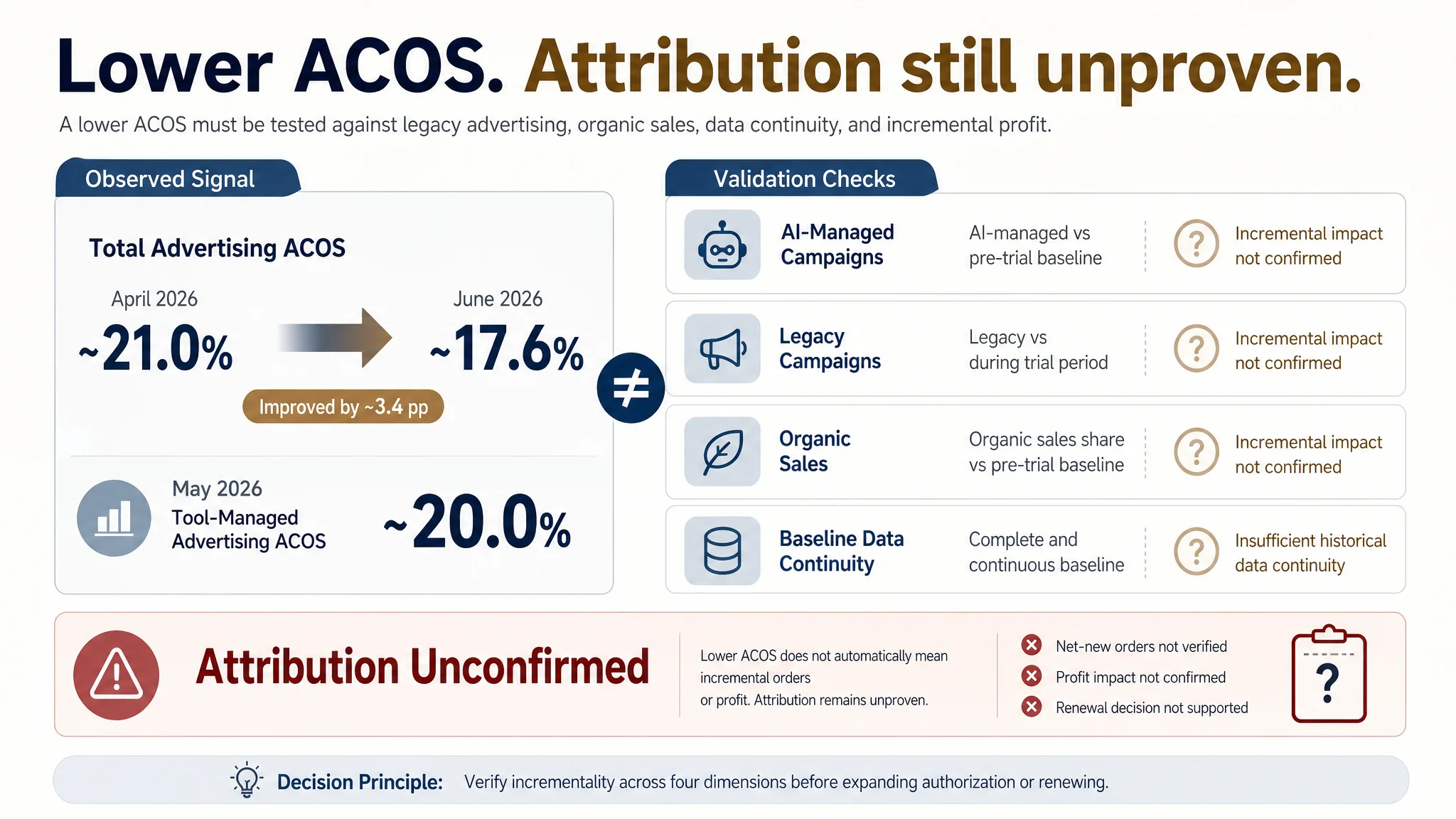
The customer’s Canadian marketplace showed temporary improvement: total advertising ACOS declined from approximately 21.0% to 17.6%, while the ACOS of tool-managed advertising in May was approximately 20.0%. Some review data also showed a decline in TACoS, an increase in the share of organic sales, and improved AI advertising ACOS.
However, a decline in ACOS does not automatically equal incremental profit. Possible reasons include:
- The original advertising campaigns were already performing relatively steadily;
- AI advertising may have captured orders that would originally have been generated by legacy advertising campaigns;
- Changes in the share of organic sales may have been influenced by the Listing, seasonality, pricing, or other operational factors;
- Historical data had gaps, with no complete pre-trial baseline;
- There was insufficiently clear comparison data between AI advertising and non-AI advertising.
Therefore, the customer was not concerned only with whether ACOS had declined as an isolated result. The real questions were whether sales generated by the tool were incremental and whether the increment was sufficient to cover advertising fees and tool costs.
3.3 A Discrepancy Emerged Between Fee Expectations and Actual Charges
During subsequent communications, the customer found a discrepancy between expectations for multi-market renewal fees and the actual charges, which raised concerns about billing transparency and consistency between the fee commitments and the amounts charged. At the same time, the tool cost was relatively high compared with the advertising budget for a single marketplace, prompting the customer to further assess whether the tool cost remained reasonable if used in only one marketplace and whether fees would exceed expectations when managing multiple marketplaces simultaneously.
This shows that the pricing of Amazon advertising automation tools is not merely a post-purchase financial issue. It is a business condition that must be confirmed before the trial begins. If the price cap, renewal terms, charging scope, and authorization relationship are not clearly documented, subsequent discussions about performance can easily be disrupted by billing disputes.
4. How DeepBI Diagnosed
The focus of this trial diagnosis was not to treat the decline in ACOS as a direct success conclusion, but to place advertising performance, Listing status, organic sales, and trial conditions within the same validation chain.
1. First, the multi-marketplace and ASIN scope was reviewed to confirm which products and advertising campaigns were covered in the US and Canadian marketplaces respectively, avoiding the mixing of results from different marketplaces and ASINs.
2. Next, the advertising structure and management scope were reviewed. Tool-managed advertising campaigns, legacy advertising campaigns, and campaigns not included in management during the same period were distinguished to determine whether there were suitable comparison subjects.
3. Changes in ACOS, TACoS, advertising sales, and the share of organic sales were then reviewed. It was not sufficient to compare ACOS before and after the trial; it was also necessary to observe whether changes in advertising sales were accompanied by improvements in overall sales and whether changes in organic sales could have resulted from other factors.
4. The adjustment process for the target ACOS was also examined. Changes in the target ACOS can affect budget allocation, bidding, and advertising coverage. If the target changed, the data before and after the adjustment needed to be interpreted separately.
5. A Listing health diagnosis was then conducted, including analysis of the main image, detail page, and the impact of negative reviews, to determine whether conversion issues originated from advertising traffic or from the product page’s ability to convert that traffic.
6. Finally, data completeness and fee conditions were checked to confirm whether historical data was continuous, whether advertising attribution standards were consistent, and whether the charging scope during the trial and renewal periods was clearly defined.
This process revealed that an advertising tool trial must answer at least two categories of questions simultaneously. The first is: “Did the advertising metrics change?” The second is: “Are the changes attributable, profitable, and sustainable?” Without evidence for the second category, the data in the first category can only serve as signals requiring further validation.
5. The Real Problem
Problem 1: The Trial Scope Was Too Broad, Making Both Costs and Results Difficult to Control
Cause: The customer operated in both the US and Canadian marketplaces and managed approximately 35 ASINs. Once multiple marketplaces and products entered the trial simultaneously, fee calculation, authorization scope, and performance segmentation all became more complex.
Impact: When the tool fee was relatively high compared with the advertising budget for a single marketplace, even a temporary improvement in ACOS in one marketplace was insufficient to determine whether the overall ROI was viable. Performance across different marketplaces could also mask one another, making it difficult for the seller to identify which marketplace and which ASINs were truly creating value.
Evidence: The customer later raised concerns about the discrepancy between expected and actual multi-market renewal fees, considered the tool cost relatively high compared with the advertising budget for a single marketplace, and ultimately canceled authorization and paused tool-managed advertising.
Problem 2: ACOS Improved, but Complete Evidence of Incremental Attribution Was Missing
Cause: Historical data had gaps, legacy advertising campaigns performed more steadily during the same period, and there was insufficient comparison design between AI advertising and the original advertising campaigns.
Impact: The decline in total advertising ACOS from approximately 21.0% to 17.6% could only indicate a temporary change in advertising efficiency. It could not directly prove that AI advertising generated net-new orders, much less that it generated additional profit for the customer.
Evidence: The ACOS of tool-managed advertising was approximately 20.0% in May. Some review data showed a decline in TACoS, an increase in the share of organic sales, and improved AI advertising ACOS. However, the available materials could not prove that all growth came from AI advertising, nor could they rule out advertising substitution, fluctuations in organic traffic, or contributions from legacy advertising campaigns.
Problem 3: Fee Conditions Were Not Integrated into a Unified Decision Standard for the Trial
Cause: The customer was concerned not only with tool performance, but also with multi-marketplace billing, renewal fees, actual charges, and authorization scope. If these conditions were not converted into a clear price cap and confirmed in writing before the trial, changes in fee expectations could affect the interpretation of the trial results.
Impact: Even if advertising data improved, the customer could still become less willing to renew because future costs were difficult to predict. When performance, cost, and profit cannot be compared in the same framework, it becomes difficult to determine whether the tool is worth using over the long term.
Evidence: Because of the discrepancy between expected and actual multi-market renewal fees, the customer raised concerns about billing transparency and consistency in fee commitments. In June 2026, the customer canceled authorization, paused tool-managed advertising, and decided not to renew.
6. Optimization Plan
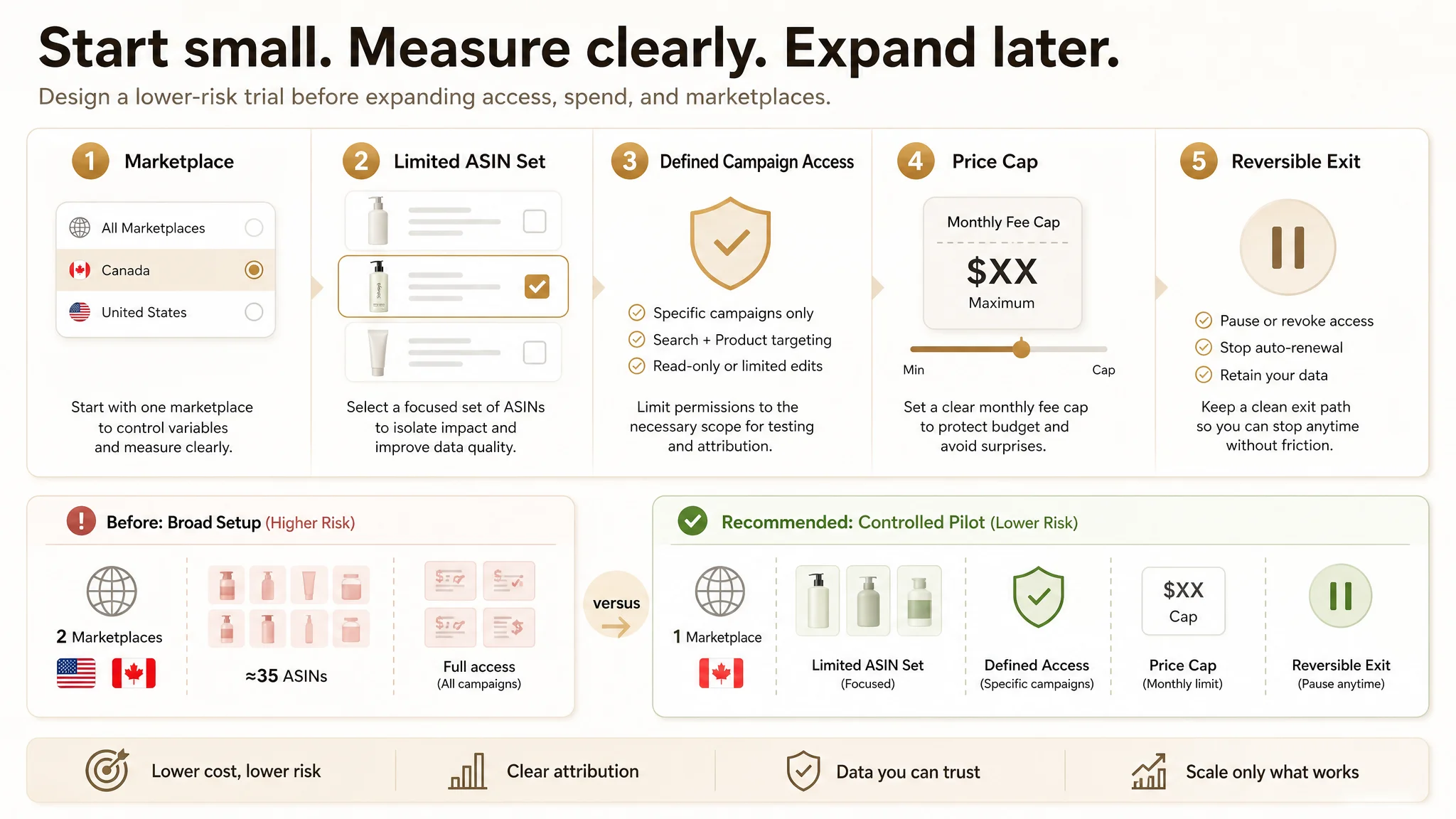
6.1 Start with a Single Marketplace and a Limited Number of ASINs
For sellers operating across multiple marketplaces, it is not advisable to open all marketplaces and all ASINs at the outset. A more prudent approach is to select one marketplace and then choose a representative group of ASINs and advertising campaigns for testing.
Starting in a single marketplace reduces three types of interference: first, the fee scope is easier to confirm; second, advertising results are easier to segment; and third, authorization suspension and budget control are more straightforward if problems arise. Only after data standards and ROI have been validated in the first phase should expansion to other marketplaces be considered.
6.2 Define Authorization Boundaries Before the Trial
The trial agreement or confirmation checklist should clearly specify:
- Which marketplaces may be connected;
- Which ASINs are included in management;
- Which advertising campaigns may be adjusted;
- Whether legacy advertising campaigns are included;
- Who may modify budgets, bids, and the target ACOS;
- How to suspend authorization and stop advertising management.
The clearer the authorization boundaries, the easier it is to distinguish the contributions of tool actions, manual actions, and original advertising campaigns.
6.3 Set a Price Cap and Renewal Conditions
Evaluating an Amazon advertising tool trial should not focus only on the trial price. Formal pricing should also be confirmed in advance. At a minimum, the following should be clarified:
1. Whether fees are calculated by marketplace, ASIN, advertising budget, or another dimension.
2. Whether charges are combined when multiple marketplaces are used simultaneously.
3. Whether the subscription renews automatically after the trial ends.
4. Whether reconfirmation is required before renewal.
5. Whether there is a cap on the actual amount charged.
6. When advertising management and fees stop after authorization is canceled.
For sellers with smaller budgets or those just beginning to validate AI PPC, a single-marketplace, short-term, low-monthly-fee, or phased billing approach is generally easier to control than opening multiple marketplaces at once.
6.4 Define the Target ACOS and Profit Standards in Advance
The target ACOS should not be set independently of product gross margin, advertising budget, and tool costs. Before the trial, it should be determined whether the target ACOS is intended to control advertising efficiency or serve as a renewal decision criterion; whether promotional expenses, platform fees, and tool costs should be deducted from advertising sales; and whether the ultimate focus is advertising profit, overall profit, or incremental profit.
If the only objective is to “reduce ACOS,” advertising efficiency may improve without increasing total sales, or advertising spend may decline at the expense of sales volume.
6.5 Validate Results Using Before/After Analysis and a Control Group
Before the trial officially begins, baseline data should be saved, including advertising sales, advertising spend, ACOS, TACoS, the share of organic sales, and overall sales. During the trial, tool-managed advertising, legacy advertising campaigns, and subjects not included in the test should continue to be distinguished.
During the results validation phase, DeepBI can help organize data changes across different advertising campaigns and marketplaces. However, data organization itself does not constitute causal proof. Only when the standards before and after the trial are consistent, the data is continuous, and a reasonable comparison exists can the question “Did the tool generate incremental growth?” be answered with greater confidence.
7. Results
This trial produced temporary changes in the data, but it did not yet generate complete evidence of success sufficient to support long-term renewal.
In the Canadian marketplace, total advertising ACOS declined from approximately 21.0% to 17.6% between April and June 2026. In May 2026, the ACOS of tool-managed advertising was approximately 20.0%. Some review data also showed a decline in TACoS, an increase in the share of organic sales, and improved AI advertising ACOS.
However, these data points need to be understood in light of the following limitations:
- Historical data had gaps;
- Legacy advertising campaigns performed more steadily during the same period;
- It could not be proven that all growth came from AI advertising;
- Net-new orders generated by AI advertising could not be confirmed;
- It could not be confirmed that the temporary changes were sufficient to cover the tool cost and generate profit.
Therefore, the results of this case should not be described as “AI advertising generated clear growth.” A more accurate conclusion is that signals of improvement appeared in ACOS and certain overall business metrics during the trial, but the incremental orders, profit, and long-term sustainability had not yet been validated. Ultimately, because of the discrepancy between expected and actual charges and the relatively high tool cost compared with the budget for a single marketplace, the customer canceled authorization and decided not to renew in June 2026.
This also shows that evaluating the ROI of Amazon advertising tools cannot rely on a single set of improved figures. Three outcomes must be considered together: whether advertising efficiency improved, whether overall profit increased, and whether the improvement was sufficient to cover the tool cost.
8. Case Summary
What this case truly exposed was not whether the advertising tool had sufficient features, but whether the trial decision lacked a complete validation mechanism covering costs, authorization, and incremental results.
First, when multiple marketplaces and ASINs are managed simultaneously, a broader trial scope makes both costs and attribution more complex. A single marketplace, a limited number of ASINs, and clear authorization are the starting points for reducing trial risk.
Second, a decline in ACOS from approximately 21.0% to 17.6% only indicates a temporary change in advertising efficiency. It does not automatically equal new orders or profit. Comparisons between advertising campaigns, segmentation of organic sales, and continuous historical data are equally important.
Third, fee transparency directly affects performance evaluation. If multi-marketplace billing, renewal conditions, and actual charges are not confirmed in advance, even improved advertising data may not be enough to establish long-term trust.
A more suitable trial approach for this type of customer is to start with a single marketplace, a short trial period, and low costs, supported by a clear price cap, renewal conditions, authorization boundaries, and before/after incremental analysis. Only when all these conditions are satisfied can temporary performance improvements be converted into an actionable purchasing decision.
9. Key Takeaways for Sellers
Takeaway 1: Define What Makes a Trial “Worthwhile” Before Starting It
Do not use “a decline in ACOS” as the only success criterion. Before starting, clarify whether the tool is intended to improve advertising efficiency, generate incremental sales, improve profit, or reduce operational labor, and set corresponding metrics for each objective.
Takeaway 2: Prioritize Verifiability When Choosing an Amazon PPC Tool
More features do not necessarily mean a better fit. Sellers should focus on whether data is continuous, whether advertising campaigns can be segmented, whether activity records are clear, and whether the contributions of tool-managed advertising and original advertising can be distinguished. Improvements that cannot be attributed are difficult to use as a basis for renewal decisions.
Takeaway 3: Include Fees, Authorization, and Exit Mechanisms in the Trial Plan
Before using an Amazon advertising automation tool, confirm the number of marketplaces, ASIN scope, fee cap, charging schedule, renewal rules, and authorization cancellation process. Sellers operating across multiple marketplaces are especially well suited to starting with a single marketplace and expanding only after costs and results have been validated.
Takeaway 4: Evaluate Both Advertising and Overall Business Performance
Advertising ACOS, TACoS, the share of organic sales, conversion rate, and profit should be reviewed together. Whether the issue lies with advertising or the Listing cannot be determined by looking only at the advertising dashboard. If traffic increases but the page cannot convert it effectively, simply increasing ad spend may only increase costs.
Takeaway 5: Treat the Trial as a Reversible Business Experiment
A low-risk trial should not require sellers to immediately open all marketplaces and advertising permissions. Instead, it should allow hypotheses to be validated within a clearly defined period. Only when data standards, fee conditions, and incremental results all meet expectations is it appropriate to expand authorization or enter into a long-term partnership.