

Introduction
When Amazon advertising data remains at 0 for an extended period, many sellers’ first reactions are: Are the ads not running? Has the system failed? Or has ad optimization been ineffective? However, for low-activity stores, 0 data may correspond to multiple operating conditions, including an actual store suspension, changes in authorization, data synchronization issues, products no longer being sold, insufficient inventory, or advertising campaigns being stopped altogether. A US marketplace seller managing multiple stores and approximately 60 ASINs previously achieved lower ACOS through intelligent advertising campaigns than through the seller’s existing campaigns. However, the system’s operating data remained at 0 from 2026年1月至7月. The key point of this case is not to prove that advertising failed, but to show that before evaluating campaign performance, sellers must first complete a layered diagnosis of the account, products, inventory, advertising, and data pipeline.
Customer Background
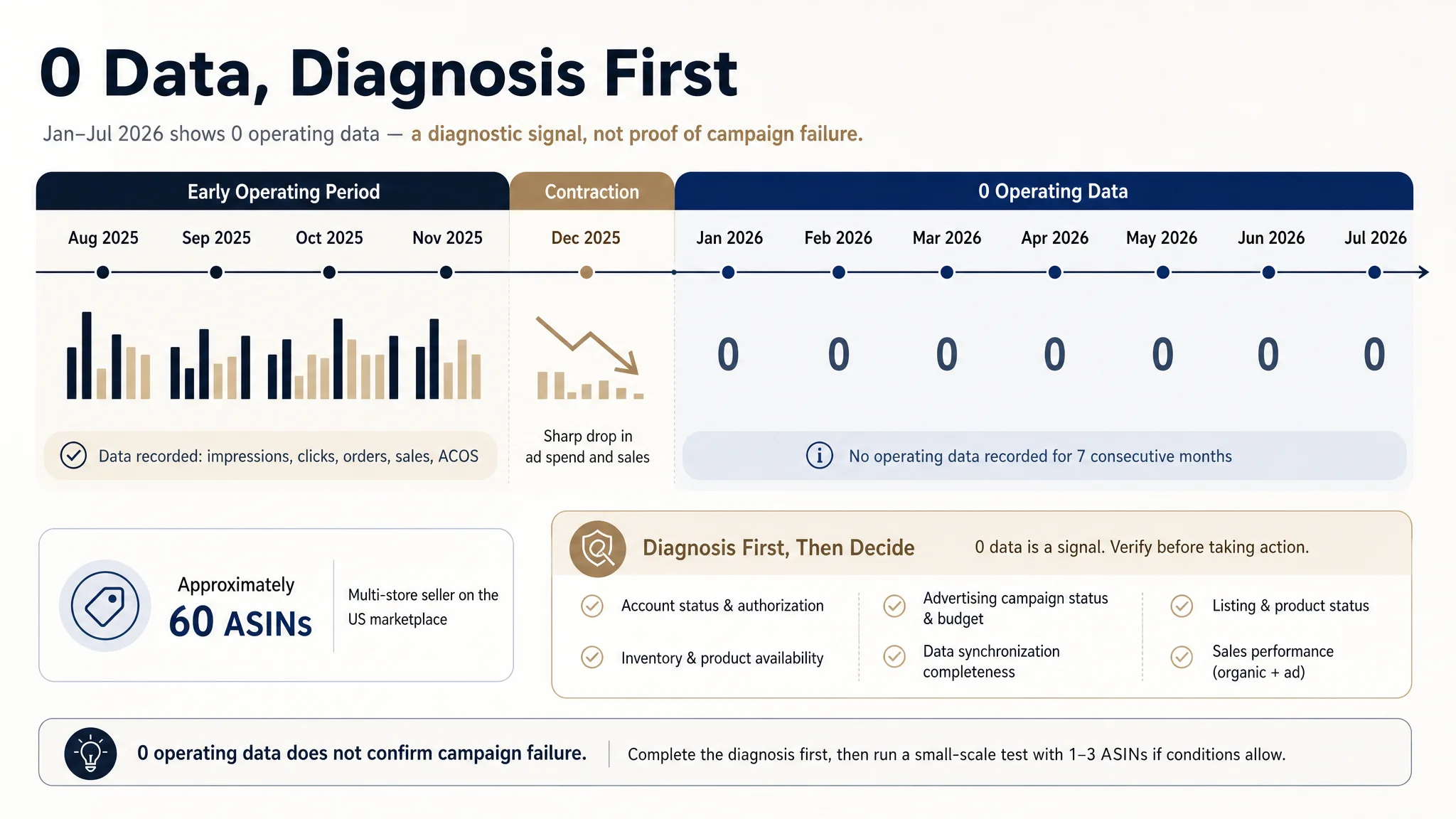
The customer is an e-commerce seller operating multiple stores on the US marketplace and managing approximately 60 ASINs. The customer registered with an ad optimization system in 2025年8月. The early operating objective was clear: reduce ACOS and improve advertising efficiency through intelligent advertising campaigns while reducing the pressure of manually adjusting campaigns.
From 2025年8月至11月, the ACOS of the intelligent advertising campaigns remained lower than that of the existing advertising campaigns:
- 2025年8月: ACOS for the intelligent advertising campaigns was 31.4%, compared with 49.8% for the existing advertising campaigns;
- 2025年9月: ACOS for the intelligent advertising campaigns was 32.3%, compared with 43.0% for the existing advertising campaigns;
- 2025年10月: ACOS for the intelligent advertising campaigns was 26.5%, compared with 42.1% for the existing advertising campaigns;
- 2025年11月: ACOS for the intelligent advertising campaigns was 26.8%, compared with 37.5% for the existing advertising campaigns.
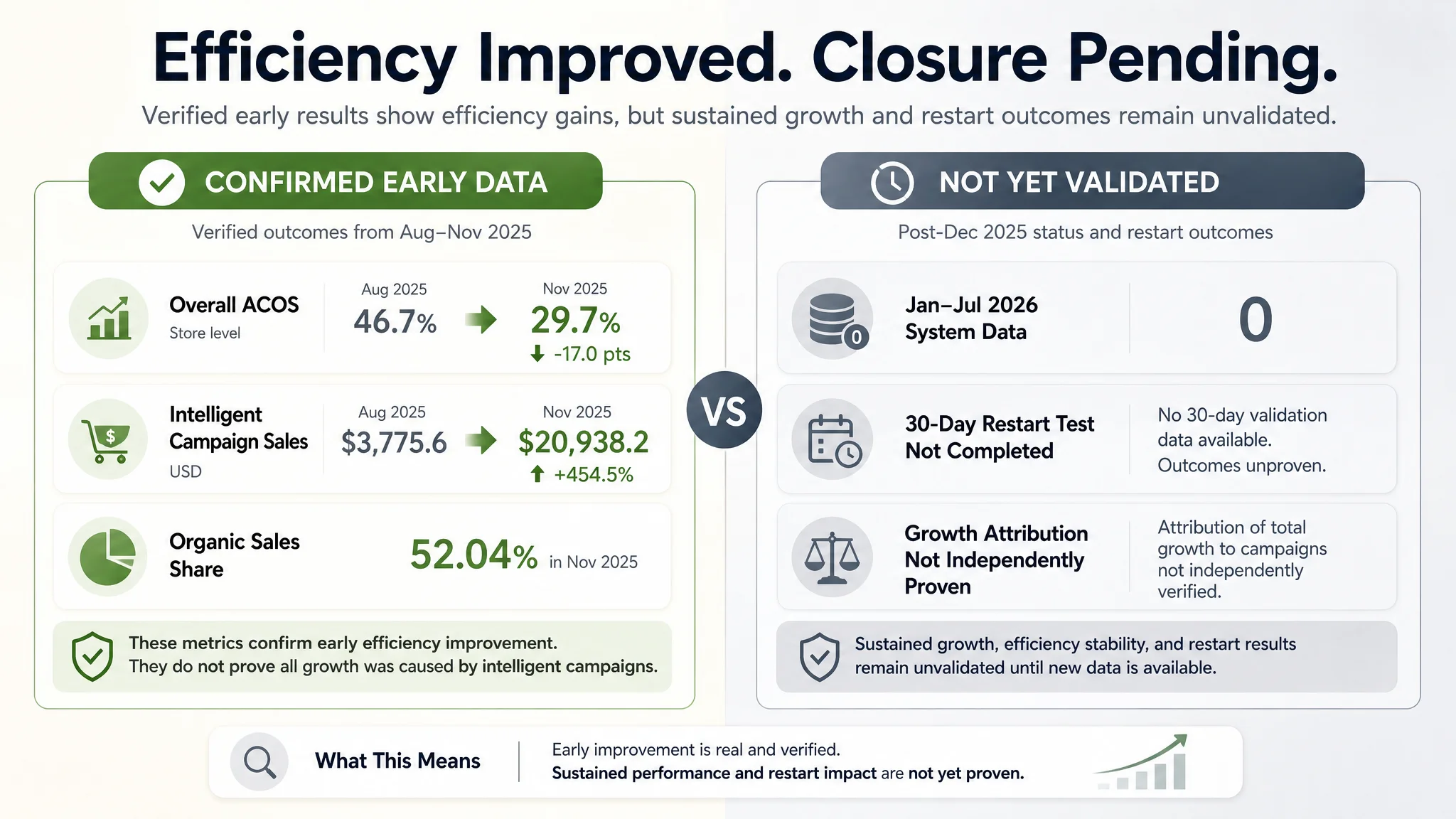
During the same period, sales generated by the intelligent advertising campaigns increased from 3775.6美元 to 20938.2美元. The store’s overall ACOS improved from 46.7% to 29.7%, total sales reached 59643.9美元 in November, and the share of organic sales reached 52.04%.
These figures indicate a clear improvement in efficiency during the early advertising period. However, they only reflect advertising and sales performance during a specific period. They cannot independently prove that all growth was caused by the intelligent advertising campaigns, nor can they directly imply that the store would continue to grow.
The Problem
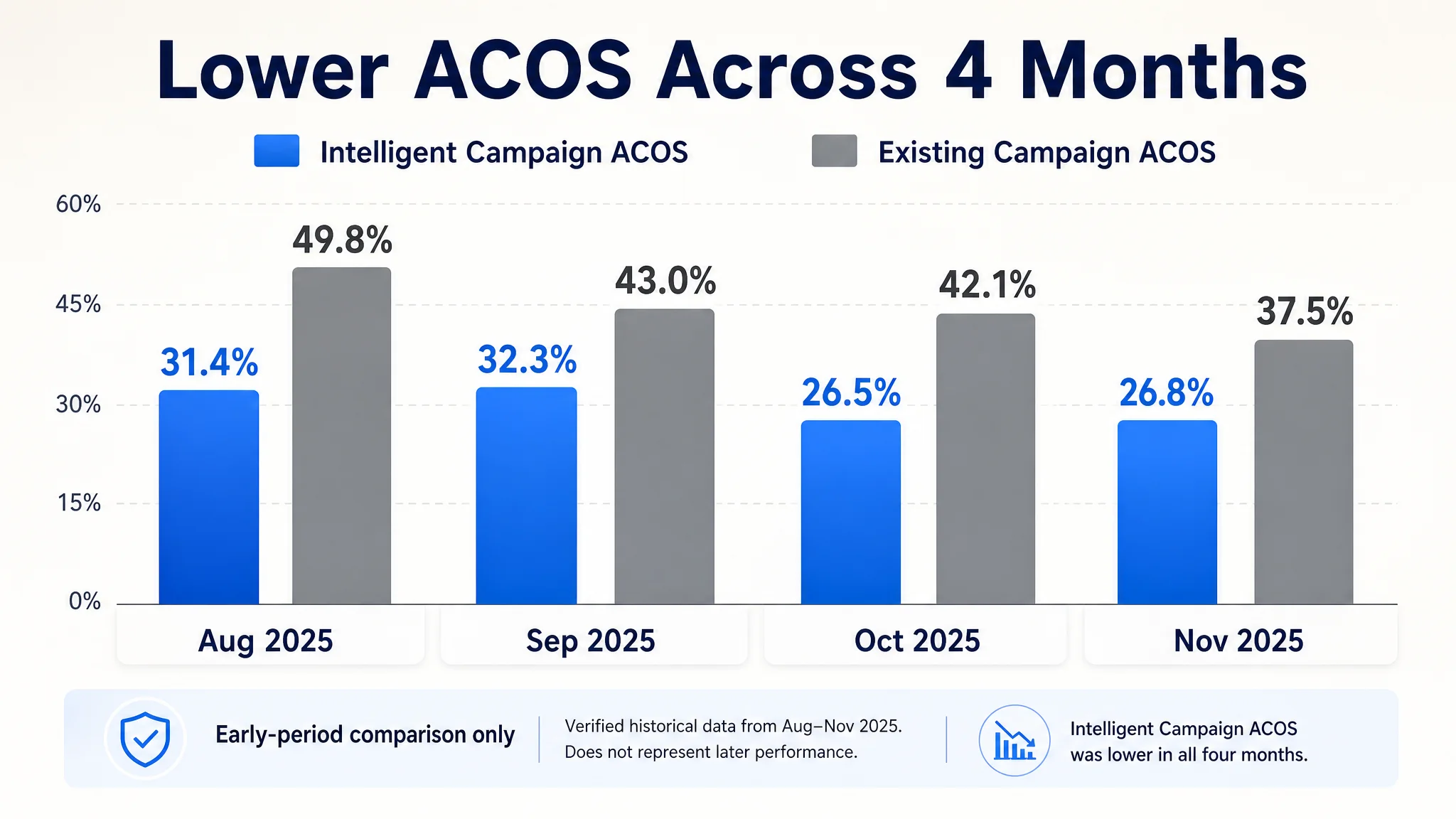
The abnormality requiring diagnosis actually emerged after 2025年12月.
Starting in 2025年12月, advertising and sales contracted significantly. From 2026年1月至7月, the system’s operating data remained at 0. For a multi-store seller managing approximately 60 ASINs, several consecutive months without advertising, sales, or related operating data cannot simply be attributed to “advertising campaign failure.”
This is because “advertising data is 0” and “advertising performance is 0” are not the same problem.
If advertising is actually running but clicks, orders, and sales are all 0, the issue may involve product competitiveness, Listing conversion, keyword coverage, or inventory status. If the advertising campaigns are not running at all, the problem may lie in the budget, campaign status, or operational arrangements. If the Amazon Seller Central backend still contains operating records but the system displays 0, authorization and data synchronization should be checked first.
During subsequent communication, the customer also focused on several specific questions:
- Whether the ACOS target was still applicable to the store’s current status;
- Whether the advertising budget was being consumed too quickly;
- Whether the intelligent advertising campaigns were more effective than manual campaigns;
- Whether the budget should be reduced when inventory for an individual product was close to running out, to prevent the advertising pace from becoming misaligned with inventory.
These concerns show that 0 data is not a single advertising problem, but a diagnostic issue that must be investigated beginning with the store’s operating status. Especially when a seller is simultaneously managing multiple stores, changing inventory levels, and allocating resources for renewals, confirming that the account is still in a position to continue advertising is more important than immediately adjusting bids or increasing the budget.
How DeepBI Diagnosed
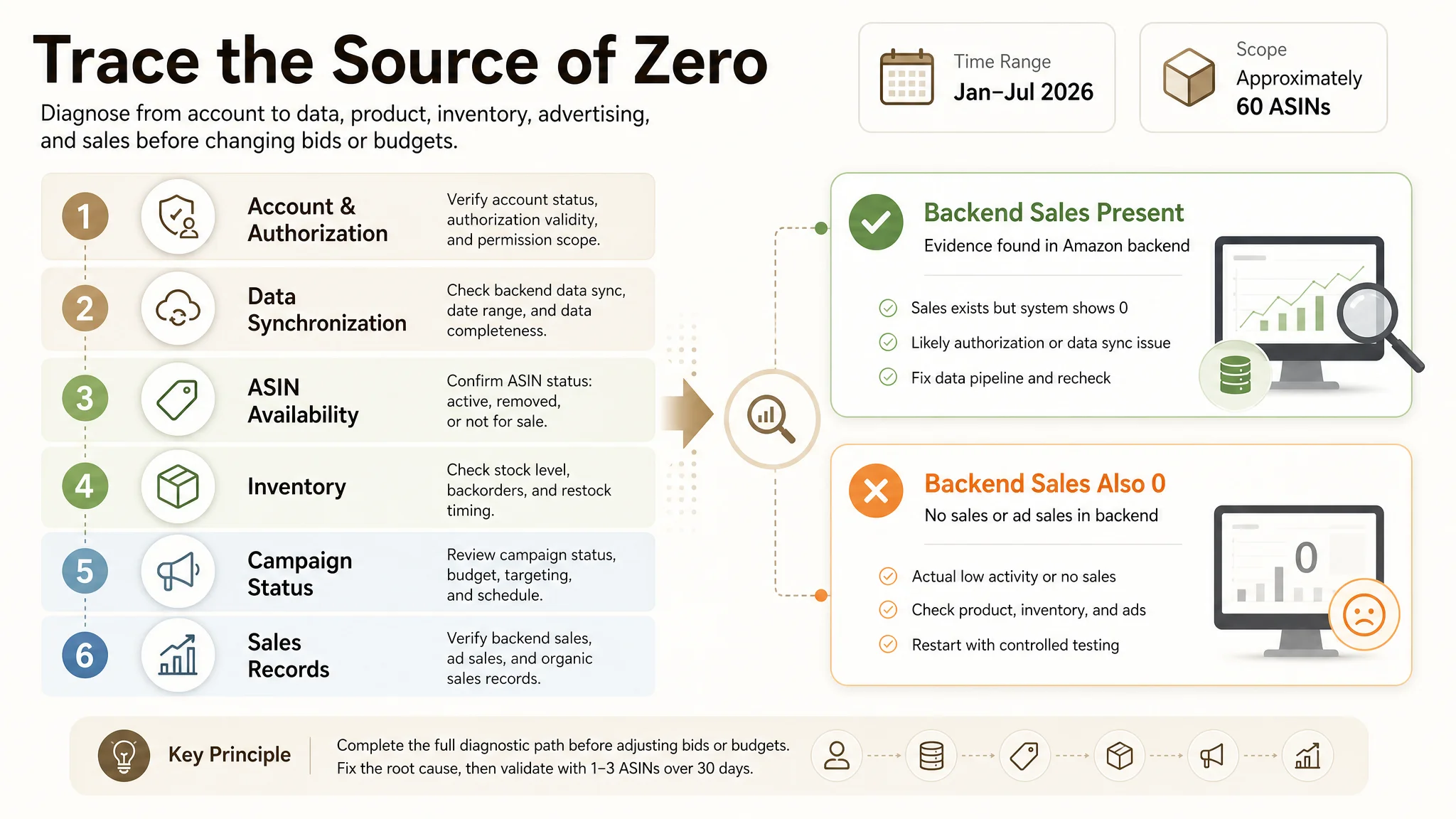
When faced with an account that had shown no data for an extended period, DeepBI did not directly define it as a closed store, nor did it interpret continuous 0 data as a failure of the advertising system. Instead, DeepBI broke the investigation down in the following order: “account—data—product—inventory—advertising—sales.”
Step 1: Confirm Account and Authorization Status
The first step is to confirm whether the account in the system still has valid authorization, whether the authorization scope has changed, and whether the system can still properly read data from Amazon’s backend.
For multi-store sellers, the fact that an account has been set up in the system or had advertising activity historically does not mean that its current authorization is still valid. If authorization has expired, permissions have changed, or account associations have been adjusted, the system may no longer be able to obtain new operating data.
Step 2: Verify Data Synchronization Completeness
After confirming the account status, the data synchronization pipeline must be checked, including whether advertising data, order data, sales data, and product data are all being updated.
If all data reaches 0 during the same period while the Amazon backend still contains sales or advertising records, data synchronization issues or authorization-related data access problems should be considered first. If only advertising data is 0 while order and sales data continue to change, the investigation should focus on advertising campaign status rather than the store’s entire data pipeline.
In this case, the system’s operating data remained at 0 from 2026年1月至7月. However, the available materials have not yet completed a cross-check of account authorization, data synchronization, and Amazon backend records. Therefore, it can currently only be confirmed that the system side has experienced a continuous absence of operating data; the specific cause cannot be confirmed based on this alone.
Step 3: Check Whether the ASINs Are Still Available for Sale
For a store managing approximately 60 ASINs, it is not enough to review only total store data. Individual ASINs must also be examined.
The following points need to be confirmed:
1. Whether the main ASINs are still active and available for sale;
2. Whether the Listing has been removed, restricted from sale, or lost the Buy Box;
3. Whether the products still have available inventory;
4. Whether variations, parent-child relationships, or product links have changed;
5. Whether ASINs with a historical conversion base still meet the requirements for continued advertising.
If the store has no products that can be purchased normally, it will be difficult to generate valid orders even if the advertising campaigns are enabled. Continuing to adjust keywords and bids at this point may only amplify ineffective operations.
Step 4: Check Inventory and Advertising Campaigns
Inventory is a variable that cannot be overlooked when diagnosing abnormal advertising data. The customer previously reported that inventory for an individual product was close to running out and asked whether the budget should be reduced. This means that the advertising budget cannot be managed separately from the inventory cycle.
The following items should be reviewed together:
- Current sellable inventory for each ASIN;
- The estimated period for which the inventory can support sales;
- Whether the advertising campaigns are enabled;
- Whether the daily budget is set to a valid amount;
- Whether the advertising campaigns have stopped because of budget, product, or policy-related reasons;
- Whether the ads are still receiving impressions, clicks, and orders.
If inventory is insufficient, reducing the budget may be a reasonable operational decision. If inventory is sufficient but the ads receive no impressions, the campaign status, keywords, and bids require further review. If the ads receive clicks but no orders, the issue may shift to the Listing or product conversion rather than whether advertising has started.
Step 5: Compare Sales Records to Distinguish “No Operations” from “No Data Collection”
Finally, system data must be compared with sales records in the Amazon backend. The key to diagnosis is not to reach a conclusion immediately after seeing “0,” but to determine at which layer the “0” occurred:
- If sales are also 0 in the Amazon backend, this may indicate actual low activity, suspended operations, or a lack of products available for sale;
- If the Amazon backend shows sales while the system shows 0, authorization and data synchronization should be checked closely;
- If sales are 0 but the ads have impressions, click-through rate, product relevance, and Listing conversion should be examined;
- If both advertising and sales are 0 but inventory and ASINs remain normal, the advertising campaigns and budget settings need to be checked.
Only after completing this cross-validation can the seller determine whether the issue belongs to the operating status, product status, inventory constraints, advertising campaigns, or the data collection pipeline.
The Real Problem
Based on the available materials, no single cause can currently be identified as the final conclusion. From a diagnostic perspective, however, the issues requiring verification can be divided into the following three categories.
Problem 1: The Account May Be in a Low-Activity or Suspended State
Cause: Advertising and sales contracted significantly starting in 2025年12月, while the system’s operating data remained at 0 from 2026年1月至7月. The customer’s subsequent needs also shifted from single-store advertising optimization to multi-store resource coordination and renewal cost control, suggesting that the store’s usage priority may have declined.
Impact: If the store has actually suspended operations, continuing to discuss ACOS targets, keyword bids, or budget expansion would misinterpret an operating-status issue as an advertising optimization issue. Advertising cannot restore growth through short-term adjustments without a sufficient sales foundation.
Evidence: The system’s operating data remained at 0 from 2026年1月至7月. However, the available materials have not completed verification of store suspension, authorization changes, or the absence of products available for sale. Therefore, the store can only be considered potentially low-activity or suspended; it cannot be directly defined as actually closed.
Problem 2: Product Availability and Inventory May Be Restricting Advertising
Cause: The customer previously expressed concern about inventory for individual products approaching insufficiency and asked how to reduce the budget to avoid misalignment between advertising pace and inventory. If the main ASINs have insufficient inventory, the Listing is unavailable, or the product status has changed, advertising may be unable to generate stable sales even if it continues running.
Impact: Continuing to increase the budget when inventory is insufficient may cause advertising-driven demand to exceed supply capacity. Continuing to optimize advertising when a product is unavailable will result in ineffective click and budget management efforts. For multi-store sellers, this may also lead to resources being invested in accounts that temporarily lack the conditions required for operations.
Evidence: The customer explicitly raised the need to control the budget when inventory was close to running out. However, complete details on ASIN inventory, availability status, and advertising campaigns are not currently available, so it cannot yet be confirmed that inventory was the direct cause of the continuous 0 data.
Problem 3: Authorization or Data Synchronization Issues Must Be Ruled Out
Cause: The system’s operating data remained at 0 from 2026年1月至7月, which may be related to authorization status, data access permissions, account associations, or synchronization completeness. In particular, when system data is inconsistent with actual records in the Amazon backend, the data pipeline must be checked before evaluating advertising performance.
Impact: If a data collection issue is mistaken for advertising failure, operators may incorrectly pause effective campaigns or continue adjusting the budget without access to accurate data. This makes it impossible to accurately assess ACOS or confirm the true changes in organic and advertising sales.
Evidence: The system continuously displayed operating data of 0 from 2026年1月至7月. There is currently insufficient evidence to confirm whether the Amazon backend also showed 0 during the same period, so authorization and data synchronization remain items requiring verification.
Optimization Plan
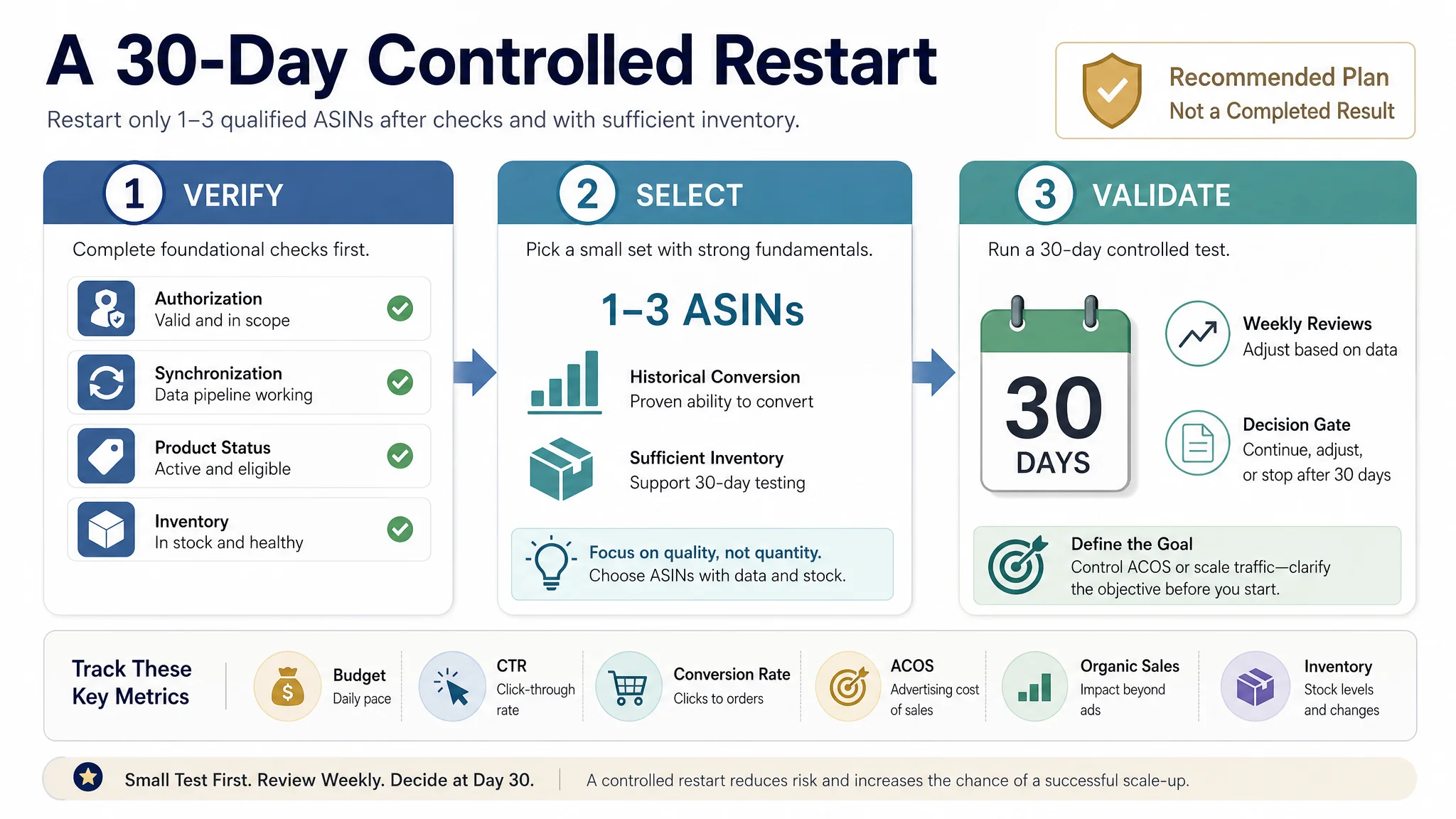
The low-activity store restart has not yet been completed in this case, and no post-restart performance results have been established. Therefore, the following plan is an execution path based on the diagnostic conclusions and should not be understood as a completed growth initiative.
1. Complete Account Status Verification First
DeepBI recommends first checking account authorization, data access permissions, and account associations to confirm whether the system can continuously obtain advertising, order, sales, and product data.
If authorization has expired or the data pipeline has been interrupted, data integrity should be restored before discussing advertising strategy. Only when data can be updated continuously do ACOS, conversion rate, and the share of organic sales have value for review.
2. Select ASINs That Meet the Requirements for Operations
It is not recommended to restart all approximately 60 ASINs at the outset. Instead, select 1 to 3 products that meet all of the following conditions:
- They remain in a normal active and available-for-sale status;
- They have enough inventory to support the testing period;
- They have a certain historical conversion base;
- Their Listing and product links can properly receive traffic;
- Their advertising campaigns can be enabled normally and generate data.
By narrowing the testing scope, the seller can avoid increasing the budget before the store status is confirmed and more easily distinguish advertising issues from product issues.
3. Conduct Small-Scale Advertising Validation Based on Operating Objectives
If the seller currently prioritizes profitability, an ACOS control target can be set. If the priority is to recover sales volume, a sales growth target can be set. However, the two objectives cannot be executed ambiguously at the same time; otherwise, it will be difficult to determine whether an increased budget generated valid orders.
During the test, the budget increase should be controlled to avoid unnecessary spending caused by insufficient inventory or incomplete data. For ASINs with inventory close to running out, the budget and advertising pace should be adjusted first rather than simply pursuing more impressions.
4. Check Listing and Organic Traffic Foundations Simultaneously
Once the ads begin receiving impressions and clicks again, the seller should further observe the Listing’s click-through rate, conversion rate, price, reviews, and content alignment. If there are clicks but no orders, the seller should not simply continue increasing the budget, but should determine whether a Listing conversion issue exists.
Organic traffic should also be observed separately. Improved advertising efficiency does not necessarily mean that organic traffic will increase. Sellers need to combine organic sales, the share of organic sales, and keyword performance for the main ASINs to determine whether advertising has generated more stable product demand rather than looking only at advertising orders.
5. Conduct a 30-Day Validation with Weekly Reviews
If the account, products, inventory, and data synchronization are all confirmed to be normal, a small-scale 30-day validation can be conducted. The following metrics should be reviewed weekly:
1. Advertising budget and actual spend;
2. Impressions, clicks, and click-through rate;
3. Conversion rate and order volume;
4. Advertising sales and ACOS;
5. Organic sales and the share of organic sales;
6. Inventory changes and order quality.
At this stage, DeepBI’s value is not to use a single metric to determine whether advertising has succeeded or failed, but to place advertising data, product status, inventory, and sales results within the same diagnostic framework and help sellers identify the layer where the issue occurred.
Results
This case requires a distinction between “historical data that has already occurred” and “restart results that have not yet been validated.”
Confirmed Early Operating Data
From 2025年8月至11月, the ACOS of the intelligent advertising campaigns was 31.4%, 32.3%, 26.5%, and 26.8%, respectively. During the same period, the ACOS of the existing advertising campaigns was 49.8%, 43.0%, 42.1%, and 37.5%, respectively. The ACOS of the intelligent advertising campaigns was lower than that of the existing advertising campaigns in all four months.
During the same period, sales generated by the intelligent advertising campaigns increased from 3775.6美元 to 20938.2美元, while the store’s overall ACOS improved from 46.7% to 29.7%. In 2025年11月, total store sales reached 59643.9美元 and the share of organic sales reached 52.04%.
These data demonstrate that advertising efficiency improved and sales growth occurred during the early period. However, they cannot independently prove that all growth was caused by the intelligent advertising campaigns, nor can they serve as the basis for assessing performance after a future store restart.
Performance Validation Has Not Yet Been Completed
Starting in 2025年12月, advertising and sales contracted significantly, while the system’s operating data remained at 0 from 2026年1月至7月. At this stage, the complete verification of account authorization, data synchronization, ASIN availability, inventory, and advertising campaigns has not been completed. Neither has the 30-day restart test for 1 to 3 ASINs been completed.
Therefore, it cannot currently be stated that “the store has been successfully restarted,” nor can it be claimed that DeepBI has generated subsequent growth. The most accurate current conclusion is that the early advertising period produced measurable efficiency improvements, while the store later entered a low-activity or suspended state. The causes and results of a restart have not yet entered a closed-loop validation process.
Case Summary
The actual issue this case needs to address is not “Why did ACOS suddenly increase?” nor “Why did the advertising system not automatically generate orders?” The first priority is to determine whether the store still has the foundation required for normal operations and advertising.
When Amazon advertising data remains at 0 for an extended period, sellers should first distinguish among three situations: the store is not actually operating, the products or inventory do not meet the conditions for sales, or the system has not fully collected the data. Advertising optimization only becomes meaningful after account authorization, data synchronization, ASIN availability, inventory, and advertising campaigns have all been confirmed to be normal.
Based on the available data, the customer’s intelligent advertising campaigns had lower ACOS than the existing advertising campaigns during the early period, and the store also experienced improvements in sales and the share of organic sales. However, the subsequent continuous 0 data shows that the early efficiency improvement cannot be directly extended into a conclusion of sustained growth. For low-activity stores, the more prudent approach is to complete the diagnosis first and then conduct a 30-day validation using a small number of ASINs with sufficient inventory and a historical conversion base.
Key Takeaways for Sellers
Takeaway 1: Advertising Data at 0 Does Not Equal Advertising Failure
When Amazon advertising data is 0, do not immediately adjust bids or change the advertising strategy. First check whether the Amazon backend contains sales and advertising records, and then determine whether the issue is actual low activity, inactive advertising, or an authorization or data synchronization issue.
Takeaway 2: Determine Whether It Is an Advertising or Listing Problem by Segmenting Click and Conversion Data
If there are impressions but no clicks, keywords, the main image, price, and advertising relevance generally need to be checked. If there are clicks but no orders, the Listing content, price, reviews, inventory, and product’s ability to convert traffic should be examined further. If there are not even any impressions, the advertising campaign, budget, and campaign eligibility should be checked first.
Takeaway 3: Inventory and Store Status Should Come Before Budget Expansion
When inventory is insufficient, an ASIN is unavailable for sale, or a store has remained at low activity for an extended period, increasing the advertising budget will not solve the underlying problem. A more appropriate approach is to confirm the operating conditions first, then select 1 to 3 ASINs with sufficient inventory and a historical conversion base for small-scale testing, with weekly reviews of ACOS, conversion rate, advertising sales, organic sales, and inventory changes.
For multi-store sellers, truly effective Amazon advertising optimization is not simply about lowering one ACOS figure. It means placing account status, data integrity, product availability, inventory cycles, and advertising results within the same framework for operational decision-making.