

Introduction
For premium Amazon stores, the value of an advertising automation tool is not limited to reducing manual bid adjustments. More importantly, the tool must be verifiable in a clear, controllable, and reversible manner without disrupting the store’s existing operating rhythm. In this case, a pet supplies seller operated on marketplaces including the United States, Canada, and Australia, with approximately 70 ASINs. The customer observed that the system advertising campaigns had a lower ACOS than the existing campaigns from March to May. However, after entering June, system advertising sales fell to 1,039.5, ACOS rose to 44.8%, and the related campaigns were eventually shut down. This process shows that an improvement in partial ACOS does not equal overall business growth, nor does it mean that the tool is already suitable for premium-store operations. For advertising tool testing, a more prudent approach is to start with a single non-core ASIN, define the budget, testing period, ACOS boundaries, scaling conditions, and stop conditions in advance, and then use phased data to determine whether to continue.
Customer Background
This was an Amazon seller of pet supplies operating across marketplaces including the United States, Canada, and Australia, with approximately 70 ASINs in the store. The customer already had a certain foundation in advertising and hoped to use an automated advertising system to reduce manual bid adjustments, while also accelerating the launch of new products on the US marketplace and maintaining stable performance across other marketplaces as much as possible.
For this type of premium store operating across multiple marketplaces with a relatively large number of ASINs, advertising is not an isolated traffic tool. The organic rankings of core products, budget allocation, Listing maintenance, inventory planning, and new-product promotion are often interconnected. Therefore, tool effectiveness cannot be evaluated solely by the ACOS of a particular advertising campaign. Advertising sales, organic sales, conversion performance, ranking risks for core ASINs, and whether operators can understand and intervene in the advertising process must also be monitored.
The Problem
From March to May, the customer observed that the system advertising campaigns had a lower ACOS than the existing campaigns during each period:
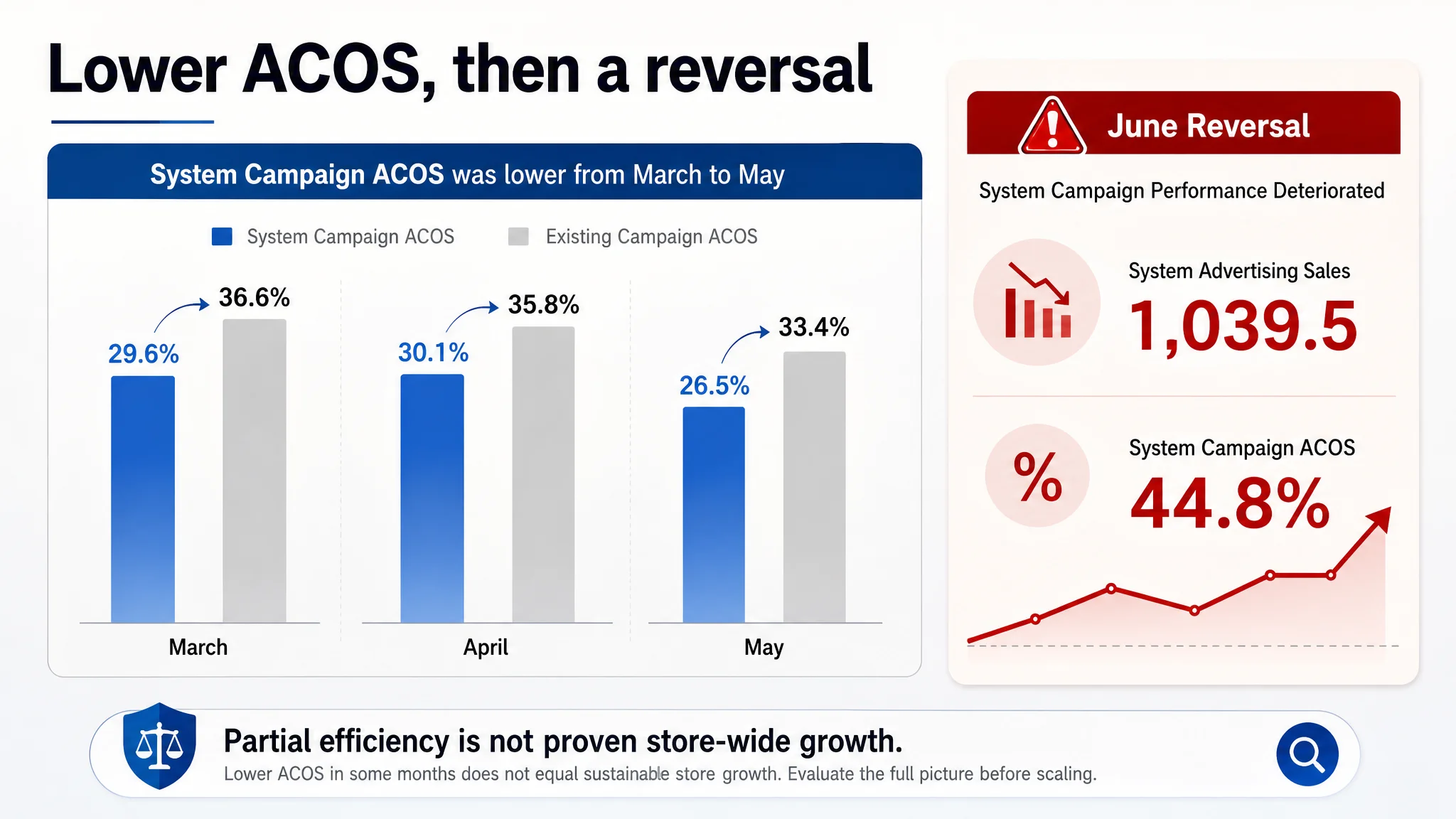
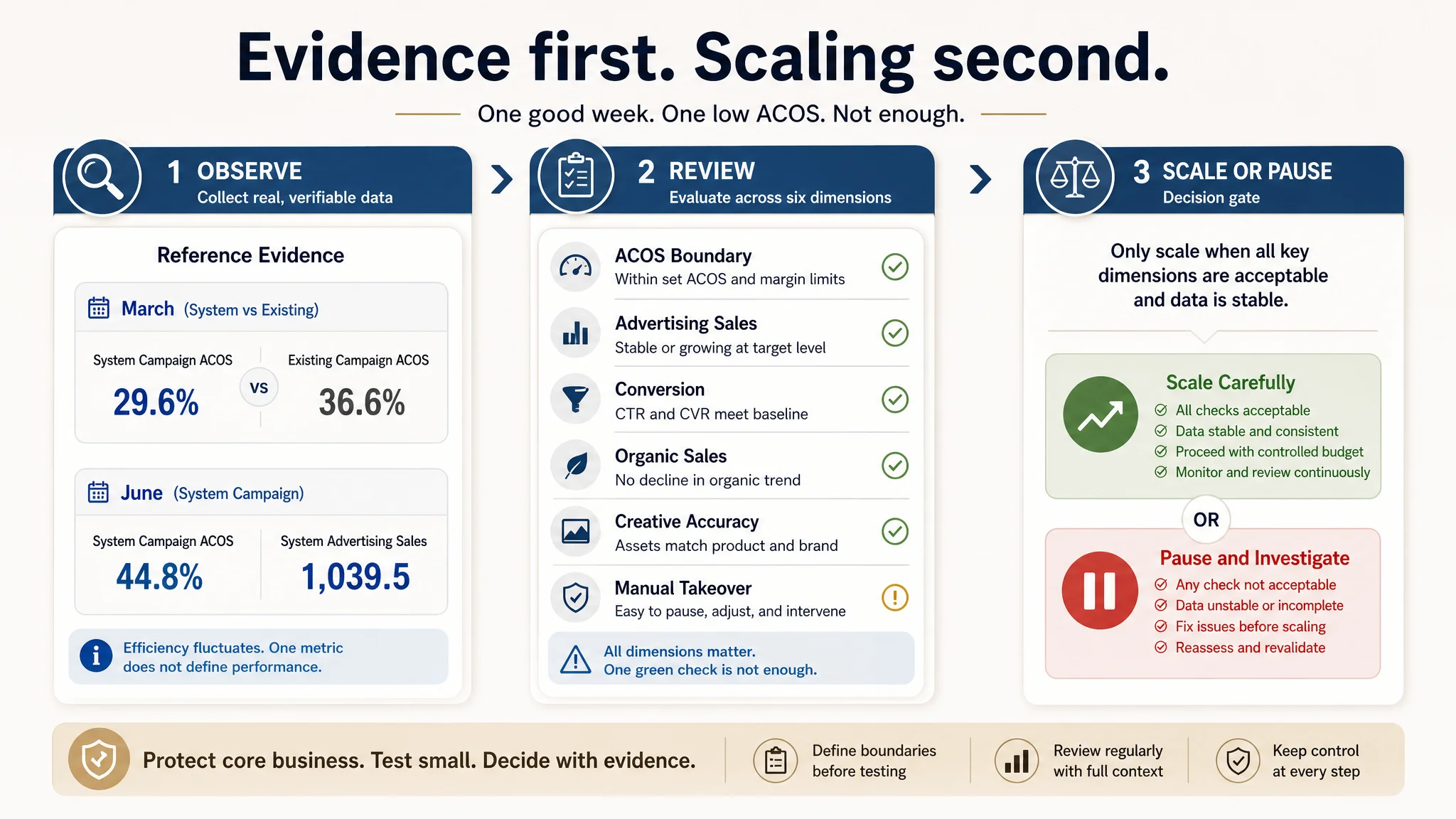
- In March, the system advertising campaigns had an ACOS of 29.6%, compared with 36.6% for the existing campaigns;
- In April, the system advertising campaigns had an ACOS of 30.1%, compared with 35.8% for the existing campaigns;
- In May, the system advertising campaigns had an ACOS of 26.5%, compared with 33.4% for the existing campaigns.
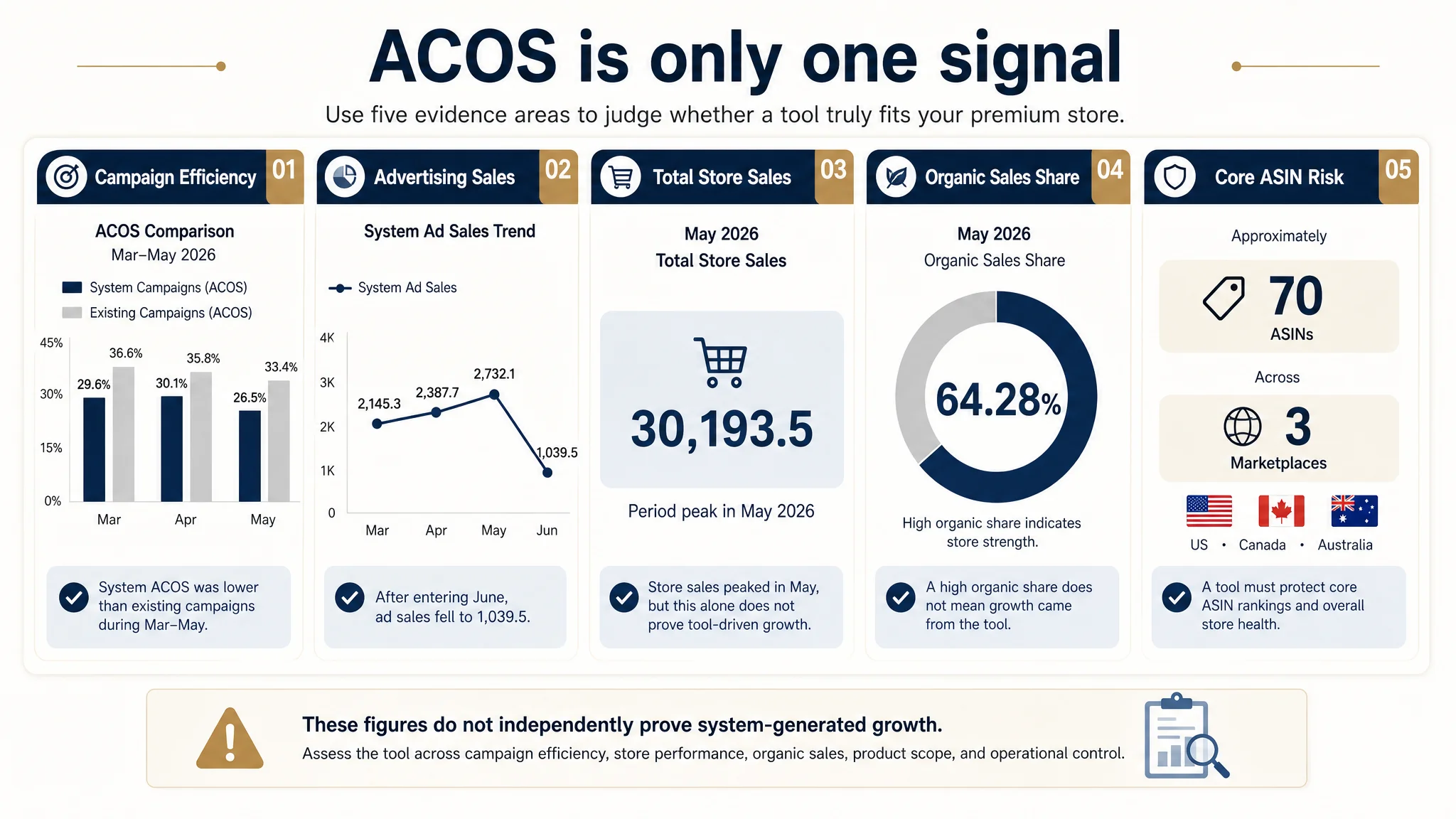
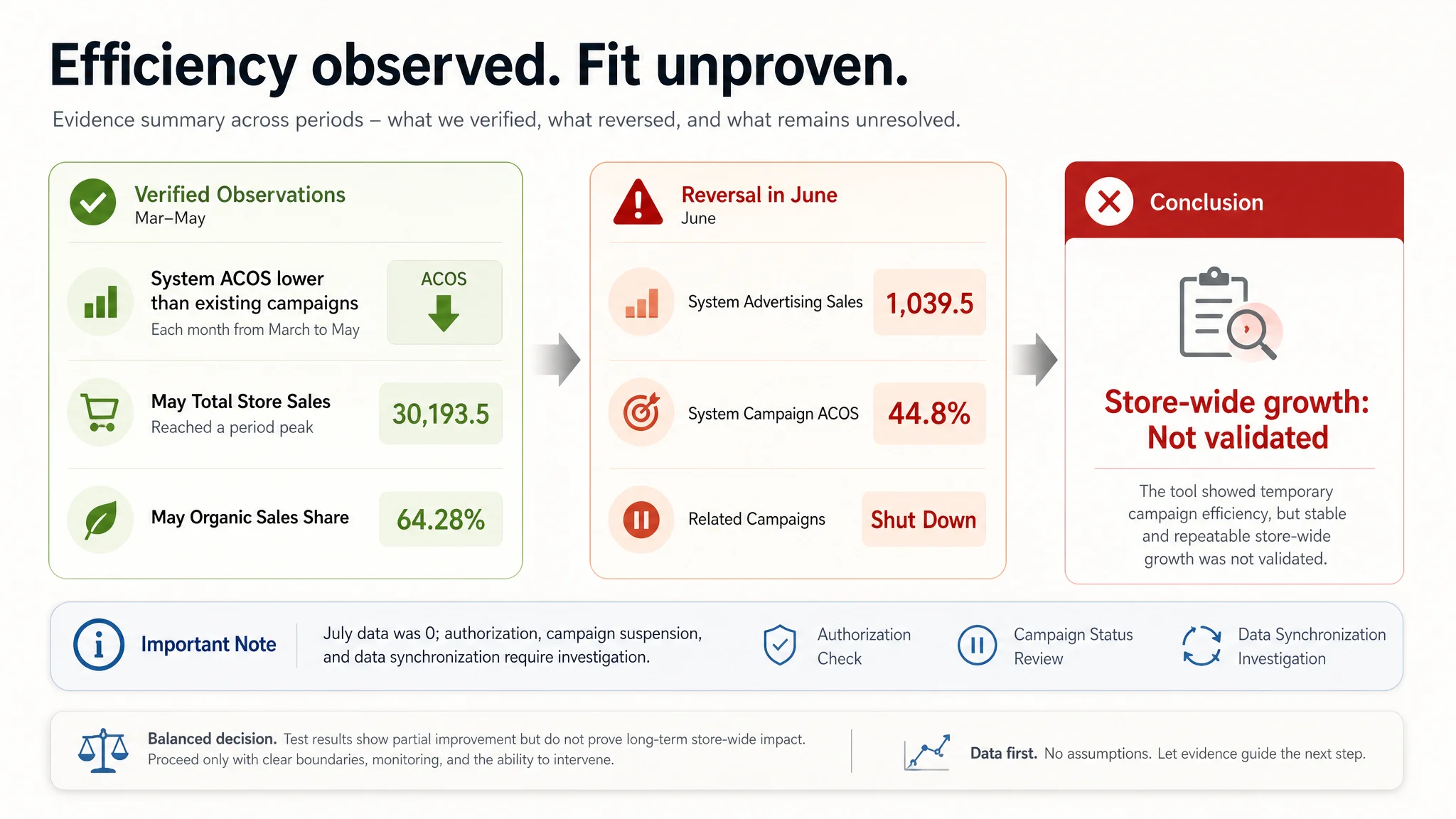
During the same period, total store sales reached a period peak of 30,193.5 in May 2026, while the share of organic sales reached 64.28%. These data indicate that partial advertising efficiency improved at one point, but they do not independently prove that all growth was generated by the automated system, nor do they directly show that the store had established a stable growth mechanism.
The real decision-making pressure emerged in the subsequent period. After entering June, system advertising sales fell to 1,039.5, and ACOS rose to 44.8%. The customer began to worry about several issues: Had automated advertising disrupted the existing premium-store operating rhythm? Was the budget being converted into low-efficiency traffic? Would the organic rankings of core products be affected? If advertising data became abnormal, could operators identify the issue and take over in time?
The customer had also previously encountered an issue in which changes to advertising campaign names caused the system to be unable to optimize properly, as well as an issue in which Listing images generated by the system did not match the actual products. These experiences further heightened concerns about creative quality, manual review, account security, and the visibility of the optimization process. Ultimately, the customer shut down all related campaigns and concluded that this type of tool was not sufficiently compatible with the current premium-store operating model.
Therefore, the issue was not simply whether advertising should be automated, but rather: How can a premium Amazon store verify whether an advertising tool is truly suitable without affecting its core business?
How DeepBI Diagnosed
In this situation, DeepBI could not directly interpret the lower ACOS as overall growth generated by the tool, nor could it simply attribute the deterioration in June to a single factor. A more appropriate diagnostic approach was to separately examine advertising efficiency, store operations, system configuration, and operational fit.
1. First, distinguish partial advertising efficiency from overall store performance. Compare the ACOS of the system advertising campaigns with that of the existing campaigns, while also reviewing advertising sales, total store sales, and the share of organic sales to avoid evaluating the tool based on a single ACOS metric.
2. Then, check whether the performance was consistent across periods. The data from March to May performed relatively well, but advertising sales declined and ACOS increased in June. It was therefore necessary to determine whether the improvement was sustained or occurred only during a particular period, in specific campaigns, or for certain ASINs.
3. Examine the relationship between the advertising targets and core products. For a store with approximately 70 ASINs across multiple marketplaces, new products, non-core products, and core products must be distinguished to determine whether automated advertising reached business units that the customer did not want to adjust frequently.
4. Check whether the advertising campaigns had stable system-identification conditions. The customer had previously encountered an issue in which changes to campaign names prevented the system from optimizing properly. Therefore, before testing, the campaign structure, naming rules, budget, and permission scope must be confirmed to prevent configuration changes from being misinterpreted as changes in advertising performance.
5. Finally, verify the creative assets and manual review mechanisms. Listing images that do not match the actual products can affect the customer’s assessment of system reliability and may also increase account and content risks. Advertising tests cannot be conducted independently of product information, Listing assets, and manual review processes.
Through the above diagnosis, “poor advertising performance” can be further broken down into advertising efficiency issues, data continuity issues, system identifiability issues, creative quality issues, and operational fit issues.
The Real Problem
Problem 1: A temporary ACOS improvement was mistaken for established long-term growth
Cause: From March to May, the ACOS of the system advertising campaigns was lower than that of the existing campaigns. However, the available materials only demonstrate a temporary difference in advertising efficiency and cannot prove that all store growth was generated by the system.
Impact: If the budget is increased solely because ACOS declined, advertising sales volume, changes in organic sales, and other operational factors may be overlooked. Once the data reverses, the operations team may find it difficult to determine whether the problem comes from the budget, traffic, Listing, or advertising strategy.
Evidence: From March to May, the ACOS of the system advertising campaigns was 29.6%, 30.1%, and 26.5%, respectively, while the ACOS of the existing campaigns was 36.6%, 35.8%, and 33.4%, respectively. However, in June, system advertising sales fell to 1,039.5, and ACOS rose to 44.8%.
Problem 2: No controllable testing scope was established outside the core business
Cause: The customer operated across multiple marketplaces and had approximately 70 ASINs, while also needing to accelerate new products on the US marketplace. Without defining the test ASINs, budget, and permission scope in advance, automated advertising could be perceived as affecting the overall operating rhythm.
Impact: The advertising, organic-ranking, and budget-safety boundaries of core products became unclear. Even if the tool affected only part of the advertising activity, the customer might still choose to shut down all campaigns because the scope of the impact could not be distinguished quickly.
Evidence: The customer ultimately shut down all related campaigns and was concerned that automated advertising would disrupt the premium-store operating rhythm and affect the rankings of core products.
Problem 3: System inputs, creative review, and the optimization process were not sufficiently explainable
Cause: Changes to advertising campaign names had previously caused the system to be unable to optimize properly. In addition, Listing images generated by the system did not match the actual products, raising concerns about creative quality, manual review, and account security.
Impact: When advertising performance deteriorated, operators had to ask not only “Why did ACOS increase?” but also whether the system correctly identified the campaigns, whether accurate product information was used, and whether there were abnormalities requiring manual intervention.
Evidence: The customer had explicitly reported issues related to naming, Listing images, and review security, and believed that continuous, visible optimization support was lacking.
Optimization Plan
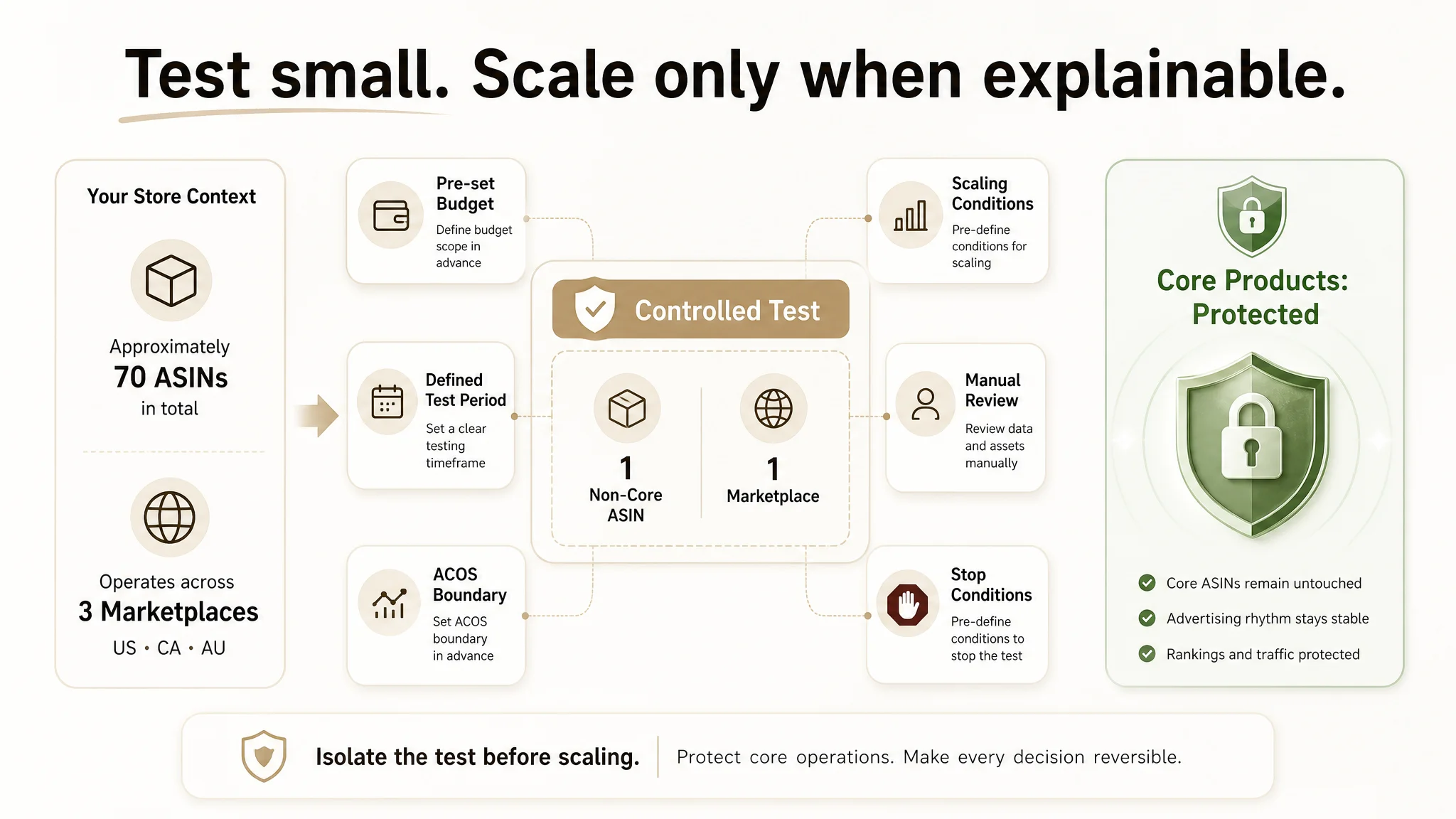
For premium stores, advertising automation should not be introduced through a one-time, store-wide transition. Instead, it should be tested through a “single ASIN, small budget, reversible, and explainable” approach. The following plan can serve as a basic framework for tool testing.
1. Select a non-core ASIN as the test subject
Prioritize a non-core ASIN rather than the store’s most important hero product, profit-generating product, or product whose organic ranking is highly sensitive. The test subject should have complete basic product information and Listing content to avoid conflating creative-quality issues with advertising-tool issues.
If the store operates across multiple marketplaces, start with one marketplace rather than launching tests simultaneously in the United States, Canada, and Australia. A single-marketplace, single-ASIN test reduces variables and makes it easier to determine whether advertising-data changes are caused by the tool itself.
2. Lock in the budget and testing period in advance
The daily budget, total budget, and testing period should be clearly defined before testing begins. The budget ceiling must be determined before execution rather than increased temporarily based on click volume during the campaign. The testing period should be long enough to allow data observation, but it should not be extended indefinitely simply because results have not yet appeared.
Without completing a specific data review, it is not possible to promise that a particular budget will definitely generate orders or growth. The purpose of the budget is to limit the cost of validation, not to guarantee advertising results.
3. Set ACOS targets and stop conditions
The ACOS target should be established based on the ASIN’s profit, selling price, conversion capability, and new-product stage. The store-wide average should not simply be applied. Stop conditions should also be defined. For example, testing should be paused and reviewed immediately if ACOS exceeds the preset boundary during consecutive observation periods, advertising sales fail to meet the minimum validation requirement, creative assets or campaign identification become abnormal, or core-product metrics are adversely affected.
Stop conditions must be documented before testing begins. Only then can the operations team treat “pause” as a normal risk-control action rather than waiting until excessive budget has been spent before responding passively.
4. Define scaling conditions instead of expanding campaigns automatically
Scaling should be considered only when the test ASIN meets the preset requirements for advertising efficiency, conversion, and data stability within the budget, and when no creative, permission, or ranking risks have emerged.
Scaling should be conducted in stages, with an observation period retained after each adjustment. A low ACOS during one week should not be used as the basis for immediately replicating the approach across other ASINs or marketplaces. For a premium store, the prerequisite for scaling is not that “one metric looks good,” but that “the data is explainable, the risks are controllable, and operators can take over when necessary.”
5. Retain manual review and anomaly take-over mechanisms
Advertising campaign names, budgets, advertising targets, and Listing assets all require manual confirmation. In particular, when product images, titles, selling points, and actual product information are involved, the process must be based on accurate product materials and completed review before publication.
At the same time, the testing period should clearly specify who is responsible for checking anomalies, how often checks should be performed, and under what circumstances testing must be paused. An automation tool can reduce repetitive operations, but it cannot replace human judgment regarding core products, product information, and account security.
6. Use phased reviews to verify operational fit
Each observation period should answer four questions: Did advertising sales meet expectations? Was ACOS within the defined boundary? Did organic sales or core ASINs show any abnormal changes? Could operators understand the system’s adjustments?
DeepBI can help organize advertising campaign, ACOS, advertising sales, and store-operation data during the diagnostic and results-validation stages. However, the final decision on whether to continue using the tool should still be made by the seller based on its operating strategy, risk tolerance, and operating rhythm.
Results
This case did not complete the controlled single-ASIN validation described above. Therefore, it cannot be presented as a success case in which growth was achieved through testing, and there are no new results that can be used to prove the effectiveness of the controlled approach.
The existing operational data shows clear differences across periods: from March to May, the ACOS of the system advertising campaigns was 29.6%, 30.1%, and 26.5%, respectively, lower than the 36.6%, 35.8%, and 33.4% of the existing campaigns during the same periods. In May 2026, total store sales reached a period peak of 30,193.5, and the share of organic sales was 64.28%. After entering June, system advertising sales fell to 1,039.5, and ACOS rose to 44.8%. The customer subsequently shut down all related campaigns, and the account is currently in a high-churn stage.
Therefore, the conclusion that can be drawn at this stage is that system advertising efficiency was better than that of the existing campaigns in some months, but this improvement was not validated as a stable, replicable growth result suitable for store-wide expansion. Operational data for July was 0, but the reasons, including authorization, campaign suspension, and data synchronization, still need to be investigated. It cannot be directly concluded that store operations had fallen to zero.
If testing is resumed in the future, the seller should first select a single non-core ASIN, set clear budget, period, ACOS, and scaling boundaries, and use manual review and phased evaluations to determine whether the tool is suitable, rather than immediately restoring all campaigns.
Case Summary
What this case truly reveals is not that automated advertising is always effective or always ineffective, but that when premium stores lack a low-risk validation mechanism, partial metrics can easily be overinterpreted.
The ACOS data from March to May shows that the system advertising campaigns had a temporary efficiency advantage. The decline in advertising sales and increase in ACOS in June, however, indicate that this advantage was not proven to be sustainable. The customer’s eventual decision to stop advertising was also related to issues involving campaign naming, Listing assets, manual review, account security, and the visibility of the optimization process.
A more suitable approach for premium stores is to change tool testing from a store-wide decision into a controlled experiment: first isolate a non-core ASIN, then limit the budget and testing period; first define the ACOS, conversion, and anomaly boundaries, then discuss whether to scale; and first retain manual review and the authority to stop campaigns, then evaluate the level of automation. The result may not necessarily be continued use, but it can answer more clearly whether the tool is suitable for the store’s current operating model.
Key Takeaways for Sellers
Takeaway 1: Do not judge whether an advertising tool works based solely on ACOS
A decline in ACOS only indicates that the temporary relationship between advertising spend and advertising sales has changed. To determine whether the tool is suitable, sellers must also consider advertising sales volume, organic sales, core ASIN performance, data continuity, and profit boundaries. In particular, avoid equating an ACOS improvement over several months directly with overall store growth.
Takeaway 2: When testing a tool in a premium store, protect the core business first
If a store depends on a small number of core ASINs and a stable premium-store operating rhythm, testing should not cover the entire store from the outset. A single marketplace, one non-core ASIN, a small budget, and clear stop conditions can limit the cost of trial and error to an acceptable range, while also making it easier to determine whether an issue is related to advertising or the Listing.
Takeaway 3: Automation requires controllable data, creative assets, and permissions
Changes to advertising campaign names, incorrect product information, mismatched Listing images, and a lack of manual review can all undermine the credibility of a tool test. Before enabling Amazon advertising automation, sellers should confirm that the campaign structure is stable, creative assets are accurate, permissions are necessary, anomalies can be monitored, and operators can pause and review the process at any time.
For multi-marketplace and premium-store sellers, the most prudent decision is not to pursue one-time, full-scale automation, but to use an explainable, reversible, and reviewable validation process to confirm whether the tool truly suits their operating model.