

Introduction
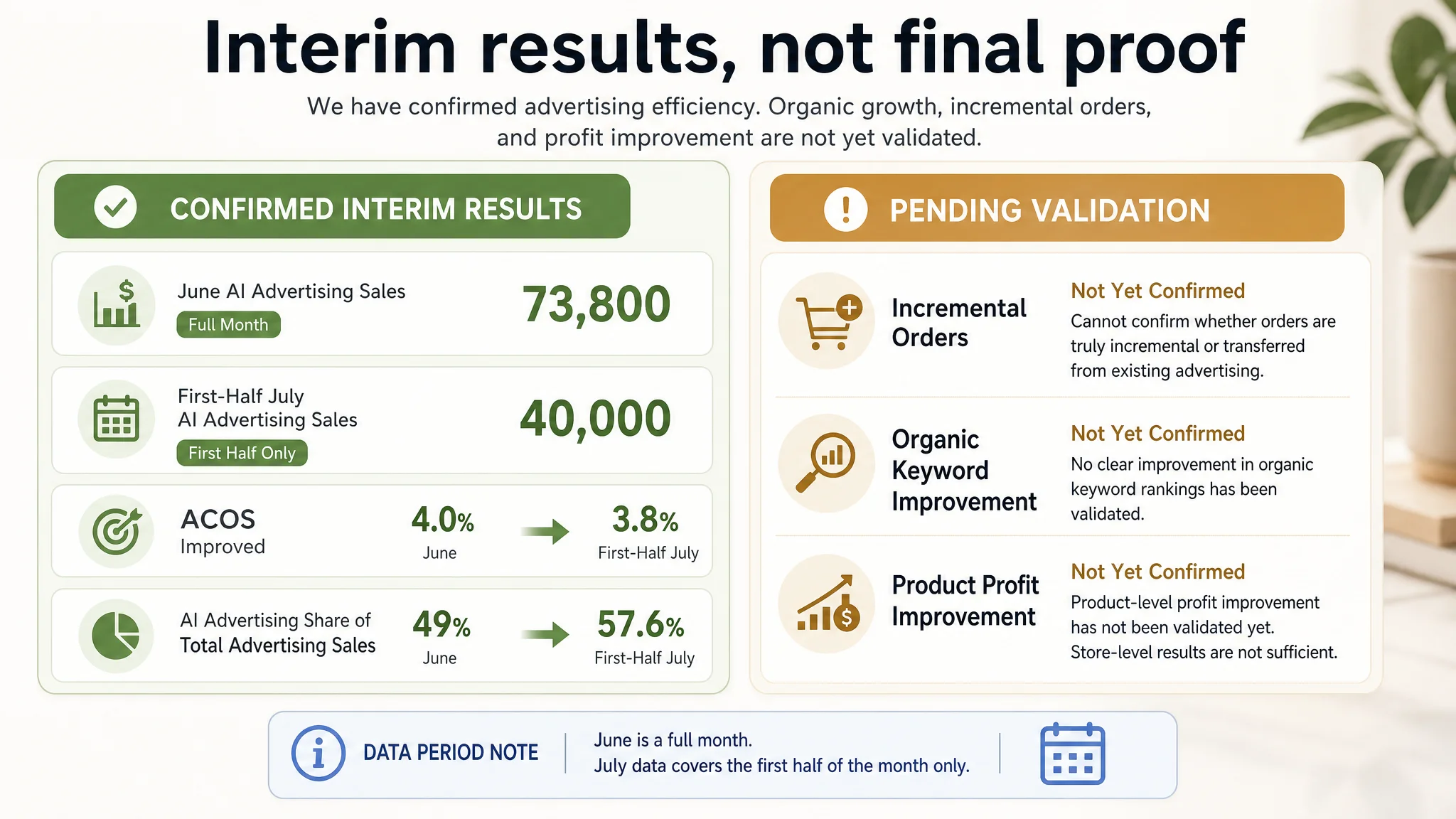
For AI advertising that has already started generating orders, sellers are often no longer primarily concerned with whether sales are being generated. Instead, they want to know whether these sales represent true incremental growth, whether they are driving organic traffic, and whether they are ultimately improving product profitability. A mobile accessories seller on a European marketplace had approximately 90 active ASINs. After AI advertising was launched, it generated approximately 7.38万 in sales in June, with an ACOS of approximately 4.0%; in the first half of July, it generated approximately 4.00万 in sales, with an ACOS of approximately 3.8%. However, stable advertising efficiency does not necessarily mean improved organic rankings, entirely new orders, or improved product profits. As the customer entered the renewal decision stage, it needed to shift from observing the entire store to validating key ASINs and establish a more reliable method for evaluating Amazon advertising renewal. It should be noted that the data in this article remains a set of interim validation results and has not yet led to a final conclusion on organic traffic, incremental orders, or profit improvement.
Customer Background
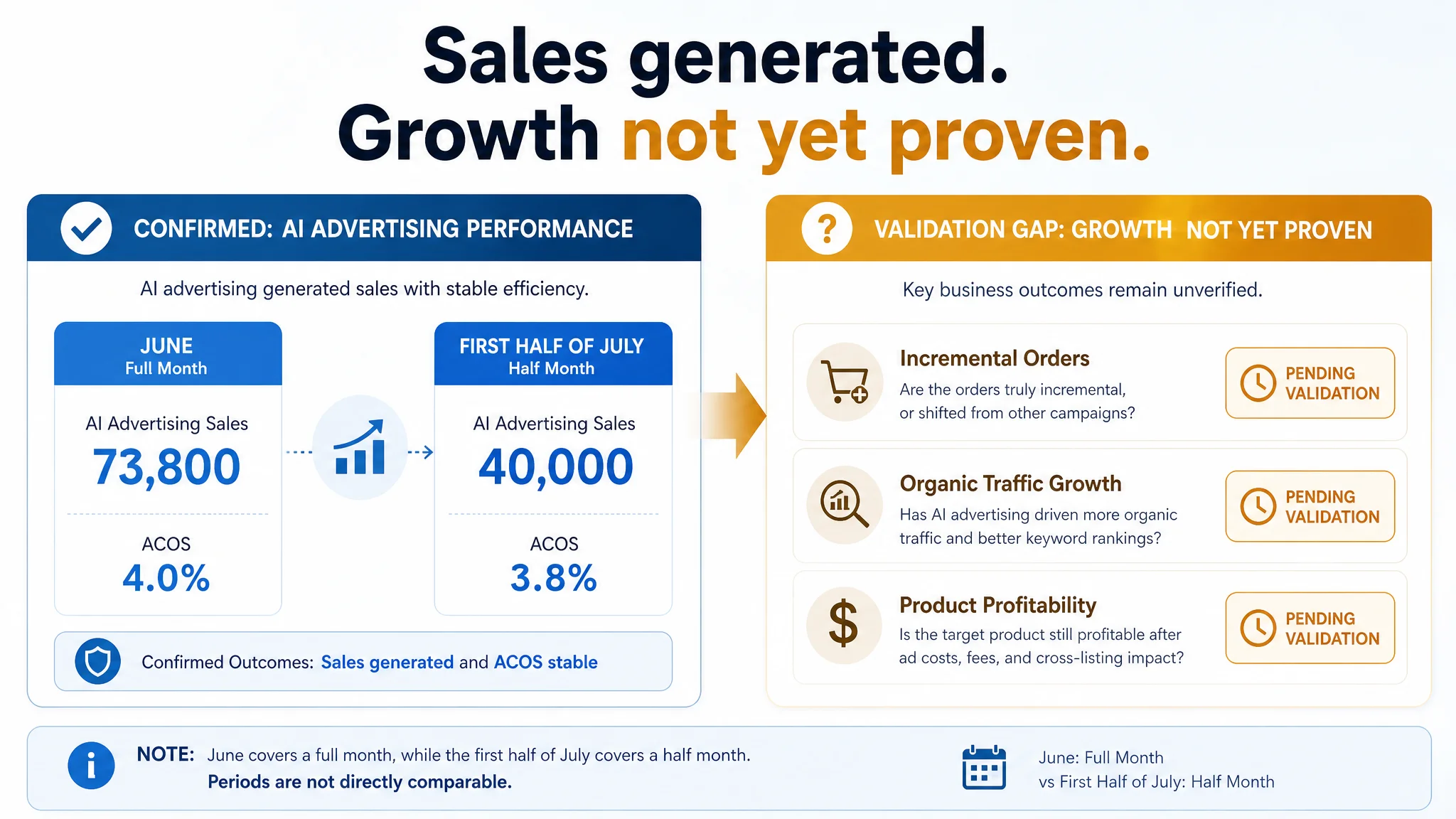
The customer is an Amazon seller of mobile accessories on a European marketplace. The store has approximately 90 active ASINs and had planned to expand the AI advertising tool to multiple stores and countries. During the early stage, the primary focus was on connecting multiple stores, managing sub-accounts, ensuring authorization security, and reducing the cost of manual operations.
After advertising was launched and began generating orders, the customer's decision criteria changed. Instead of simply focusing on whether the advertising was running, the customer began asking:
- Were the orders generated by AI advertising incremental orders, or were existing advertising orders merely transferred between different campaigns?
- Did the advertising investment drive organic sales and organic keyword rankings?
- If advertising-driven orders converted to other Listings, was the originally advertised target product still profitable?
- Could the advertising strategy be adjusted in time when faced with stockouts, warehouse transfers, new products, and cross-Listing conversions?
The customer has now entered the post-expiration extension or renewal window but has not yet reached a clear decision. The reason is not that advertising sales were absent, but that a complete review of organic traffic, incremental orders, and product profit was still missing.
The Problem
Advertising Generated Sales, but “Effective Growth” Could Not Yet Be Confirmed
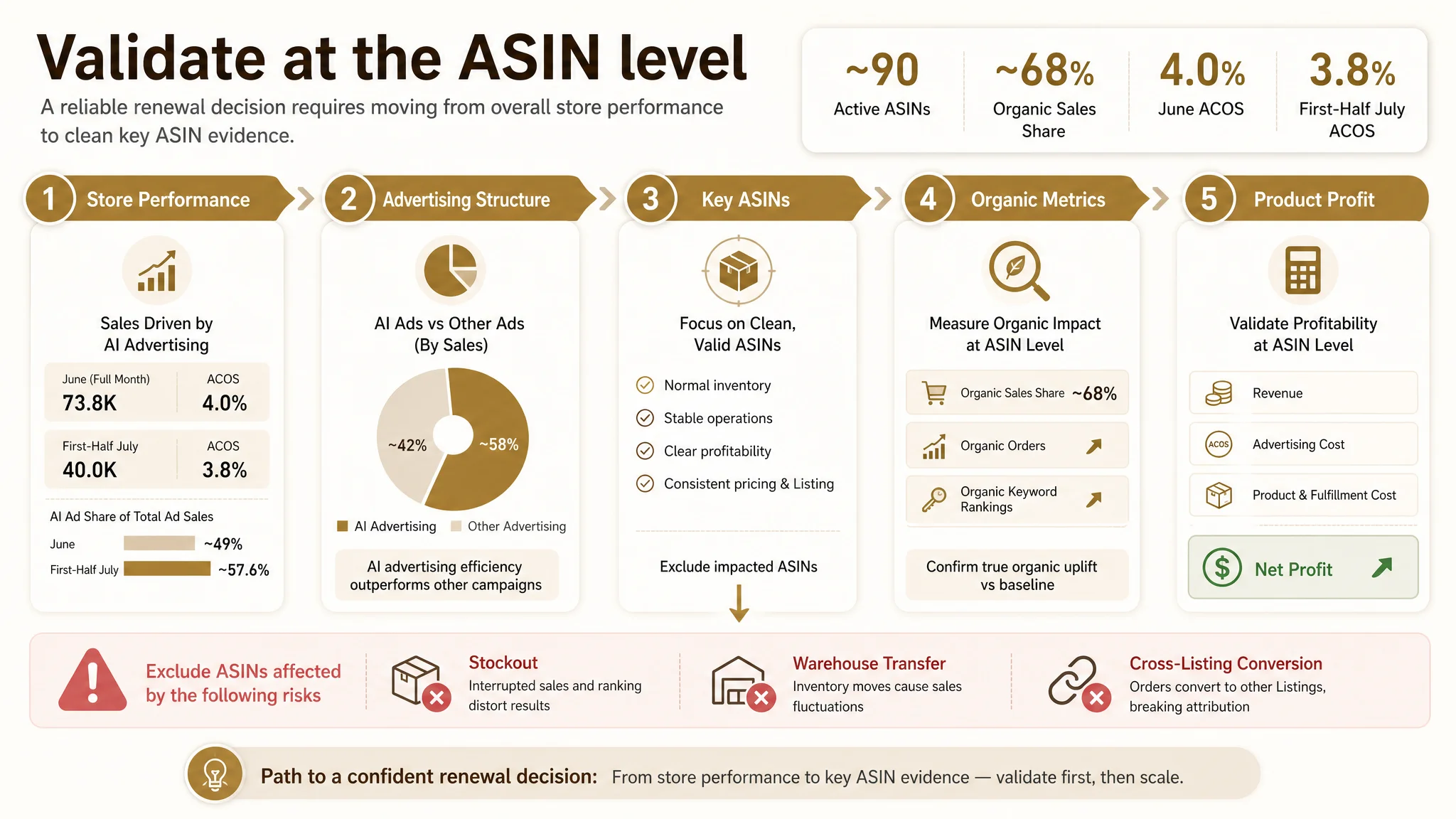
In the full month of June, the store generated approximately 47.25万 in sales, while AI advertising generated approximately 7.38万 in sales, with an ACOS of approximately 4.0%. In the first half of July, the store generated approximately 21.68万 in sales, while AI advertising generated approximately 4.00万 in sales, with an ACOS of approximately 3.8%. From the perspective of advertising metrics, ACOS remained low, and AI advertising did generate sales.
However, an increase in advertising sales cannot directly answer whether the advertising generated true incremental growth. Advertising orders may have come from customers who would have purchased anyway, or they may simply have shifted from existing advertising campaigns to AI advertising campaigns. If customers acquired through advertising ultimately purchased from other Listings, the sales contribution must be reassessed to determine which product should receive the attribution.
Advertising Efficiency Was Strong, but No Clear Corresponding Change in Organic Traffic Appeared
The share of AI advertising sales in total advertising sales increased from approximately 49% in June to approximately 57.6% in the first half of July. During the same period, its efficiency outperformed the existing advertising campaigns. This indicates that AI advertising contributed to sales and delivered efficient performance during the period.
However, the store's organic sales share remained stable at approximately 68%. The available data shows that no significant structural change occurred in organic sales, but it cannot prove that organic traffic increased as a result of AI advertising, nor can it prove that organic keyword rankings improved. For sellers preparing to renew, “stable advertising efficiency” and “organic growth has already occurred” are two different judgments.
Store-Level Results Could Not Replace Product-Level Profitability Assessment
The mobile accessories store had approximately 90 ASINs. Different products may vary in inventory, selling price, costs, advertising conversion, and organic orders. Some products were also affected by stockouts, warehouse transfers, and cross-Listing conversions.
Therefore, total store sales and overall ACOS could only serve as operational observations and could not directly indicate that every ASIN was profitable. If a product generated a large number of advertising orders but also incurred high advertising fees, product costs, and fulfillment costs, store-level advertising efficiency would not mean that the product had achieved sustainable profitability.
This was the customer's core issue during the renewal stage: the question was not whether to continue advertising, but which products and metrics should be used to determine whether continued advertising investment was worthwhile.
How DeepBI Diagnosed
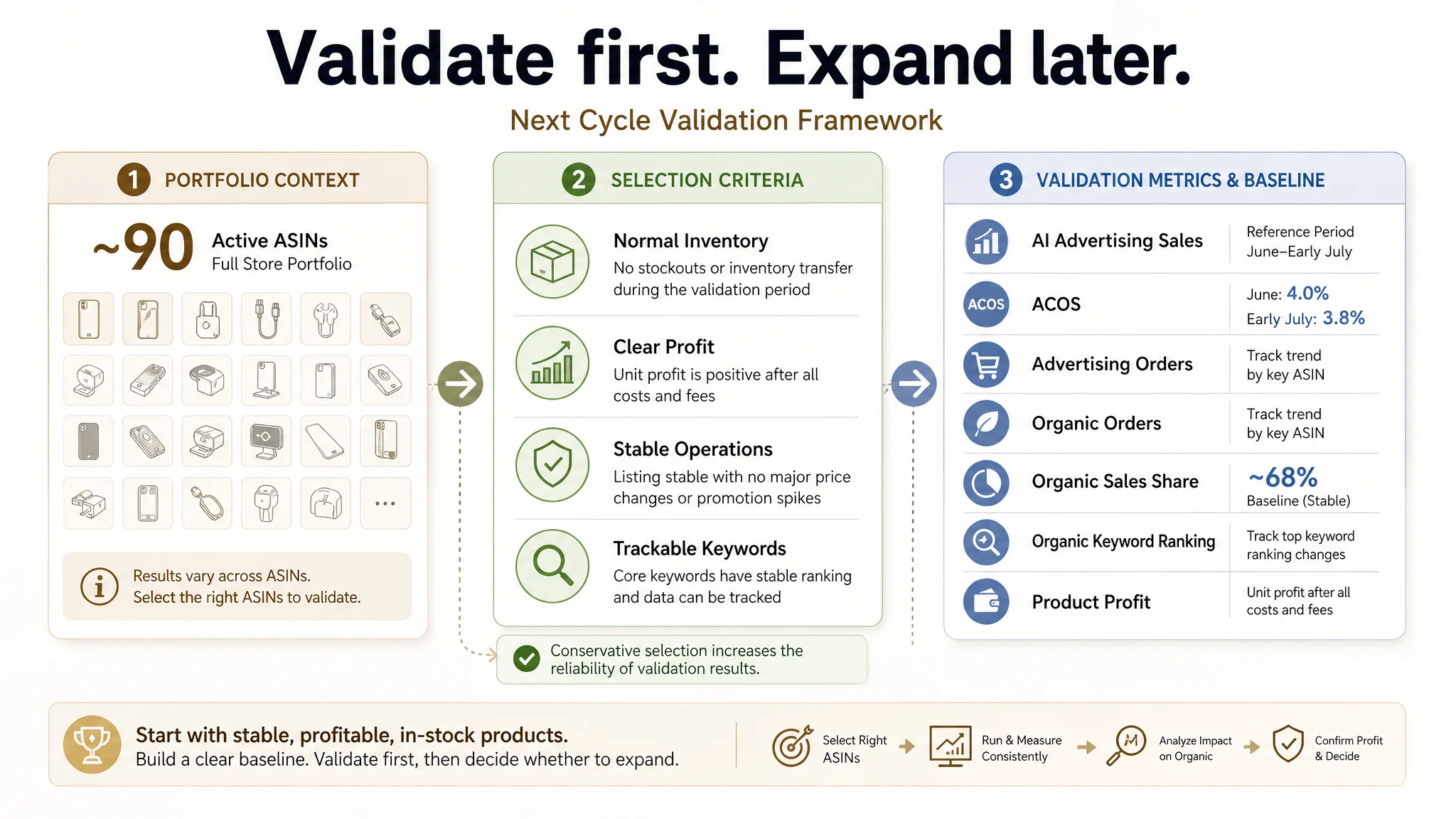
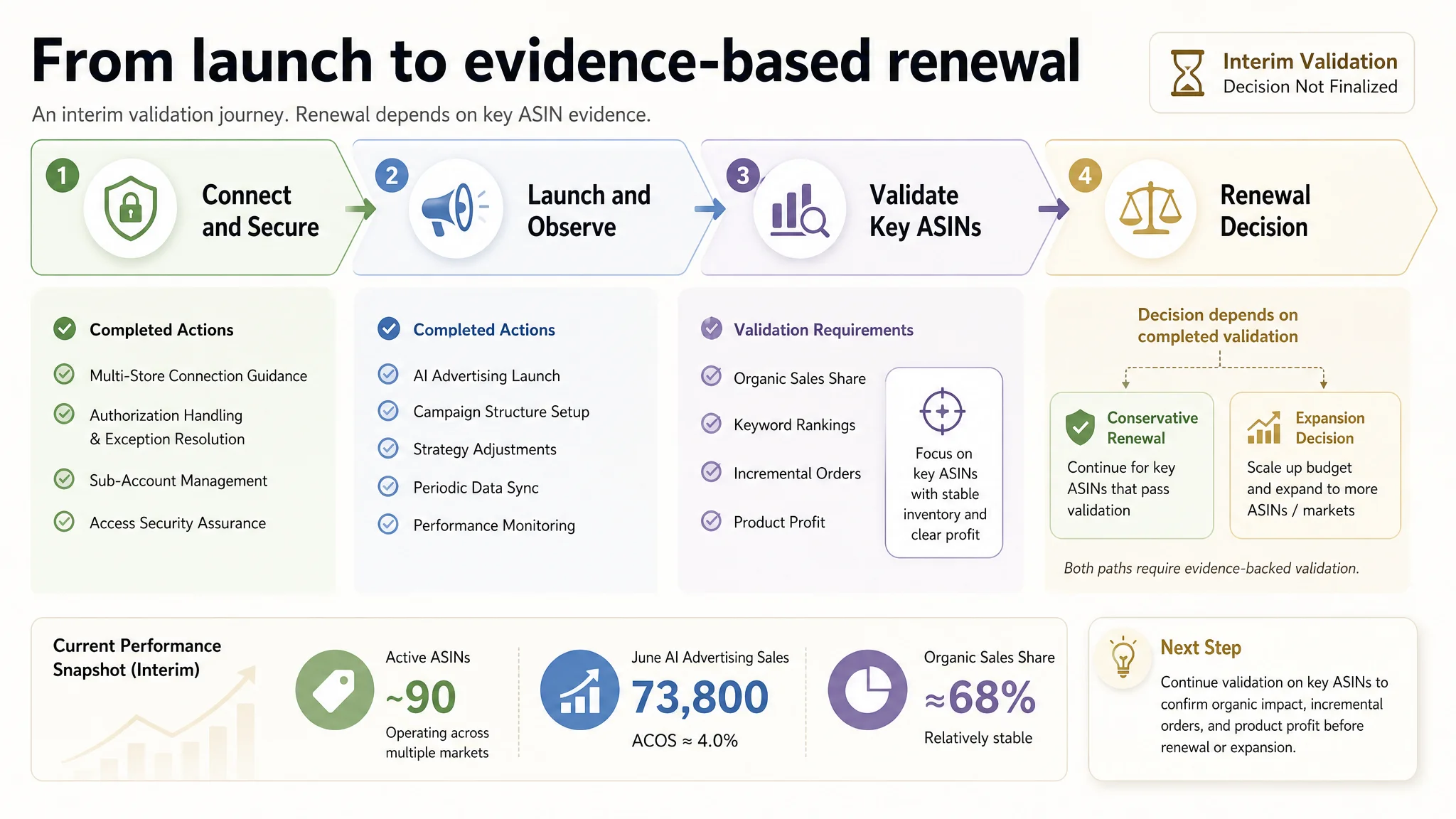
DeepBI did not equate AI advertising sales directly with growth results. Instead, it broke down the situation through the following path: “overall store performance—advertising structure—key ASINs—organic metrics—profit validation.”
1. First, review overall store performance. Compare store sales, AI advertising sales, the share of AI advertising sales, and the organic sales share for the full month of June and the first half of July. Confirm that advertising had generated sales while distinguishing between full-month and mid-month data to avoid directly comparing two different statistical periods.
2. Next, examine campaign efficiency and contribution. Focus on AI advertising sales and ACOS, and compare them with the performance of the existing advertising campaigns. In June, AI advertising generated approximately 7.38万 in sales with an ACOS of approximately 4.0%; in the first half of July, it generated approximately 4.00万 in sales with an ACOS of approximately 3.8%. This step can confirm efficiency during the period, but cannot independently prove that all orders were entirely incremental.
3. Drill down further to the ASIN level. Observe advertising sales, advertising orders, advertised products, actual conversion Listings, and inventory status together. Identify which products are suitable for validation in the next cycle, and avoid using products significantly affected by stockouts, warehouse transfers, or cross-Listing conversions as direct samples for profitability assessment.
4. Check changes in organic sales and organic keywords. Use the organic sales share, organic orders, and organic keyword rankings of key ASINs as independent observation dimensions. Determine whether sustainable changes in organic performance appeared after advertising was launched. At this stage, the store's organic sales share remained at approximately 68% and should still be recorded as a stable baseline rather than directly attributed to an increase generated by AI advertising.
5. Finally, return to product-level profitability. Conduct a separate review of key ASINs with normal inventory, stable operating performance, and clearly defined profit metrics. Combine advertising sales, advertising costs, organic orders, and product profit to assess advertising value. Only after completing this level of validation can the customer make a more reliable renewal or expansion decision.
Throughout this process, DeepBI's role was not to provide a single “renew or not” conclusion. Instead, it helped the customer place advertising sales, organic traffic, order attribution, and product profit within the same validation framework.
The Real Problem
Problem 1: Advertising Sales Had Been Generated, but Incremental Orders Had Not Yet Been Proven
Cause: Advertising orders may have been newly generated by AI advertising, or they may have been reallocations of existing advertising orders between different campaigns. At the same time, some products experienced cross-Listing conversions, making order attribution less clear-cut.
Impact: Looking only at AI advertising sales could lead to an overestimation of advertising's true growth contribution and result in overly optimistic decisions when renewing or increasing the budget.
Evidence: AI advertising generated approximately 7.38万 in sales in June and approximately 4.00万 in the first half of July. However, the available materials were not sufficient to prove that all these orders were incremental orders beyond existing sales.
Problem 2: Advertising Efficiency Was Stable, but Improvement in Organic Traffic Had Not Yet Been Proven
Cause: ACOS reflects the relationship between advertising investment and advertising-attributed sales. It cannot directly represent changes in organic keyword rankings, organic orders, or the organic sales share.
Impact: If low ACOS is directly interpreted as organic growth, sellers may misjudge the long-term value of advertising and may be unable to determine whether the product can maintain its organic performance after advertising stops or the budget changes.
Evidence: AI advertising ACOS remained stable, moving from approximately 4.0% in June to approximately 3.8% in the first half of July. During the same period, the store's organic sales share remained at approximately 68%, and the available data did not show clear growth in organic traffic.
Problem 3: Store-Level Advertising Results Could Not Directly Represent Product Profitability
Cause: The operating conditions of approximately 90 ASINs were not completely consistent, and some products were affected by stockouts, warehouse transfers, and cross-Listing conversions. Advertising costs, selling prices, and profit structures also needed to be assessed separately for different products.
Impact: Store-level sales growth or advertising efficiency could conceal profit pressure on certain key products. Without a product-level profit review, the renewal decision would still lack an operational basis.
Evidence: The customer had raised the question of whether the target product remained profitable after advertising sales converted to other Listings. The current materials did not yet include complete profitability data, organic keyword changes, or order attribution results for the key ASINs.
Optimization Plan
Advertising Optimization: Shift from Store-Wide Advertising to Key ASIN Validation
In the next cycle, renewal should not be based solely on total store advertising sales. Instead, priority should be given to key products with normal inventory, clear profitability, and stable operating performance, with a separate observation scope established for them. For these ASINs, continuously track AI advertising sales, ACOS, advertising orders, organic orders, and the organic sales share to reduce the interference of operational variables such as stockouts and warehouse transfers.
For products with significant cross-Listing conversions, the advertised Listing and the actual conversion Listing should be recorded separately. This avoids simply attributing advertising sales to the originally advertised product.
Listing Optimization: Confirm the Product's Ability to Capture Demand Before Assessing the Advertising Issue
If an ASIN receives clicks and advertising traffic but has unstable conversion performance, first review its Listing readiness, including page information, product selling points, price, and inventory status, before deciding whether to increase advertising investment.
The purpose of this step is neither to attribute all conversion issues to advertising nor to attribute all problems to the Listing. Instead, it distinguishes between “advertising did not generate effective traffic” and “the Listing failed to capture the traffic.” Only when the product page and inventory status are relatively stable are advertising-driven orders suitable for incremental validation.
Organic Traffic Strategy: Establish Trackable Validation Metrics
Organic traffic validation should focus on key ASINs and key keywords. At a minimum, continuously monitor the organic sales share, organic orders, organic keyword rankings, and their trends. The store's organic sales share of approximately 68% can serve as the baseline for the current stage, but it cannot be used as proof that AI advertising generated organic growth.
If advertising investment for key ASINs remains relatively stable while organic keywords and organic orders show sustained changes, it will then be appropriate to further discuss the potential impact of advertising on organic traffic.
Service Actions: Support Renewal Decisions Through Periodic Reviews
DeepBI has completed product training, multi-store connection guidance, authorization and management exception handling, advertising strategy adjustments, and periodic data synchronization. After entering the renewal window, the service focus should shift from “completing connection and launching advertising” to “completing key product validation.”
Specifically, the validation ASINs and baseline period should be defined first. Then, advertising sales contribution, ACOS, key ASIN orders, organic sales share, organic keyword changes, and product-level profit should be reviewed periodically. If the data is still affected by inventory or cross-Listing conversions, it should be clearly marked as pending validation rather than being used to reach an early conclusion.
Results
As of now, the case has produced measurable interim changes, but it has not yet entered the final validation stage for organic traffic, incremental orders, and product profitability.
- AI advertising sales: Approximately 7.38万 in the full month of June and approximately 4.00万 in the first half of July. The two periods use different statistical scopes and cannot be directly treated as monthly growth.
- AI advertising ACOS: Approximately 4.0% in June and approximately 3.8% in the first half of July. Efficiency during the advertising period remained stable.
- Share of AI advertising sales: Increased from approximately 49% of total advertising sales in June to approximately 57.6% in the first half of July.
- Organic sales share: Remained stable at approximately 68%; this cannot yet be used to prove organic traffic growth.
- Operational decision status: The customer has entered the post-expiration extension or renewal window. However, because the review of organic traffic, incremental orders, and profitability for key ASINs has not yet been completed, no clear renewal decision has been reached.
Therefore, what can be confirmed at this stage is that AI advertising has generated sales and that ACOS has remained stable. What cannot yet be confirmed is whether the advertising orders were entirely incremental, whether organic keyword rankings improved, and whether product-level profitability increased. Subsequent results should be based on key ASIN validation data rather than substituting total store advertising sales for a complete assessment.
Case Summary
The key issue in this case was not whether AI advertising generated orders, but whether the seller could further determine the true operational value of those orders after they were generated.
For a store with approximately 90 ASINs, total store sales, overall advertising share, and ACOS can help identify interim performance, but they cannot independently answer whether organic traffic increased, whether orders were incremental, or whether products were profitable. The truly effective next step is to select key ASINs with normal inventory, clear profitability, and stable operations, then establish continuous validation from advertising orders to organic keywords and finally to product profit.
The current case has completed advertising launch, data observation, and strategy adjustments, but it has not yet produced a strong conclusion on organic traffic growth or profit improvement. Therefore, renewal evaluation should follow a “conservative renewal + key product validation” approach: validate first, then decide whether to expand the advertising scope.
Key Takeaways for Sellers
Takeaway 1: Low ACOS Does Not Mean Advertising Generated True Incremental Growth
An excessively high Amazon advertising ACOS requires optimization, but a low ACOS does not mean that all advertising orders are incremental orders. When evaluating advertising value, sellers should also examine existing advertising sales, organic orders, the organic sales share, and order changes for key ASINs.
Takeaway 2: Organic Traffic Validation Requires an Independent Baseline
To determine whether Amazon advertising generated organic traffic, sellers cannot look only at increases in advertising sales. They should record organic sales, organic orders, and organic keyword rankings for key ASINs in advance, and continue comparing them while inventory, price, and the Listing remain relatively stable.
Takeaway 3: Complete a Product-Level Profit Review Before Renewing or Expanding Advertising
Store-level data cannot replace ASIN-level analysis. Products with high advertising investment, significant cross-Listing conversions, or a history of stockouts and warehouse transfers should have their advertising costs and product profits calculated separately. Only after confirming that key products can continuously capture traffic and have clear profitability does an Amazon advertising review provide real decision-making value.