

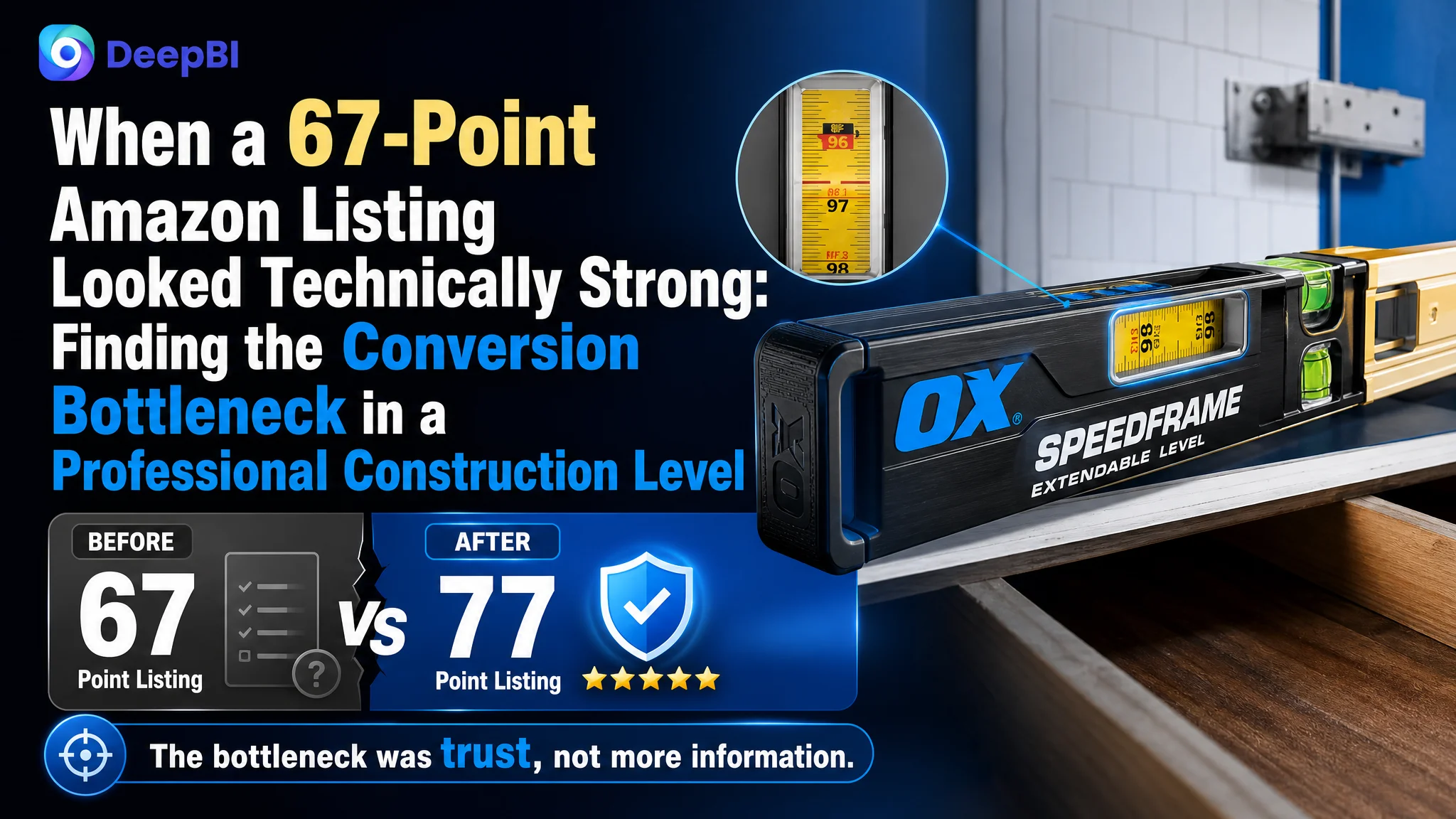
An Amazon seller in the US construction-tool category was facing a product-page conversion problem with a 29"-48" extendable measuring level. The Listing contained strong technical information, a clear product identity, and several differentiated functions. Yet its overall competitiveness remained below a comparable high-performing Listing, scoring 67 out of 100 versus 77.
The initial direction was to keep refining keywords, specifications, and functional descriptions. That diagnosis was incomplete. DeepBI found that the title and bullet points were not the main constraint. The larger problem was that the Amazon product page did not build enough trust or communicate the product's value quickly enough through its main images, A+ content, and customer feedback.
The later optimization therefore focused on conversion logic rather than more information: show the extendable function clearly, prove measurement accuracy, demonstrate the scribing edge, explain how one tool replaces several standard levels, and rebuild the page around professional jobsite concerns. For other Amazon sellers, the lesson is direct: before sending more paid or organic traffic to a Listing, determine whether the page has enough evidence to deserve that traffic.
The Seller Did Not Have a Traffic Story. It Had a Conversion-Capacity Problem.
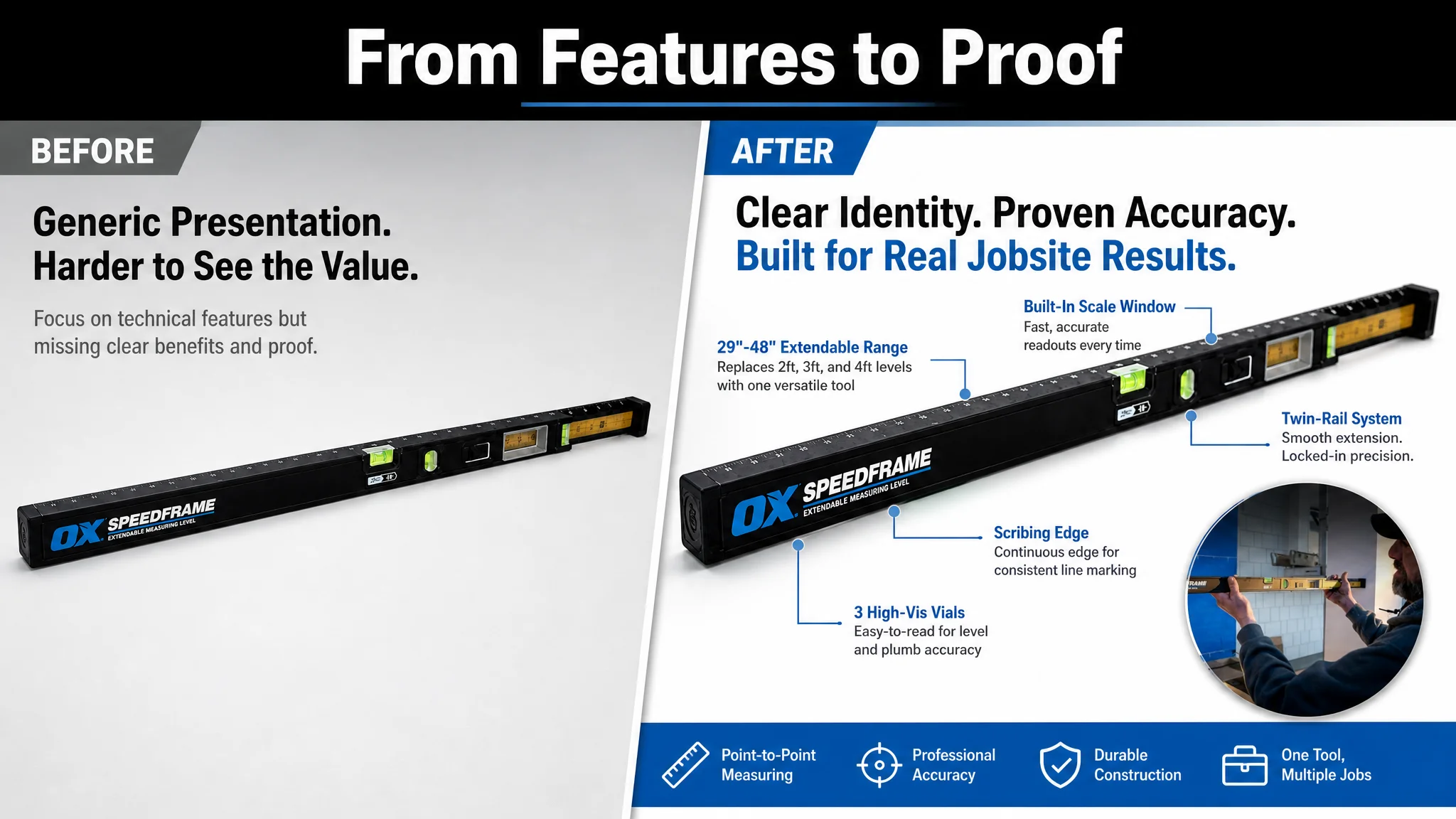
The target product was not a generic level. It was an extendable construction measuring tool with a 29"-48" range, a built-in scale window, a patented twin-rail system, three vials, and a continuous scribing edge.
Those functions gave the product a meaningful point of difference. In theory, the tool could replace separate 2-foot, 3-foot, and 4-foot levels while also supporting point-to-point measurement and line marking.
But the Amazon Listing did not consistently communicate that value in the order a buyer needed to understand it.
The product was being described as a tool with multiple functions. It was not yet being presented as a more efficient professional workflow.
The page had product information. It did not yet have a sufficiently strong reason to trust, click, and buy.
That distinction became important because the Listing's total score was 10 points behind the comparable benchmark:
- Title: Target Listing: 16/20, Comparable Listing: 14/20, Gap: +2
- Main images: Target Listing: 24/30, Comparable Listing: 26/30, Gap: -2
- Bullet points: Target Listing: 7/10, Comparable Listing: 6/10, Gap: +1
- Detail page and A+ content: Target Listing: 19/25, Comparable Listing: 21/25, Gap: -2
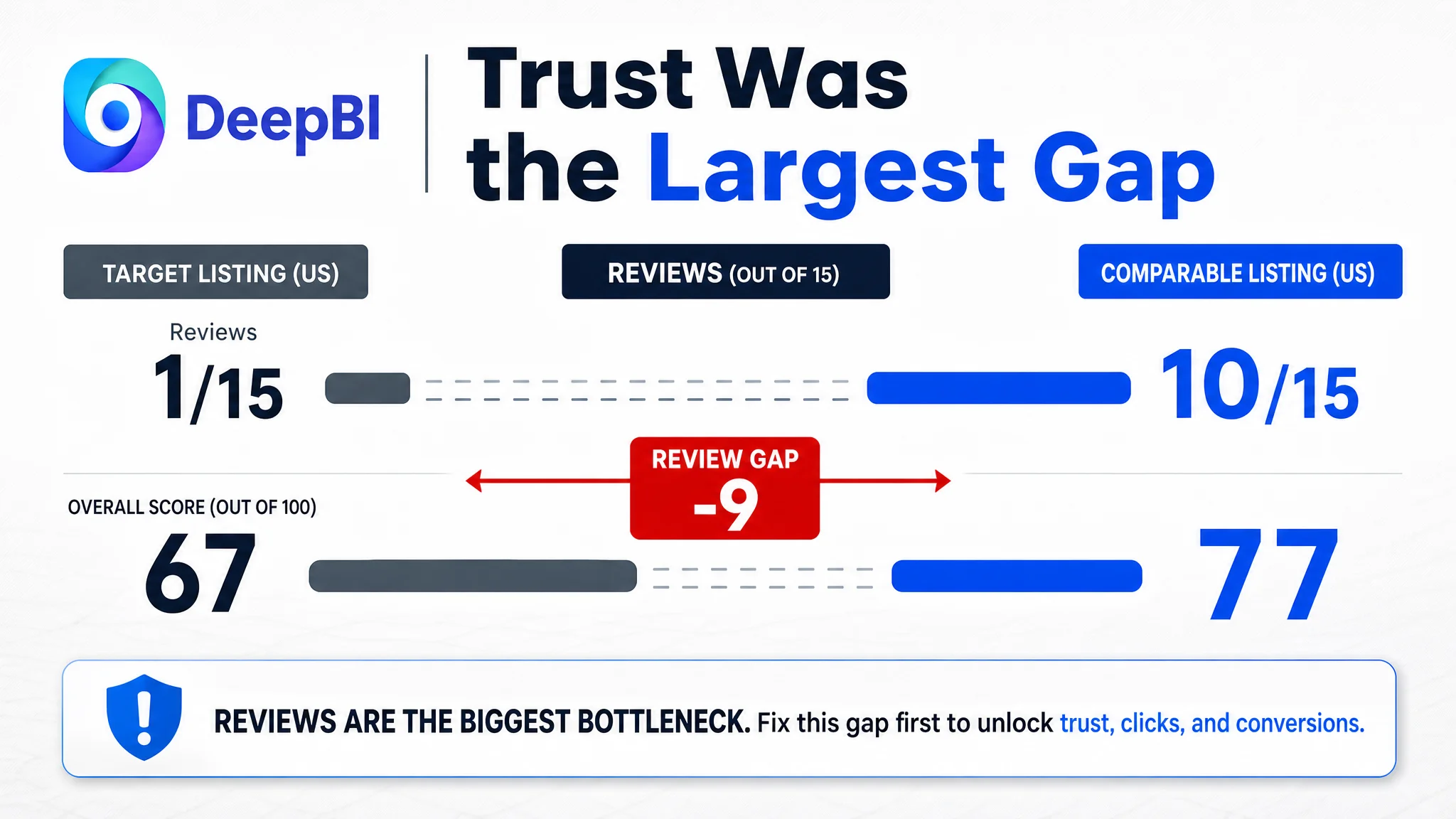
- Reviews: Target Listing: 1/15, Comparable Listing: 10/15, Gap: -9
- Total: Target Listing: 67/100, Comparable Listing: 77/100, Gap: -10
The numbers changed the direction of the diagnosis. The weakest dimension was not keyword structure. It was customer trust.
The Original Diagnosis Focused Too Closely on Technical Expression
The seller's title was already relatively mature. It placed the core product identity and search terms clearly, included the 29"-48" range, and highlighted functions such as the twin-rail system, scale window, three vials, and scribing edge.
The bullet points were also stronger than the benchmark in several respects. They connected functions to use cases and outcomes, explained the tool's extendable versatility, and introduced the replacement value of carrying fewer conventional levels.
That created a misleading situation.
Because the product had several technical advantages, the natural reaction was to add or refine even more specifications. More precision language, more functional details, and more keyword coverage appeared to be the logical next step.
But this approach treated the problem as an information deficit.
The actual issue was an evidence and sequencing deficit:
- The main image did not make the extendable measuring innovation immediately obvious.
- The scale window was not demonstrated as a practical accuracy benefit.
- Several images repeated framing and measuring scenes without advancing the buying decision.
- The A+ content described functions but did not sufficiently prove professional value.
- The page did not fully answer concerns about durability, readout errors, handling, and long-term jobsite use.
- The review profile created a serious trust barrier for first-time buyers.
The seller did not necessarily need more claims. It needed a clearer path from what the tool is to why a professional buyer should rely on it.
The Listing Score Made the Misdiagnosis Visible
DeepBI's comparison did not treat the benchmark as a source of phrases to copy. It used the comparison to identify where the two Listings were asking buyers to make different levels of judgment.
The target Listing was technically compact and professionally written. The benchmark was weaker in title and bullet-point maturity, but it performed better in the areas that reduce perceived purchase risk: reviews, value framing, and visual proof.
That difference mattered.
The title was not the primary leak
The target title already communicated:
- The extendable product form
- The 29"-48" range
- The twin-rail construction
- The integrated scale window
- The three vials
- The scribing edge
- The construction-tool context
The title still had room for refinement. The recommended direction was to place the core phrase “Extendable Measuring Level” closer to the front, retain the physical range, and combine it with the product's most distinctive functions.
But the title was not the reason the Listing remained 10 points behind.
A title can help a product appear relevant in Amazon search. It cannot, by itself, establish that a moving tool will remain stable, that measurements will be easy to read, or that the product is worth choosing over a multi-level set.
The bullet points had logic, but the page did not fully support it
The bullet points already used a relatively strong structure:
Function → jobsite situation → practical result
For example, the extendable range was connected to replacing multiple traditional levels. The twin-rail system was connected to smooth extension and stability. The scribing edge was connected to framing and interior finishing.
The problem was not that the bullet points lacked selling points. The problem was that the visual and A+ content did not consistently prove those selling points.
A buyer could read that the tool provides easy readout or maintains precision. The page did not always show how that confidence was earned.
Reviews created the largest trust gap
The review dimension scored 1 out of 15 for the target Listing, compared with 10 out of 15 for the benchmark.
The target product had:
- A 3.0-star rating
- Four total reviews
- No meaningful review content visible in the primary review area
The comparable Listing had:
- A 4.4-star rating
- Forty-nine total reviews
- A much healthier overall review profile
This was a structural disadvantage, not a copywriting detail.
A professional buyer may understand the product's features and still hesitate when the page provides limited evidence that the tool performs reliably in real working conditions. For a construction tool, concerns about accuracy, stability, durability, and handling are not abstract. They directly affect whether a buyer is willing to risk the purchase.
DeepBI Reframed the Problem as Trust-Building Across the Product Page
The key judgment was not that every module was weak. It was that the modules were not working together to resolve the buyer's main doubts.
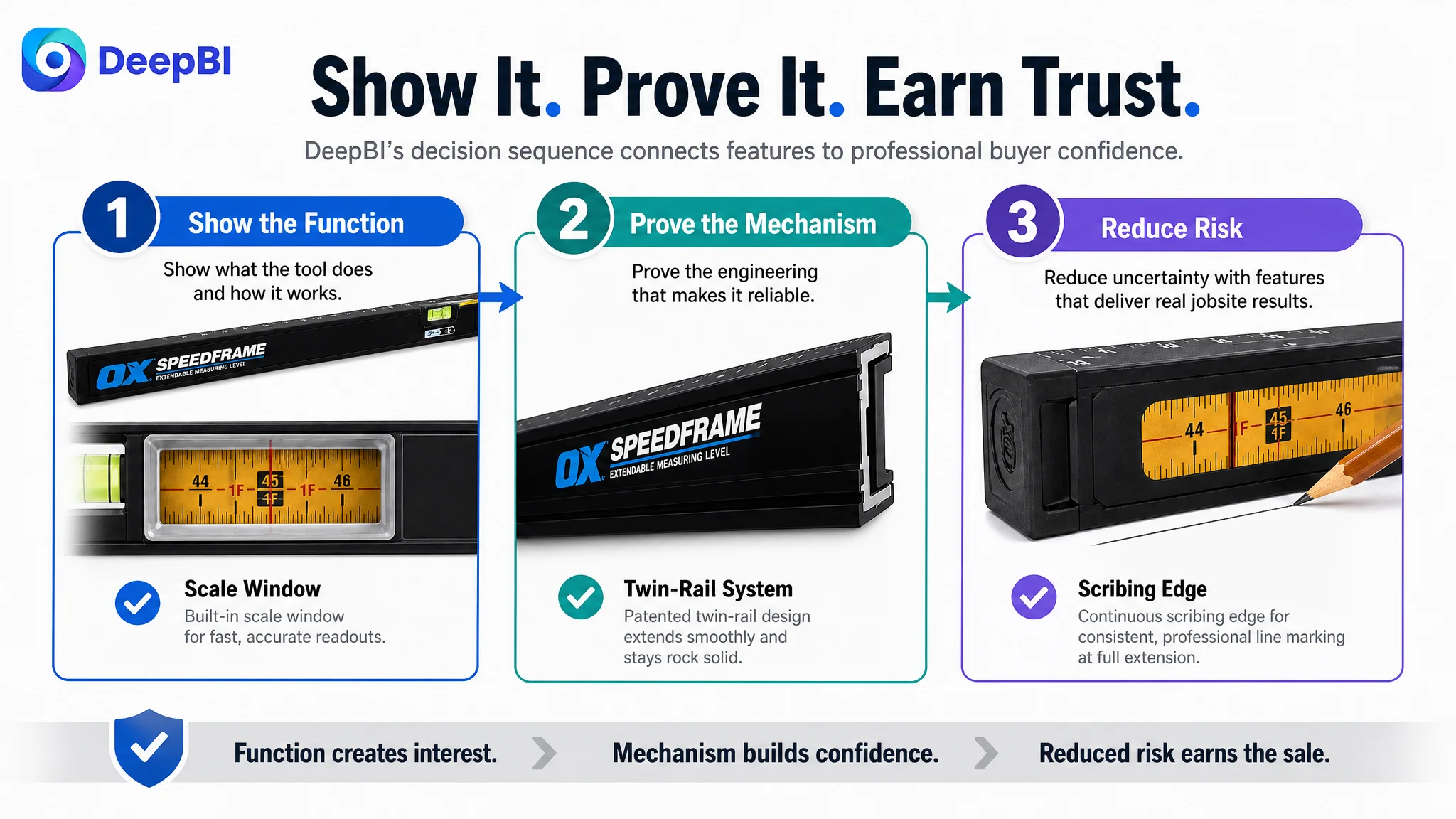
The product page needed to move through a more persuasive sequence:
1. Establish what the tool is.
2. Show the 29"-48" extendable range.
3. Prove how the scale window supports fast and accurate readout.
4. Demonstrate the twin-rail system and locking function.
5. Show the continuous scribing edge in a real jobsite task.
6. Explain how one tool can replace several standard levels.
7. Reinforce durability, usability, and professional suitability.
8. Reduce purchase risk with credible evidence.
The original Listing often restarted at product description instead of advancing through that sequence.
That was why DeepBI did not treat the page as a collection of isolated assets. It compared the title, bullets, main images, A+ modules, and reviews as a single conversion system.
The real question was not “Which feature should be added?” It was “Which buyer doubt remains unresolved after the feature is presented?”
The Main Images Explained the Product, but Did Not Create Enough Immediate Understanding
The first image slot used a side-by-side presentation that attempted to communicate several ideas at once. The result was visually understandable at a basic level, but it did not make the central innovation obvious enough: this is an extendable measuring level that changes how the buyer works.
The recommended direction was to shift from product identification to function demonstration.
The first visual story should make the sequence immediately clear:
Measure the space → read the value in the scale window → mark the line.
That sequence gives the product a jobsite role. It shows why the extendable structure matters instead of merely showing that the structure exists.
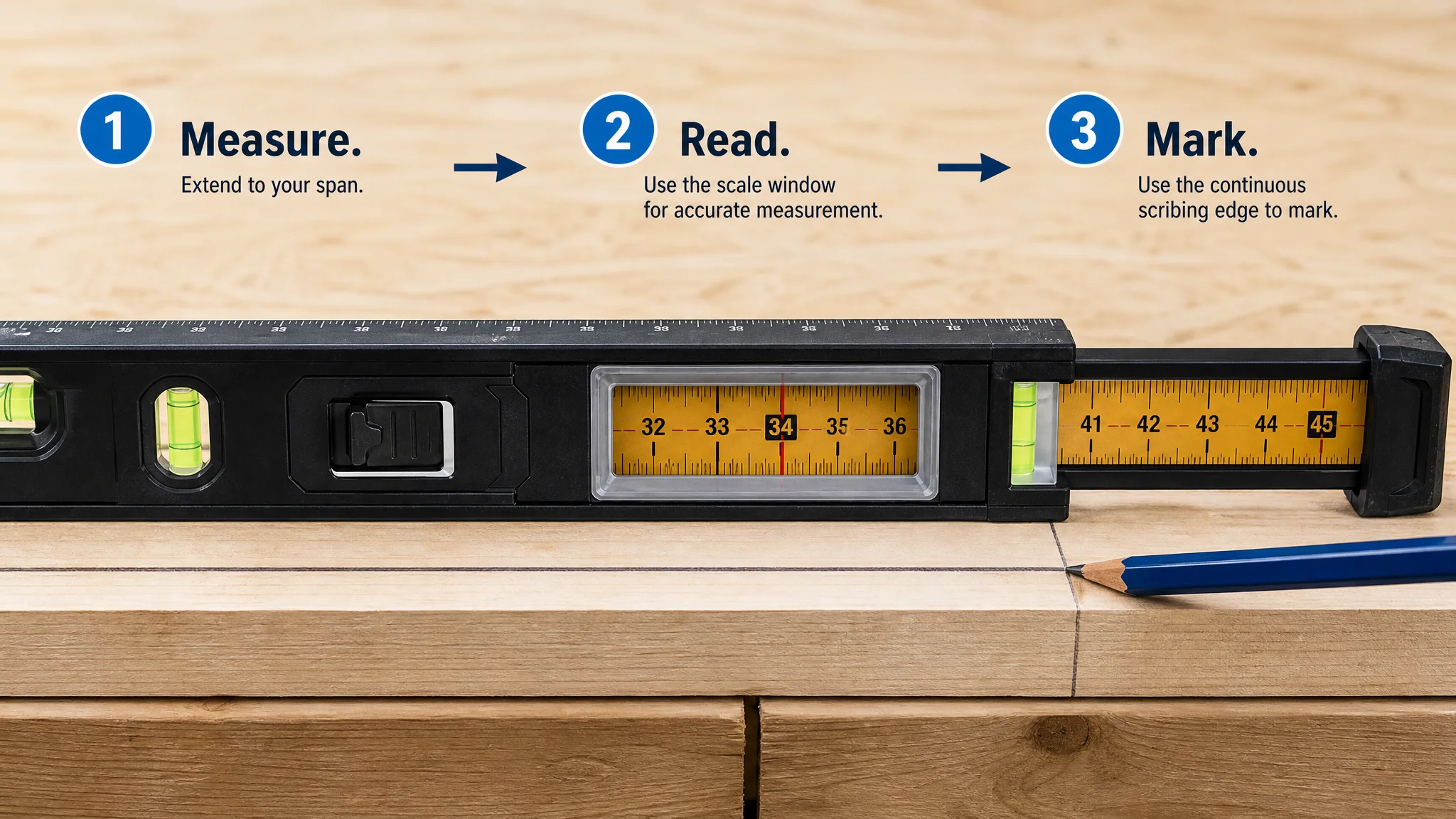
The scale window needed to become proof, not decoration
A generic statement such as “accurate measurements” is easy for any tool listing to make. It does not create much confidence without a visible mechanism or clear explanation.
The built-in scale window was more valuable because it could demonstrate how the buyer reads the measurement. The image strategy therefore needed to show:
- Where the scale is located
- How it is viewed during use
- How the measurement is read quickly
- How the result can be locked for later reference
This would turn a technical term into a practical reason to trust the tool.
The product model had to remain consistent
One existing image used a much larger model than the 29"-48" product. Even if the underlying measuring logic was relevant, showing a different physical range introduced uncertainty.
For Amazon product pages, visual accuracy is part of conversion quality. A buyer should not have to wonder whether the illustrated range, proportions, or use case applies to the product being purchased.
The optimization direction therefore emphasized the actual product boundary and avoided unsupported efficiency claims based on a different model.
Repetition weakened the selling path
Several images repeated framing and overhead measuring contexts. Repetition can make a page feel complete while still leaving important questions unanswered.
The image sequence needed to assign a different decision role to each slot:
- Product identity and extendable range
- Measurement accuracy and scale-window readout
- Scribing function at full extension
- Locking and easy readout
- Replacement value and professional utility
This was not a request for more images. It was a request for less duplication and better decision coverage.
The A+ Content Was Too Focused on Functions and Not Focused Enough on Proof
The A+ content was clear, but its sequence remained close to a feature explanation:
- Measuring function
- Scribing edge
- Easy-read window
- Locking mechanism
- Three vials
- Basic operating details
The benchmark used a different commercial logic. It presented a multi-piece professional solution, addressed ergonomic details, and connected the product to durability and storage.
The target Listing did not need to imitate that product structure. It needed to understand why that structure worked.
The benchmark was selling a professional workflow. The target Listing was still mainly selling a single tool.
The opening module needed to confirm the product's identity
The A+ introduction used broad claims such as faster performance and extreme precision. These phrases were not as persuasive as concrete product facts.
The opening should have established:
- This is a 29"-48" extendable measuring level.
- It is designed for construction and framing work.
- Its core value comes from combining leveling, point-to-point measurement, readout, locking, and scribing in one tool.
The first module should reduce uncertainty before introducing secondary functionality.
Accuracy needed to come before secondary features
The original sequence introduced functions such as inner and outer measurement before fully establishing the tool's core identity and accuracy.
For a professional buyer, the first rational question is not how many functions the tool has. It is whether the measurements can be trusted.
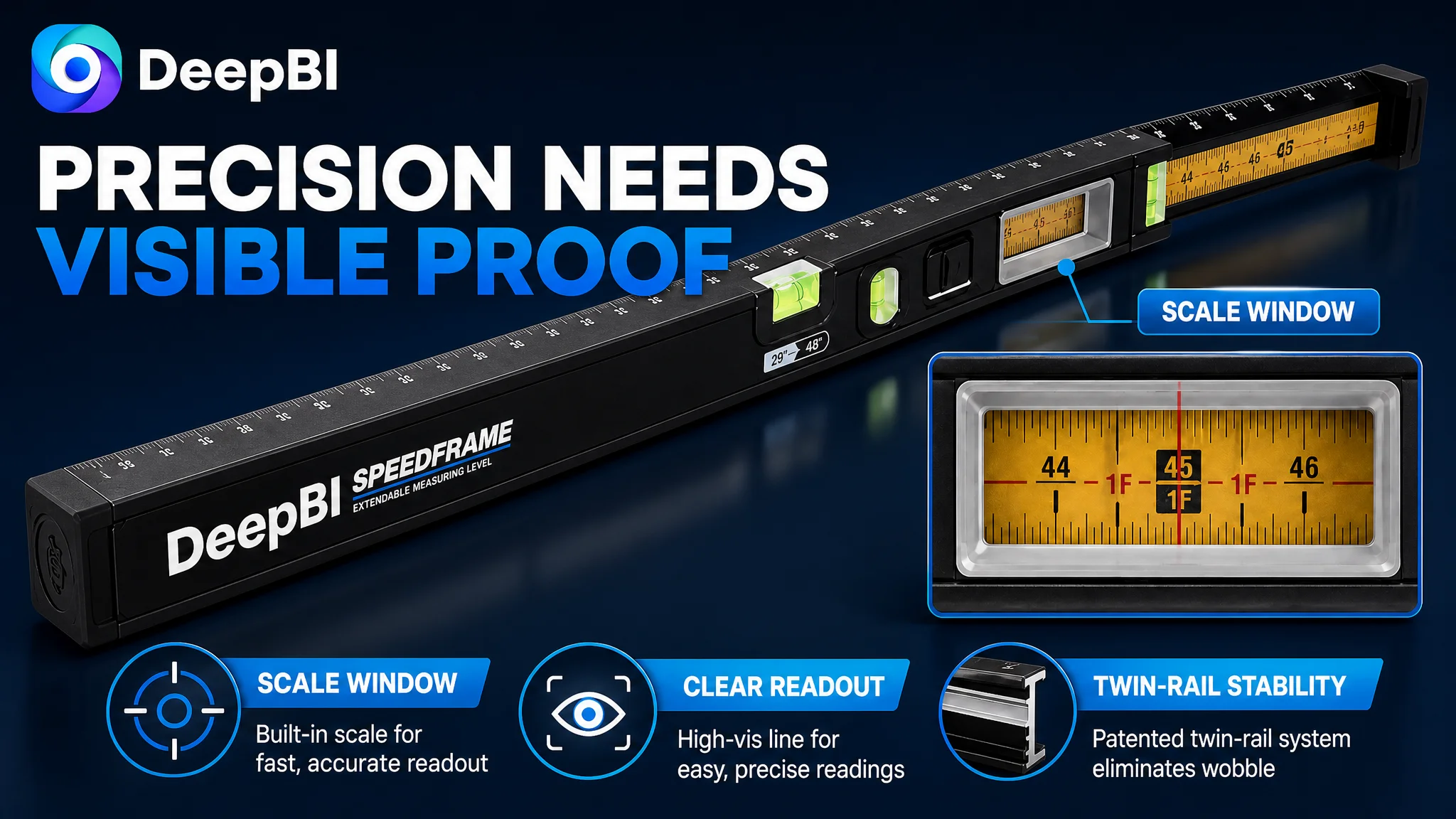
The revised sequence placed accuracy and reliability earlier, using:
- The built-in scale window
- Clear, high-visibility vials
- Precisely machined measurement references
- Measurements that can be locked for later use
The goal was to replace vague precision language with visible or verifiable mechanisms.
The scribing edge needed a real work context
The scribing edge was one of the product's strongest differentiators, but its value was not fully developed through repeated generic descriptions.
The better explanation was practical:
A continuous scribing edge allows consistent line marking even when the tool is fully extended. That connects the feature to framing, layout work, and interior finishing, where inconsistent marking can create rework.
The page needed to show the function as a productivity benefit, not simply name it as a component.
Professional confidence also comes from handling
The benchmark addressed concerns such as front-facing vials, reduced parallax, cushioned grips, and impact resistance. These details helped it appear more credible for frequent jobsite use.
The target Listing did not need to claim features it did not have. It did need to answer comparable concerns using its own verified strengths:
- Smooth extension
- Stable twin-rail movement
- Secure locking
- Easy readout
- Point-to-point precision
- A tool format that reduces the need to carry multiple levels
This distinction reflects an important DeepBI principle: competitive analysis should reveal the buyer doubt being addressed, not encourage unsupported feature imitation.
Why DeepBI Did Not Keep Tuning the Listing in Isolation
The title and bullet recommendations remained useful, but they were not the first repair.
DeepBI's decision was based on the size and nature of the gaps. The title scored above the benchmark, and the bullet points also showed a stronger functional structure. Meanwhile, reviews were dramatically behind, and the main images and A+ content were not converting the product's strongest differences into immediate proof.
That meant further keyword refinement would likely improve discoverability without solving the central trust problem.
The more important decision was to improve the page's ability to receive and convert attention.
If Amazon ads or organic search traffic were increased before that repair, the seller would risk sending more visitors into the same unresolved experience:
- The buyer sees a technically detailed tool.
- The main innovation is not understood immediately.
- Accuracy is asserted more than demonstrated.
- The page does not fully prove professional value.
- The review profile does not provide enough reassurance.
- The buyer delays or chooses a more established alternative.
Advertising can amplify a strong Listing, but it can also amplify the weaknesses already present on the product page.
For this case, the responsible order was therefore:
Repair the Listing's conversion logic first. Then evaluate whether additional traffic can be converted efficiently.
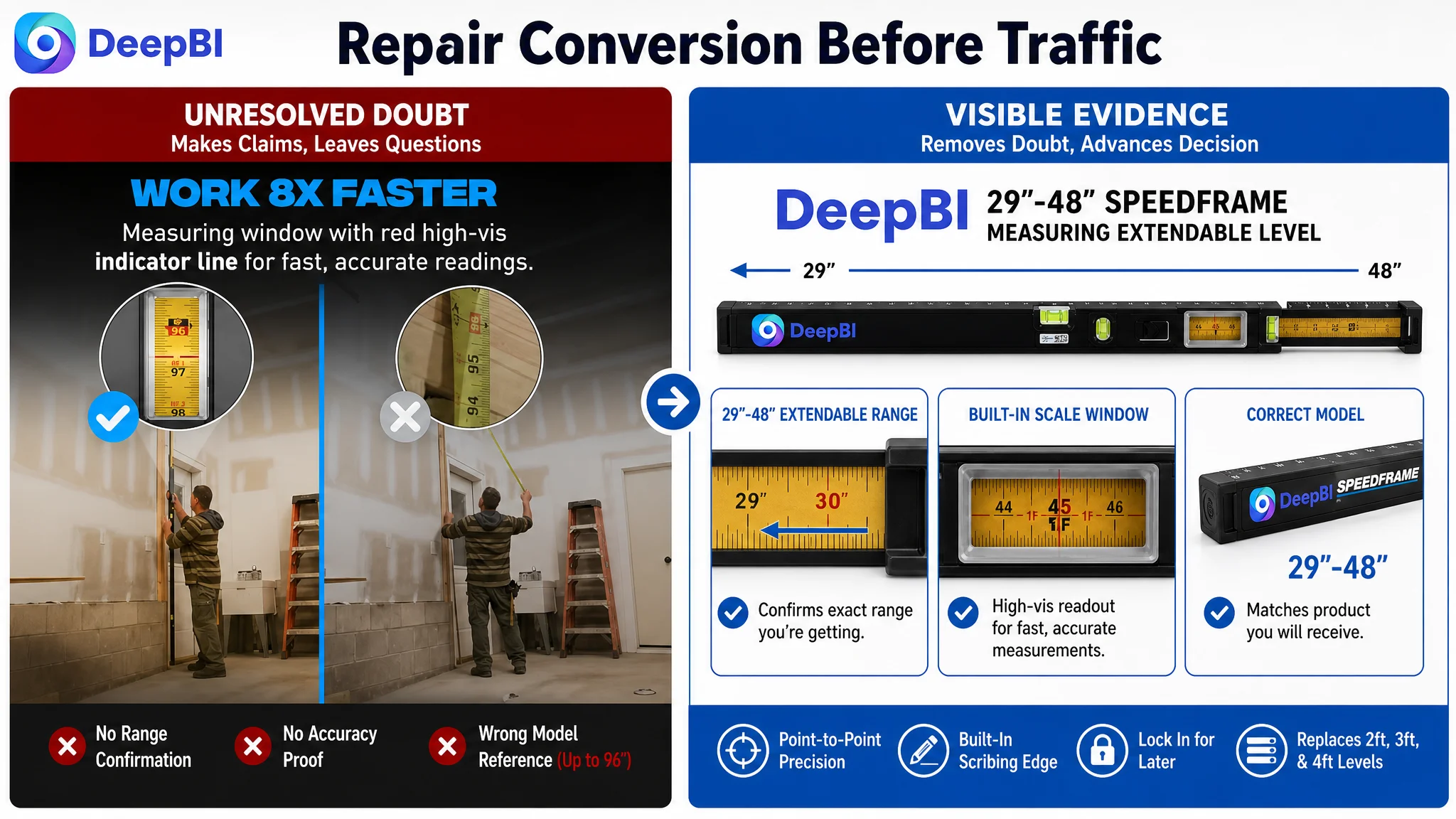
The Optimization Direction Changed From “More Detail” to “Better Decision Coverage”
The revised strategy did not discard the product's technical strengths. It reorganized them around the buyer's decision process.
The title became a clearer search-to-value bridge
The proposed title direction emphasized:
- Extendable Measuring Level
- 29"-48" range
- Twin-rail system
- Built-in scale window
- Professional construction use
- Three vials
- Scribing edge
The purpose was not to add every possible keyword. It was to ensure that the first visible phrase connected the search intent with the product's distinctive value.
The bullet points became evidence-led
The revised bullet structure prioritized:
- High-precision measuring through the scale window
- Flexible range replacing separate standard levels
- Twin-rail durability and stable extension
- Continuous scribing at full extension
- Easy-read accuracy through three visible vials
Each point was expected to answer three questions:
1. What does the tool provide?
2. Where does the buyer use it?
3. What problem does it prevent or solve?
This made the copy more commercially useful without relying on exaggerated claims.
The image sequence became a persuasion path
The main-image strategy shifted toward showing the product in use and clarifying its logic:
- Lead with the actual extendable range.
- Show the scale window at the point of measurement.
- Demonstrate line marking with the scribing edge.
- Show how measurements are read and locked.
- Consolidate the value of replacing multiple conventional levels.
The images were no longer treated as separate demonstrations. Together, they were expected to move the buyer from recognition to confidence.
The A+ page became a professional-use narrative
The revised A+ structure placed greater emphasis on:
- Product identity and jobsite utility
- Accuracy and measurement reliability
- Easy readout and reduced reading uncertainty
- Stable extension and long-term use
- Scribing efficiency
- Smooth handling in professional applications
- Space-saving value compared with carrying multiple levels
This shifted the page from “here are the functions” to “here is how the tool supports the work.”
The Review Gap Could Not Be Designed Away
The Listing score made one limitation especially clear: content optimization could improve understanding, but it could not erase a weak review foundation.
A 3.0-star rating with four reviews creates a different buying environment from a 4.4-star rating with forty-nine reviews. The seller's page had to compensate where it could by making the product's mechanisms, use cases, and value more transparent.
That meant the Listing should avoid vague superlatives and focus on credible product evidence:
- Show the actual measurement process.
- Show the actual scale window.
- Show the actual extension and locking mechanism.
- Show the actual scribing edge.
- Use precise, supportable product language.
- Avoid visual claims that the physical product cannot deliver.
This does not replace the need for stronger customer feedback. It does reduce the amount of uncertainty that the content itself creates.
What Changed in the Seller's Business Understanding
The case did not conclude with unsupported claims about a specific CVR increase or ACOS decline. No post-optimization performance figures were provided, so the business change should be described through the decision state rather than invented results.
The most important change was the order of operations.
The seller moved away from treating the Listing primarily as a keyword and feature container. The product page was reframed as the foundation that determines whether future Amazon traffic becomes useful.
That change produced several clearer operating priorities:
- Main images should explain the product's core innovation before adding secondary detail.
- A+ content should prove professional value rather than repeat functions.
- Bullet points should connect specifications to buyer problems and outcomes.
- The page should show why one extendable level can replace several conventional tools.
- Reviews should be treated as a material conversion constraint, not a minor supporting metric.
- Paid traffic should not be scaled aggressively while the product page still leaves major trust questions unresolved.
The seller's central question therefore changed from:
“How can we describe this tool more completely?”
to:
“What does a professional buyer still need to see before trusting this tool with a real jobsite task?”
The Broader Lesson for Amazon Sellers
A product can have a strong title, differentiated functions, and technically competent bullet points while still underperforming on Amazon.
The missing element may be the page's ability to convert information into confidence.
For this construction-tool Listing, the core advantages were already present:
- Extendable 29"-48" range
- Built-in scale window
- Twin-rail system
- Three vials
- Continuous scribing edge
- Potential to replace multiple standard levels
The problem was that those advantages were not yet arranged into a sufficiently convincing sales logic.
DeepBI's role in the case was not to produce a longer list of edits. It was to identify that the seller was looking at the wrong constraint. The Listing did not primarily need more technical language. It needed clearer proof, stronger sequencing, and a more complete response to professional buyer risk.
Before investing further in Amazon ads, sellers should ask whether their product page can do four things quickly:
- Explain what makes the product different
- Show how the difference works
- Prove why the buyer should trust it
- Make the value of choosing it over alternatives easy to understand
When those conditions are missing, more traffic may only make the underlying conversion problem more expensive.