

This case involves an Amazon US seller of automotive dash cameras whose Listing had a familiar problem: the product offered clear technical specifications, but the product page did not give shoppers enough reasons to trust those specifications. The issue was not a lack of information alone. It was the gap between what the dash cam could do and how quickly the Amazon product page could make those benefits understandable.
The initial working assumption was that the Listing mainly needed more detailed specifications, better-organized images, and stronger keyword coverage. That direction addressed visible content gaps, but it did not fully explain why a comparable competitor Listing was creating a more convincing buying path.
DeepBI’s diagnosis placed the main constraint elsewhere: the Listing was underperforming as a conversion system. Its title, main image, bullet points, detail content, and review foundation were not working together to reduce purchase uncertainty. The later optimization therefore focused on making the product’s value visible through driving scenes, parking protection, evidence locking, wide-angle coverage, night recording, installation, and included accessories.
For other Amazon sellers, the lesson is direct: before increasing paid traffic or rewriting isolated modules, determine whether the product page is prepared to convert the traffic it receives. A technically capable product can still lose orders when its Amazon Listing explains features without building confidence.
The Amazon Listing Had a Product, but Not Yet a Strong Buying Argument
The target Listing received an overall score of 58 out of 100, compared with 82 out of 100 for a comparable high-performing Listing in the same automotive accessories category.
A 24-point gap is not a cosmetic difference. It indicates that the page was losing persuasive strength across several stages of the Amazon buying journey.
- Title: Target Listing: 12/20, Comparable Listing: 16/20, Gap: -4
- Main image: Target Listing: 23/30, Comparable Listing: 26/30, Gap: -3
- Bullet points: Target Listing: 6/10, Comparable Listing: 8/10, Gap: -2
- Detail content: Target Listing: 17/25, Comparable Listing: 22/25, Gap: -5
- Reviews: Target Listing: 0/15, Comparable Listing: 10/15, Gap: -10
- Total: Target Listing: 58/100, Comparable Listing: 82/100, Gap: -24
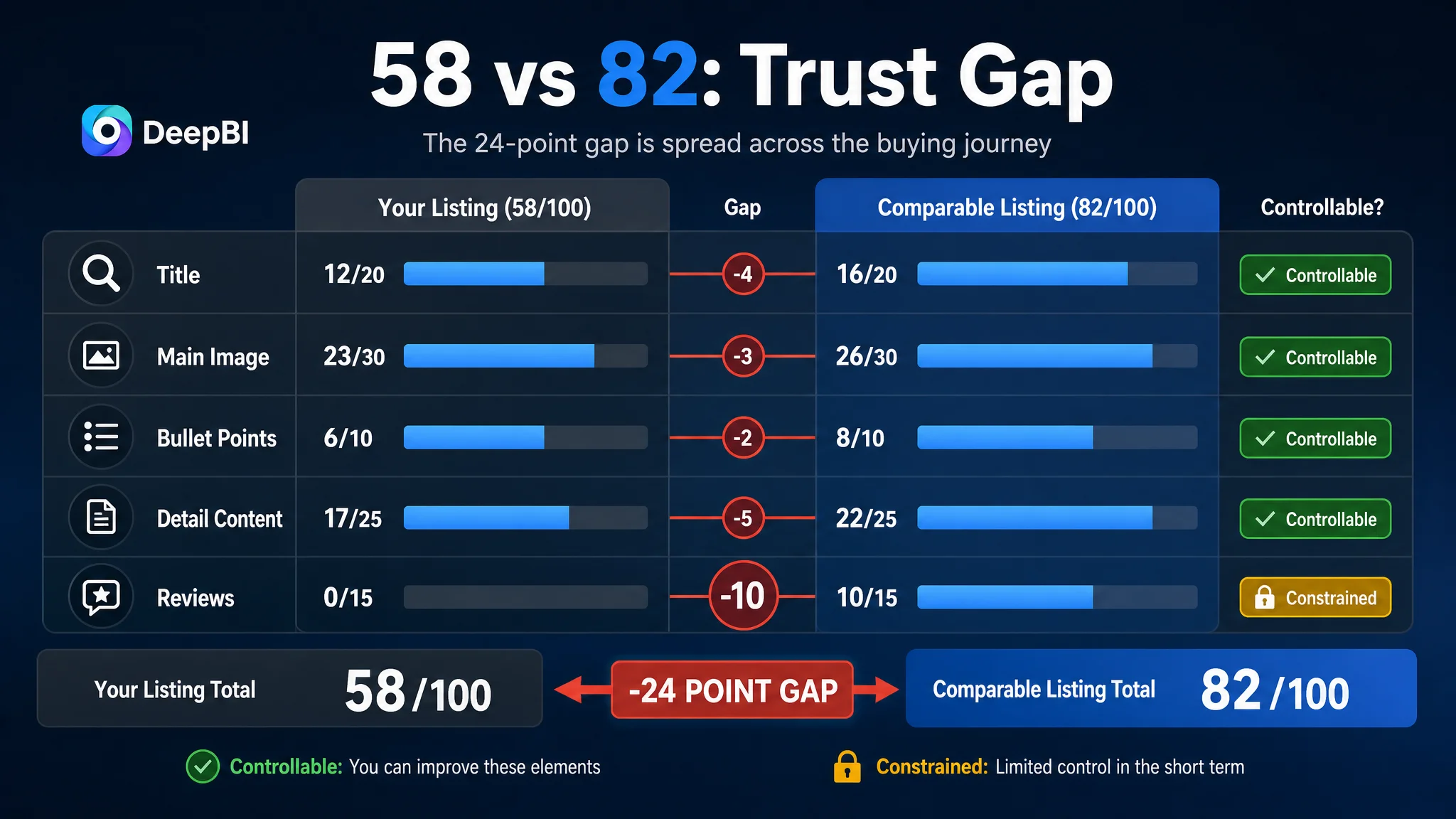
The largest gap was in reviews, but the diagnosis could not stop there. A new or review-light Amazon Listing cannot immediately manufacture a mature review base. That meant the controllable page elements had to carry more of the trust burden.
The page needed to communicate three things quickly:
- What the dash cam captures
- How it protects the driver after an incident
- Why this particular product would be practical to install and use
Instead, several parts of the Listing were presenting information without forming a clear decision sequence.
The page did not lack product claims. It lacked a convincing order in which those claims could be believed.
The First Misdiagnosis: Treating Content Gaps as Isolated Fixes
The initial direction was understandable. The Listing needed stronger keywords, clearer specifications, improved imagery, and more complete feature coverage. These are common areas for Amazon optimization, especially in a technical category such as dash cameras.
But the working assumption was too narrow: that adding or refining individual pieces of information would be enough.
The title could be made more keyword-focused. The images could show more features. The bullets could include more specifications. The detail page could explain storage and loop recording in greater depth.
Those changes might improve completeness, but completeness is not the same as conversion.
A shopper looking at a dash cam is not only asking:
- Is it 1080P?
- Does it have a 120-degree lens?
- Does it support loop recording?
- Is a TF card included?
The shopper is also asking:
- Will it capture useful evidence when something goes wrong?
- Can I understand the image quality before buying?
- Will installation be difficult?
- Will the product stay discreet behind my mirror?
- What happens while my vehicle is parked?
- Can I trust the page if there are few or no reviews?
The customer’s original page tended to answer the first group of questions. The stronger reference Listing was better at addressing the second.
That distinction changed the diagnosis from “the Listing needs more information” to “the Listing needs a more persuasive sales logic.”
The Title Was Searchable, but Not Yet Commercially Specific
The title scored 12 out of 20, four points below the comparable Listing.
The gap was not simply a matter of missing keywords. It reflected a difference in how the product was positioned in search results.
The comparable Listing made its category and major use cases clear through a structure built around:
- The dash cam product type
- Dual-view positioning
- Front and interior recording
- G-Sensor protection
- Parking mode
- Night vision
- Storage support
The target title used broader wording such as “Super Night Vision” and did not communicate the product’s key safety functions with the same specificity. The core product type and its use case were also not organized as clearly for mobile scanning.
DeepBI’s suggested direction placed “1080P Full HD Dash Cam for Cars” near the beginning, then connected the product type with wide-angle recording, night vision, G-Sensor functionality, parking mode, loop recording, and compatibility with trucks and SUVs.
The goal was not to fill the title with every possible term. It was to make the title perform two jobs at once:
1. Help Amazon understand the product and its search relevance
2. Help shoppers understand the product’s practical role before they open the page
The title therefore needed to move from general capability language toward a clearer combination of product identity, safety function, and usage context.
The title’s missing layer was outcome-oriented specificity
“Night vision” is a feature.
“G-Sensor” is a function.
“Automatically locking impact footage as evidence” is closer to a buying reason.
That difference matters throughout an Amazon Listing. Search terms create the entry point, but concrete use cases create the conditions for conversion.
The Main Image Showed the Product, but Not the Reason to Choose It
The main image dimension scored 23 out of 30. The image was clear enough to identify the product, but it was less effective at creating immediate attention and confidence than the comparable Listing.
The most important weakness was not product visibility. It was the lack of visual evidence.
The target image set leaned heavily on static product presentation and text-based explanation. The stronger reference Listing used more visual context:
- Dual-screen and driving scenes
- Real road conditions
- Interior recording context
- Night footage
- Functional visual overlays
- More direct demonstrations of coverage and protection
For a dash cam, this difference is commercially important. Buyers are not purchasing an abstract camera. They are purchasing a record of what happens on the road and around the vehicle.
A static product close-up can establish what the device looks like. It cannot, by itself, answer whether the product can capture a license plate at night, cover multiple lanes, or protect an incident recording from being overwritten.
In this category, the image must show more than the device. It must show what the device makes possible.
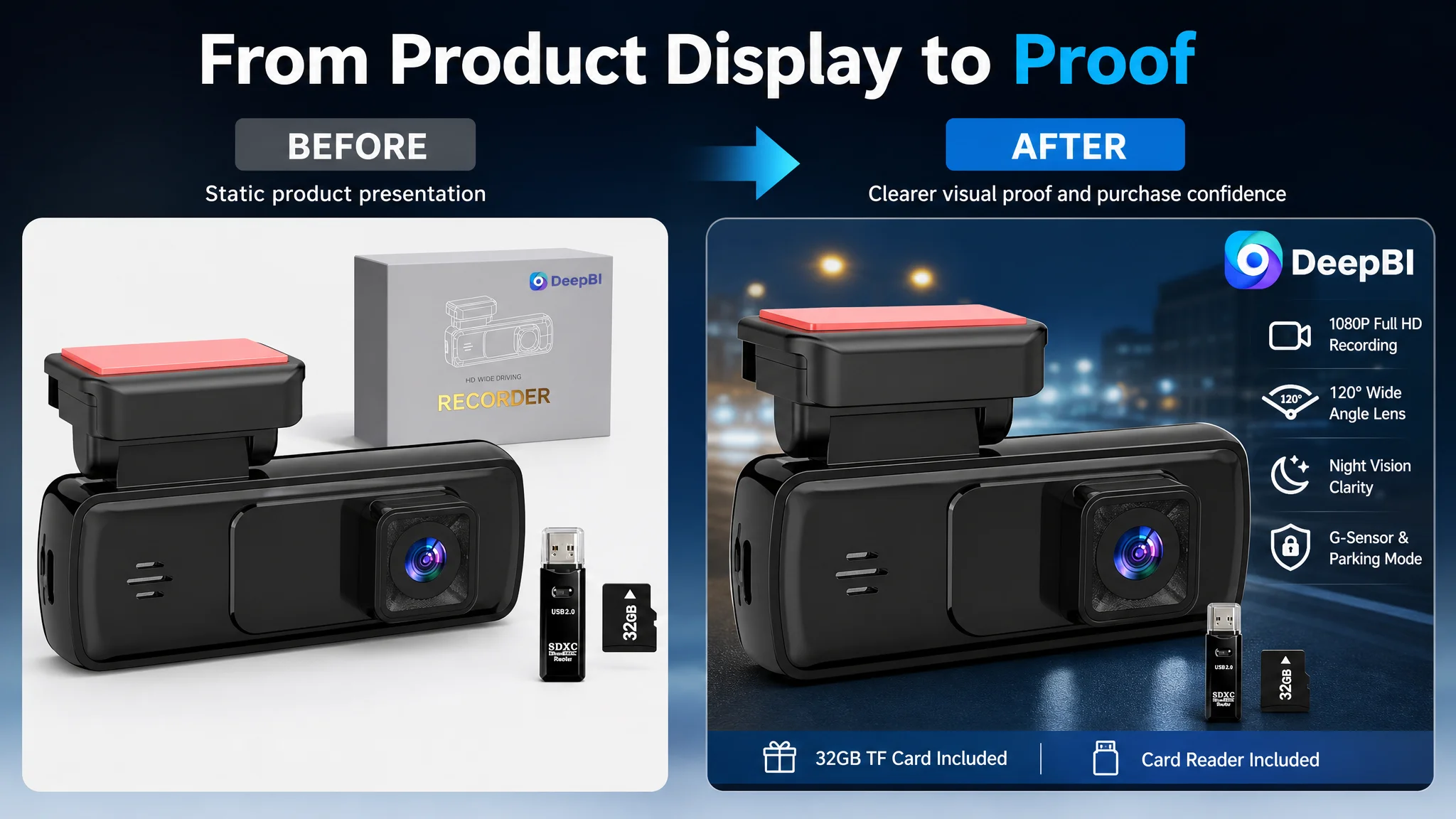
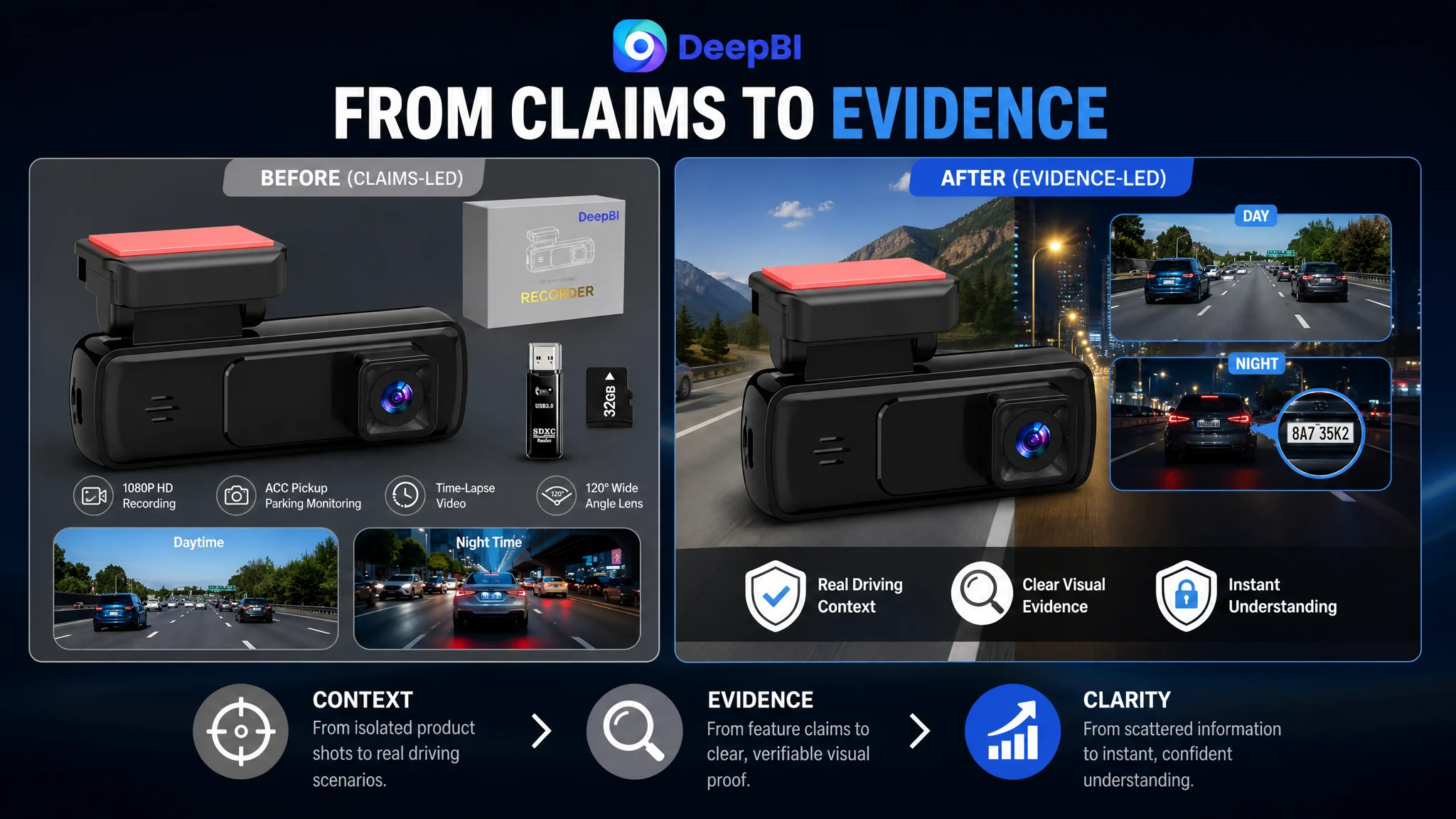
The later visual direction therefore focused on transforming technical claims into visible evidence:
- A clean product-centered presentation with the included 32GB card and reader
- A realistic vehicle interior to communicate installation and use
- Day-and-night recording comparisons to make 1080P more tangible
- A 120-degree road-coverage visualization
- A parking-monitoring scene in a dark garage
- An impact scenario showing footage being locked
- A clear view of the TF card and recording workflow
- A structured accessories layout to communicate completeness
These were not independent image concepts. Together, they created a sequence from product recognition to functional proof to purchase confidence.
The Bullet Points Listed Features Without Leading the Shopper
The bullet-point score was 6 out of 10, two points below the comparable Listing.
The difference was primarily structural.
The target bullet points placed greater emphasis on technical specifications, physical dimensions, and general product descriptions. The comparable Listing led with the most important user-facing value:
- Dual-camera coverage
- Fast installation
- Parking protection
- G-Sensor evidence locking
- Loop recording and night vision
This ordering reduced the shopper’s cognitive effort. It began with the question, “What problem does this solve?” and then explained how the product solved it.
The revised bullet strategy followed a more commercially useful sequence.
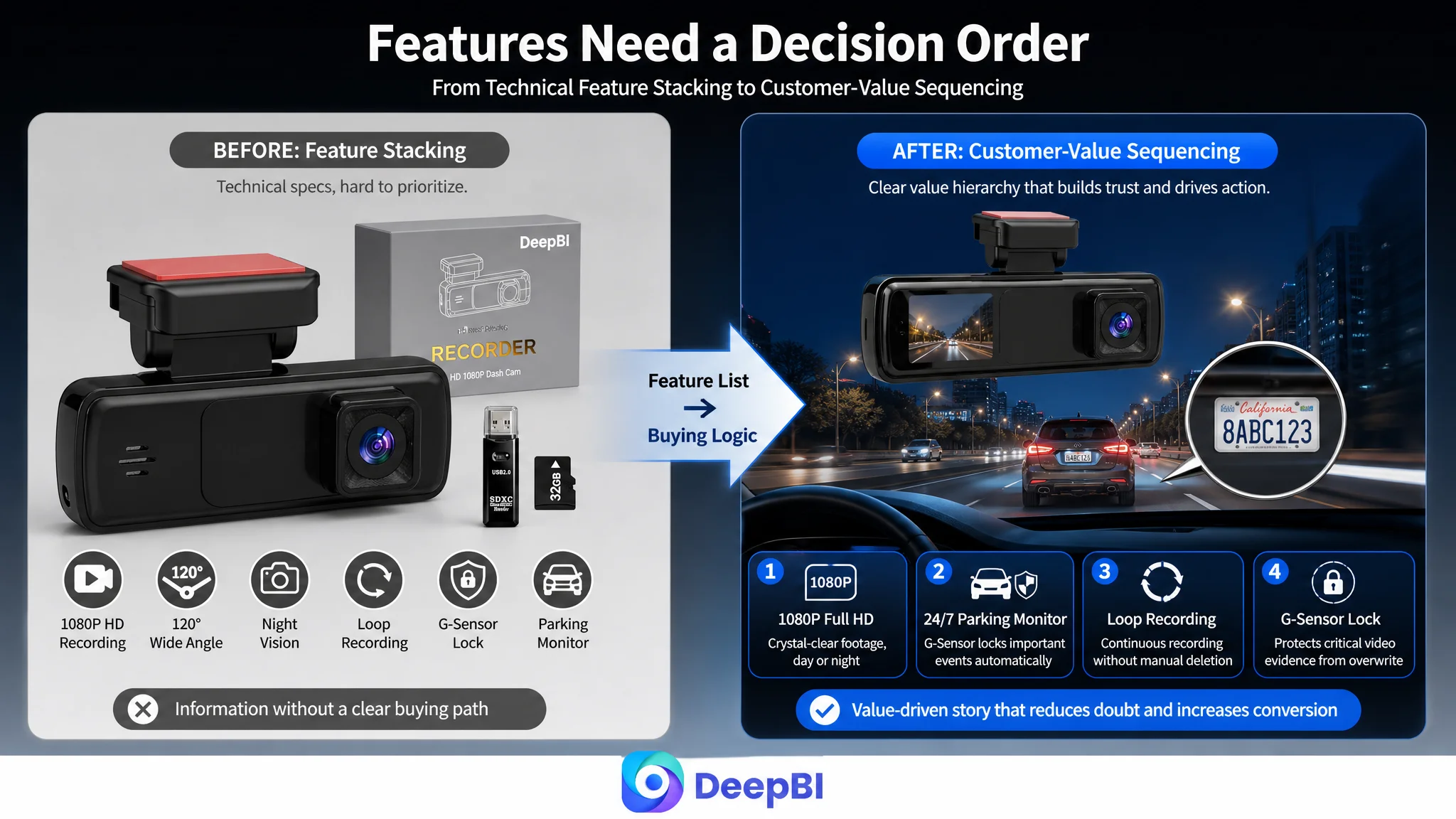
1080P recording should lead to usable evidence
The revised first bullet connected 1920x1080P recording, a 120-degree lens, night capture, and the built-in screen. The important improvement was not only the presence of specifications. It was the connection between those specifications and immediate playback when a phone or computer was not available.
Installation should reduce hesitation
The second bullet emphasized the included 32GB TF card and reader, a compact form factor, and a one-minute installation process. This moved the message away from physical dimensions and toward a practical promise: the customer can begin using the product with fewer additional purchases and less setup anxiety.
Parking mode should be presented as protection
The third bullet connected 24-hour parking monitoring with G-Sensor detection and automatic file locking. It also preserved the important limitation that a dedicated hardwire kit is required for continuous 24-hour power.
That qualification matters. A conversion-focused Listing still has to remain accurate. Overstating parking capability may create short-term interest but can produce confusion, negative feedback, and returns later.
Durability should support trust, not distract from it
The fourth bullet used the product’s stated heat-resistant materials, operating range, compact profile, and adhesive mount to establish reliability in real vehicle conditions.
Loop recording should finish the daily-use story
The fifth bullet explained automatic overwriting, packaging, the user guide, and customer support. This positioned the dash cam not only as a technical device, but as a product intended for ongoing daily use.
The key change was the movement from:
Specification → specification → specification
to:
User concern → product function → practical outcome
That is the difference between information density and buying logic.
The Detail Page Was the Largest Controllable Conversion Gap
The detail-page dimension scored 17 out of 25, five points below the comparable Listing. This was the largest gap among the controllable content modules.
The target detail page included useful material:
- Product and feature imagery
- TF card and loop-recording information
- Recording-duration comparisons
- Front-camera demonstrations
- Wide-angle lens details
- Package contents
But the content was organized more like a technical explanation than a decision journey.
The comparable Listing used a stronger narrative chain:
Problem → consequence → protection
For example, a collision or dispute leads to concern about evidence. The G-Sensor then automatically locks the footage, reducing the risk that the relevant file will be overwritten.
The target page described functions, but did not consistently connect them to the situations that make those functions valuable.
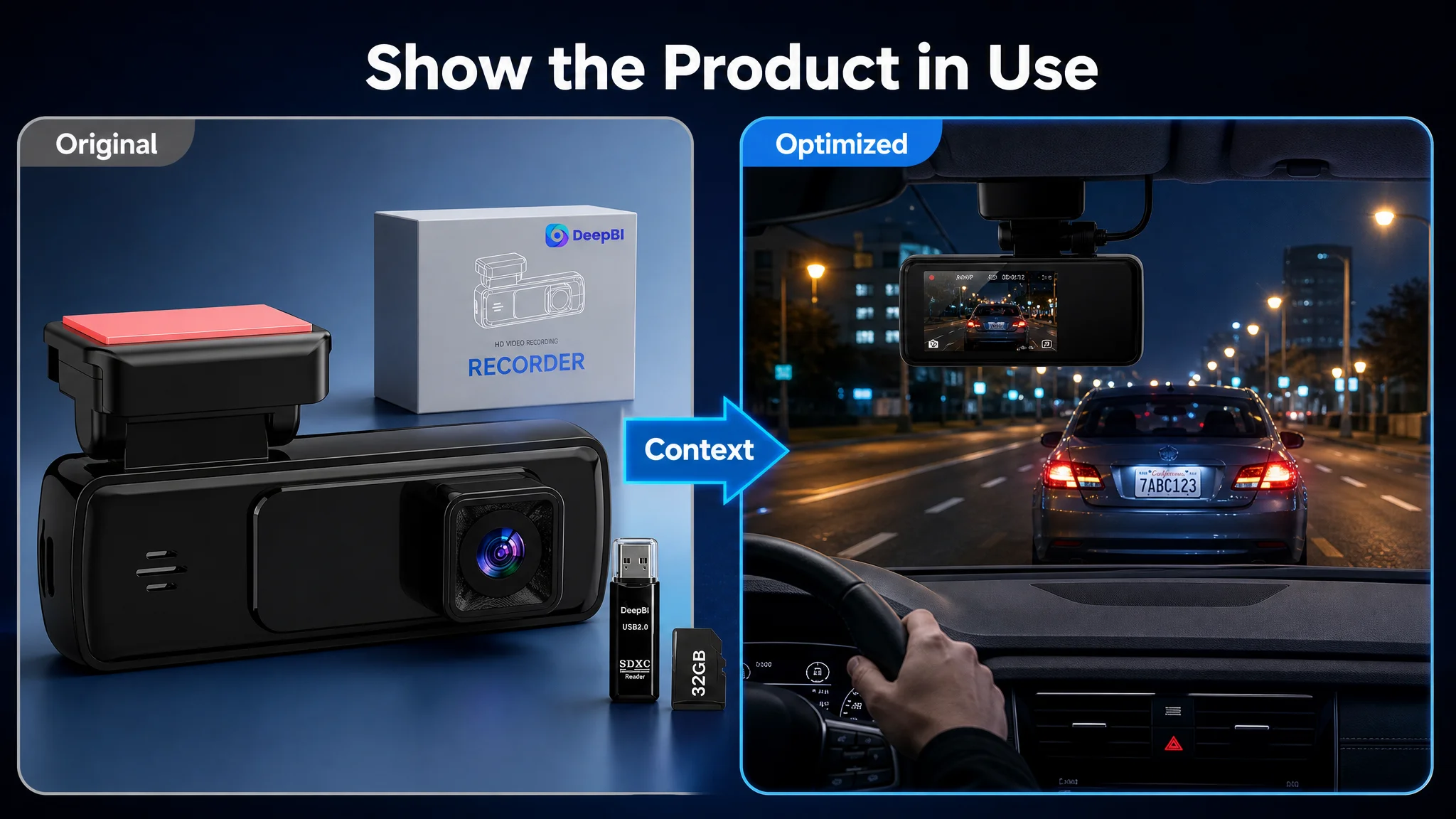
The product needed to appear in the driver’s world
The first proposed detail module placed the dash cam behind the rearview mirror from a driver’s perspective, with an open road visible through the windshield.
That scene addressed two important concerns at once:
- How discreet the installation looks
- What the driver can see after installation
A product image says, “This is the device.”
A realistic driving perspective says, “This is how the device fits into your daily use.”
Parking mode needed a clearer protection structure
The target Listing had parking-monitoring capability, but the expression was dispersed. The revised direction grouped three distinct functions:
- Collision detection
- Time-lapse recording
- Low-voltage protection
Presenting these as a unified parking-monitoring system made the function easier to understand and gave the page a stronger sense of continuous protection.
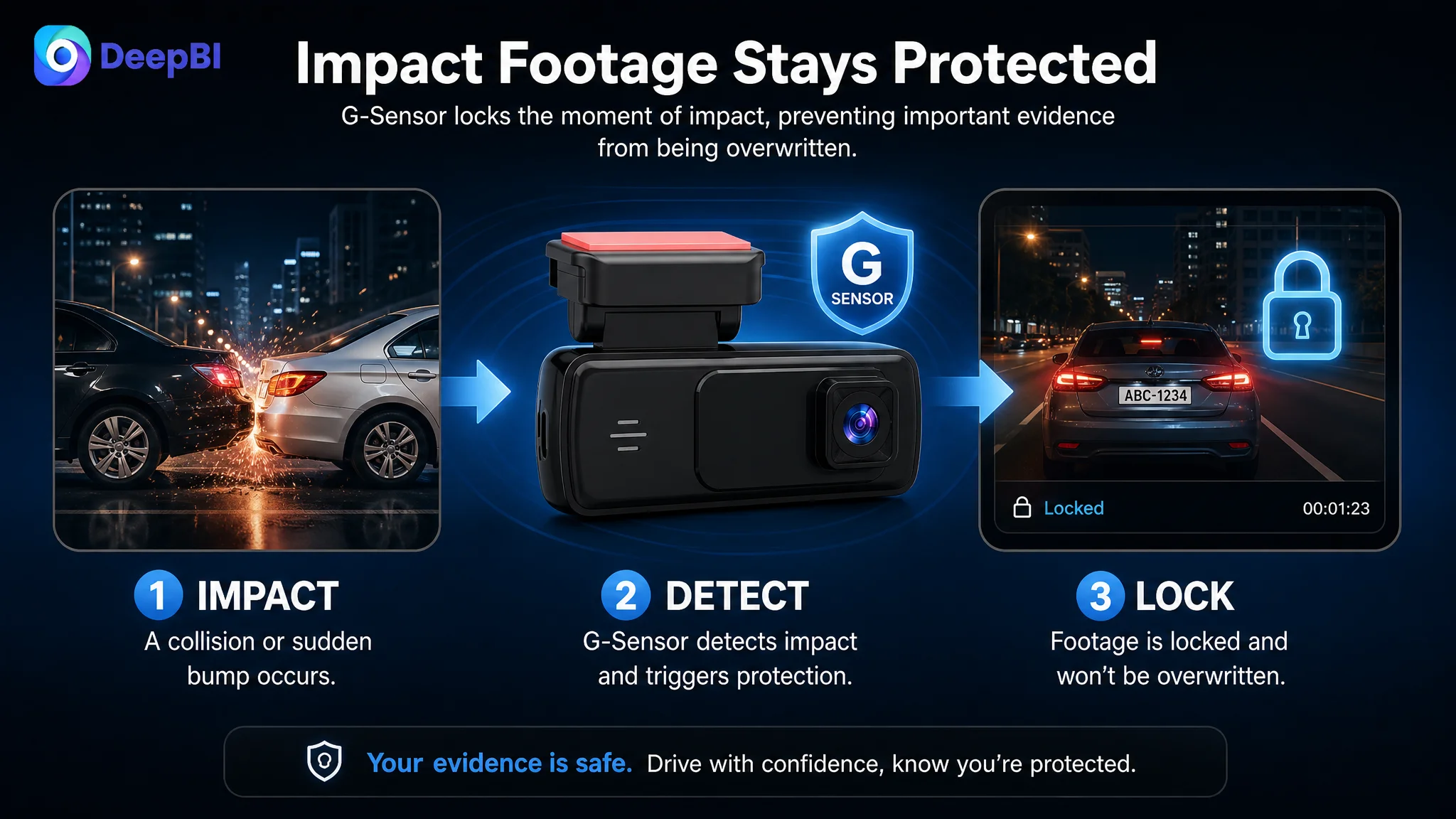
G-Sensor needed a visible consequence
The G-Sensor was present in the product information, but it was not given enough narrative weight.
The proposed visual treatment showed a minor collision, a highlighted lock symbol, and a filmstrip containing protected footage. This was designed to answer a specific concern:
If an incident happens, will the relevant video still be available afterward?
That is a more powerful question than whether the product merely includes an impact sensor.
Wide angle needed to be converted from a number into coverage
“120 degrees” is technically precise but visually abstract.
The proposed overhead road view used a transparent coverage area extending across three lanes. This allowed the shopper to interpret the number as a practical field of view rather than as an isolated specification.
Night vision needed proof, not another label
The revised detail module contrasted a conventional blurred night image with a clearer 1080P recording and used a magnified view of a license plate area.
The purpose was not to claim performance beyond the product’s stated capability. It was to make the existing resolution and night-recording proposition easier to evaluate.
Accessories needed to reinforce readiness
The TF card, reader, car charger, adhesive, and manual were reorganized into a clean, labeled package layout.
This addressed a common source of hesitation: whether the buyer will have everything needed to begin using the product.
The page therefore moved from a collection of product explanations toward a more complete sequence:
1. Install the camera
2. Understand what it sees
3. See how it protects parked vehicles
4. Understand how footage is locked
5. Interpret the viewing angle
6. Evaluate night recording
7. Confirm what is included in the box
Reviews Were a Trust Constraint, Not a Copywriting Problem
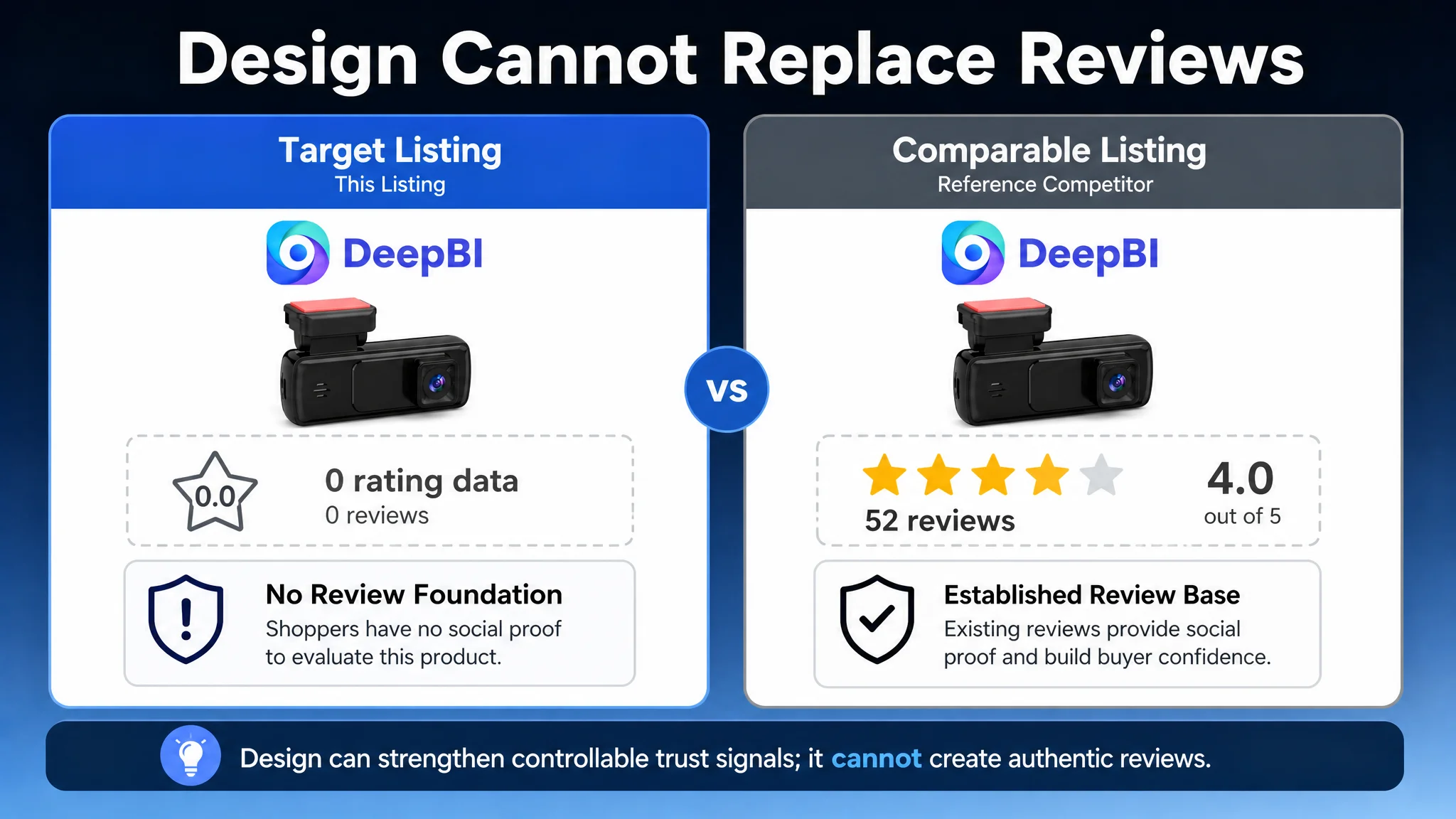
The review dimension scored 0 out of 15. The Listing had no rating data and no reviews displayed on the first page, while the comparable Listing had a 4.0-star rating, 52 total reviews, and eight reviews visible on its first page.
This difference created a significant trust disadvantage.
The comparable Listing was not perfect. Its visible review set included lower-rated feedback, and those reviews reduced the overall strength of its rating profile. But even an imperfect review base provides shoppers with evidence that the product has been purchased and used.
The target Listing had no such evidence.
That meant the page could not solve the review gap through visual polish alone. The correct response was not to imitate the competitor’s review volume or make unsupported claims about customer satisfaction. It was to strengthen every controllable trust signal while the review foundation remained limited:
- Clear product demonstrations
- Accurate parking-mode limitations
- Visible installation guidance
- Concrete evidence-locking logic
- Transparent accessory presentation
- More professional visual consistency
- Practical customer-support information
This is an important distinction for Amazon sellers:
When review trust is weak, the Listing has to become more precise—not more exaggerated.
The page cannot replace authentic customer feedback, but it can avoid adding uncertainty through vague claims, scattered information, or unsupported visual promises.
Why DeepBI Did Not Treat This as an Image-Beautification Task
The recommendations were detailed at the production level: camera angles, visual hierarchy, road scenes, night conditions, icon placement, color direction, and component layout.
But the value of the diagnosis was not the number of image instructions. It was the reason those instructions were prioritized.
DeepBI first established the competitive gap through a structured comparison across five Listing dimensions:
- Title
- Main image
- Bullet points
- Detail content
- Reviews
It then separated structural problems from constraints that could not be solved immediately.
The review gap was real, but it was not an immediate design task. The title gap was important for search clarity, but title changes alone would not resolve the page’s trust deficit. The main image gap affected attention, but a better thumbnail would still send shoppers to a page that lacked enough functional proof.
The most urgent controllable constraint was the relationship between visual evidence and product-page conversion.
That is why the optimization did not begin with a random collection of new images. It began with a hierarchy:
1. Make the product type and primary safety value clear
2. Establish a credible installation and driving context
3. Visualize parking protection and evidence locking
4. Make viewing angle and night recording tangible
5. Confirm included accessories and ease of use
6. Align the title and bullets with the same buying logic
This order reduced the risk of improving one module while leaving the rest of the page commercially disconnected.
Advertising Should Not Be Asked to Repair a Low-Trust Page
There was no advertising performance dataset in the case material, so the case does not claim a specific ACOS, CTR, or CVR change.
The business logic is still clear.
Amazon ads can bring a shopper to the product page. They cannot independently make a vague title specific, turn a static product image into evidence, or create trust where the page has not explained how the product protects the buyer.
If paid traffic is sent to a Listing that does not communicate its value quickly, advertising may amplify the page’s weaknesses:
- More impressions without enough clicks
- More clicks without enough confidence
- More traffic reaching a page that explains features but does not resolve objections
That is why the correct decision was to repair the Listing’s conversion capacity before treating additional traffic as the primary answer.
Advertising is not always the source of the efficiency problem. Sometimes it is the mechanism exposing a product page that is not ready to convert.
For this dash cam Listing, the page had to become more capable of converting both paid and organic visitors. Only then could advertising data be interpreted more reliably.
The Optimization Direction Shifted from Features to Decision Relief
The final direction did not change the product’s physical identity. It changed how the product’s existing capabilities were presented.
The revised Listing logic centered on the customer’s decision concerns:
- Will the footage be clear enough?
Show 1080P recording, night visibility, and the built-in screen.
- Will installation be difficult?
Show the compact behind-the-mirror position, simple setup, and included TF card.
- What happens when the vehicle is parked?
Explain collision detection, time-lapse recording, low-voltage protection, and the hardwire-kit requirement.
- Will an incident file be protected?
Show G-Sensor detection and automatic locking.
- How much of the road will be visible?
Turn the 120-degree specification into a road-coverage visual.
- What arrives in the package?
Present the accessories in an organized, easy-to-check layout.
This is where DeepBI’s role was most valuable. It did not treat AI-generated images as a separate creative exercise. The visual recommendations were tied to the specific gaps found in the Amazon Listing and constrained by the product’s actual attributes.
The product could be placed in a more realistic environment, but its physical design and specifications could not be invented. The page could use stronger visual storytelling, but it could not claim unsupported functions. The competitor could serve as a reference for information structure and visual clarity, but not as a template to copy.
What Changed in the Business Understanding
The case did not provide verified post-optimization performance data. Therefore, it would be inappropriate to claim a specific CVR increase, ACOS decline, or organic-order recovery.
What did change was the operating judgment.
The seller’s problem was no longer viewed as a series of disconnected content defects. It became a conversion-system problem with a clear decision order:
- Reviews created a significant trust disadvantage but could not be solved through design alone.
- The title needed stronger product and safety positioning.
- The main image set needed more immediate visual evidence.
- The bullet points needed to lead with customer value rather than technical detail.
- The detail page needed a problem-to-protection narrative.
- Advertising should not be treated as the first lever until the Listing could better receive and convert traffic.
That reframing made future testing more controllable. Instead of changing images, title wording, and bullets without a shared hypothesis, the team could evaluate whether each change strengthened a specific stage of the Amazon buying journey.
The Broader Lesson for Amazon Sellers
This dash cam case is not mainly about whether a product image should use a darker blue background or whether a title should contain one more keyword.
It is about recognizing when a page is technically complete but commercially under-explained.
A Listing can contain:
- A valid product
- Real specifications
- Multiple images
- Functional bullet points
- A+ content
- A competitive price
And still fail to convert efficiently if those elements do not work together.
The most useful diagnostic questions are therefore not limited to “What information is missing?” They should also include:
- Does the main image create a reason to click?
- Does the title communicate the product’s core use case?
- Do the bullet points connect features to buyer concerns?
- Does the detail page show what happens in real use?
- Does the page address the risk the customer is actually trying to avoid?
- Can the Listing convert traffic before more traffic is added?
For the target Amazon dash cam Listing, the answer required more than a content refresh. It required a shift from specification display to evidence-led conversion.
The page did not need to say more about the product. It needed to make the product’s value easier to believe.