

Introduction
After switching Amazon Ads from a legacy setup to intelligent management, sellers often face an unsettling situation: advertising data appears to improve, while overall sales temporarily decline. Does a lower ACOS indicate improved advertising efficiency, or is it merely a short-term fluctuation caused by reduced budgets, lower traffic, and the system's learning phase? This article analyzes the real operating situation of a single-product seller on the UK marketplace. The customer had only 1 ASIN, a profit of approximately £6 per unit, and historically high advertising ACOS, reaching approximately 639.7% in the highest week. After adopting DeepBI intelligent Ads management, the account generated 2 advertising orders in the first week, with an ACOS of 53.83%, but sales subsequently declined by approximately 44% for a period. By distinguishing advertising efficiency, traffic replacement, and changes in organic sales, this case demonstrates that sellers should not decide to stop advertising or increase budgets based solely on sales in a single week. Instead, they should evaluate orders, advertising sales, spend, ACOS, and traffic quality together.
Customer Background
This was an e-commerce seller operating a single-product business on the UK marketplace. The product was a mobile accessory led by its inventor, and the store relied primarily on 1 ASIN to generate sales.
The customer's operating constraints were typical. On the one hand, the product generated approximately £6 in profit per unit, so even slightly uncontrolled advertising spend could directly erode profitability. On the other hand, the customer operated the business alone and had limited time available for advertising management and data analysis. Therefore, the customer needed advertising to generate more orders while being unable to accept continuously increasing spend without a clear profitability boundary.
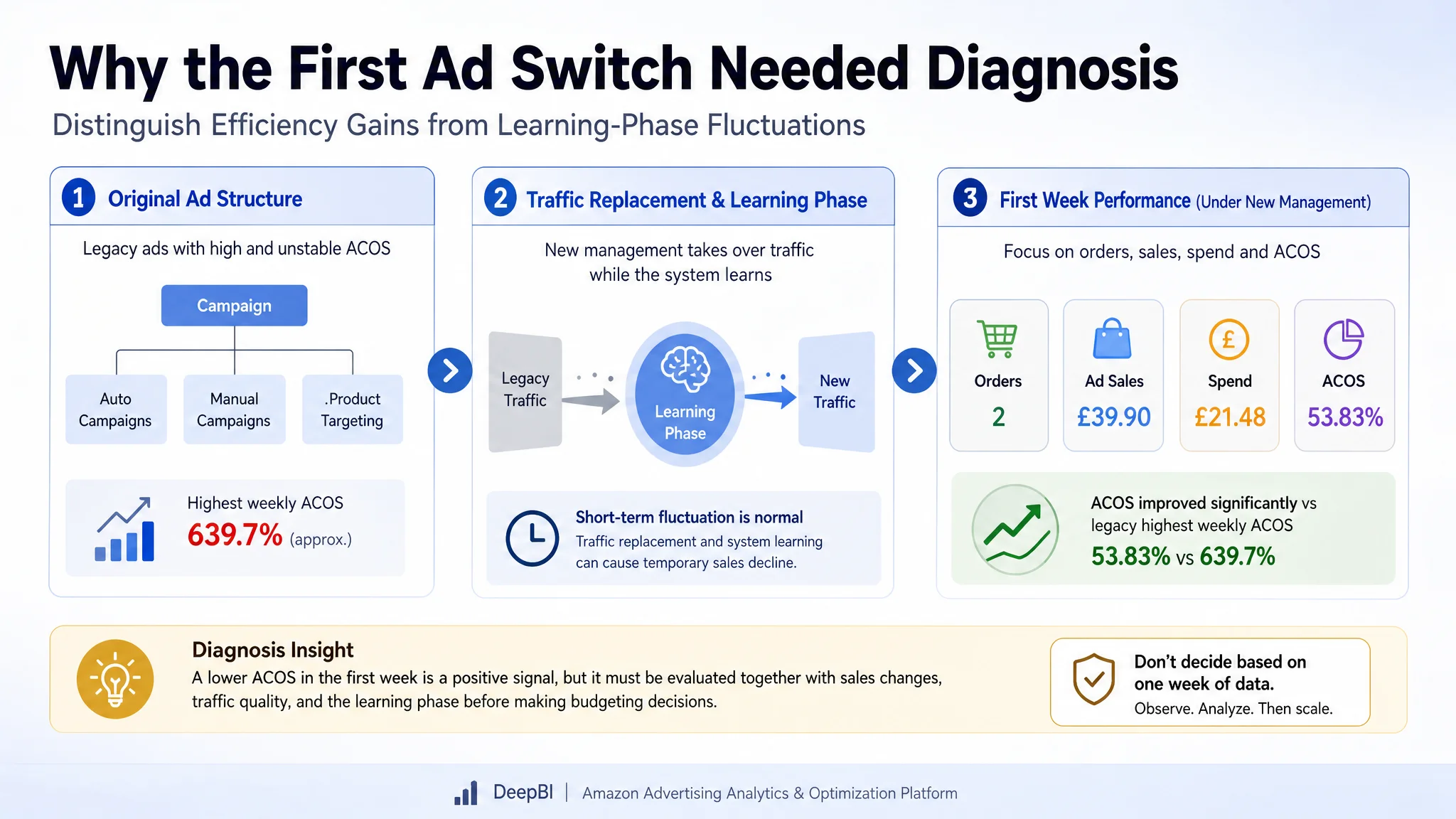
Before connecting to DeepBI, the legacy advertising ACOS remained high and fluctuated significantly, reaching approximately 639.7% in the highest week. At the same time, the product Listing did not sufficiently communicate its functions, use cases, and reasons to trust the product. This meant that the advertising problem might not have been limited to bids or budgets; it could also have involved traffic quality and the Listing's ability to convert incoming traffic.
After the store was connected and advertising authorization was completed, the customer launched intelligent Ads management. The key question was not whether the new advertising setup would immediately generate more sales, but rather: after the advertising switch, which changes represented improved advertising efficiency, and which were still part of the learning phase and traffic replacement process?
The Problem
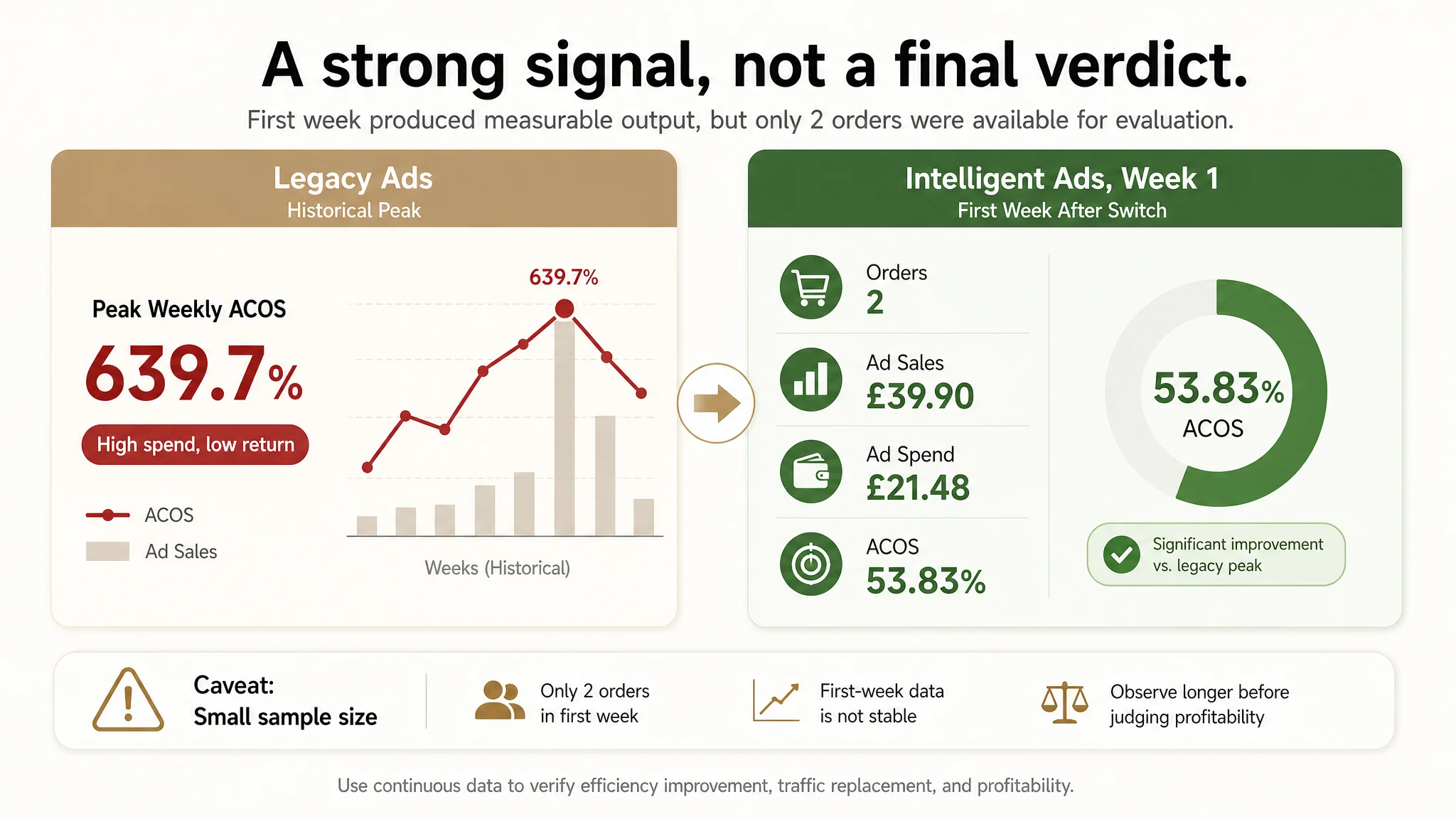
Before the advertising switch, the customer faced a conflict between high ACOS and low profit. The product generated approximately £6 in profit per unit, while the highest weekly ACOS of the legacy advertising reached approximately 639.7%. There was no stable relationship between advertising investment and sales output. Under these circumstances, even if advertising generated impressions, it might not produce an acceptable cost per order.
In the first week after adopting intelligent Ads management, the data showed positive changes: advertising generated 2 orders, advertising sales were £39.90, spend was £21.48, and ACOS was 53.83%. Compared with the highest weekly ACOS of approximately 639.7% under the legacy advertising, the first week's ACOS had already decreased significantly.
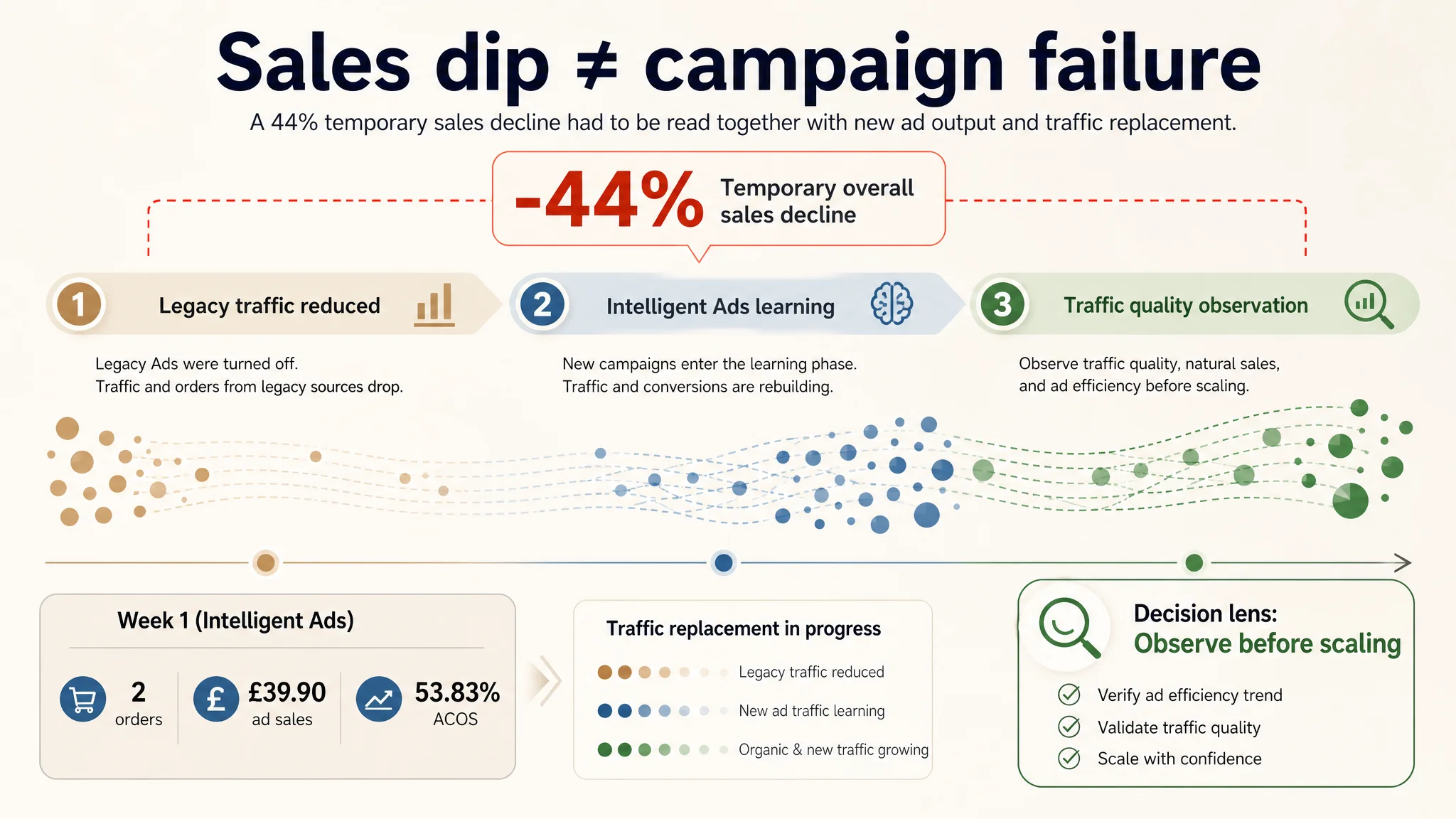
However, a problem emerged at the same time. The customer subsequently turned off most of the legacy advertising in the hope that the new advertising setup would take over traffic more actively and increase sales. After the advertising structure changed, overall sales temporarily declined by approximately 44%. For a store with only 1 ASIN and a small sales volume, changes in sales can easily be overinterpreted:
- Did the new advertising fail to cover the effective traffic previously generated?
- Did organic sales also suffer after the legacy advertising was turned off?
- Was the first week's ACOS of 53.83% merely an accidental result caused by a very small number of orders?
- Should the seller continue observing, or increase the budget immediately?
This is one of the most common decision-making challenges when switching Amazon Ads. A lower advertising ACOS does not necessarily mean that overall business performance has improved, and lower sales do not necessarily mean that the new advertising setup has failed. Both need to be analyzed within the same evaluation framework.
How DeepBI Diagnosed
DeepBI did not treat the change in weekly sales as a direct conclusion about the success or failure of the advertising setup. Instead, it evaluated two questions: whether advertising efficiency had improved and whether traffic had been effectively replaced.
1. First, compare the core outputs of the legacy and intelligent advertising
The diagnosis first focused on orders, advertising sales, spend, and ACOS, rather than impressions or clicks alone. The legacy advertising had reached a highest weekly ACOS of approximately 639.7%; intelligent advertising generated 2 orders in its first week, with advertising sales of £39.90, spend of £21.48, and an ACOS of 53.83%. This showed that the new setup had at least generated measurable advertising output in its first week and could not simply be categorized as having “no effect.”
2. Next, evaluate advertising data together with changes in overall sales
After the advertising data improved in the first week, the customer turned off most of the legacy advertising, and overall sales temporarily declined by approximately 44%. The focus of the diagnosis therefore expanded from “Did ACOS decrease?” to “Did the advertising switch cause short-term fluctuations during the traffic replacement process?” Looking only at the advertising report could overlook changes in organic sales and legacy advertising traffic; looking only at total sales could overlook the orders and sales already generated by the new advertising.
3. Distinguish learning-phase fluctuations from sustained efficiency changes
For a store whose advertising structure has changed, first-week data can only prove that the new advertising has generated orders; it cannot independently prove that stable efficiency has been established. DeepBI recommended controlling the scope of exploration first, observing subsequent traffic quality, and then deciding whether to scale, rather than immediately stopping the new setup because weekly sales declined or expanding the budget simply because ACOS fell to 53.83% for the first time.
4. Use profitability boundaries to determine whether continued advertising is worthwhile
The customer earned approximately £6 in profit per unit, so advertising decisions could not be separated from the target CPA and acceptable profitability boundaries. An increase in advertising sales with an excessively high cost per order might not generate actual profit; a lower ACOS with too few orders could not directly demonstrate that the store was ready to scale. Therefore, the diagnosis needed to answer two questions simultaneously: Is the current traffic more effective, and is this efficiency close to the cost range the customer can afford?
5. Continue monitoring advertising efficiency and the organic sales structure
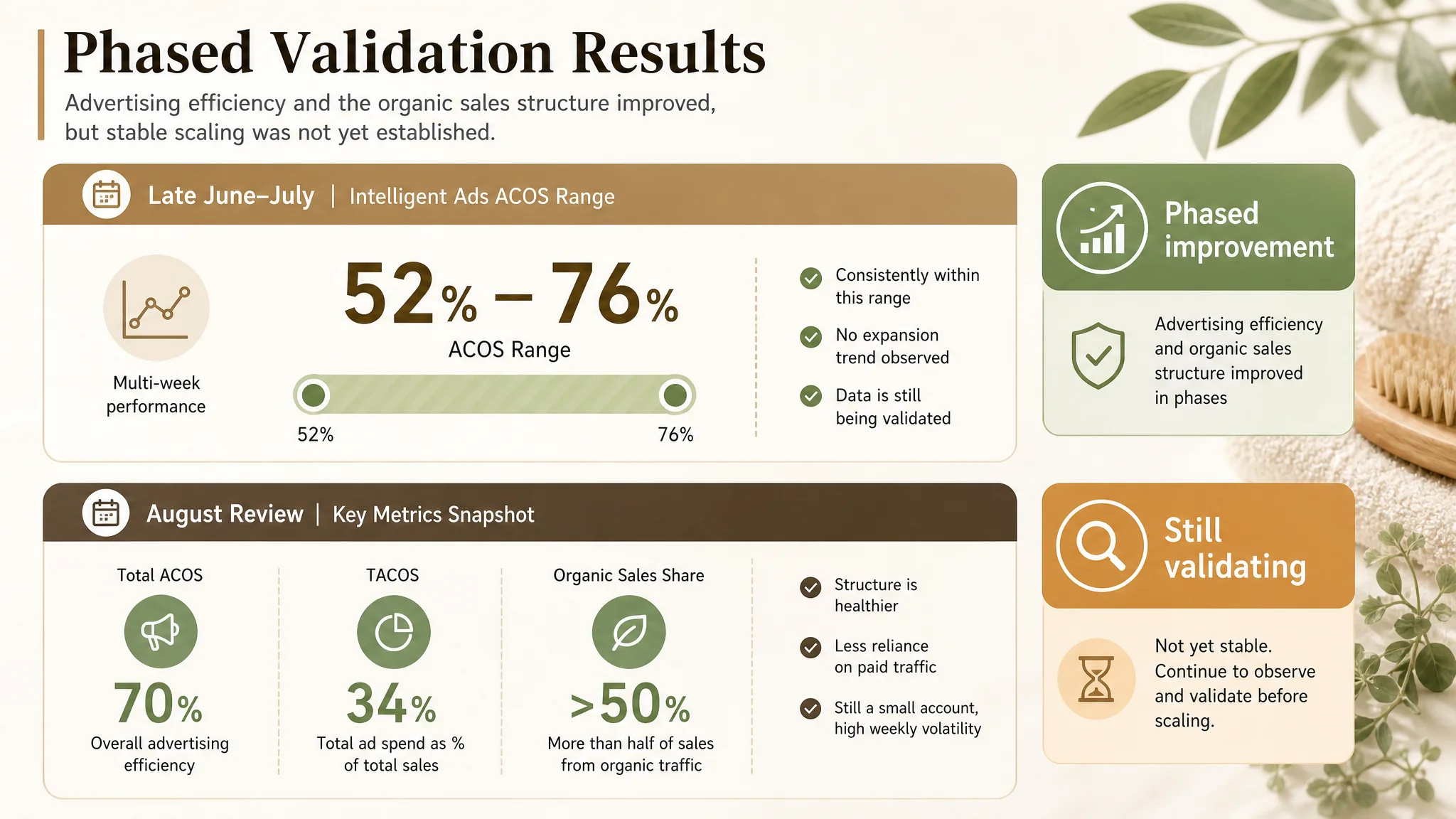
Data from subsequent periods showed that intelligent advertising ACOS fell to approximately the 52%–76% range over multiple weeks from late June through July. The August review showed a Total ACOS of approximately 70% and a TACOS of approximately 34%, with more than 50% of total sales coming from organic traffic. Together, these figures indicated phased improvements in advertising efficiency and sales structure. However, because sales volume was small and weekly fluctuations were significant, they still could not be used to conclude that a stable scaling trend had been established.
The Real Problem
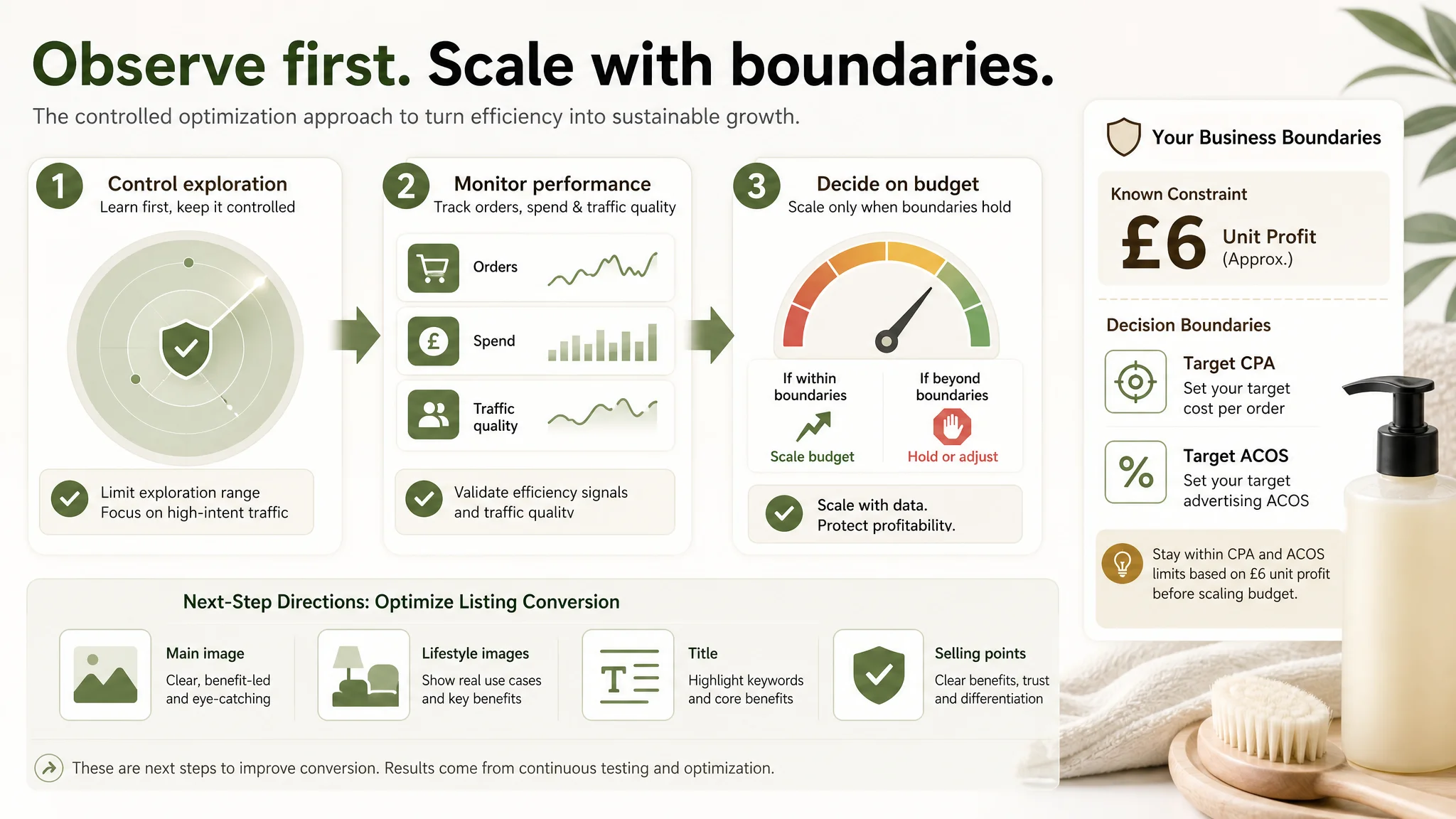
Problem 1: Legacy advertising had excessive ACOS and lacked an affordable cost boundary
Cause: The customer earned approximately £6 in profit per unit, while the legacy advertising ACOS remained high and fluctuated significantly, reaching approximately 639.7% in the highest week. Without clearly defined target CPA, target ACOS, and acceptable loss boundaries, advertising could continue consuming budget without consistently contributing effective orders.
Impact: The customer found it difficult to determine whether advertising was acquiring effective traffic or exchanging profit for low-quality exposure. Even when orders occurred occasionally, it was impossible to confirm whether the order cost could be covered by the product's profit.
Evidence: The highest weekly ACOS of the legacy advertising was approximately 639.7%; after adopting intelligent advertising, first-week spend was £21.48, advertising sales were £39.90, and ACOS was 53.83%. The difference between the two periods indicated substantial room to improve the efficiency of the original advertising.
Problem 2: Traffic replacement occurred after the advertising switch, causing a temporary sales decline that was mistaken for solution failure
Cause: The customer turned off most of the legacy advertising, and the new intelligent advertising needed to retake and explore traffic. Once legacy advertising was stopped or reduced, its traffic could not automatically or immediately be fully replaced by the new advertising, particularly in a store with only 1 ASIN and a small sales volume, where short-term fluctuations were more pronounced.
Impact: Overall sales temporarily declined by approximately 44%, causing the customer to worry that the advertising switch had affected organic sales and creating pressure to decide whether to continue observing, control exploration, or increase the budget immediately.
Evidence: Intelligent advertising generated 2 orders and £39.90 in advertising sales in its first week, but overall sales still temporarily declined by approximately 44% after most legacy advertising was turned off. This showed that the new advertising's output and overall traffic changes needed to be observed together; the effectiveness of the new setup could not be judged solely by the decline in total sales.
Problem 3: A single-week ACOS improvement was insufficient to prove stable profitability
Cause: The first week generated only 2 orders, representing a small sample size. At the same time, the customer's overall sales volume was small and weekly fluctuations were significant. The decrease in ACOS from approximately 639.7% in the highest week of the legacy advertising to 53.83% was an important improvement signal, but it was not sufficient on its own to represent a stable long-term result.
Impact: If the customer immediately increased the budget because of the low first-week ACOS, an incidental result from the learning phase could be mistaken for stable efficiency. If the customer stopped observing because sales declined during a particular period, they could miss the opportunity for the advertising structure to adjust gradually.
Evidence: Intelligent advertising ACOS remained approximately within the 52%–76% range over multiple weeks from late June through July. In August, Total ACOS was approximately 70%, TACOS was approximately 34%, and more than 50% of total sales came from organic traffic. These data indicated phased structural improvement, but did not yet establish a stable scaling trend.
Optimization Plan
1. Complete the advertising structure transition first, then control the scope of exploration
After the store was connected and advertising authorization was completed, DeepBI launched intelligent Ads management. In response to sales fluctuations after the legacy advertising was turned off, the optimization priority was not to expand the budget immediately, but to control the scope of exploration first and observe the traffic quality and order output generated by the new advertising.
The purpose was to avoid expanding both the budget and traffic scope during the learning phase, which would make it difficult for the customer to determine whether subsequent changes came from the advertising structure, budget changes, or traffic quality.
2. Evaluate advertising using orders, advertising sales, spend, and ACOS together
During the advertising switch, it was not sufficient to monitor only one metric. At a minimum, the first-week data should include:
- Advertising orders: 2;
- Advertising sales: £39.90;
- Advertising spend: £21.48;
- ACOS: 53.83%;
- Change in overall sales: temporarily down by approximately 44%.
This combined assessment identified that the new advertising had already generated orders, while overall traffic was still in the replacement and observation phase. This conclusion was closer to the actual operating status than either “sales declined, so the advertising failed” or “ACOS declined, so the advertising has already succeeded.”
3. Use target CPA and profitability boundaries to decide whether to scale
The customer earned approximately £6 in profit per unit. Therefore, future budgets should not be set solely according to sales targets. The customer should first define a target CPA, target ACOS, monthly sales target, and acceptable profitability or loss boundary.
If the current priority is to limit losses, the customer should first verify whether the order cost is close to the affordable range. If the goal is to generate more sales, the customer needs to define how much advertising cost they are willing to pay for each additional order. Only with clear boundaries can the customer determine whether “further reducing ACOS” or “increasing the budget” is more appropriate for the next stage.
4. Monitor the Listing's ability to convert traffic at the same time
The product's original Listing did not sufficiently communicate its functions, use cases, and trust-building reasons. After advertising brings in traffic, if the main image, lifestyle images, title, and selling points cannot quickly answer consumers' purchase questions, advertising clicks may not convert into orders.
Therefore, advertising optimization should not be completely separated from Listing optimization. In the next phase, the seller could continue optimizing the main image, lifestyle images, title, and selling-point messaging within a low-cost range, and then observe whether the conversion rate and advertising order cost change. Existing materials identify these as directions for subsequent optimization and should not be described as actions that have already been completed and produced results.
Results
Based on the recorded data, the main changes brought by this advertising switch appeared in advertising efficiency and sales structure, rather than large-scale sales growth.
- The highest weekly ACOS of the legacy advertising was approximately 639.7%;
- Intelligent advertising generated 2 orders in the first week;
- First-week advertising sales were £39.90;
- First-week advertising spend was £21.48;
- First-week ACOS was 53.83%;
- Overall sales temporarily declined by approximately 44% after most legacy advertising was turned off;
- Over multiple weeks from late June through July, intelligent advertising ACOS fell to approximately 52%–76%;
- The August review showed a Total ACOS of approximately 70%;
- August TACOS was approximately 34%;
- More than 50% of total sales came from organic traffic.
These results demonstrate two points. First, compared with the highly volatile legacy advertising, intelligent advertising showed a phased improvement in efficiency. Second, the advertising switch did not immediately produce stable scaling; sales continued to fluctuate significantly, and the customer still needed to make decisions regarding target CPA, target ACOS, and budget size.
Therefore, the more accurate conclusion from this case is that advertising efficiency and the organic sales structure showed phased improvements, but remained in the validation and optimization stage. The results should not be directly described as stable profitability or scalable growth.
Case Summary
The core of this case is not to present a single ACOS decline as proof that the advertising setup was completely successful. Instead, it demonstrates how changes should be diagnosed after an advertising switch.
There were three real problems: the legacy advertising ACOS was excessively high and lacked an affordable cost boundary; traffic replacement occurred after the legacy advertising was turned off, resulting in a temporary decline in overall sales; and the small number of first-week orders meant that one week's ACOS could not prove stable profitability.
The truly effective approach was to first confirm whether the new advertising generated effective output through orders, advertising sales, spend, and ACOS; then assess changes in traffic structure by combining overall sales with the proportion of organic sales; and finally decide whether to scale based on target CPA, target ACOS, and profitability boundaries.
For this single-product seller, the phased results showed that advertising efficiency improved from the approximately 639.7% ACOS recorded in the highest week of the legacy advertising to 53.83% in the first week of intelligent advertising, remained within approximately the 52%–76% range over multiple subsequent weeks, and reached approximately 34% TACOS in August, with the proportion of organic sales exceeding 50%. However, because sales volume was small and weekly fluctuations were significant, the next step should remain focused on continuous validation and boundary management rather than simply pursuing a larger budget.
Key Takeaways for Sellers
Takeaway 1: A sales decline after switching advertising does not necessarily mean the new setup has failed
After legacy advertising is turned off, its original traffic needs to be redistributed and taken over. A temporary sales decline of approximately 44% should be evaluated together with the orders, sales, and spend generated by the new advertising. Sellers need to distinguish between “short-term fluctuations during traffic replacement” and “a continued lack of effective orders,” which are two completely different situations.
Takeaway 2: Amazon Ads optimization cannot be evaluated by ACOS alone
A lower ACOS is an important signal, but sellers must also examine order volume, advertising sales, advertising spend, TACOS, the proportion of organic traffic, and changes in overall sales. For low-margin products in particular, whether advertising is approaching the target CPA is more important than simply pursuing a lower ACOS.
Takeaway 3: Whether the problem lies in advertising or the Listing must be determined through conversion results
If advertising generates clicks but insufficient orders, the problem may not lie solely in the advertising setup. It may also be related to the main image, lifestyle images, title, selling points, or trust-building messaging. Amazon Ads diagnosis should not stop at bids and budgets; it should also examine whether the Listing can effectively convert incoming traffic. Only when advertising efficiency, Listing conversion, and profitability boundaries improve together is there a stronger basis for increasing the budget.
For sellers currently switching their Amazon Ads setup, the safest approach is neither to stop advertising immediately after seeing sales decline nor to scale as soon as ACOS falls. Instead, sellers should first establish an observation period and profitability boundaries, then use continuous data to verify whether advertising efficiency has genuinely improved.