

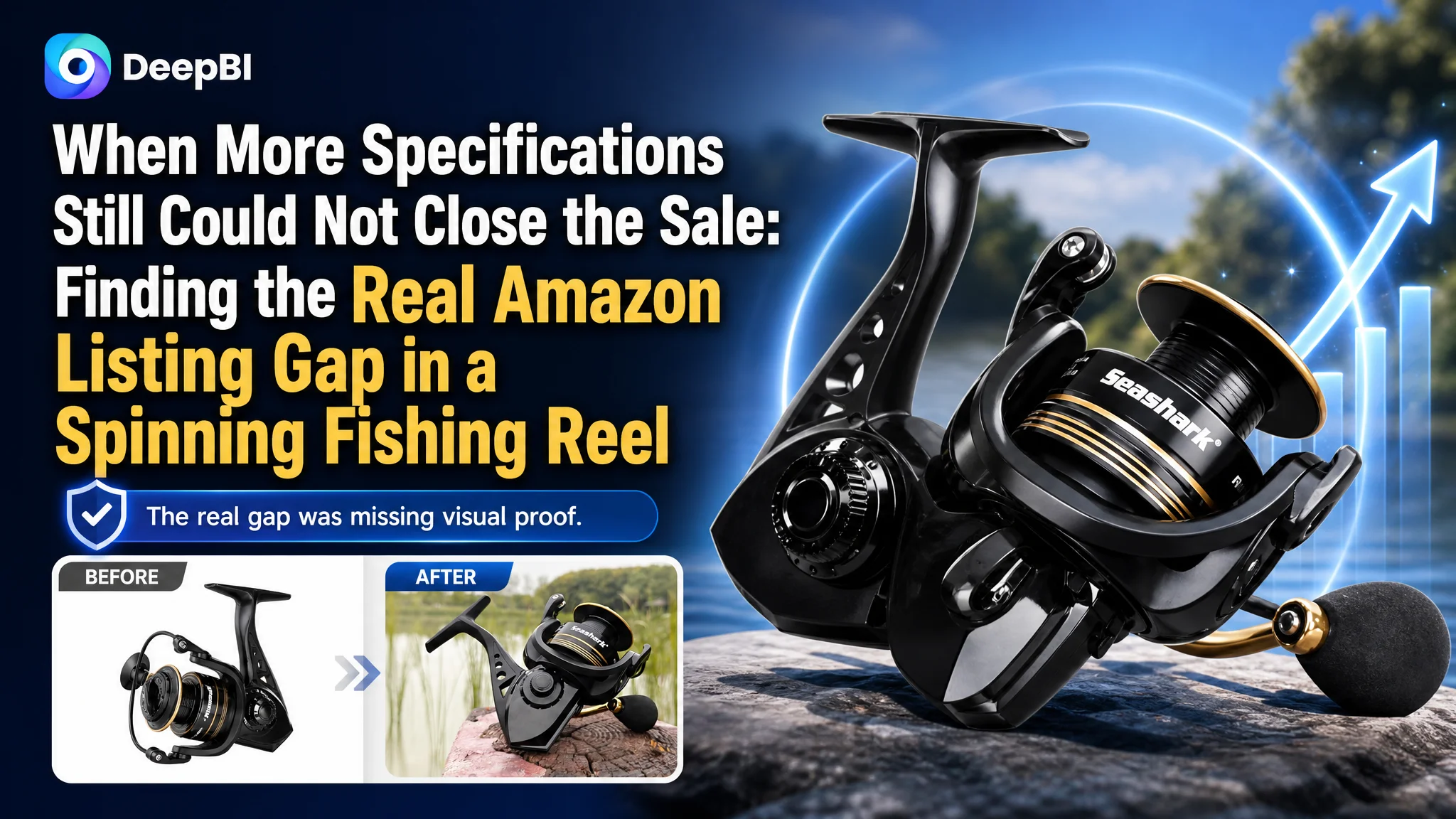
This case follows an Amazon seller in the US marketplace whose spinning fishing reel Listing was not competitive despite having credible technical specifications. The initial direction focused on sharpening the title, adding more performance language, and rearranging product images. The underlying assumption was that the Listing mainly needed clearer product information and stronger feature communication.
DeepBI found a more structural problem. The product page was not only weaker in title, main-image sequencing, and bullet-point logic; it was missing the visual proof and decision support that helped a category-leading Amazon Listing turn technical claims into buyer confidence. The largest gap was not a single word or image. It was the absence of a convincing product-page sales logic.
The later optimization therefore focused on restoring that logic across the Amazon Listing: lead with performance proof, visualize the drag and bearing systems, connect specifications to fishing scenarios, reorganize the bullet points around user benefits, and build an A+ content structure that could support final purchase decisions.
For other Amazon sellers, the lesson is direct: when an Amazon Listing has traffic or product advantages but weak conversion capacity, continuing to tune ads or add isolated specifications may only send more shoppers toward the same trust gap. Before scaling traffic, sellers need to know whether the product page has earned the right to receive it.
The Amazon Listing Looked Underdeveloped, Not Necessarily Underpowered
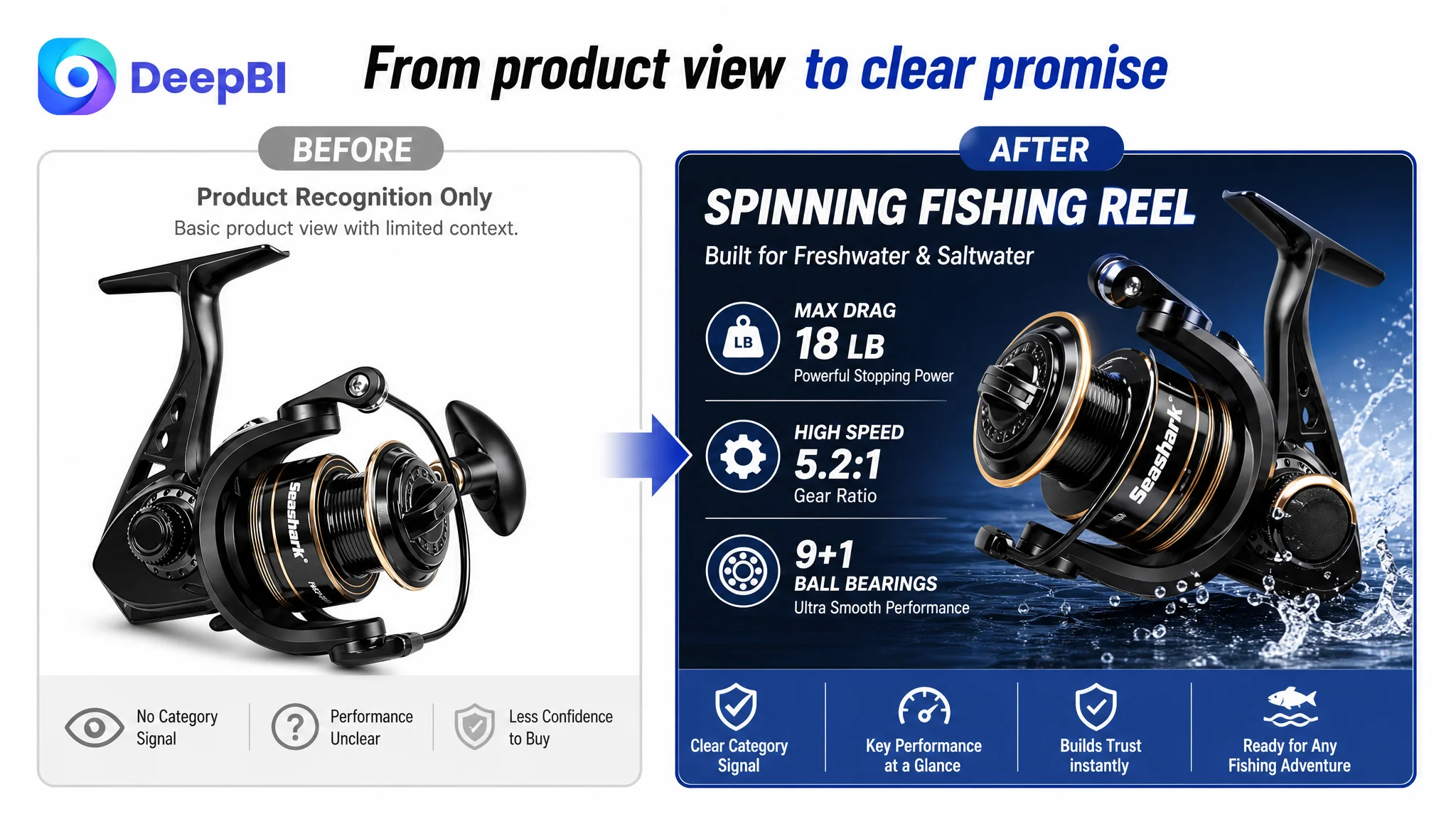
The product was an entry-level spinning fishing reel positioned for freshwater and saltwater use, with claims around drag strength, gear ratio, metal construction, bearings, and lightweight handling.
On paper, it had material for a competitive Listing:
- Up to 18 lb of drag resistance
- A metal spool and handle
- A high-speed gear ratio
- Reinforced internal components
- Ball bearings and a precision-machined pinion gear
- Multiple size options for different fishing environments
Yet the Amazon product page did not present these points as a connected reason to buy.
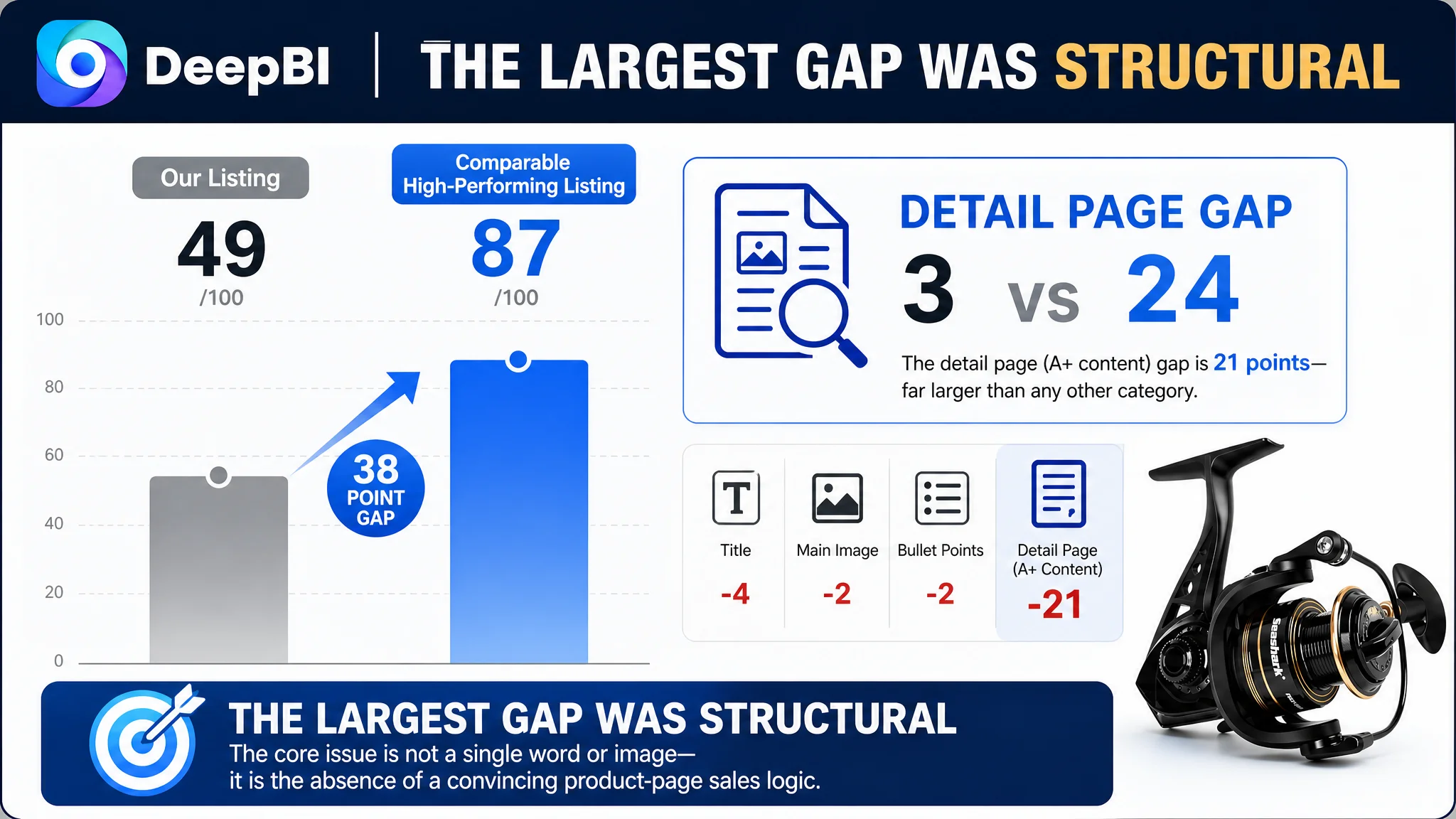
DeepBI's comparison produced a total score of 49 out of 100, compared with 87 out of 100 for a comparable high-performing Listing in the same category.
The most important detail was not the 38-point overall difference. It was where those points were lost.
- Title: Target Listing: 13/20, Comparable high-performing Listing: 17/20, Gap: -4
- Main image: Target Listing: 24/30, Comparable high-performing Listing: 26/30, Gap: -2
- Bullet points: Target Listing: 5/10, Comparable high-performing Listing: 7/10, Gap: -2
- A+ content and detail page: Target Listing: 3/25, Comparable high-performing Listing: 24/25, Gap: -21
- Reviews: Target Listing: 4/15, Comparable high-performing Listing: 13/15, Gap: -9
- Total: Target Listing: 49/100, Comparable high-performing Listing: 87/100, Gap: -38
The score showed that the Listing was not suffering from one isolated creative weakness. It had a broad conversion problem, with the most severe deficiency concentrated in the detail-page experience.
The product page did not simply need more information. It needed a way to make the information believable and usable.
The Initial Diagnosis Stopped at Text and Image Refinement
The early optimization direction was understandable.
The title was less structured than the benchmark Listing. It described rolling bearings, drive gears, and materials, but did not communicate the product category and performance promise as quickly. It also lacked a clear use-case signal such as ice fishing or a more specific size-selection context.
The bullet points contained relevant specifications, but they were not arranged around a strong buying sequence. Material, weight, smoothness, performance, and handling features appeared as separate statements rather than as a progression from customer concern to product solution.
The image set also contained useful material, including technical views and performance information. But several images were doing similar work, while the strongest proof appeared too late in the sequence.
That created a tempting but incomplete diagnosis:
- Make the title more professional
- Use stronger performance words
- Add more specific technical language
- Move the drag image earlier
- Reduce repetitive product views
These changes were necessary. They were not sufficient.
The deeper issue was that the Amazon Listing treated important claims as information to be read rather than as evidence to be understood.
A shopper evaluating a spinning reel is not only asking, “What is the maximum drag?” The shopper is also asking:
- Can I trust that performance claim?
- Will the internal parts hold up under load?
- Will the reel operate smoothly?
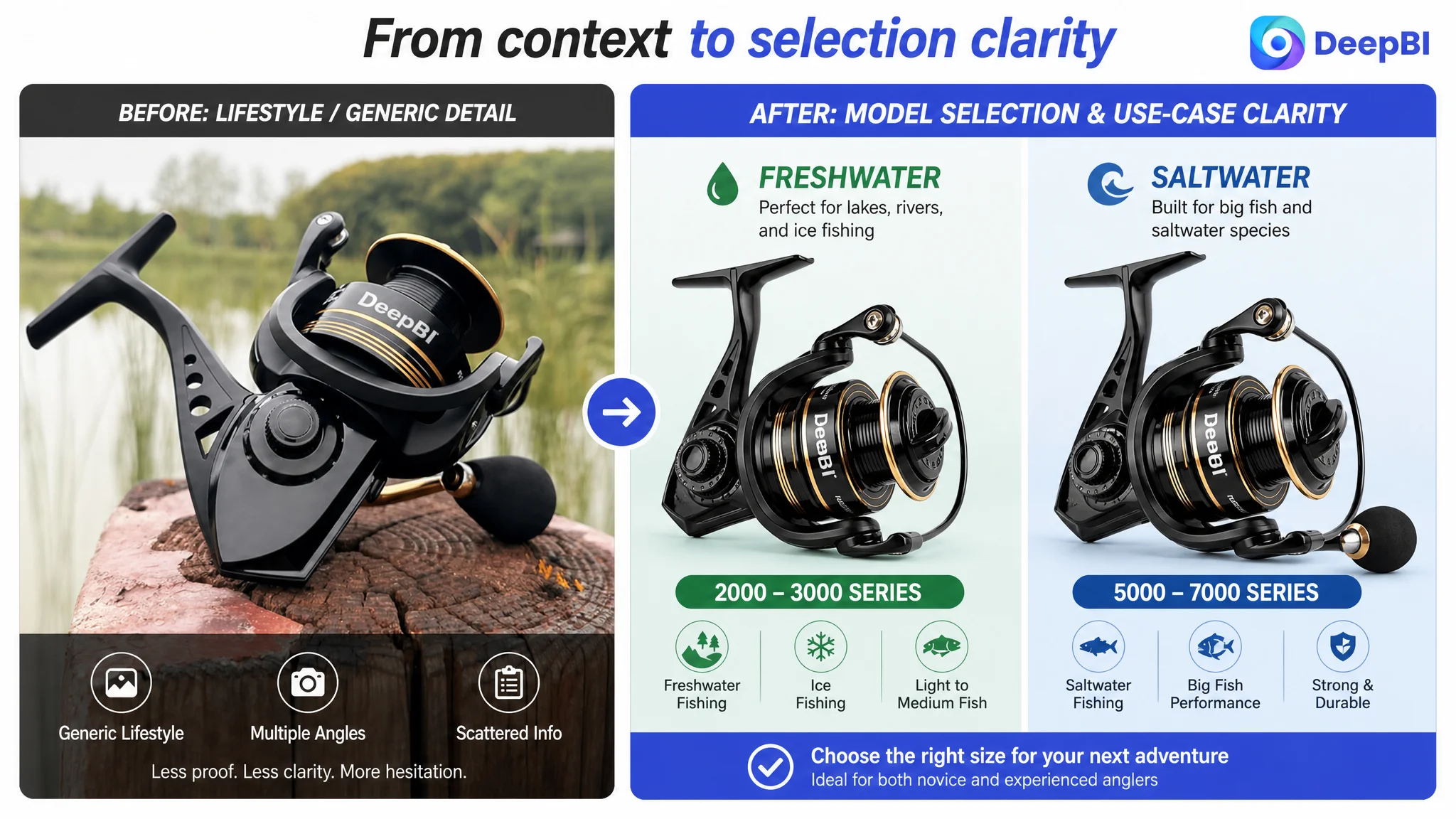
- Which size fits freshwater, ice fishing, or saltwater use?
- What makes this reel different from a lower-cost alternative?
- Does the product look like equipment built for real use?
The existing page did not answer those questions in a clear visual sequence.
The 21-Point Detail-Page Gap Changed the Priority
The title, main image, and bullet-point differences were visible, but relatively contained. The detail-page score exposed the real constraint.
The target Listing used a mostly text-based detail section without meaningful A+ visual modules. The comparable Listing used a much fuller structure, including:
- A lead performance image
- A foldable-handle explanation
- A drag-system visualization
- A bearing-system diagram
- Multiple product angles
- Handle and gear close-ups
- An assembled product view
- A fishing-rod combination scene
- Color and size comparisons
- Specification tables
This was not simply a difference in design quality. It was a difference in how each page handled buyer uncertainty.
The comparable Listing used A+ content to move the buyer through a decision path:
Performance claim → mechanical proof → handling reassurance → durability evidence → model selection
The target Listing largely remained at the level of repeated description.
That distinction matters on Amazon because paid or organic traffic does not automatically create trust. A shopper may click after seeing a relevant title or an attractive main image, but the product page still has to justify the purchase.
DeepBI's diagnosis was therefore not “add more images.” It was:
The Listing was missing the visual evidence needed to convert technical specifications into purchase confidence.
The Main Image Was Not Only a Visual Problem
The main-image score was 24 out of 30, so this was not the largest weakness. But the image sequence was not aligned with the buyer's decision process.
The first image could communicate the product type more directly and bring the most important performance signal closer to the first impression. A minimal category cue and a prominent, factual drag specification could help shoppers understand the product faster.
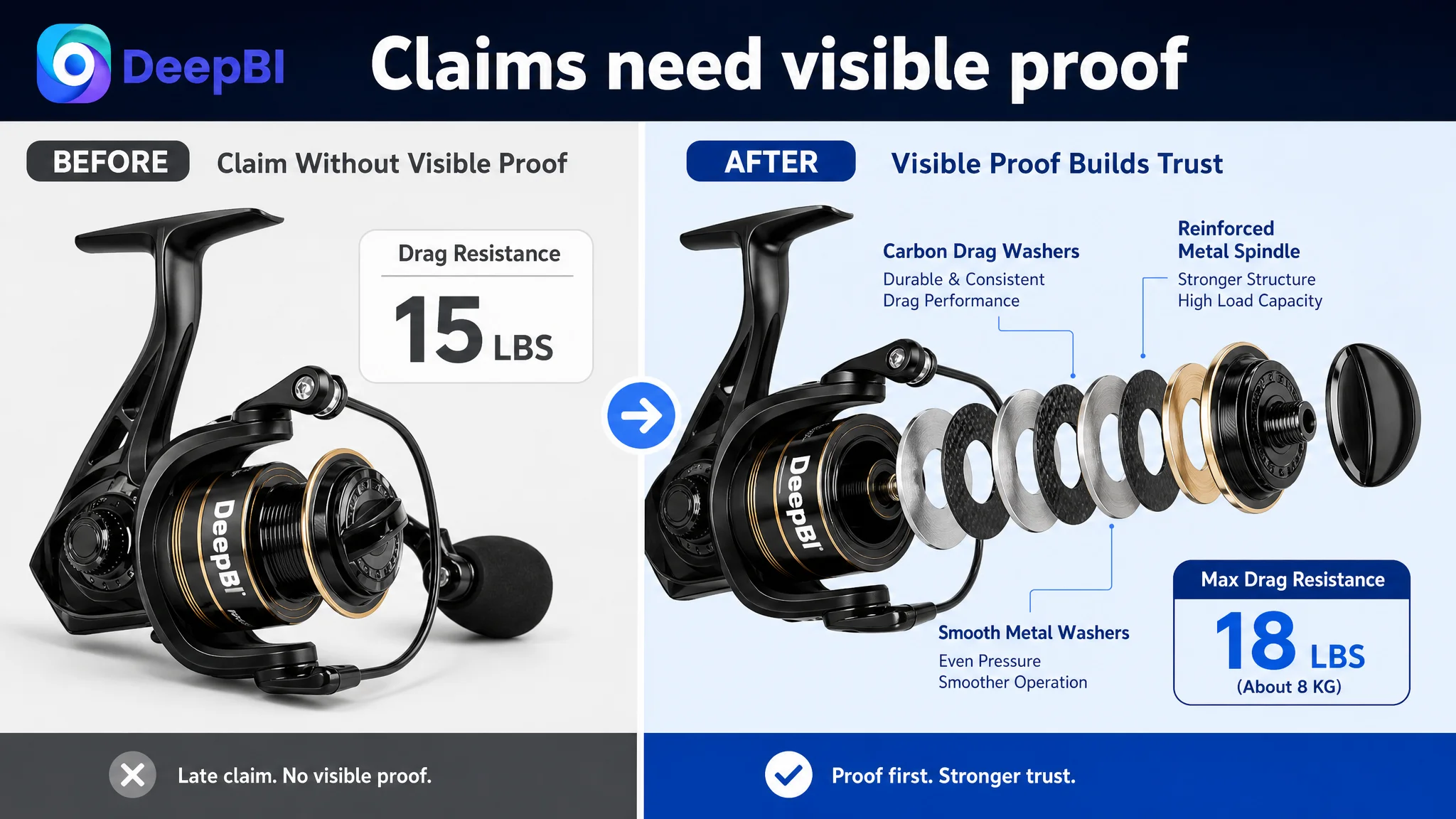
The second image was more important than its existing role suggested. It was functioning as another product view, but shoppers who had already seen the reel needed justification for its performance claims.
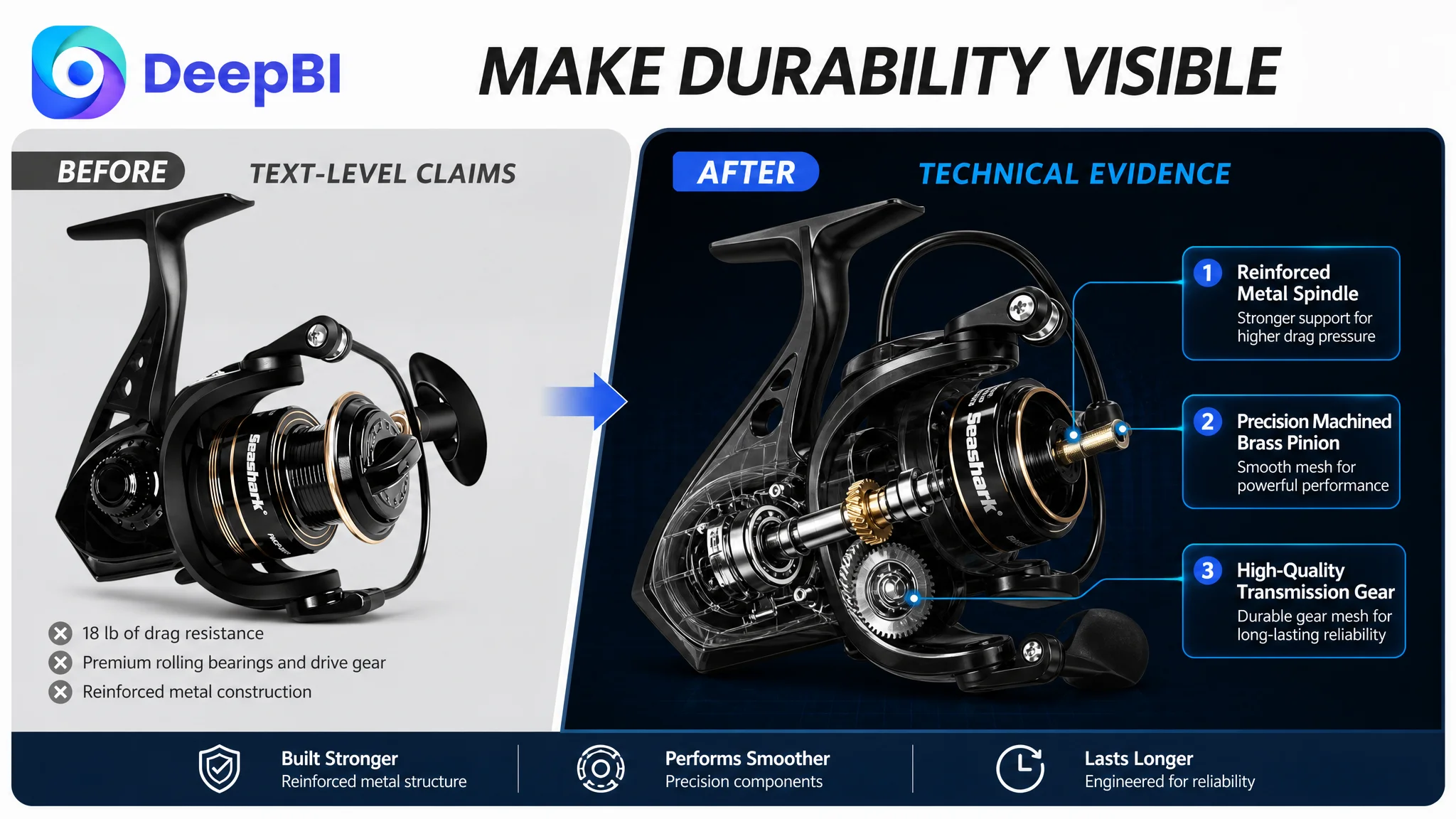
DeepBI recommended moving the drag-system proof forward and using that position to show:
- The drag washer or related internal structure
- The reinforced metal spindle
- The material basis behind the stated drag resistance
The next image could then explain the internal transmission system, including the main gear, shaft, and precision-machined pinion. Another image could connect size and use-case selection to freshwater, ice fishing, and saltwater applications. The final technical image could address the remaining concern: smoothness.
This ordering follows a simple commercial principle:
Show the reason to believe before adding more decoration
The existing image set included lifestyle and aesthetic content, but the most important unanswered questions were technical:
- Is the drag claim credible?
- Will the reel remain stable under load?
- Will the internal components operate smoothly?
- Which model should the buyer choose?
For this Listing, technical proof needed to appear before lifestyle context.
The Title Needed Search Clarity, Not Just More Specifications
The title gap was smaller than the A+ gap, but it affected the beginning of the funnel.
The existing title leaned toward a list of components: rolling bearings, drive gears, metal spool, and handle. Those terms may be relevant, but they did not create a quick hierarchy of meaning.
The proposed direction placed the product type and primary performance information earlier:
Spinning Fishing Reel, Max 17.6lb Carbon Drag Resistance, High Speed Gear Ratio, Premium Rolling Bearing and Drive Gear, Metal Spool and Handle for Saltwater & Freshwater
The important change was structural:
- Product category first
- Performance specification next
- Mechanical attributes after that
- Fishing environment at the end
This is not about making the title louder. It is about helping Amazon shoppers identify the product, understand its primary value, and decide whether the Listing fits their search intent without parsing a loose collection of technical phrases.
A strong Amazon title should help both discovery and first-stage judgment. In this case, the page needed to communicate that it was a spinning fishing reel with meaningful drag capability and broad use-case relevance before asking shoppers to process component-level details.
The Bullet Points Had Specifications, but Not a Buying Logic
The bullet-point score was 5 out of 10. The problem was not a complete lack of useful content. It was the relationship between the content and the shopper's concerns.
The revised structure gave each bullet a clearer job.
Performance came before general attributes
The first bullet led with smooth and powerful drag performance, then connected the 18 lb claim to the metal spool, even line lay, and the practical use case of handling larger fish.
This made the specification more meaningful. The shopper was not left with “18 lb” as an isolated number; the number was connected to a fishing outcome.
Internal components were presented as a reason to trust smoothness
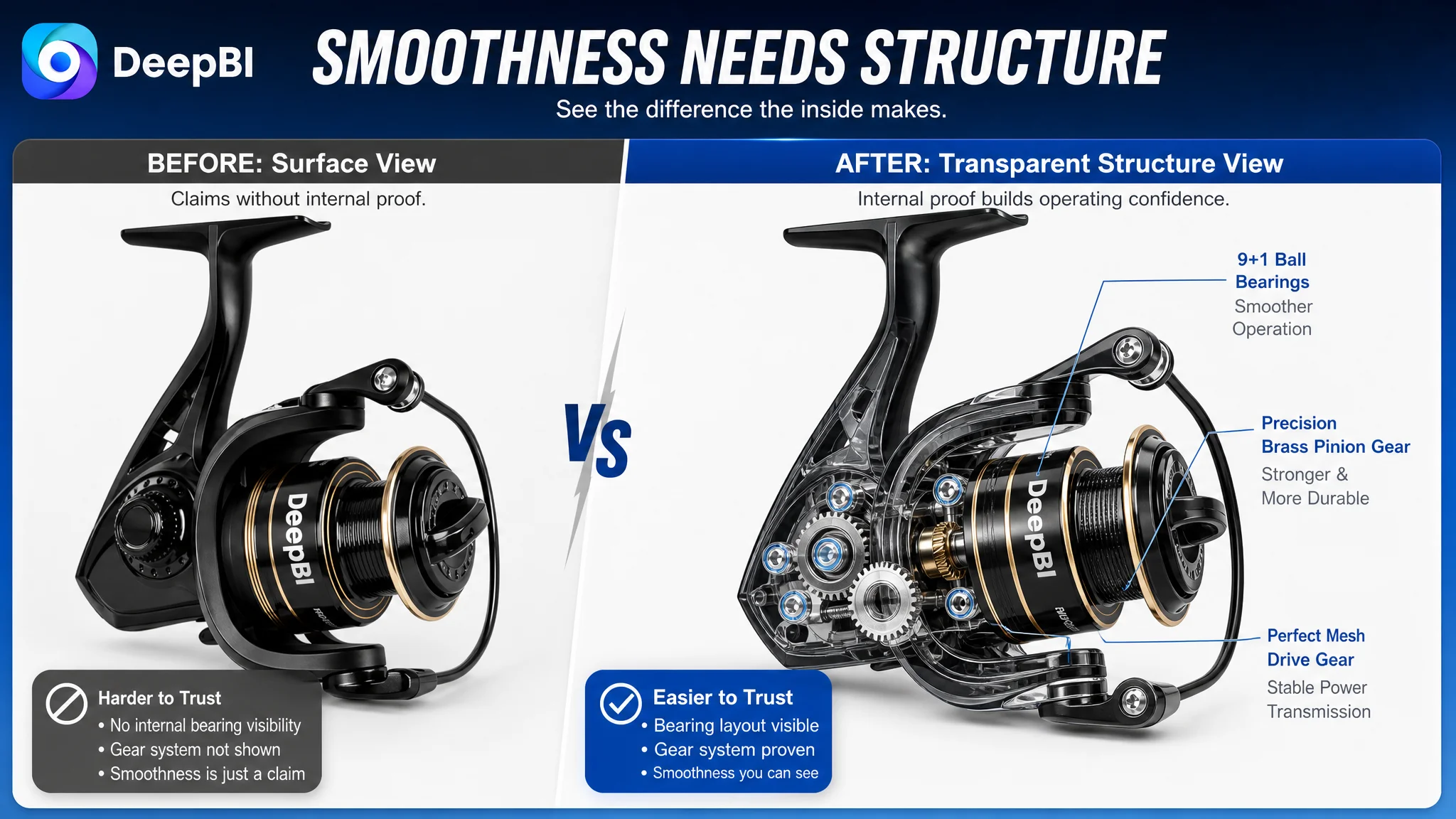
The second bullet grouped bearings, the precision-machined brass pinion gear, the hardened metal shaft, and gear mesh into one mechanical explanation.
That helped translate internal construction into a user-facing benefit: less noise and vibration during operation.
Size options were connected to fishing environments
The third bullet used the product range to explain selection:
- Smaller sizes for freshwater and ice fishing
- Larger sizes for saltwater species and larger fish
This is more useful than listing size availability alone. A model range becomes a decision tool when each range is tied to a recognizable use case.
Handling features were linked to control
The fourth bullet connected the interchangeable handle and anti-reverse system to direct power transmission and retrieval control.
The feature was no longer presented only as a design detail. It was framed around how the angler uses the reel.
Lightweight construction was given a clear audience
The fifth bullet connected the compact frame and lightweight construction to balance, durability, and suitability for both novice and experienced anglers.
The goal was not to claim that every attribute was superior. It was to make each attribute answer a practical buyer question.
A bullet point should not merely state what the product has. It should explain why that detail matters during use.
The Missing A+ Content Was the Trust Gap
The A+ section was where the diagnosis became decisive.
A spinning fishing reel is a mechanical product. Buyers may not be able to verify the internal gear structure, drag system, or bearing layout from a standard product photo. If the page only repeats claims in text, the buyer must accept the claims without much supporting evidence.
That is especially difficult when review volume is limited.
The target Listing had only four total reviews, a 3.9-star rating, and two reviews visible on the first page. The comparable Listing had 9,635 reviews, a 4.5-star rating, and a much stronger base of visible customer evidence.
The review gap could not be solved through copywriting. It meant the product page had to work harder in the areas it could control:
- Explain the product clearly
- Show how the internal structure supports performance
- Reduce uncertainty around size selection
- Make the product feel professionally engineered
- Give buyers a reason to believe the technical claims before purchase
DeepBI therefore prioritized A+ content that could act as visual proof rather than as a decorative extension of the bullet points.
The first module: establish construction credibility
The opening module should visibly confirm the product's key materials and overall construction logic.
Its purpose is to address the immediate concern that an affordable reel may rely on weak or overly basic construction.
The second module: demonstrate handling and robustness
The handle system should be shown as a practical mechanism, including left- and right-hand interchangeability and the all-in-one high-strength rocker.
This module answers whether the reel is convenient to use and whether the handling components appear dependable.
The third module: substantiate drag performance
The drag system should be visualized through an exploded or structured technical view, using only confirmed product attributes.
The goal is not to make the product appear more advanced than it is. The goal is to connect the stated drag resistance to visible mechanical evidence.
The fourth module: make smooth operation understandable
An internal bearing and gear visualization can explain how the rolling bearings and precision gear mesh support smooth performance and reduced noise.
This addresses the question that the existing image sequence left until too late: “Will it feel smooth in actual use?”
The fifth module: support durability expectations
Close-ups of the reinforced spindle, transmission gear, and precision-machined brass pinion can give the durability claim a more concrete foundation.
The sixth module: reconnect construction with real use
A complete assembled-product view can bring the page back from mechanical detail to practical ownership. The focus should be balance, weight, handling, and suitability for freshwater or saltwater fishing.
The seventh module: help the buyer choose
A model-by-model comparison table is critical for this product range.
The shopper should be able to understand which size is more appropriate for:
- Freshwater fishing
- Ice fishing
- Larger fish
- Saltwater use
Without this structure, even a convinced buyer may hesitate at the final selection step.
Why DeepBI Did Not Prioritize More Ad Tuning First
The case material does not provide post-optimization ad metrics or a confirmed before-and-after ACOS or CVR result. It would therefore be inaccurate to claim that the seller's campaigns had already failed or that a specific advertising adjustment produced a result.
The business logic is still clear.
When the product page has a 3 out of 25 detail-page score and a major review disadvantage, sending additional traffic to the page carries a specific risk: the store may pay to expose the same unresolved uncertainty to more shoppers.
In that situation, ad optimization should not disappear from the plan. It should be sequenced correctly.
The priority is to avoid using Amazon ads to amplify a low-conversion page before the page can explain and support its value.
The decision order becomes:
1. Repair the page's ability to communicate the product's value.
2. Add visual proof where technical claims are difficult to verify.
3. Improve title and bullet-point clarity so traffic lands on a coherent message.
4. Make model selection easier.
5. Then evaluate whether paid traffic is being converted efficiently.
This is not an argument that Listing optimization replaces advertising. It is an argument that advertising efficiency depends partly on what happens after the click.
Ads can bring a shopper to the product page. They cannot decide which size to buy, prove the drag system, or replace missing trust.
What Changed in the Seller's Understanding
The most important change was not a particular title phrase or image module. It was the definition of the problem.
The Listing was initially treated as a collection of content elements that needed refinement: title, images, specifications, and bullet points.
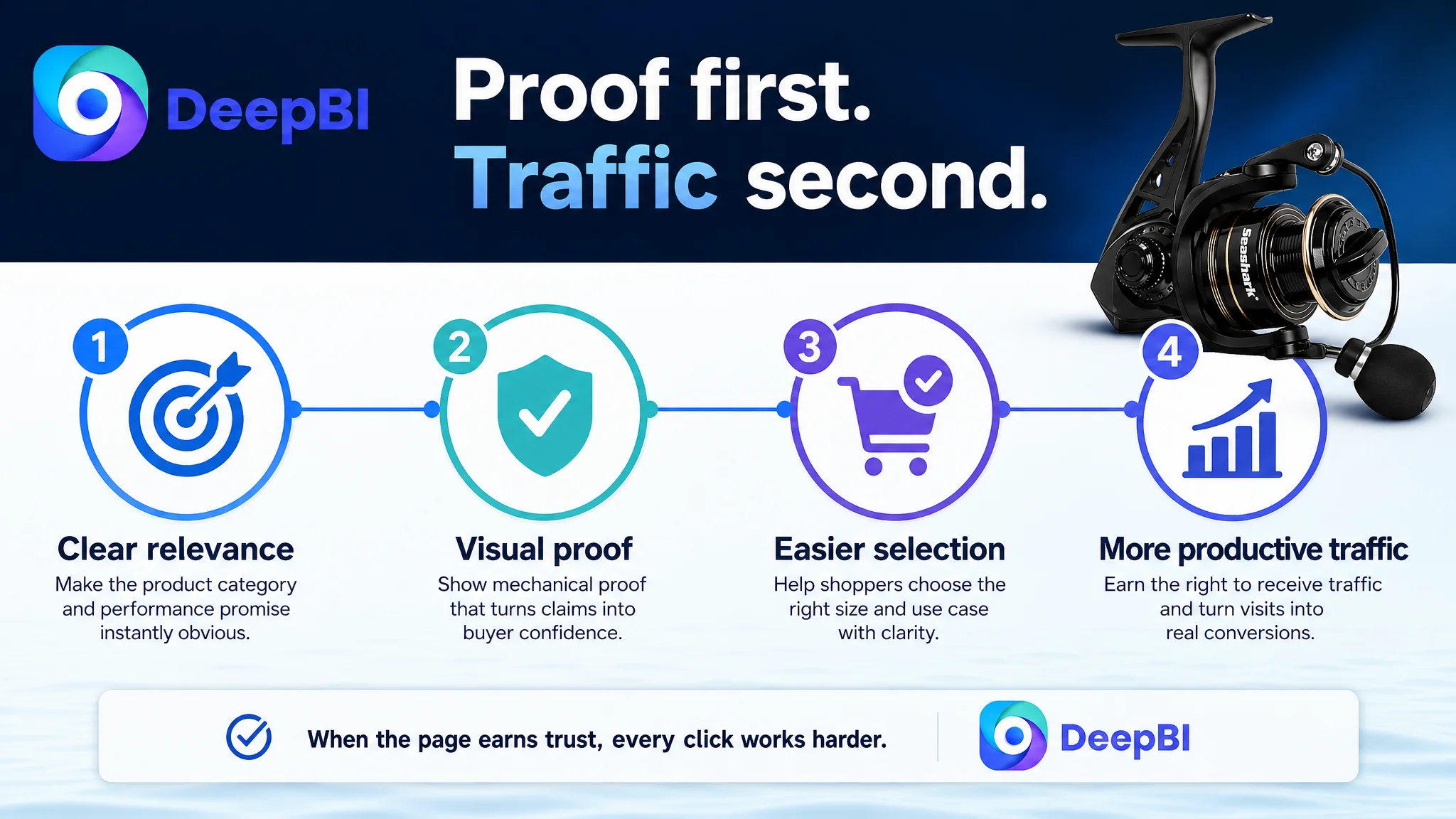
DeepBI reframed it as a conversion system with a missing middle:
- The title needed to create clearer relevance.
- The main images needed to establish a proof sequence.
- The bullet points needed to connect specifications to fishing outcomes.
- The A+ page needed to visualize engineering and reduce uncertainty.
- The comparison structure needed to help shoppers choose a size.
- The review disadvantage meant the page could not depend on social proof alone.
This reframing changed what should happen first.
The seller did not simply need more traffic or more polished language. The Amazon Listing needed greater conversion capacity before traffic could become more productive.
The Broader Lesson for Amazon Sellers
This case does not provide a numerical post-optimization outcome, so no unsupported improvement in CVR, ACOS, organic orders, or keyword ranking should be claimed.
What it does provide is a clear operating lesson.
A Listing can contain real specifications and still fail to communicate value. A main image can be acceptable and still appear in the wrong position within the decision sequence. A product can have credible mechanical features and still lose trust because those features are not visualized. A title can include relevant keywords and still make shoppers work too hard to understand the product.
For Amazon sellers, the practical questions are:
- Is the largest Listing gap really in advertising, or in post-click conversion?
- Are technical claims supported by visible evidence?
- Do the first five images answer the buyer's most important objections in order?
- Do bullet points explain user outcomes rather than repeat specifications?
- Does A+ content help the shopper choose, or merely repeat the description?
- Can a buyer quickly understand which variation fits the intended use?
- Is the page relying on reviews it does not yet have?
In this spinning fishing reel case, DeepBI's value came from identifying the constraint behind the visible symptoms. The solution was not to keep polishing every element equally. It was to prioritize the missing conversion architecture: proof first, then selection clarity, then traffic efficiency.
That is the difference between making an Amazon Listing look more complete and making it more capable of converting the traffic it receives.