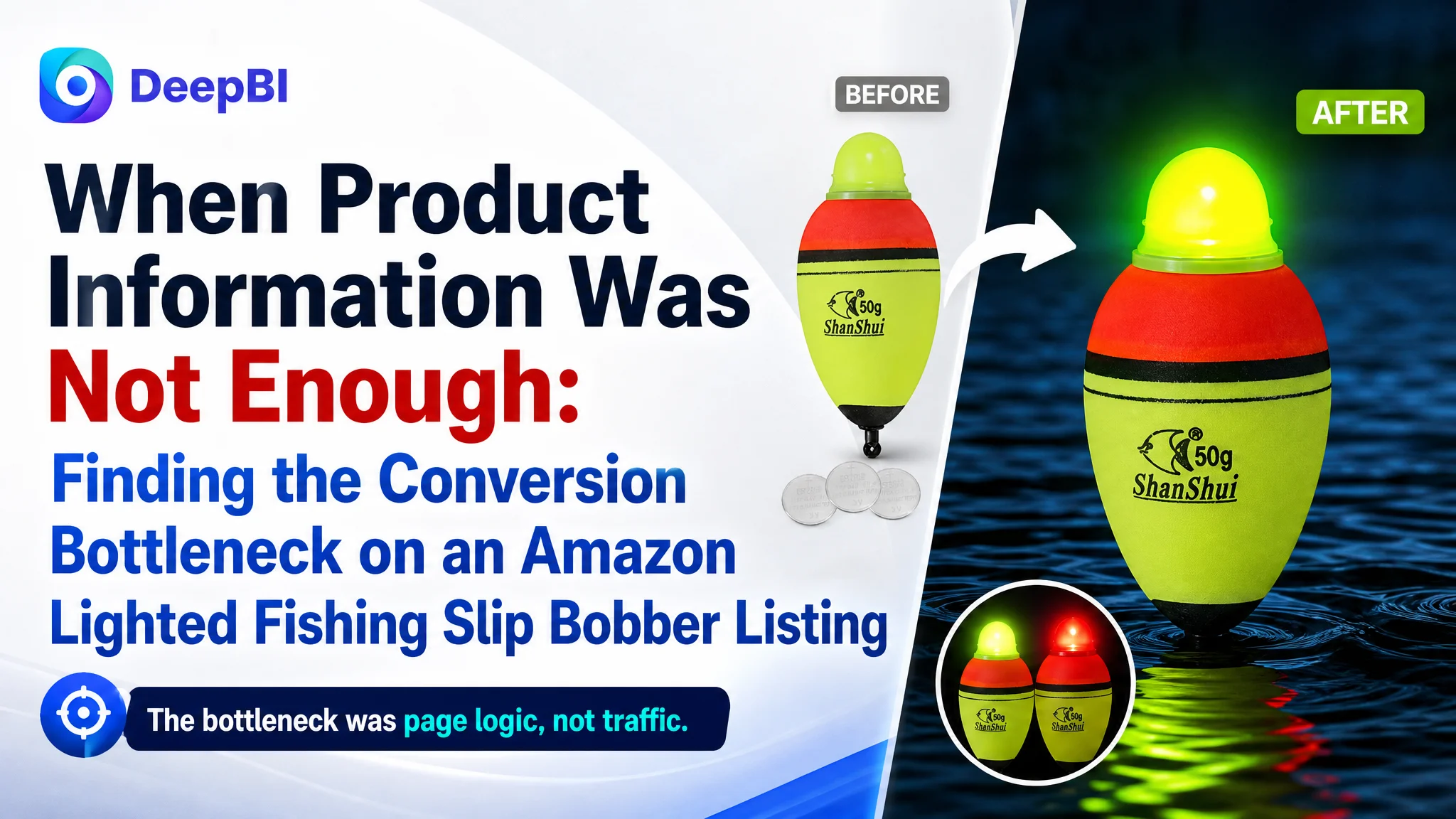
An Amazon seller in the US fishing-accessories category was not facing a simple traffic problem. The product page offered a functional electronic lighted fishing slip bobber, but the Amazon Listing was not communicating its value with enough clarity or confidence. The customer’s initial direction leaned toward adding more specifications and explaining how the product worked.
DeepBI’s diagnosis showed a broader issue. The Listing scored 48 out of 100 against 82 for a comparable high-performing Amazon listing. The largest gap was not the main image alone, but the combined weakness of the title, bullet points, A+ content, and customer proof. The page described the product, but did not create a convincing path from night-fishing need to product benefit to purchase confidence.
The later optimization therefore focused on rebuilding the Listing’s sales logic: make the night-glow benefit visible earlier, position the LED bite indication as the central differentiator, turn bullet points into a problem-solution sequence, and replace text-only detail content with a visual A+ story. For other Amazon sellers, the lesson is direct: before trying to scale Amazon ads or increase traffic, confirm that the product page can convert the attention it receives.
The Listing Was Not Empty. It Was Under-Communicating Its Value
The product had several meaningful advantages:
- An electronic LED glow for low-light fishing
- A green light when powered on
- A red-light bite indication
- EVA construction
- Slip-bobber functionality for controlling bait depth
- A design intended for use across different fishing environments
Yet those advantages were not arranged according to how an Amazon shopper makes a decision.
The Listing leaned heavily toward product information: materials, operating instructions, dimensions, and functional descriptions. That information was not necessarily wrong. The problem was that it did not answer the buyer’s first questions in the right order:
- Can I see this clearly during night fishing?
- How does it help me recognize a bite?
- Is it more useful than a conventional glow-stick float?
- Will it be reliable in water?
- Can I understand how to set it up?
- Is it suitable for the fish and water depth I target?
This distinction matters because a product page can contain accurate information and still have weak conversion capacity.
The overall score made that visible:
- Title: Target Listing: 12/20, Comparable listing: 17/20
- Main image: Target Listing: 25/30, Comparable listing: 24/30
- Bullet points: Target Listing: 3/10, Comparable listing: 7/10
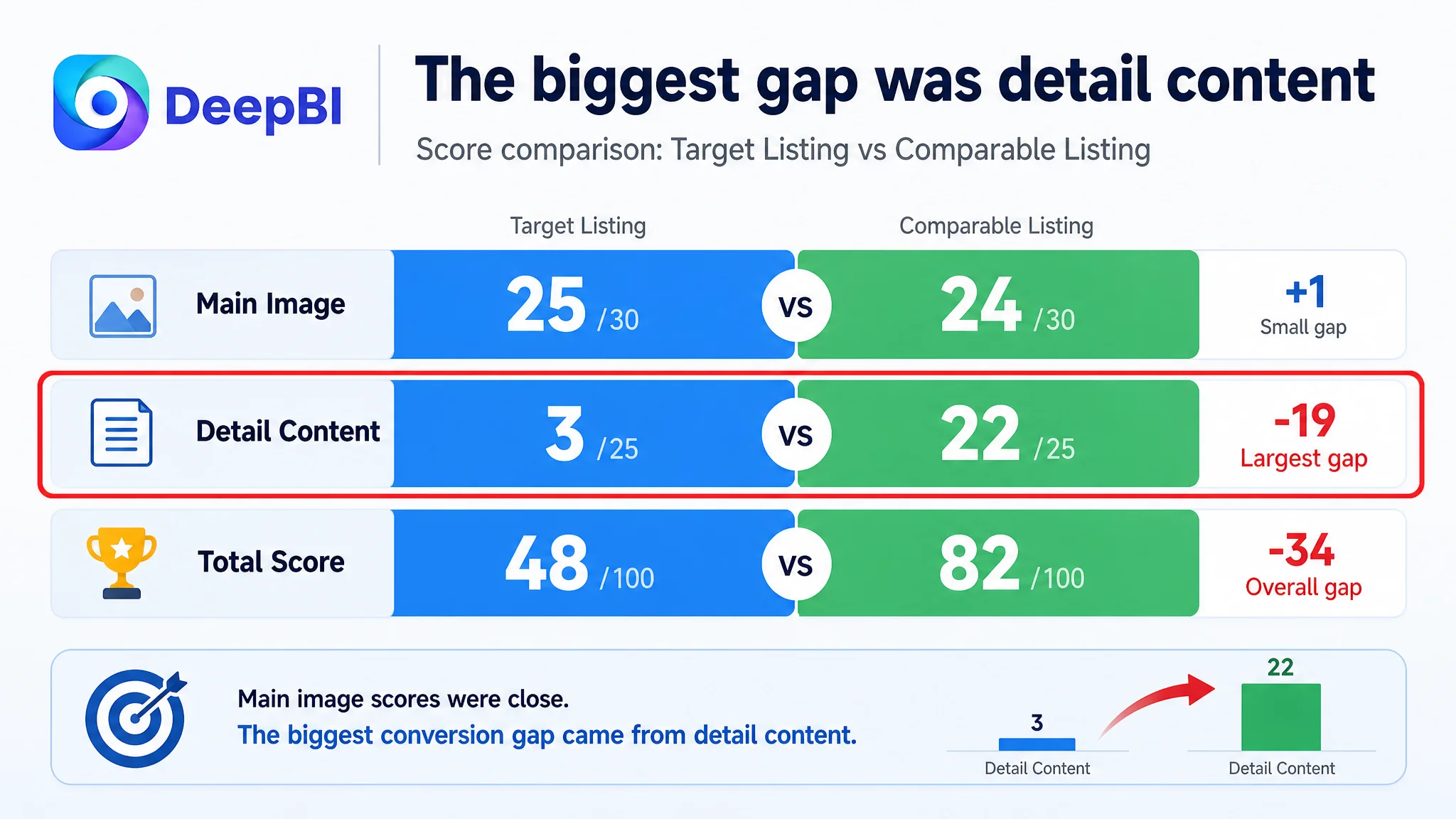
- Detail content: Target Listing: 3/25, Comparable listing: 22/25
- Reviews: Target Listing: 5/15, Comparable listing: 12/15
- Total: Target Listing: 48/100, Comparable listing: 82/100
The score pattern was important. The main image was only one point behind the comparison listing, while detail content was behind by 19 points. Bullet points were behind by 4 points, and reviews were behind by 7.
That changed the operating question.
The issue was not simply, “How can the seller make the product image more attractive?” It was, “Why is the Amazon Listing failing to build enough understanding and trust after the shopper arrives?”
The Original Direction Focused on Information, Not Decision Logic
The customer’s existing content was built around functional explanation. The page described the LED system, usage steps, product specifications, and general applications.
That approach is common in fishing accessories and other technical categories. Sellers often assume that once shoppers understand the product’s construction, they will understand its value.
But Amazon shoppers do not process every detail equally. They first look for a clear reason to continue:
- What problem does this solve?
- What is different about it?
- Can I trust the difference?
- Will it work in the situation where I need it?
The Listing did not establish that sequence strongly enough.
The title placed the core search phrase too far back and did not make the product’s key advantages immediately visible. It also missed several relevant species and use-case terms that comparable listings used to expand search coverage, including crappie, bass, panfish, catfish, and walleye.
The bullet points had a similar weakness. They contained information, but the information was mostly presented as a list of functions and instructions. The copy did not consistently connect each feature to a fishing problem or a practical outcome.
This created the original misdiagnosis: the team was treating the Listing as if it needed more explanation, when it actually needed a clearer buying argument.
The page did not lack product information. It lacked a persuasive order for that information.
The Largest Gap Was the Amazon Detail Page
The strongest diagnostic signal came from the detail-content score: 3 out of 25, compared with 22 out of 25 for the comparable listing.
The target Listing relied mainly on text. The comparison listing used a structured visual sequence:
- A strong opening banner
- Day and night usage scenes
- Material and construction details
- Specification graphics
- Real fishing situations and catch results
This difference was not cosmetic. It changed how much work the shopper had to do.
A text-only description asked the shopper to imagine:
- What the bobber looks like on dark water
- How visible the light is from a distance
- How the bite indication works
- Whether the electronic components appear reliable
- How the product fits into a real fishing setup
- Why the product is preferable to a replaceable glow stick
The comparison listing answered those questions visually. It showed the product in a fishing context and used modules to translate technical characteristics into buyer-facing benefits.
For the target Listing, the missing A+ story removed an important layer of persuasion. The page could explain what the product was, but it did not sufficiently demonstrate why the product deserved a place in the buyer’s tackle box.
The Real Root Cause Was a Trust and Translation Gap
DeepBI’s diagnosis was not that the product had no differentiator. The product did have a potentially meaningful distinction: an electronic LED system with a color-change bite indication, rather than a conventional chemical glow stick alone.
The problem was that the distinction was not translated into a complete customer-facing story.
The Listing needed to move through three stages:
1. Recognition — The shopper immediately understands that this is a lighted fishing slip bobber.
2. Relevance — The shopper sees how the LED glow and bite indication help during night or low-light fishing.
3. Confidence — The shopper understands the material, sealing, setup, dimensions, and expected use before purchasing.
The existing page was strongest at the third stage’s raw specifications, but weak at recognition, relevance, and visual confidence.
That is why DeepBI did not treat every content issue as equally urgent. Adding more dimensions would not solve the lack of night-fishing visibility. Repeating the operating instructions would not create stronger product differentiation. A more elaborate technical explanation would not replace missing usage proof.
The first priority had to be making the product’s practical value visible and credible.
The Main Image Was Not the Main Failure, but It Still Needed a Better Job
The main-image score was 25 out of 30, slightly higher than the comparable listing’s 24.
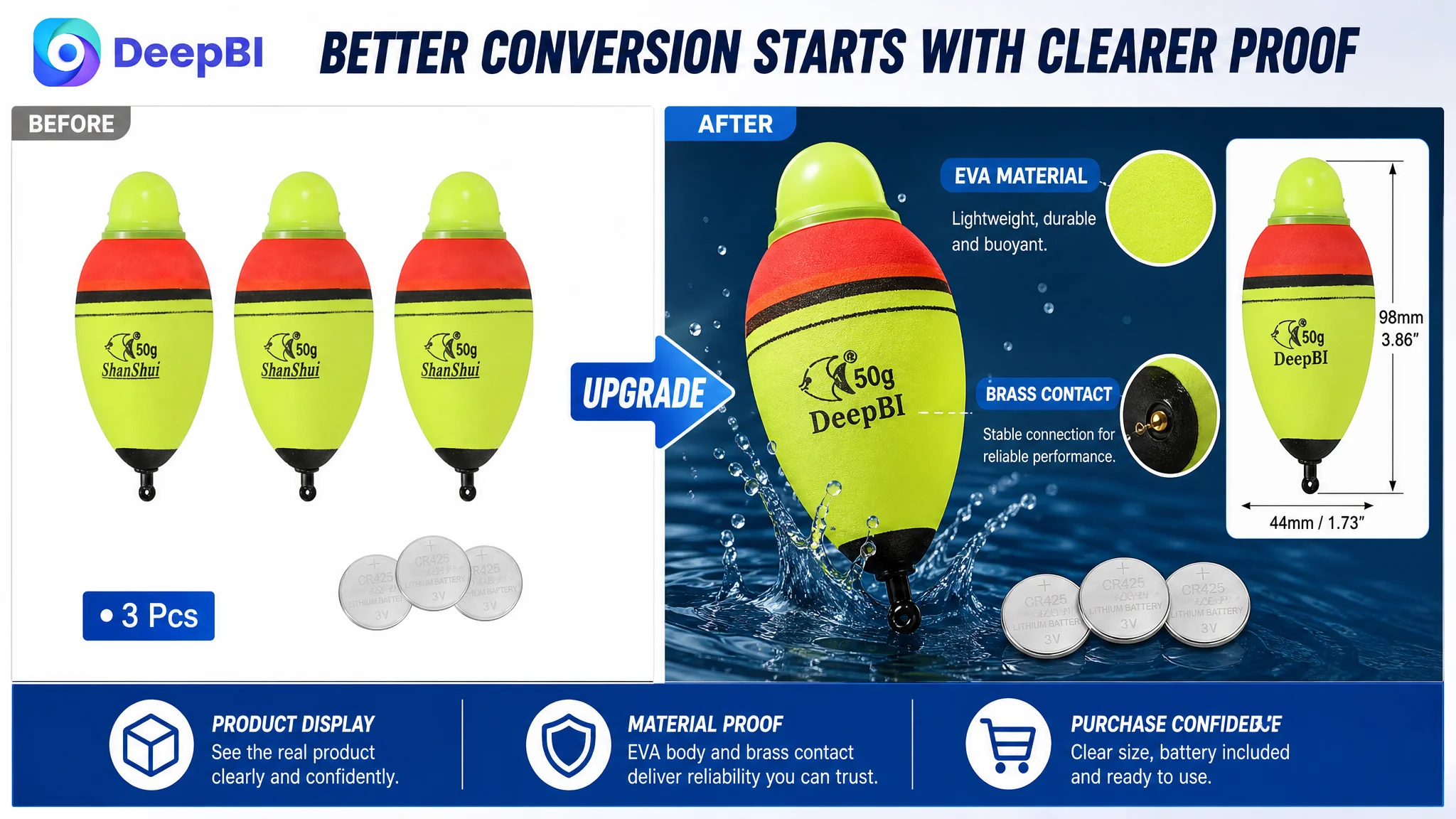
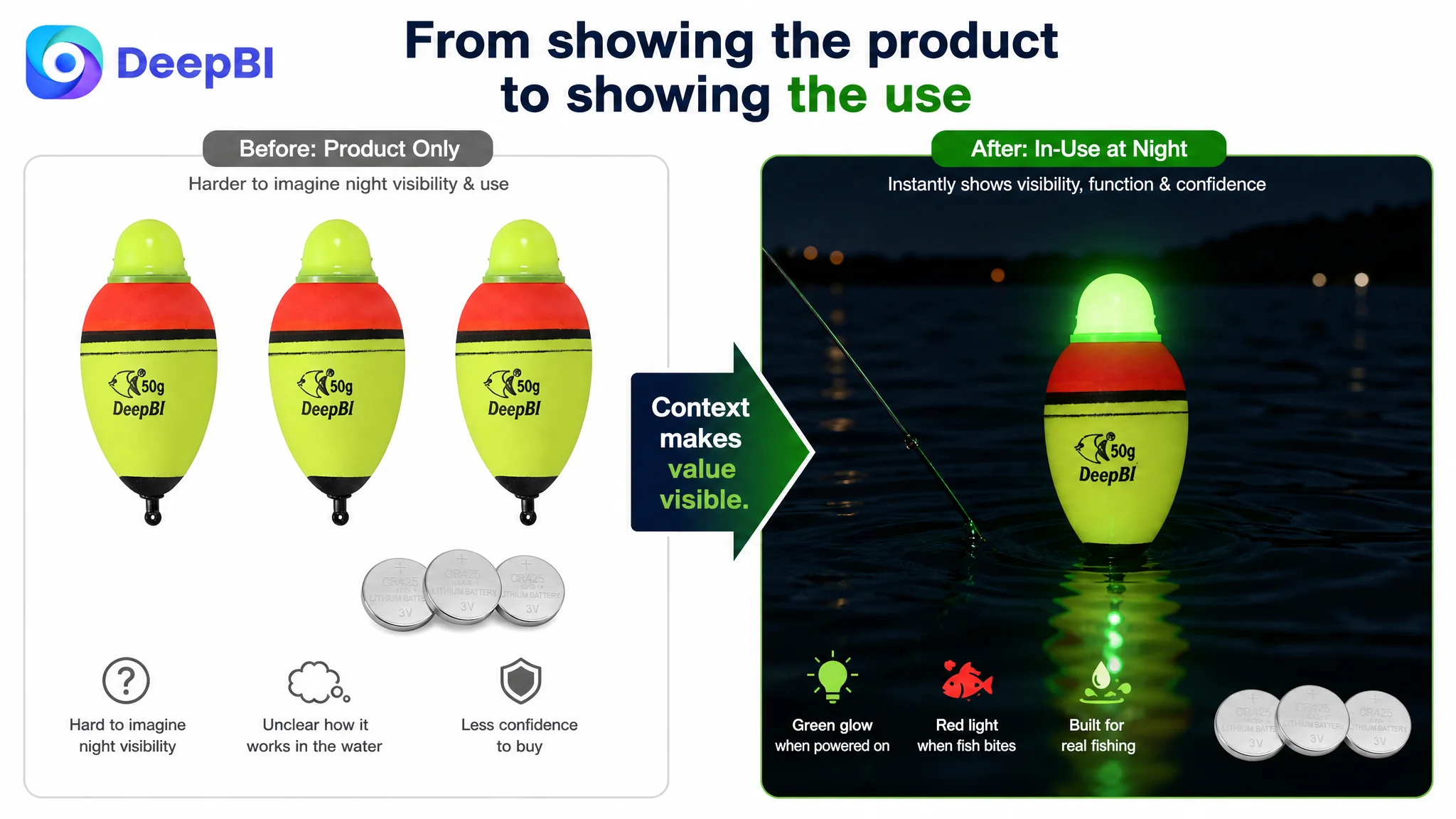
That result prevented an easy but inaccurate conclusion that the main image was simply poor. The image set already communicated the product type and basic function. However, it did not lead with the strongest reason a shopper might want this product: visible performance during night fishing.
The recommended visual direction was therefore not “make everything more dramatic.” It was more specific:
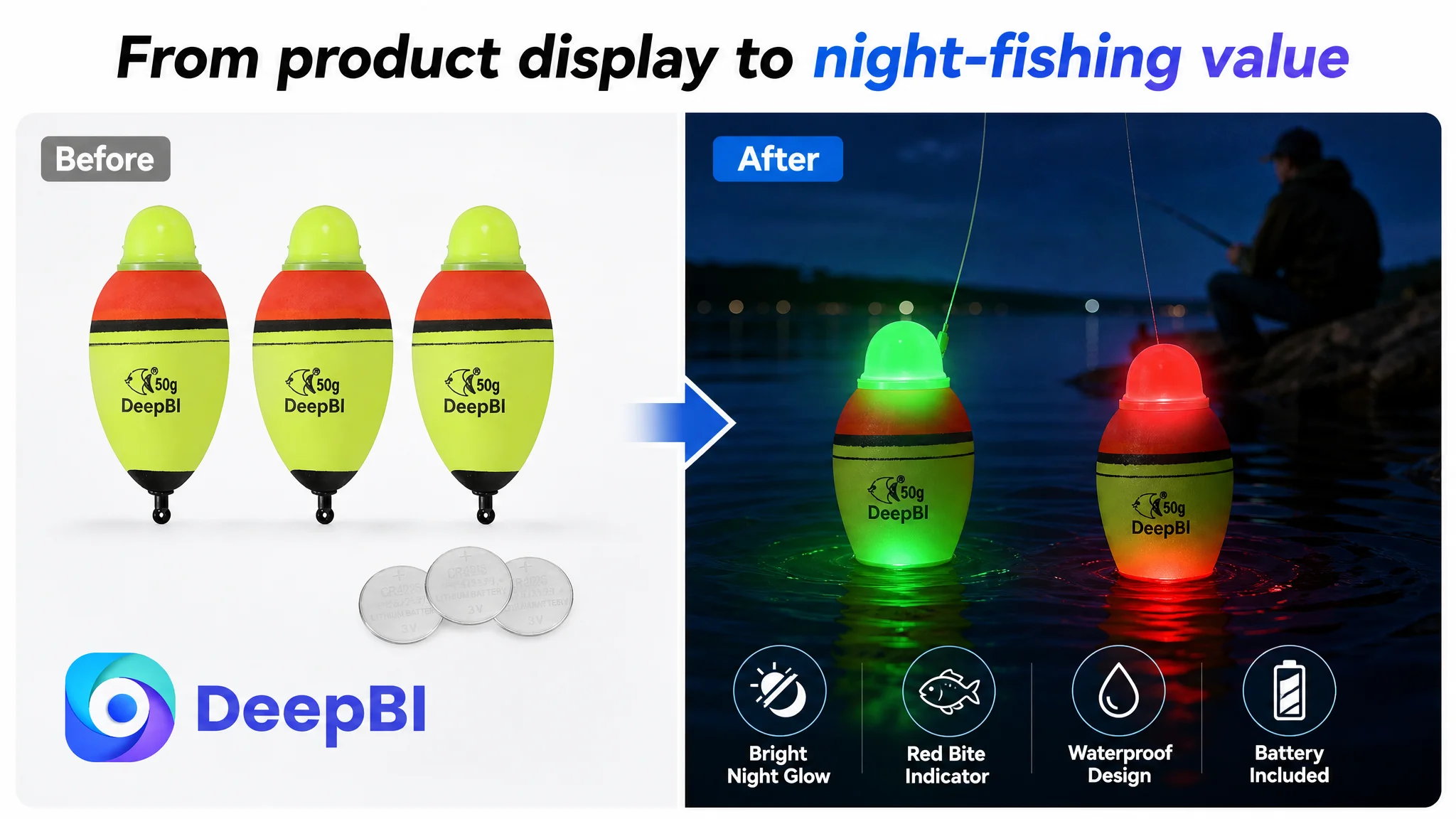
- Show the bobber actively glowing green
- Make the night-fishing use case immediately recognizable
- Add a realistic water environment later in the image sequence
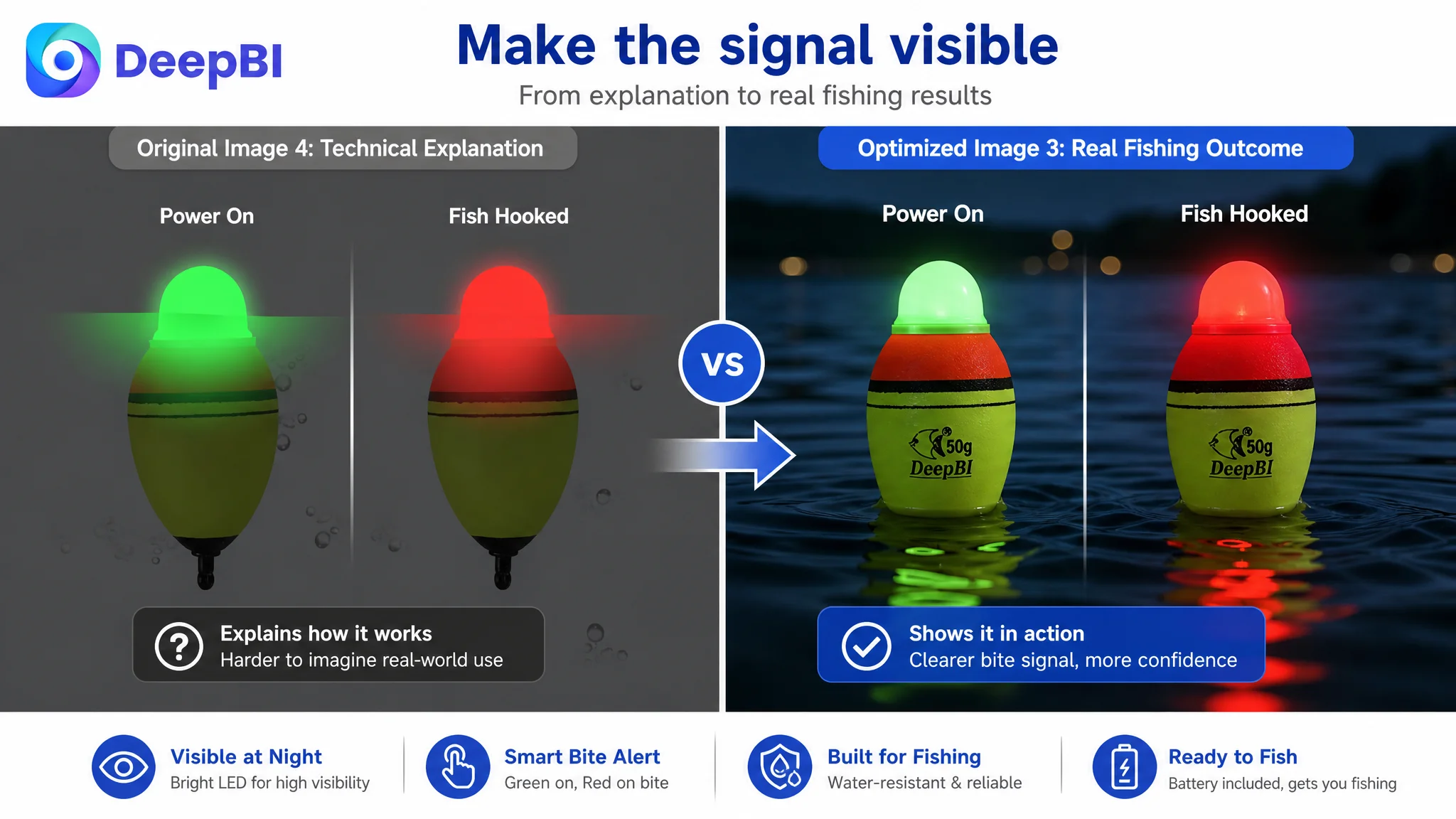
- Explain the green-to-red bite indication more intuitively
- Move routine size information later, after the core value is established
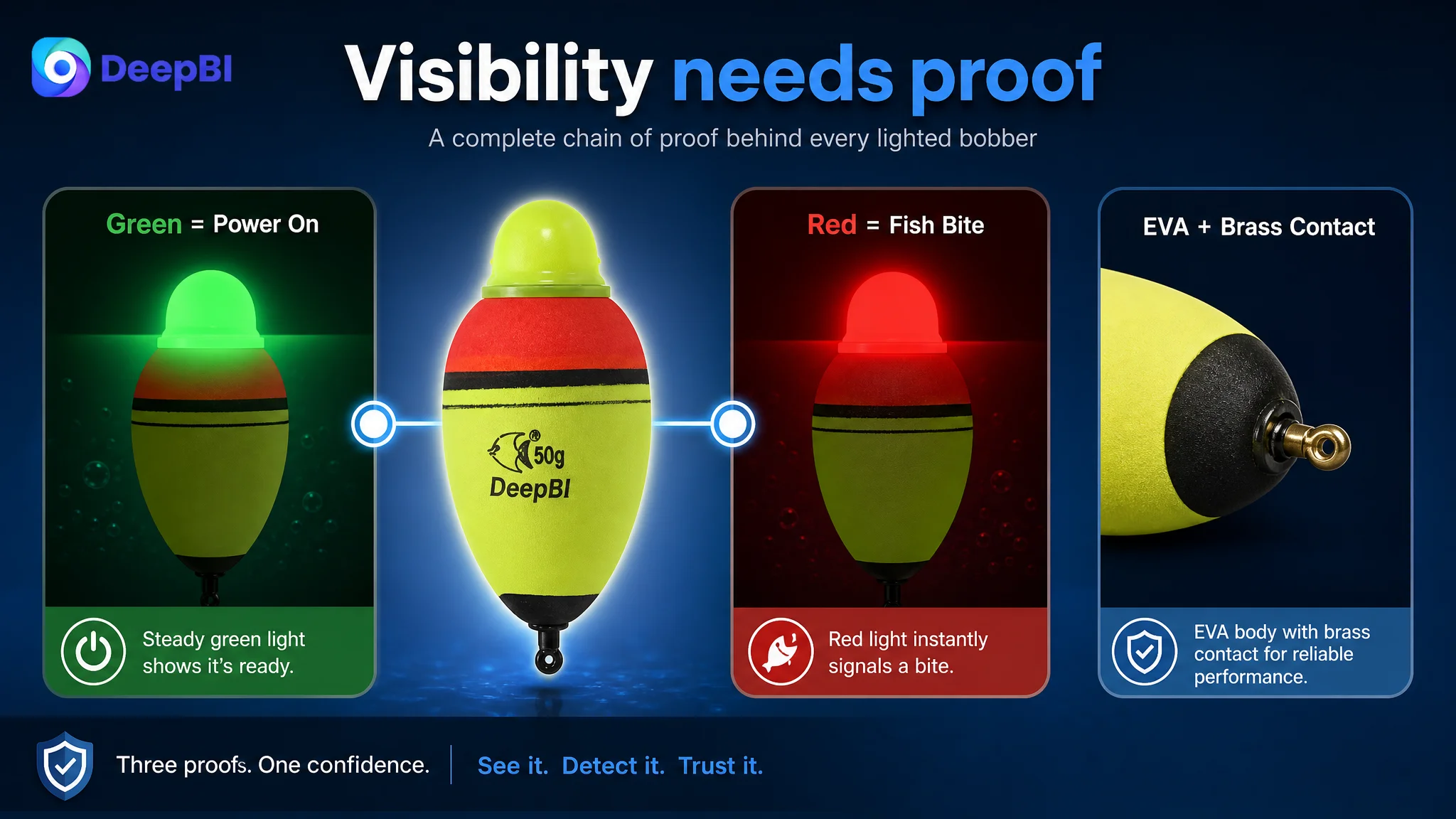
- Use a later image to validate EVA buoyancy, durability, and brass contact reliability
This was a change from selling components to showing fishing outcomes.
The image sequence should answer questions in a more natural order:
First: What is the product and what does it do?
The opening visual should confirm the product type, quantity, electronic glow, and included batteries while making the active night-use benefit visible.
Next: Why is it useful at night?
A dark-water scene with the glowing bobber can create immediate context. The shopper should not need to infer how the product appears in low light from a technical diagram.
Then: How does the bite indication work?
The color transition should be shown as a practical signal: green when powered on, red when a fish bites. The explanation must be clear without implying that ordinary movement automatically triggers the color change.
Finally: Why should I trust the construction?
Material, buoyancy, dimensions, and contact details can then support the decision after the main benefit is understood.
This ordering reflects a broader Amazon Listing principle: a specification is more persuasive after the shopper understands why it matters.
The Title Needed to Win Both Search and Attention
The title score was 12 out of 20, with a 5-point gap against the comparable listing.
The existing title structure placed the core phrase too far back and emphasized descriptive wording before establishing the product’s primary identity. It also missed several relevant fishing species and did not make the battery-supported electronic design prominent enough.
The proposed direction brought the central phrase forward:
EVA LED Lighted Fishing Slip Bobber
It then added the most relevant supporting information:
- Green and red night-fishing lights
- Battery inclusion
- Applicable fish species
- The slip-bobber format
This was not a recommendation to fill the title with every possible keyword. It was a restructuring of the search and conversion priorities:
1. Identify the product clearly.
2. State the key differentiator.
3. Confirm the primary use case.
4. Add relevant species and application terms.
5. Remove repeated wording that consumes title space without adding meaning.
The title should help Amazon’s search system understand the product while helping the shopper understand its relevance within seconds.
The Bullet Points Had Features, but Not a Buying Path
The bullet-point score was only 3 out of 10. The comparison listing used a clearer progression from use case to performance to specifications.
The target Listing’s bullets were more parameter-driven. That made them informative but less persuasive.
DeepBI’s recommended structure rebuilt the bullets around five buyer questions.
The first bullet: Why use it at night?
The first point should lead with the smart bite-alert function and explain the green-to-red signal. This places the product’s most distinctive benefit ahead of secondary details.
The second bullet: How does it perform in the water?
The EVA construction, low resistance, buoyancy, and sensitivity can then explain why the float is suitable for detecting subtle movement.
The third bullet: Can I control bait depth?
The slip-bobber mechanism should be connected to practical use: the ability to let the bait remain at a chosen depth across different fishing situations.
The fourth bullet: Can I see it and rely on it?
Visibility, material durability, and the electronic contact system should address concerns about tracking the float and maintaining reliable operation.
The fifth bullet: What exactly do I receive?
Package quantity, dimensions, buoyancy, and applicable fish species should close the sequence with clear purchase information.
The key change was structural. Each bullet needed to follow a simple logic:
Buyer concern → product capability → practical benefit
That is more useful than presenting five independent specifications.
Reviews Turned the Content Problem Into a Trust Problem
The review dimension exposed another constraint that content alone could not fully repair.
The target Listing showed:
- 3.9-star rating
- 21 total reviews
- 6 reviews visible on the first page
- 4 of those 6 first-page reviews rated one star
The comparable listing showed:
- 4.2-star rating
- More than 2,000 total reviews
- 13 visible first-page reviews
- Only one one-star review among those visible reviews
The review comments on the target Listing concentrated on practical failure concerns, including batteries not matching and lights not working. By contrast, the positive review themes on the comparable listing emphasized ease of use, durability, and suitability for night fishing.
This meant the Listing was not only competing against a more complete page. It was also asking shoppers to overcome a weaker trust signal.
That is why the diagnosis could not stop at title, images, or A+ content. If a product page promotes an electronic benefit, shoppers will naturally look for evidence that the electronics work reliably in actual fishing conditions.
The revised content therefore needed to address reliability concerns directly and accurately:
- Clarify the battery and package information
- Show the operating state clearly
- Explain the color-change behavior
- Present the sealing and material logic without inventing unsupported claims
- Reduce confusion around setup and compatible use
- Avoid promising more than the product can demonstrate
No content change can substitute for product quality or erase existing negative feedback. But clearer communication can prevent avoidable misunderstandings and make the real product value easier for future buyers to judge.
Why DeepBI Did Not Recommend Tuning Ads First
The case material does not provide post-optimization advertising metrics, so there is no basis for claiming a specific ACOS, CVR, CTR, or order improvement.
The business logic is nevertheless clear.
If Amazon ads send more shoppers to a page that does not make the product’s value visible, additional traffic can increase exposure without solving the conversion constraint. In this case, the page had several unresolved questions:
- What is the primary reason to choose this electronic bobber?
- How does the bite indication work?
- Is it more convenient than a glow-stick solution?
- Can the product be trusted in water?
- How should the buyer use it?
- Is the listed configuration suitable for the intended fish and water depth?
Until those questions were handled, continuing to adjust bids or expand traffic would risk amplifying an incomplete sales message.
Advertising can bring a shopper to the product page. It cannot make a weak product-page argument on the shopper’s behalf.
The correct decision order was therefore:
1. Clarify the product’s strongest differentiator.
2. Rebuild the title and bullet-point logic.
3. Make the night-fishing benefit visible in the image sequence.
4. Build an A+ story around operation, reliability, and application.
5. Then evaluate how paid and organic traffic respond.
This is not an argument that Amazon ads are unimportant. It is an argument that ad efficiency depends partly on the Listing’s ability to convert qualified attention.
The A+ Story Needed to Follow the Fishing Experience
The recommended A+ structure was designed to guide shoppers through the product rather than repeat the description.
Start with product confirmation
Show the package contents and establish that the shopper is looking at an electronic lighted slip bobber, not a conventional glow-stick accessory.
Make the night benefit visible
Demonstrate the glow in low-light conditions and clarify how the electric design supports night fishing without relying only on replaceable glow sticks.
Establish material and reliability confidence
Use close-up visual treatment to explain the EVA body, battery arrangement, and sealing-related construction. The goal is not to expose imaginary internal components, but to address the buyer’s concern about using an electronic float around water.
Explain the bite indication
Present the green powered-on state and the red bite signal in a simple visual sequence. This is the product’s most important technical differentiator and should not be buried in a later module.
Clarify dimensions and use
Show the confirmed measurements and buoyancy, then connect them to bait depth and target species. The page should help buyers judge whether the current configuration fits their intended fishing situation.
Reduce setup uncertainty
Show the line and swivel connection at the lower loop. A small amount of clear guidance can remove hesitation without turning the A+ content into a lengthy instruction manual.
End with application value
Bring the functions together: position visibility, bait-depth control, and bite information during night fishing.
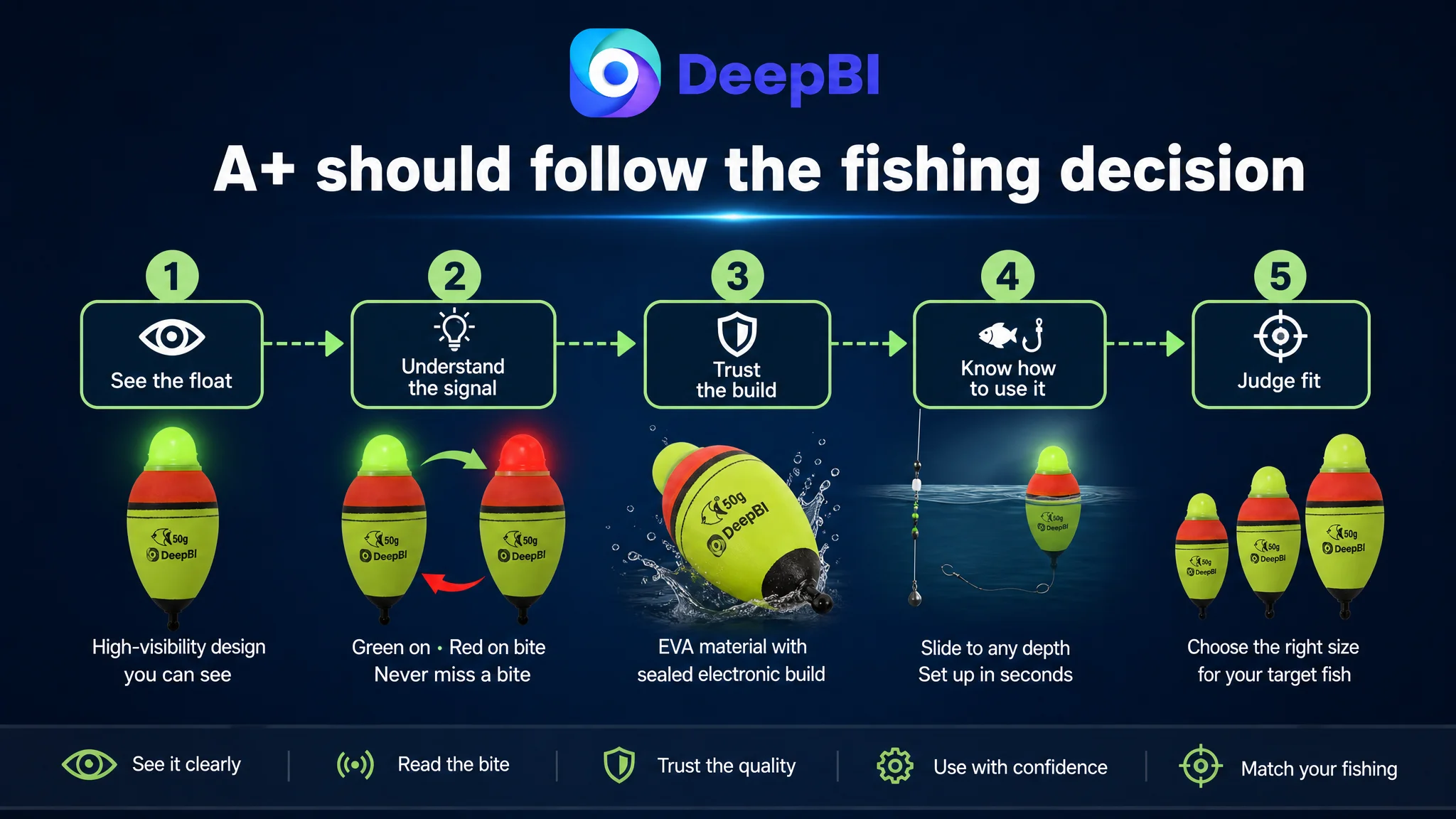
This sequence converts technical attributes into a practical use story:
See the float → understand the signal → trust the construction → know how to use it → judge whether it fits your fishing.
What This Amazon Case Reveals About Listing Diagnosis
The most important change was not a single rewritten bullet or a new image concept. It was a change in how the problem was defined.
The seller initially had a product with identifiable features and a page containing a reasonable amount of information. But the information was not organized around the buyer’s decision.
DeepBI’s comparison exposed three different kinds of weakness:
- Search weakness: the title did not prioritize the core phrase and relevant species terms.
- Persuasion weakness: the bullet points described features without forming a problem-solution path.
- Trust weakness: the detail page lacked visual proof, while the review profile raised reliability concerns.
Those weaknesses interacted. A weak title can limit qualified discovery. A weak bullet structure can reduce relevance after the click. A text-only detail page can leave technical and usage doubts unresolved. Negative reviews can make those doubts more serious.
That is why a single “optimize the images” instruction would have been incomplete.
The real constraint was the Listing’s overall conversion capacity.
The Operating Lesson for Amazon Sellers
For Amazon sellers, this case offers a practical diagnostic sequence.
Before deciding that ads need more aggressive optimization, ask:
- Is the core product benefit visible in the first moments of the page?
- Does the title identify the product and its differentiator clearly?
- Do the bullet points connect features to real buyer concerns?
- Does the image sequence show use, not only components?
- Does the A+ content provide enough visual proof?
- Are reviews creating a trust gap that content must address?
- Is the page asking shoppers to imagine too much?
- Would more traffic reveal a stronger offer, or simply expose the same uncertainty to more people?
For this fishing-accessories Listing, the answer was to repair the page’s sales logic before treating traffic expansion as the primary solution.
The case does not prove a guaranteed performance outcome, and the available material does not include post-change advertising or sales data. What it does establish is a more reliable decision path: diagnose the Listing against a relevant market benchmark, find the largest conversion constraint, and prioritize the content changes that remove the most important buyer doubts.
The product did not need to be described more loudly.
It needed to be understood more quickly, trusted more easily, and connected more clearly to the moment when an angler is deciding whether this is the right tool for night fishing.