

This case follows an Amazon seller in the US marketplace whose 12-inch outdoor drain grate Listing was materially behind a comparable high-performing product page. The immediate temptation was to treat the gap as a collection of isolated issues: rewrite the title, improve the main image, add more technical details, and make the product look more industrial.
That direction was not wrong, but it was incomplete. The deeper problem was that the Amazon product page did not yet give buyers enough evidence to trust the product in demanding conditions. Its title was less search-oriented, its images made users infer too much, its bullets described functions without building a full buying argument, and its A+ content did not demonstrate the product in the situations that mattered most.
DeepBI reframed the case around Listing conversion capacity. Before increasing Amazon ads or trying to force more traffic into the page, the seller needed to repair the chain from click to confidence: clearer search intent, stronger visual proof, more concrete use cases, and a more complete explanation of load-bearing, drainage, corrosion protection, installation, and fit.
For other Amazon sellers, the lesson is practical: when a product page trails the market across several trust-building dimensions, ad optimization alone may only send more visitors into the same conversion bottleneck.
The Amazon Listing Was Not Losing on One Detail
The product was an outdoor metal drain grate designed for settings such as driveways, garages, yards, concrete floors, and drainage channels. This is a category where the buyer is not evaluating appearance alone.
A homeowner may want to know whether the grate will fit the intended area and remain safe in wet conditions. A contractor, property manager, or facilities buyer may care more about pressure resistance, water flow, corrosion protection, maintenance, and installation reliability.
The page therefore had to answer two different questions:
“Will this product work in my environment?”
and:
“What evidence shows that it will keep working under pressure, rain, traffic, and long-term outdoor exposure?”
The Listing did not fail because one sentence was poorly written. It fell behind because the page did not consistently answer those questions across the Amazon buying journey.
DeepBI’s score comparison made the pattern visible:
- Title: Target Listing: 12/20, Comparable Listing: 16/20, Gap: -4
- Main image: Target Listing: 23/30, Comparable Listing: 26/30, Gap: -3
- Bullet points: Target Listing: 7/10, Comparable Listing: 8/10, Gap: -1
- Detail content: Target Listing: 17/25, Comparable Listing: 21/25, Gap: -4
- Reviews: Target Listing: 0/15, Comparable Listing: 11/15, Gap: -11
- Total: Target Listing: 59/100, Comparable Listing: 82/100, Gap: -23
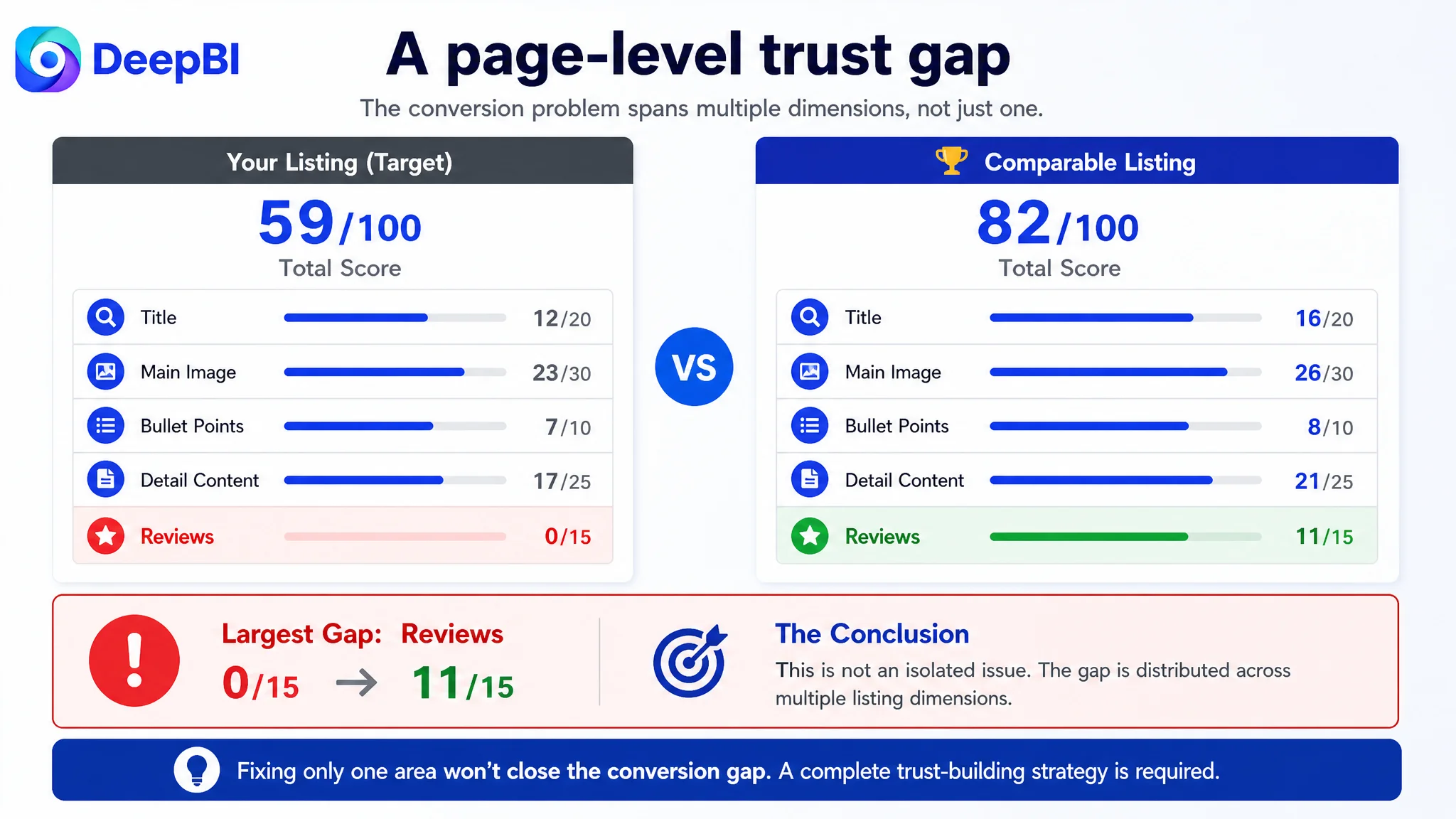
The most important finding was not simply the total score. It was the distribution of the gaps.
The Listing was behind in the search entrance, the visual click layer, the product explanation, the A+ persuasion layer, and the review-based trust layer at the same time.
That meant there was no single creative adjustment likely to solve the entire problem.
The Initial Diagnosis Focused on Assets, Not Conversion Logic
The seller’s working direction was understandable. The product needed a stronger title, more persuasive bullet points, better images, and richer detail content. In practice, this can easily become a checklist exercise:
- Add more keywords to the title
- Replace the main image
- Add specifications
- Mention heavy-duty performance
- Show more application scenarios
- Improve the visual style
These actions may improve individual components, but they do not automatically create a persuasive Amazon product page.
The risk is that the team improves each asset separately without deciding what the customer must believe before placing an order.
For this drain grate, the buying logic had to move in a clear sequence:
1. The shopper recognizes the product as relevant to the intended drainage use.
2. The shopper understands the actual size, material, and application.
3. The shopper sees why it can handle outdoor pressure and runoff.
4. The shopper believes it will resist common problems such as clogging, corrosion, slipping, or poor fit.
5. The shopper finds enough evidence to accept the purchase risk.
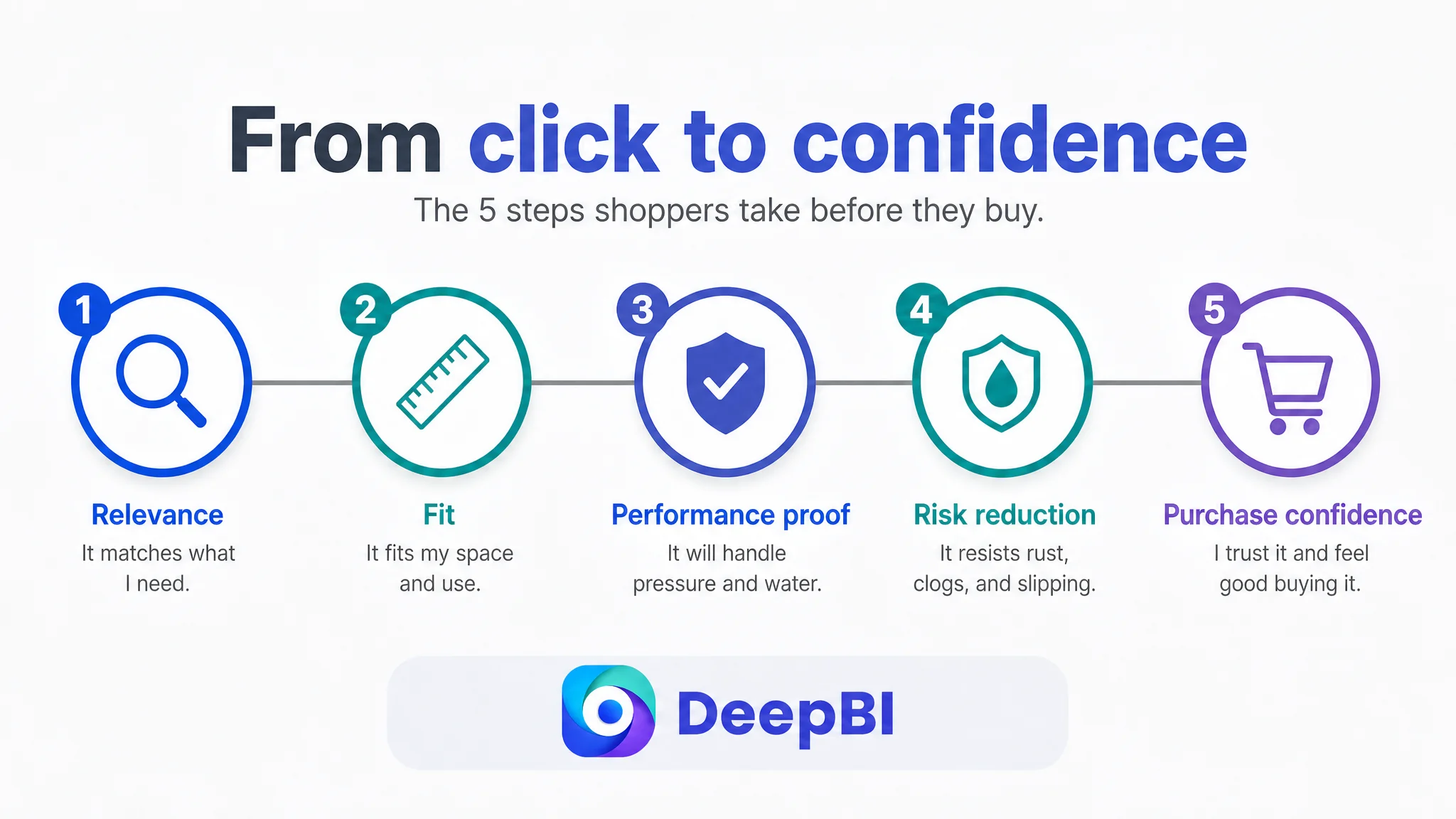
The original page provided information, but not enough proof in that sequence.
The issue was not a shortage of product claims. It was a shortage of connected reasons to believe those claims.
This is where traditional Amazon optimization often stalls. The team keeps refining words or images, but the page remains structurally weak because the underlying decision path has not been defined.
The Real Constraint Was Listing Conversion Capacity
The score pattern pointed to a page-level conversion problem rather than a single keyword or design problem.
The title gap suggested that shoppers could encounter the product without immediately understanding its most relevant search and use-case signals. The main-image gap suggested that the product did not create enough visual differentiation at the thumbnail stage. The detail-content gap showed that the page lacked sufficient proof for more demanding decisions.
The review gap made the situation more severe.
The target Listing had no visible rating data and no customer reviews, while the comparable Listing displayed a 4.6-star rating, 73 total reviews, and 11 reviews visible on the page. A stronger title or image could help earn attention, but it could not fully replace the trust accumulated through customer feedback.
This did not mean reviews were the only problem. It meant that the page had to compensate through stronger product evidence wherever it could.
For a functional outdoor hardware product, trust must often be built through visible demonstration:
- Water actually moving through the grate
- A vehicle or heavy load passing over it
- The metal surface and protective finish shown in close detail
- The product installed in a realistic drainage channel
- The intended fit and dimensions clearly presented
- Multiple environments showing where it can be used
The existing content did not provide enough of this evidence. Several images showed the product clearly, but static visibility is not the same as functional proof.
The Title Was Not Just a Keyword Problem
The suggested title direction moved from a less familiar size expression toward a more searchable and readable structure:
12x12 Inch Galvanized Steel Drain Grate, B125 Heavy Duty Outdoor Drain Cover, Rust-Proof Square Metal Sewer & Channel Grate for Driveway, Garage, Yard and Concrete Floor
The commercial logic behind this structure was more important than the wording itself.
The title needed to establish:
- The product form: drain grate and drain cover
- The core material: galvanized steel
- The expected use level: heavy duty and outdoor
- The relevant category terms: sewer and channel grate
- The major application environments: driveway, garage, yard, and concrete floor
The original size expression of 11.82 inches was less immediately readable than a rounded 12x12-inch format. The competing title also placed “Cast Iron” early and connected the product to a specific use environment, such as a concrete floor.
The point was not to imitate the competitor’s language. It was to make the product’s search identity and buying context easier to understand.
A title can attract the right traffic, but it also pre-qualifies the click. If the shopper does not quickly see the product’s material, size, load class, and intended setting, the Listing starts the conversion journey with unnecessary uncertainty.
The Main Image Needed to Create a Reason to Continue
The main-image diagnosis was not that the product was invisible or unusable. The issue was that the visual hierarchy did not communicate enough industrial reliability at a glance.
On Amazon, especially on mobile, the main image has very little time to establish relevance. A generic product photograph can make a specialized drain grate look interchangeable with ordinary hardware.
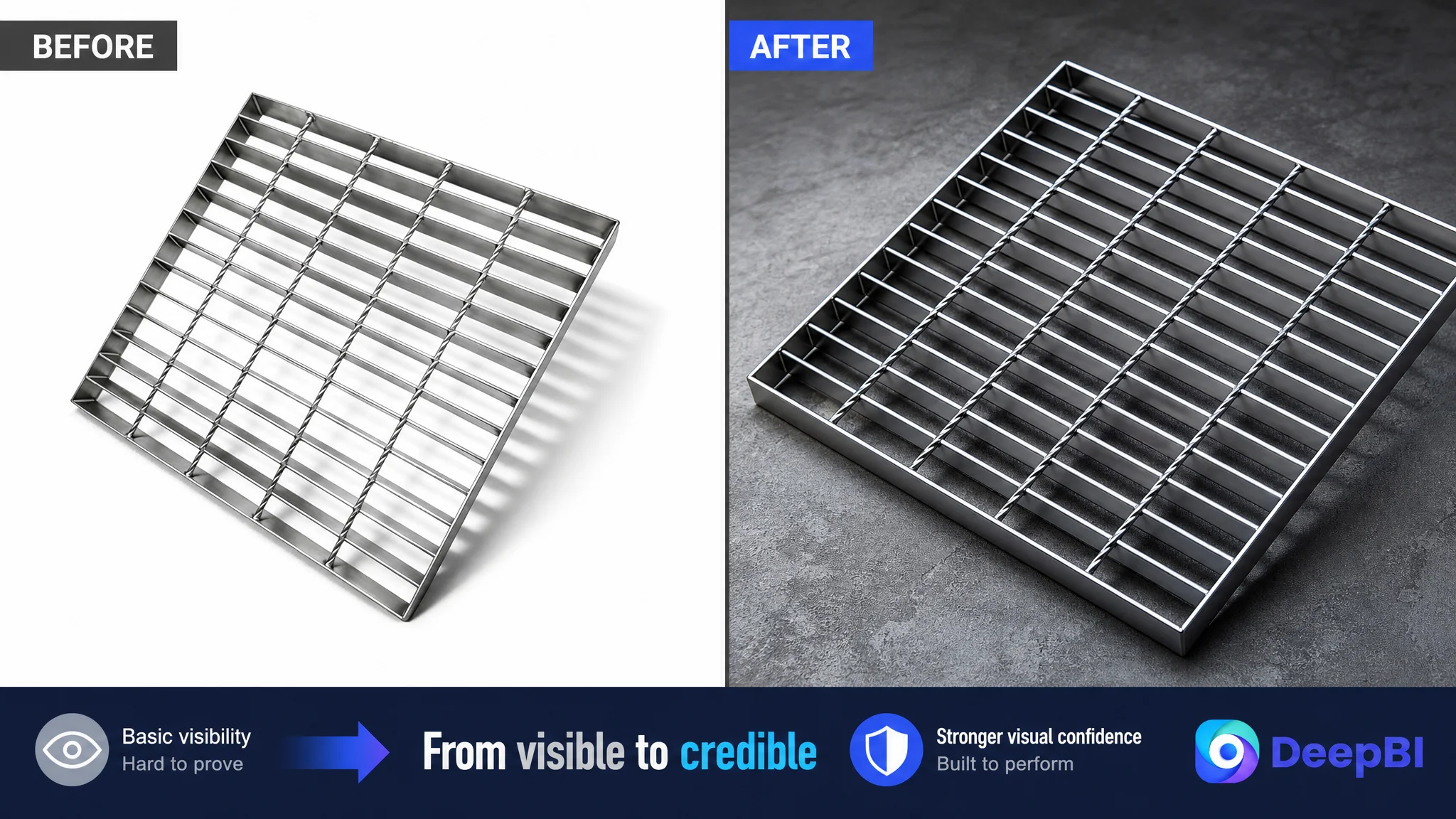
The recommended direction was to move toward a more modern, reliable industrial presentation while keeping the actual product unchanged:
- Center the product with a stronger visual presence
- Use a controlled 45-degree perspective where appropriate
- Improve lighting and edge definition
- Show dimensions in a cleaner specification image
- Use realistic drainage and installation scenes in secondary images
- Show the grate under vehicle pressure
- Use close-ups to communicate surface treatment and anti-slip detail
These changes were not intended as decoration. Each visual had a different job in the decision process.
The first image had to establish product identity
A cleaner composition and more deliberate lighting could help the grate read as a purpose-built outdoor drainage component rather than a generic metal panel.
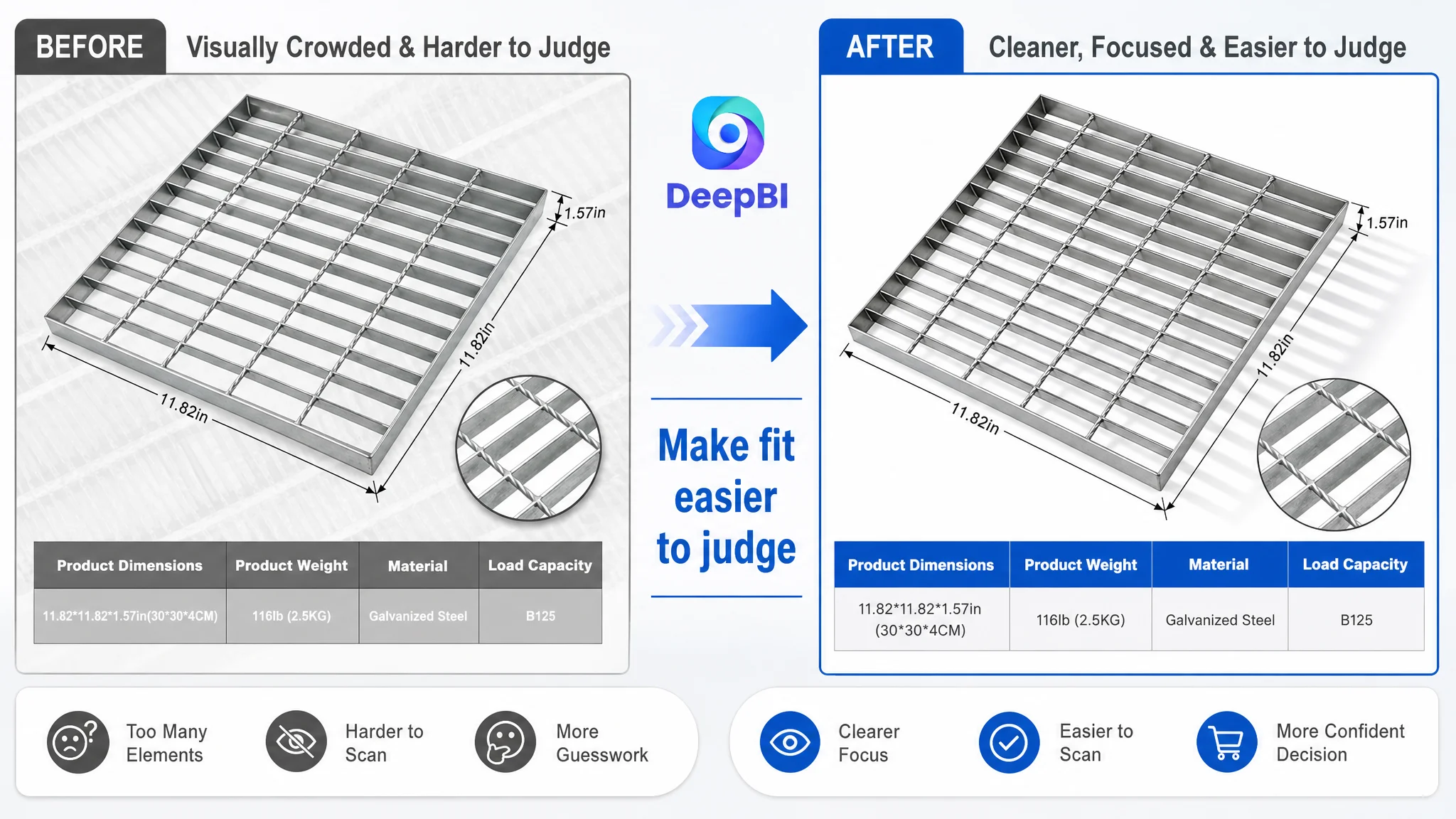
The specification image had to reduce fit anxiety
Dimensions, height, and grate spacing needed to be easier to read. A buyer deciding whether the product fits an existing channel should not have to infer measurements from a crowded graphic.
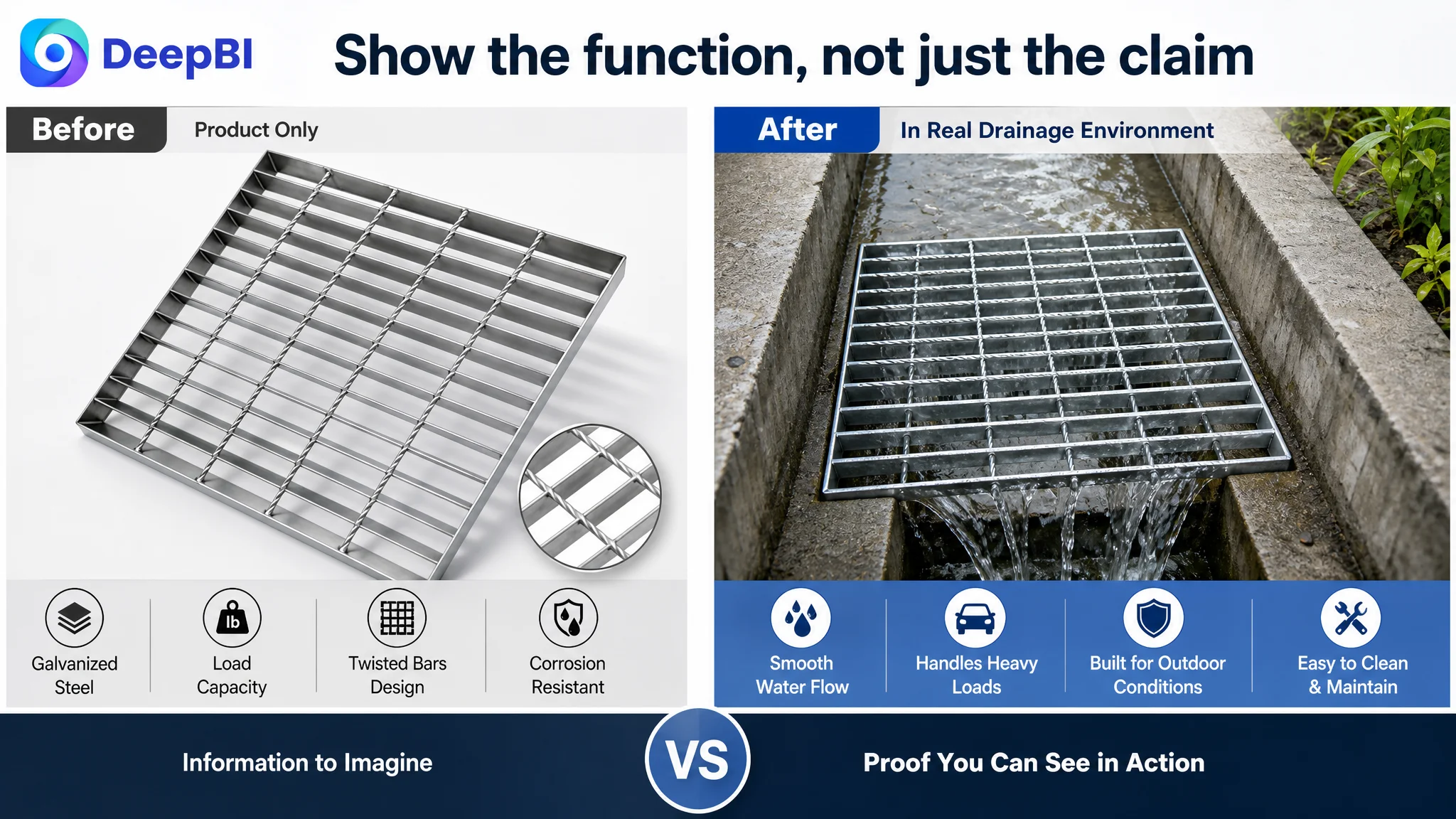
The drainage image had to demonstrate function
A realistic water-flow scene could convert an abstract claim such as “efficient drainage” into something visually understandable.
The load-bearing image had to make pressure visible
The page mentioned vehicle traffic and heavy-duty use, but the visual evidence was not strong enough. A controlled image showing a heavy vehicle tire pressing on the installed grate could make the intended use more concrete.
The crucial distinction was between saying that a product is strong and showing the context in which strength matters.
The Bullet Points Had Information, but Not a Complete Buying Argument
The existing bullet structure was relatively clear but leaned toward specifications and functional descriptions. The competing page was more effective at turning features into consequences for the buyer.
For this category, the bullets needed to connect:
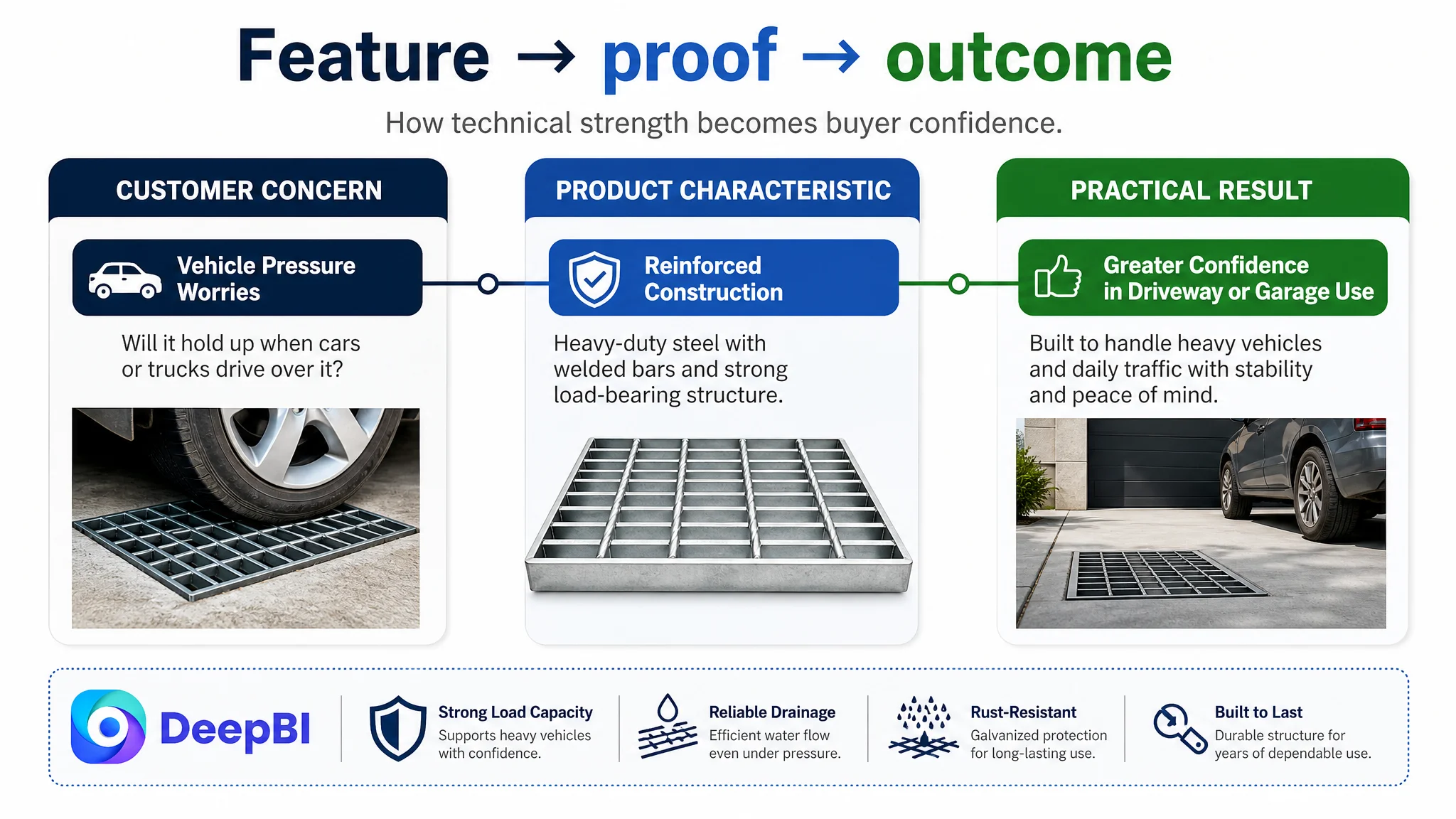
Concern → Product characteristic → Practical result
For example:
- Concern: A grate may buckle under vehicle traffic.
- Product characteristic: Reinforced heavy-duty construction.
- Practical result: Greater confidence in driveways, garages, and high-traffic areas.
Or:
- Concern: Leaves and debris may enter the drainage system.
- Product characteristic: Evenly spaced openings.
- Practical result: Water can flow through while maintenance demands remain more manageable.
The recommended bullet logic covered several key concerns:
- Material and structural integrity
- Load-bearing performance
- Corrosion protection
- Drainage and clog resistance
- Anti-slip safety and rounded edges
- Weather and aging resistance
- Installation and application range
The priority was not to add every possible claim. It was to give each major buyer concern a clear place on the page.
Some suggested copy in the source material described testing, certification, customized sizes, or specific performance properties. Those claims would require confirmation before publication. DeepBI’s diagnostic value depends on preserving the boundary between a persuasive presentation and an unsupported promise.
That boundary matters particularly in Amazon Listing optimization. A page can become more persuasive without inventing a load rating, test result, certification, or material advantage that the product does not actually possess.
The Missing A+ Story Left the Hardest Questions Unanswered
The target Listing used several core selling-point images, but it did not offer the same breadth of application storytelling as the comparable page.
The competitor’s content combined product-focused visuals with a multi-scene module covering settings such as installation areas, storage, and different terrain or property environments. The target page showed the product clearly, but the story remained more static and less situational.
That created a specific conversion risk:
The shopper could understand what the grate looked like, but still be unsure whether it belonged in their environment.
A stronger A+ structure would not simply add more images. It would assign each module a role.
Real weather should introduce the problem
A rainy urban or residential drainage scene could establish why fast water flow and reliable surface protection matter.
Load pressure should validate structural confidence
A heavy vehicle or truck tire placed over the installed grate could make the load-bearing proposition more tangible, provided the visual claim matched verified product capability.
Drainage comparison should clarify the outcome
A carefully controlled comparison between standing water and unobstructed flow could show the practical meaning of the grate opening design. Any comparison would need to remain factual and avoid implying performance that has not been validated.
Surface detail should support durability and safety
A close-up of the coating, texture, edges, and finish could address concerns about corrosion, slipping, and manufacturing quality.
Multiple environments should broaden relevance
Garden paths, garage entrances, driveways, sidewalks, and similar settings could help both household and professional buyers assess fit.
Installation should reduce purchase hesitation
Showing the grate being placed into a prepared channel could address a common concern: whether the dimensions and edge design will work in the intended installation.
A specification panel should close the decision
The final module should bring the page back to measurable information, including confirmed dimensions and applicable load classification.
This is the role of A+ content in the case: not to repeat the title and bullets, but to resolve the questions that remain after the initial product scan.
Why DeepBI Did Not Prioritize More Traffic First
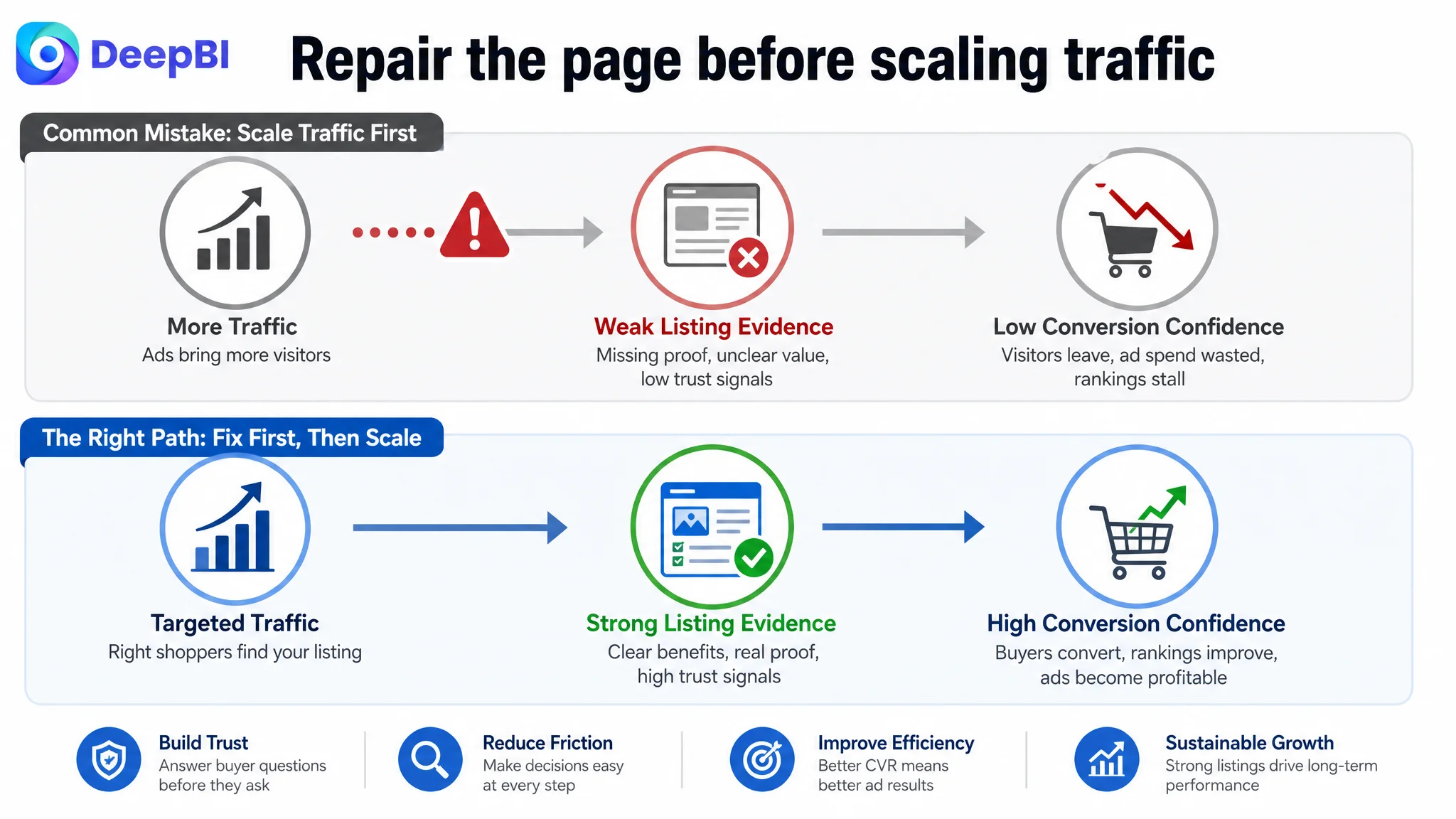
Without reliable conversion evidence on the page, increasing Amazon ad traffic would create an avoidable risk.
If the title attracts the wrong expectations, the main image fails to distinguish the product, and the detail content does not establish confidence, more clicks do not necessarily produce more useful demand. They may simply increase the volume of shoppers leaving after encountering uncertainty.
The decision order therefore had to change:
1. Establish whether the Listing could clearly attract the intended shopper.
2. Repair the page’s ability to explain the product and demonstrate its value.
3. Address the review and trust gap through compliant operational work.
4. Only then evaluate how aggressively to scale Amazon ads.
This does not mean ads were irrelevant. Amazon ads remain an important source of traffic and learning. But the page must be capable of converting the traffic before increased spend can become a reliable growth lever.
Advertising can amplify a strong product page. It can also amplify the cost of a weak one.
DeepBI’s role in this case was to connect the Listing score to a business decision: the largest risk was not merely low traffic. It was paying for traffic before the product page had enough evidence to convert it.
From “Make the Listing Better” to a More Precise Operating Plan
The useful change was not a longer list of recommendations. It was a clearer prioritization of what the page had to accomplish.
The revised direction focused on:
- Making the title more searchable and immediately legible
- Making the main image communicate a credible industrial product identity
- Translating technical features into buyer outcomes in the bullets
- Demonstrating drainage, load-bearing, durability, safety, and installation visually
- Expanding A+ content from static product presentation into real-use evidence
- Clarifying specifications so shoppers could judge fit
- Recognizing the review deficit as a major trust constraint rather than treating it as a minor content issue
- Keeping all claims within verified product capabilities
The image recommendations were also structured around business questions rather than visual style alone. A 45-degree view, a realistic rain scene, a load-bearing demonstration, a coating close-up, and a multi-environment module each addressed a different conversion barrier.
That is the difference between producing more Listing assets and repairing the Listing’s sales logic.
What Other Amazon Sellers Can Learn From This Case
This case does not provide a post-optimization performance dataset, so it would be inappropriate to claim a specific CVR increase, ACOS decline, or organic-order recovery.
What it does provide is a clear diagnosis of the operating state before optimization.
The Listing was exposed to several risks:
- Paid traffic could be sent to a page with limited trust support
- Shoppers could misunderstand the product’s search identity or intended use
- Static images could force buyers to infer performance
- Missing scenario coverage could create uncertainty about fit
- The absence of reviews could make even accurate product claims less persuasive
- Continued ad tuning could distract the team from the page-level constraint
The broader Amazon lesson is that ad efficiency and Listing quality cannot be separated.
When a page scores materially below a relevant market benchmark, the first question should not be:
“Which bid or keyword should we adjust next?”
It should be:
“If the right shopper arrives today, does the product page give that shopper enough reason to continue?”
For this drain grate Listing, the answer required more than better copy. It required a coordinated page narrative built around the buyer’s actual concerns: fit, water flow, load, corrosion, safety, maintenance, installation, and long-term use.
That is where DeepBI’s judgment mattered. The system did not treat the 59-point score as a cosmetic report card. It used the gap across title, imagery, detail content, and reviews to identify the more consequential constraint: the Amazon Listing needed to earn trust before the seller could expect advertising to work efficiently.