

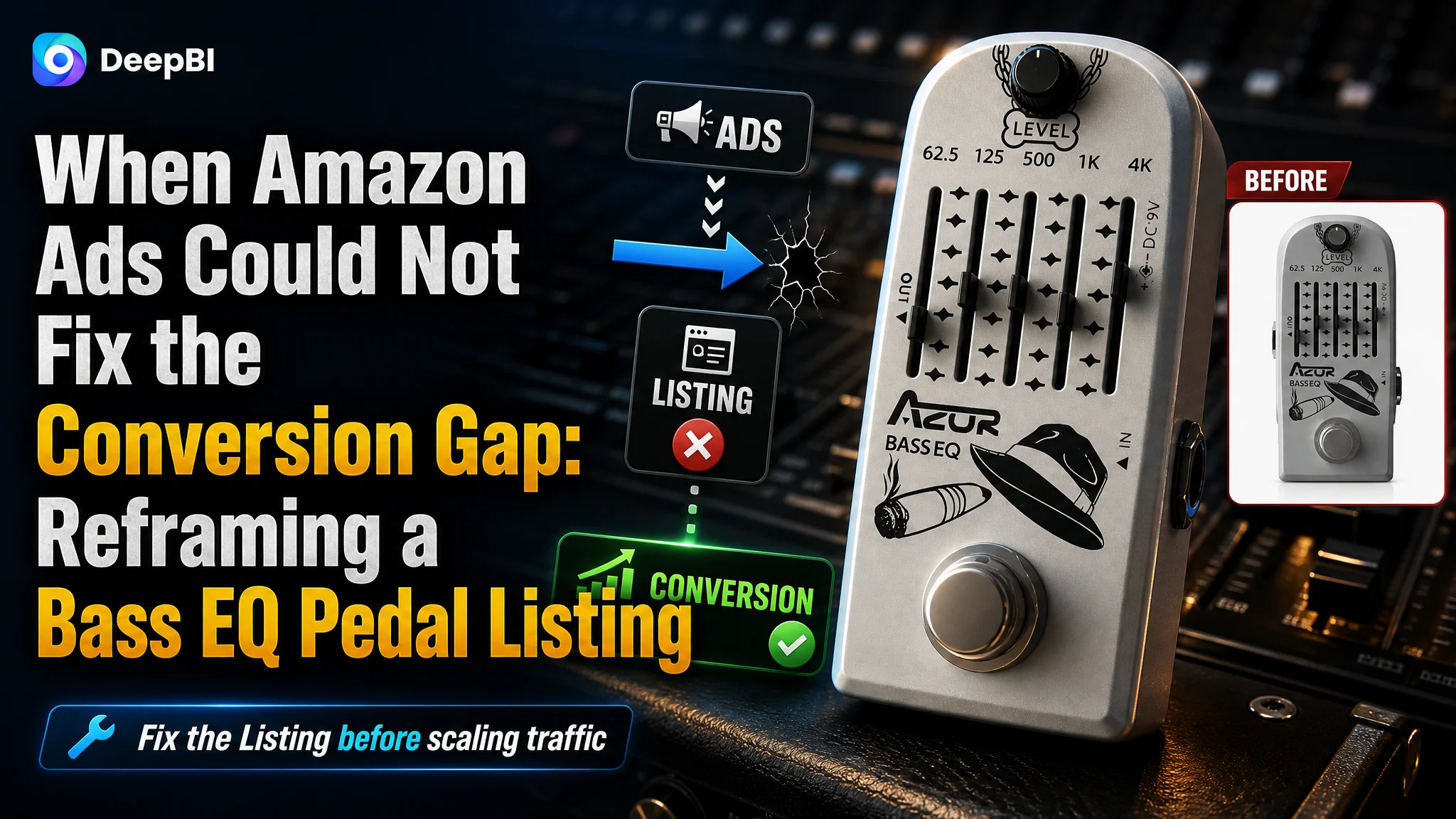
The customer was an Amazon seller in the musical-instrument accessories category, working with a bass EQ pedal on the US marketplace. The Listing was receiving attention, but its product-page content was not making the product’s technical value easy to understand or trust. The initial concern naturally pointed toward traffic and advertising efficiency: perhaps the keywords, bids, or campaign structure needed more adjustment.
DeepBI’s diagnosis pointed somewhere else. The central issue was not simply the amount or quality of traffic. The Amazon product page was too weak to convert that traffic. Its title buried the core category term, its images showed the product without enough technical or usage context, its bullet points did not build a professional buying argument, and its A+ content was completely absent.
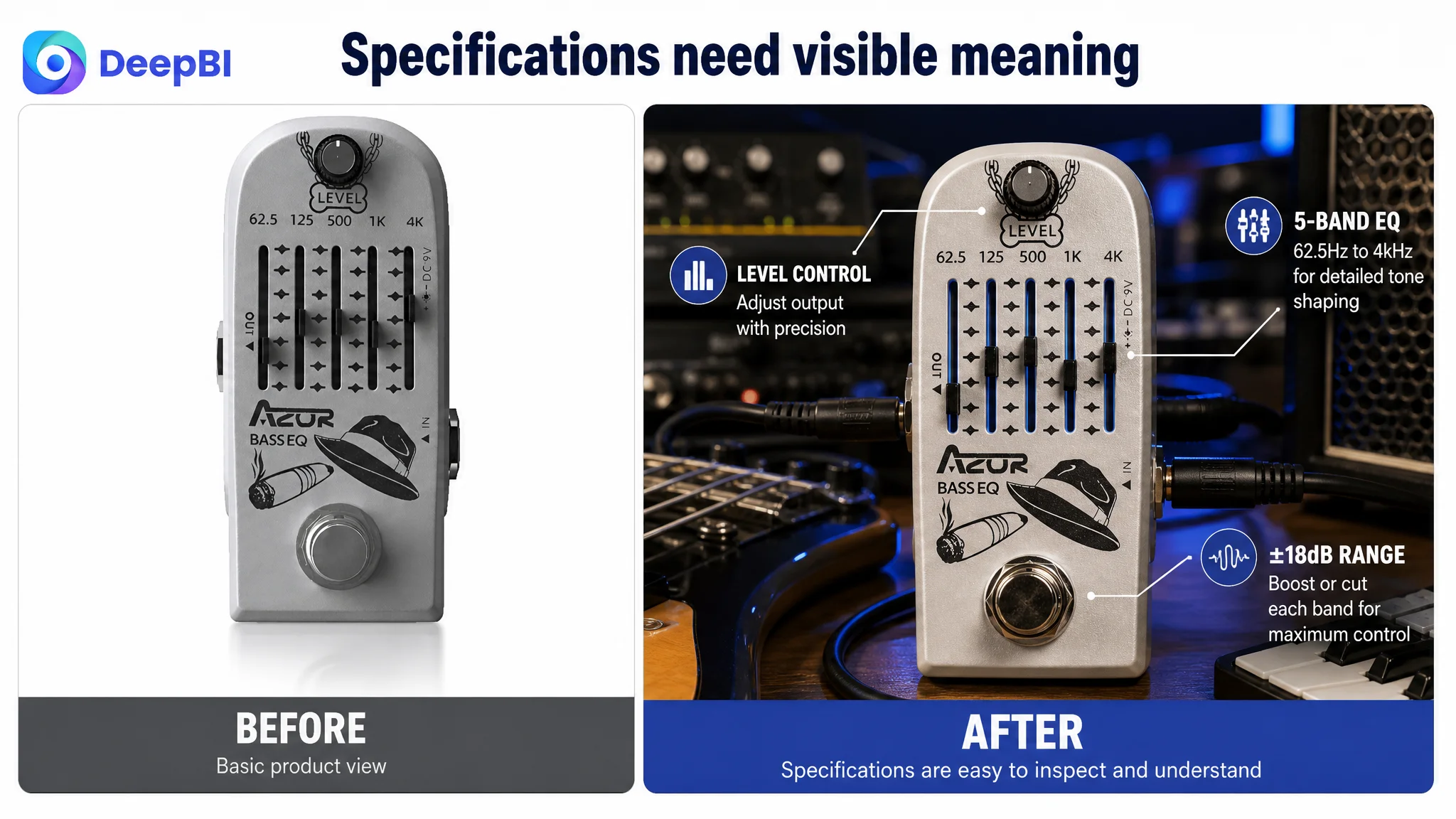
The later optimization therefore focused on rebuilding the Listing’s sales logic: clarify the product’s search identity, make its five-band EQ control and ±18 dB range easier to understand, strengthen the visual language of a professional audio tool, and use A+ content to explain operation, compatibility, interfaces, and power requirements. For other Amazon sellers, the lesson is direct: before scaling Amazon ads, first determine whether the product page is capable of converting the traffic being purchased.
The Listing Did Not Have a Small Content Problem
The score comparison made the gap difficult to dismiss as a matter of taste.
The customer’s Amazon Listing scored 43 out of 100, while a comparable high-performing listing scored 82. The 39-point difference was spread across several areas, but one dimension dominated the diagnosis:
- Title: Customer Listing: 12/20, Comparable listing: 16/20, Gap: -4
- Main image: Customer Listing: 21/30, Comparable listing: 26/30, Gap: -5
- Bullet points: Customer Listing: 3/10, Comparable listing: 5/10, Gap: -2
- Detail page and A+ content: Customer Listing: 0/25, Comparable listing: 22/25, Gap: -22
- Reviews: Customer Listing: 7/15, Comparable listing: 13/15, Gap: -6
- Total: Customer Listing: 43/100, Comparable listing: 82/100, Gap: -39
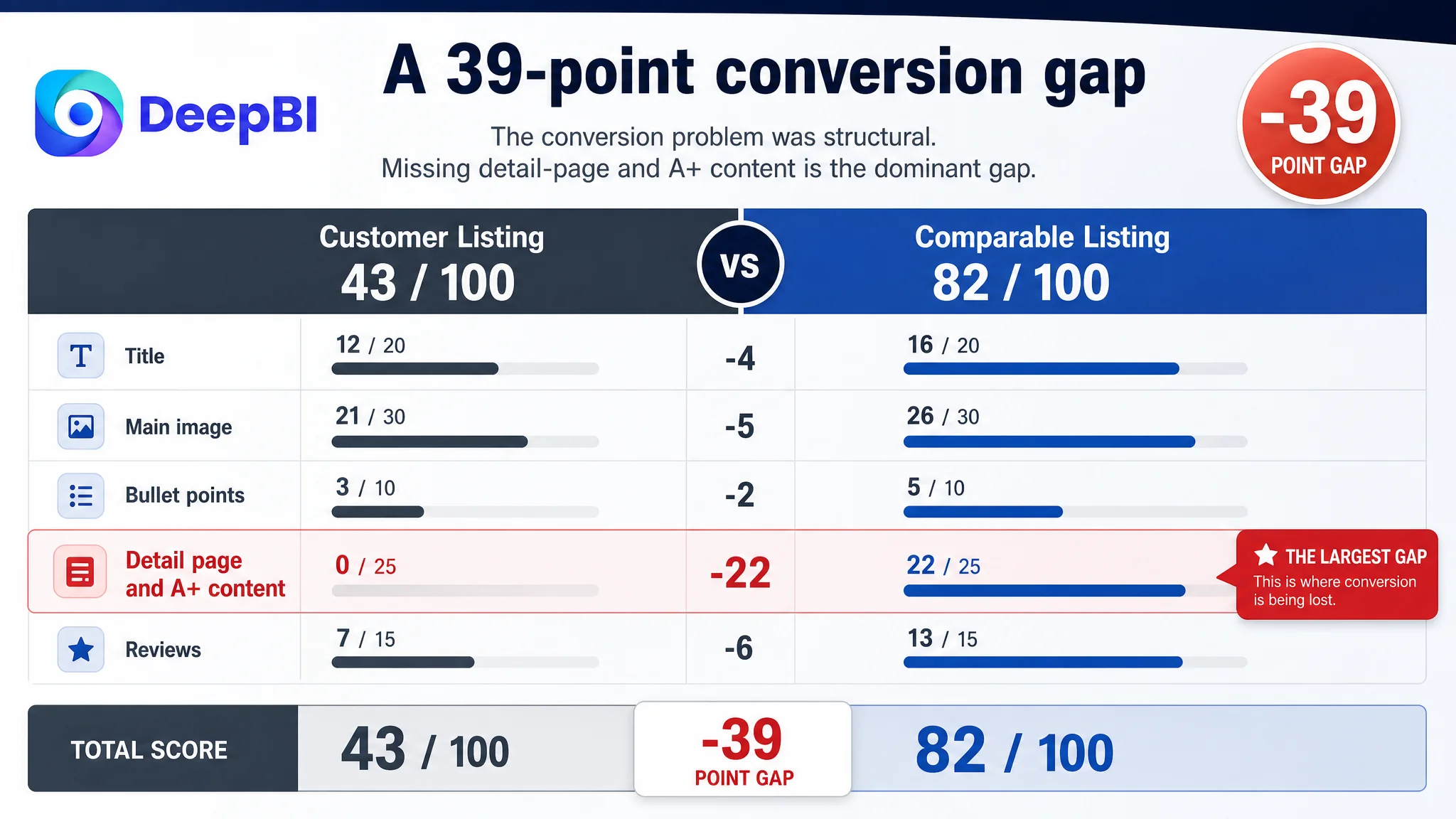
The result was not a Listing with one weak image or one imperfect keyword. It was a product page with a structural conversion gap.
The most important finding was not that the Listing looked weaker. It was that the page had too little evidence to support a purchase decision.
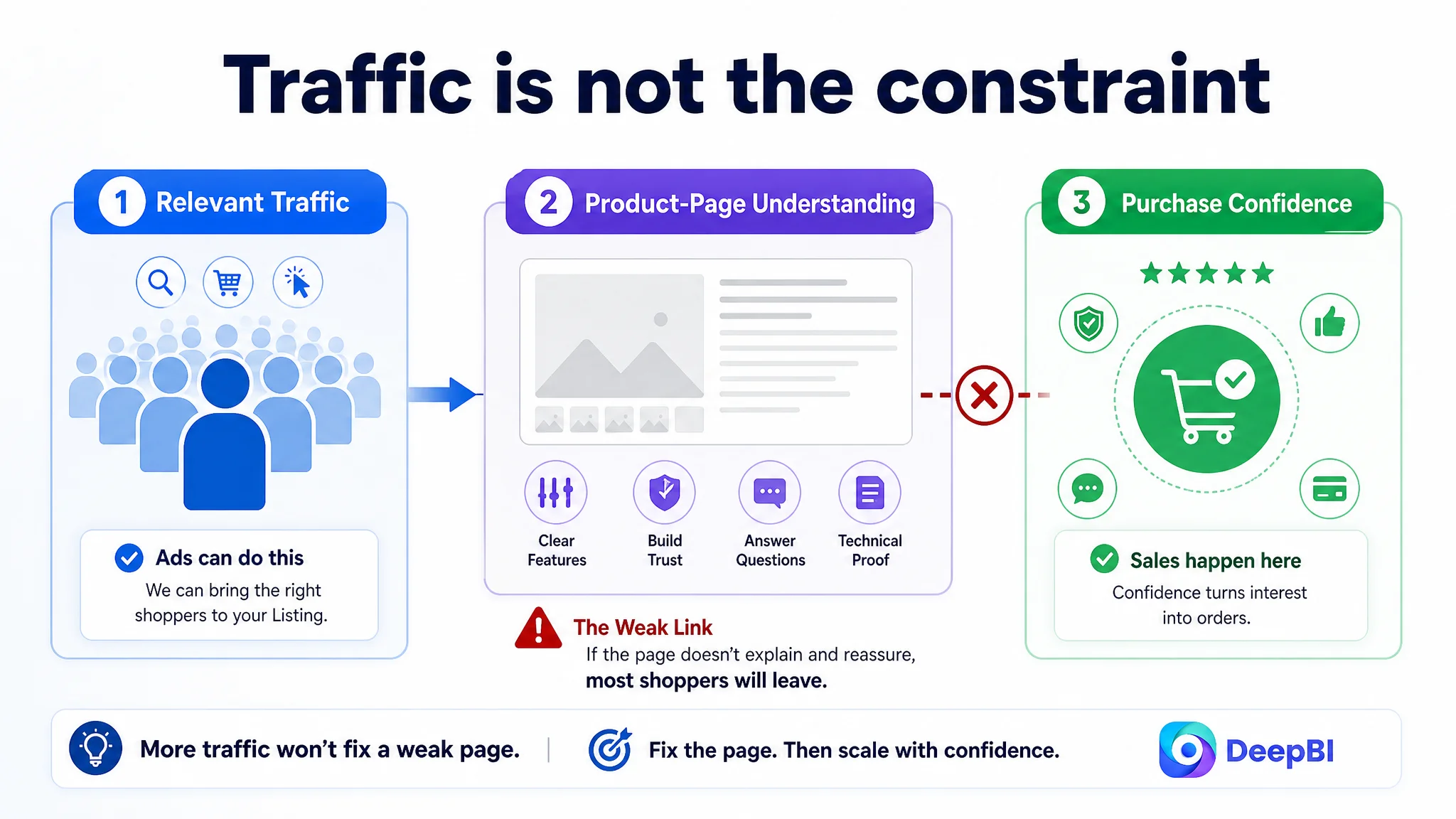
This distinction matters for Amazon advertising. Ads can bring a product into a shopper’s consideration set, but they cannot compensate for missing product information, weak positioning, or a page that fails to establish technical credibility. When those defects remain, additional traffic only creates more opportunities for shoppers to leave without ordering.
The Original Diagnosis Focused Too Close to the Ads
For an Amazon seller, a weak order result is often first interpreted as an advertising issue.
The team may look at:
- Search terms that appear too broad
- Bids that are not competitive enough
- Campaign structures that need more segmentation
- Keywords that are not receiving sufficient impressions
- Spending that appears inefficient
Those are legitimate questions. But they are not always the first questions to answer.
In this case, the Listing itself showed why continued ad tuning would have limited value. The page did not clearly communicate what kind of EQ pedal it was, who it was for, or why its specifications mattered in actual use. Even if a campaign reached a relevant bass player, the page still had to complete the persuasion process.
The customer’s initial direction was therefore incomplete: it treated the problem as a traffic-acquisition problem before confirming that the product page could convert qualified traffic.
DeepBI reframed the situation around Listing conversion capacity.
That changed the operating question from:
“How can we make Amazon ads more efficient?”
to:
“What is preventing a relevant shopper from understanding and trusting this pedal after the click?”
The Title Was Not Helping the Product Enter the Right Conversation
The title score was 12 out of 20. The issue was not simply that the title contained too few words. It was that the words were arranged around the brand rather than around the shopper’s search intent.
The comparable listing led with “EQ Pedal” and then added the specific category signal “10 Band Equalizer Pedal.” It also stated that the product was suitable for both guitar and bass and used a concrete numerical specification to create a stronger professional impression.
The customer’s title placed the brand name first, limited the application more narrowly to bass, and moved the aluminum-alloy construction toward the end. That structure weakened both search clarity and first-glance comprehension.
The product had meaningful attributes to communicate:
- Bass EQ pedal positioning
- Five-band equalizer control
- Bass guitar compatibility
- True Bypass
- Aluminum-alloy shell
But those attributes needed a more deliberate order. The recommended direction was:
Core category first, then product form and use case, followed by technical and durability attributes.
The suggested title structure made “Bass EQ Pedal” visible earlier and used “Equalizer Effects Pedal for Bass Guitar” to clarify the product’s role. The aluminum-alloy shell remained part of the differentiation, but it no longer competed with the primary category message for attention.
This is a small textual change with a larger business implication. On Amazon, the title has to serve both the search system and the human shopper. If the title does not quickly establish product identity, the rest of the page begins from a weaker position.
The Main Image Showed a Product, Not Yet a Professional Tool
The main-image score was 21 out of 30. The customer’s images presented the pedal, but they did not create the same level of professional recognition as the stronger comparison listing.
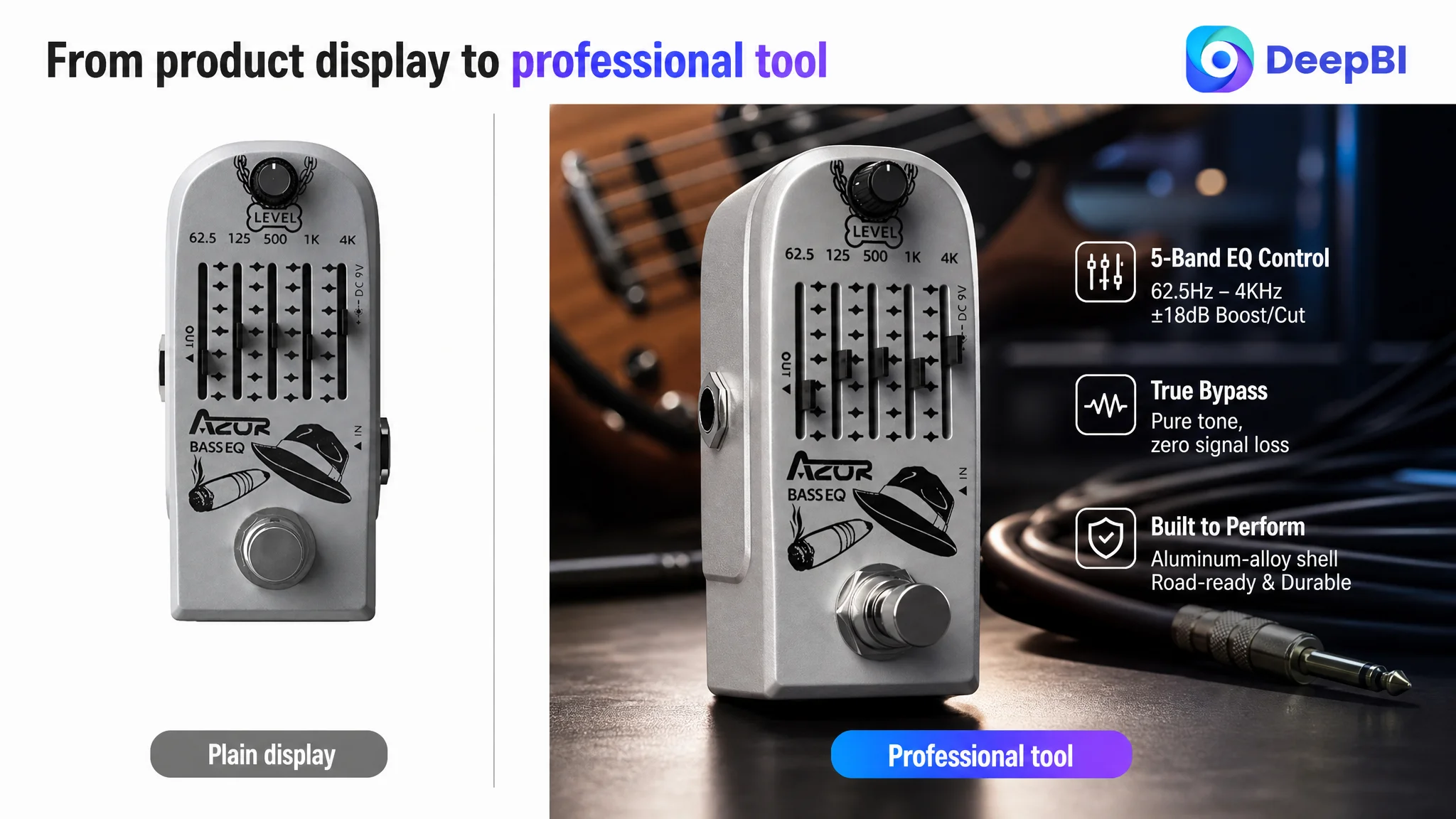
The visual gap appeared in three places.
The product lacked a strong visual hierarchy
The customer’s imagery was relatively plain and did not establish a distinctive industrial or audio-equipment language. The product could be seen, but it did not immediately feel like a serious piece of performance gear.
A stronger direction was to use controlled contrast, sharper product edges, and a cool-toned industrial studio treatment for supporting images. The goal was not decoration. It was to help a shopper recognize the pedal as a precise tool for shaping sound.
The technical value was difficult to read at a glance
An EQ pedal is not purchased only for its outer shell. Shoppers want to understand the controls, frequency bands, level adjustment, and signal behavior.
The customer’s images did not sufficiently prioritize those interaction points. A more effective image sequence would make the sliders, frequency markings, level control, input and output ports, and power connection easier to inspect.
For Amazon compliance, the primary image still needs to follow the platform’s requirements. Technical labels, application scenes, dimensions, and explanatory graphics belong in compliant secondary images and A+ content rather than being forced into the main image.
There was no clear performance context
The product remained largely isolated from the world in which a musician would use it. The comparison listing created stronger associations with stages, instruments, and professional equipment.
That difference affects more than visual appeal. It helps answer an unspoken question:
“Is this a serious performance tool, or just another inexpensive pedal?”
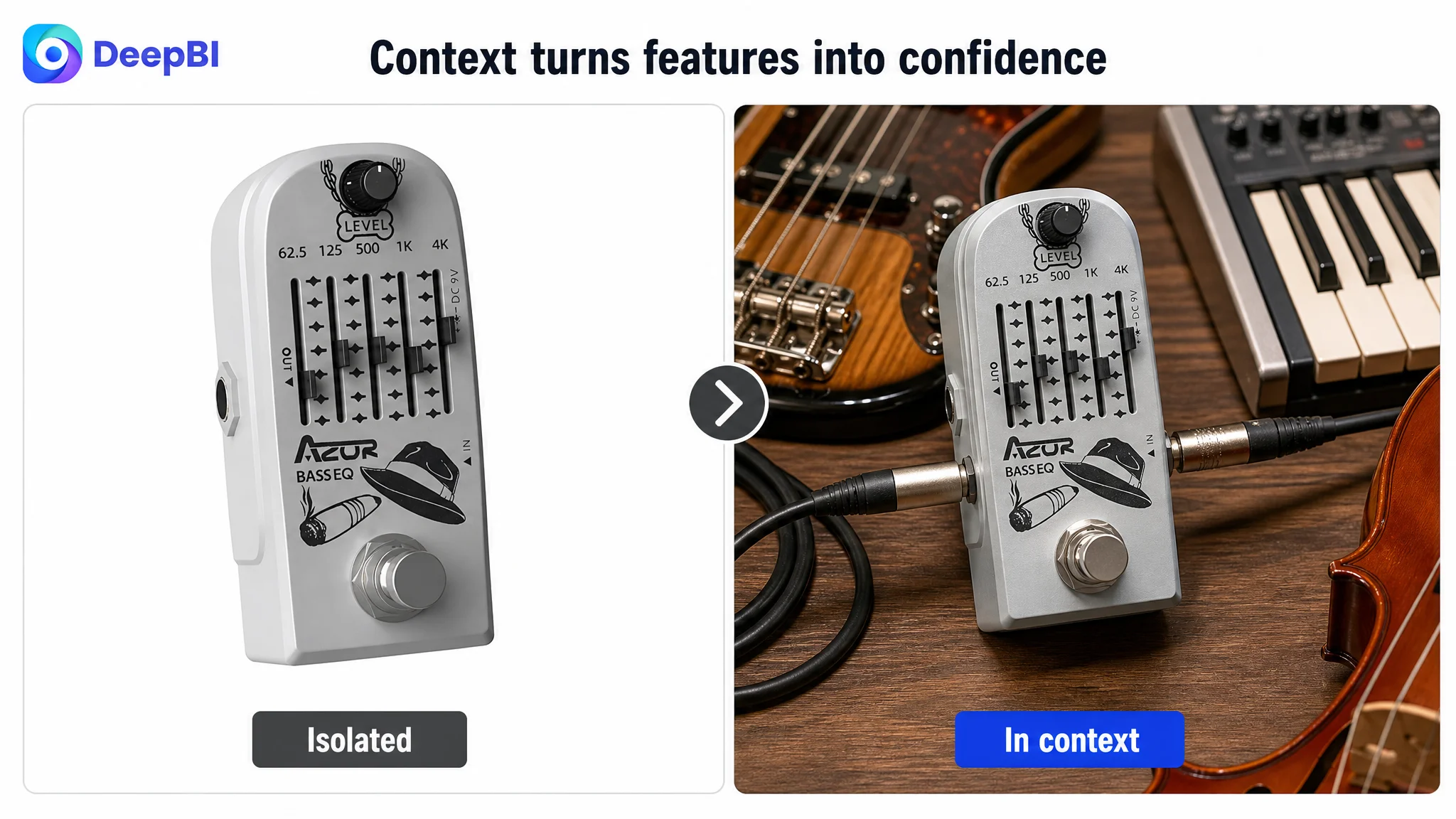
The revised visual direction therefore emphasized pedalboard and music-production contexts for supporting content, while preserving the actual product structure and appearance. The purpose was to connect the pedal with real use without inventing capabilities it did not have.
The Bullet Points Had Information, but Not a Buying Logic
The bullet-point score was only 3 out of 10. The problem was not a total lack of product claims. The problem was that the claims did not follow the order in which a technically minded shopper makes a decision.
The customer’s copy opened with broad promotional language such as achieving a “perfect tone.” It then moved through durability, portability, gift suitability, and service-related claims. The comparison listing took a more functional route:
1. Core EQ value
2. Concrete frequency or control specifications
3. Signal and performance characteristics
4. Construction and operating details
5. Power and usage notice
For this product, a stronger structure needed to begin with what the pedal actually allows a musician to control.
The recommended content direction emphasized:
- The five frequency bands, from 62.5Hz to 4KHz
- The ±18 dB boost and cut range
- Level control for signal adjustment
- Compact aluminum-alloy construction
- Transparent signal behavior and True Bypass, where supported by the product specification
- Bass-guitar use and the 9V DC power requirement
This sequence is more persuasive because it connects a specification to a practical decision. A frequency range matters because it explains what can be adjusted. An 18 dB range matters because it communicates the degree of control. A compact aluminum-alloy shell matters because it relates to pedalboard space and transport.
Technical shoppers do not need more adjectives. They need a clearer connection between the specification and the result they are trying to achieve.
The same principle also prevented the page from overstating the product. DeepBI’s role was not to add more impressive-sounding claims. It was to reorganize the product’s real attributes into a more credible and commercially useful explanation.
The Biggest Leak Was the Missing A+ Story
The detail-page score was 0 out of 25, compared with 22 out of 25 for the comparable listing. This was the decisive gap.
The customer’s Amazon product page had no A+ content or structured visual explanation. The comparison listing used multiple layers of communication:
- Brand identity
- A performance-oriented hero visual
- Functional callouts
- Frequency and level explanations
- Product structure and interface details
- Technical notices
- A comparison section across related effects
Without those modules, the customer’s page asked shoppers to infer too much from the title, bullets, and basic images.
That is particularly risky for a product such as an EQ pedal. The shopper may want to know:
- How the controls are arranged
- What each connection does
- Which instruments are supported
- What the frequency controls represent
- How much adjustment range is available
- Which power supply is required
- Whether the pedal belongs in a serious performance setup
A+ content does not replace the core Listing. It provides the space to resolve questions that cannot be answered effectively in a title or five bullet points.
A performance context should come first
The recommended opening module placed the pedal in a realistic stage or music-performance setting. The purpose was to establish the product’s role before presenting technical details.
The control system should be made visually legible
A close-up of the sliders and frequency markings could make the adjustment logic easier to understand. The product should remain physically accurate, while the image composition directs attention to the control area.
Interfaces and power requirements should be explicit
Input, output, and 9V DC power information should be presented through a clear interface diagram. This is not merely a content enhancement. It can reduce avoidable uncertainty and help prevent incorrect power-supply use.
Compatibility should be shown through context
The product’s intended use with bass guitar, and any other confirmed supported instruments, should be communicated through a restrained studio or equipment setup. The scene should clarify application without implying unsupported functionality.
A technical summary can consolidate the decision
A structured module combining the product image with confirmed specifications can give shoppers the feeling of consulting a concise professional reference rather than scanning disconnected marketing claims.
The key issue was not that the customer lacked more images. It was that the page lacked a complete explanation path.
Reviews Added Another Trust Barrier
The review score was 7 out of 15.
The customer’s Listing had:
- 4.0 stars
- 115 total reviews
- One-star feedback visible among the first ten reviews
The comparable listing had:
- 4.4 stars
- 1,528 total reviews
- No review below four stars among the first ten visible reviews
The review gap was not something that could be solved immediately through copy or image work. Review volume and rating history reflect accumulated market experience. But the comparison showed why the product page needed stronger proof in other areas.
When review authority is weaker, every unclear specification becomes more costly. Every missing interface explanation creates more hesitation. Every generic bullet point leaves more of the trust burden on the customer’s limited review history.
This is why the absence of A+ content was especially serious. The Listing was already behind in social proof, yet it had not built additional confidence through technical clarity, professional presentation, or structured usage explanation.
Why DeepBI Did Not Recommend More Ad Tuning First
The decision order was the most important part of the diagnosis.
DeepBI did not treat the 43-point Listing score as a reason to change everything at once. It identified the page-level constraint that had the greatest potential to affect the rest of the funnel:
The product page lacked the content and structure needed to convert relevant traffic.
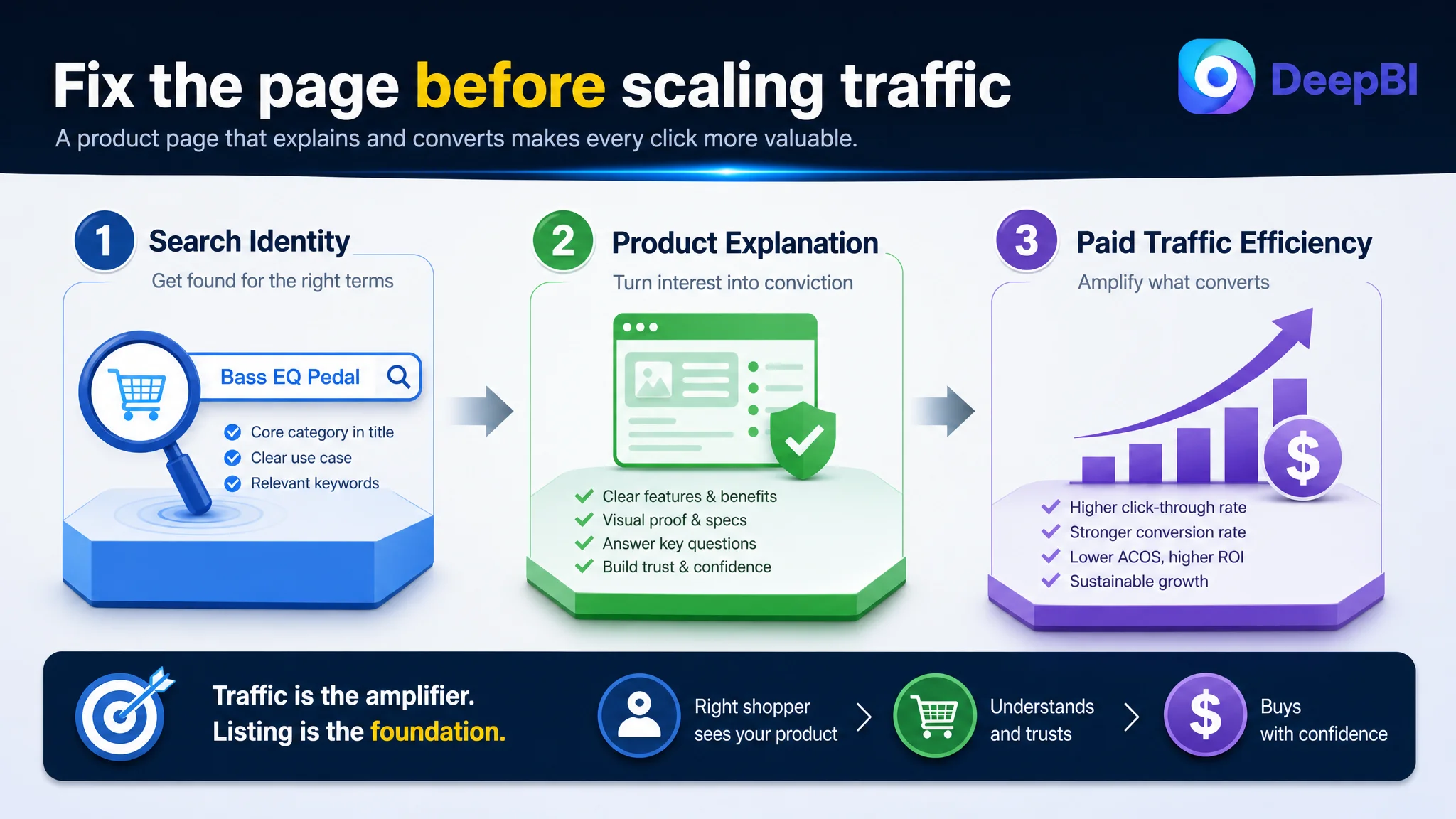
The priority was therefore:
1. Clarify the Listing’s category and search identity
2. Rebuild the visual hierarchy around a professional EQ tool
3. Rewrite the bullets around technical value and usage logic
4. Add A+ content to close the information and trust gaps
5. Only then evaluate how further Amazon ad optimization should be allocated
This order reduced a specific business risk: allowing paid traffic to keep amplifying a low-conversion page.
If the page remains weak, increasing bids may create more clicks without a corresponding increase in orders. Expanding keyword coverage may bring in shoppers who are even less likely to understand the product. More spend can make the symptom more visible while leaving the constraint untouched.
The decision was not that advertising was unimportant. It was that advertising efficiency depended on the Listing being ready to receive traffic.
From Product Display to Sales Logic
The recommended changes formed one connected argument rather than a collection of design tasks.
The title established that the product was a bass EQ pedal and surfaced the relevant technical identity earlier. The main and secondary images made the pedal’s professional use, controls, and physical details easier to recognize. The bullet points translated specifications into practical value. A+ content supplied the deeper explanation that the rest of the page could not carry.
The page would then answer the shopper’s questions in sequence:
- What is this product?
- Who is it for?
- What can I control with it?
- How much adjustment does it provide?
- How does it fit into my setup?
- What connections and power supply does it require?
- Why should I trust this product despite its smaller review history?
That is the difference between adding content and rebuilding conversion logic.
DeepBI’s analysis also kept the optimization grounded in the product’s actual boundaries. The objective was to improve composition, information hierarchy, scene relevance, and wording without changing the pedal’s physical design or inventing unsupported functions. Competitor visuals served as a market reference for clarity and professionalism, not as a template to copy.
What Other Amazon Sellers Can Take From This Case
This case does not prove that every high-ACOS problem is caused by a Listing. It shows why Amazon sellers should not assume the ads are the first place to intervene.
A product page can lose commercial efficiency through several connected weaknesses:
- The title does not lead with the core category term
- The main image fails to create a strong reason to click
- The bullet points list features without explaining their importance
- A+ content is missing or unable to answer technical questions
- Review authority is weaker than the category benchmark
- Paid traffic is being sent to a page that has not earned the shopper’s confidence
The practical lesson is to diagnose the funnel in order.
If the problem is primarily click creation, examine the search-facing title and main image. If relevant shoppers are clicking but not ordering, inspect the product-page explanation, trust signals, images, bullets, A+ content, and reviews before assuming that another bid adjustment will solve the issue.
For this bass EQ pedal Listing, DeepBI’s value was not a list of isolated recommendations. It was the judgment that the Amazon product page had become the limiting factor—and that the page needed to regain its ability to explain, reassure, and convert before advertising could become more productive.
Amazon ads can bring a shopper to the Listing. The Listing still has to earn the order.