Cases

Real results and actionable strategies from successful Amazon PPC campaigns

Proven Amazon PPC management results from real sellers

When More Amazon Traffic Would Not Fix the Page: Finding the Conversion Bottleneck in a Car Air Freshener Listing

When More Amazon Traffic Would Not Fix the Page: Finding the Conversion Bottleneck in a Car Air Freshener Listing

This case study examines an Amazon US car air freshener Listing evaluated against a stronger category competitor. The issue was not simply weak title, images, or bullet points, but incomplete conversion logic across the product page. The analysis identified unclear product variety, delayed search and value signals, feature-led bullets, and A+ content that addressed leakage, safe use, and gifting too late. The optimization rebuilt the page in shopper decision order to clarify the first impression, explain use and safety, connect scents to odor problems, and establish confidence before increasing Amazon ad traffic.

Marketing Automation Expert

DeepBI

Marketing Automation Expert

2026-08-07
When Amazon Ad Pressure Hid a Product-Page Trust Gap: Reframing Conversion for a Kids Gardening Tools Listing

When Amazon Ad Pressure Hid a Product-Page Trust Gap: Reframing Conversion for a Kids Gardening Tools Listing

This case study examines how an Amazon seller of kids’ gardening tools discovered that weak conversion capacity, rather than insufficient traffic, was limiting results. DeepBI’s diagnosis found a product-page trust gap, including A+ content without images or video, weak usage logic, and limited proof of what children could do with the set. The optimization rebuilt the Listing around a clearer decision sequence: set contents, real gardening use, material and durability evidence, family activities, outdoor learning, and gifting. The case shows why sellers should validate product-page readiness before scaling Amazon ads.

AI Specialist

DeepBI

AI Specialist

2026-08-07
When a Zero-Review Amazon Listing Blamed the Images: Finding the Conversion Bottleneck in a Pilates Socks Bag

When a Zero-Review Amazon Listing Blamed the Images: Finding the Conversion Bottleneck in a Pilates Socks Bag

This case study examines an Amazon seller’s zero-review Pilates socks pouch listing, initially approached as a searchability and image-presentation problem. DeepBI identified a deeper conversion constraint: the page lacked trust and explanation, relied on text, did not clearly show capacity, and left the “bag only, no socks” concern unresolved. The optimization rebuilt the page’s sales logic through clearer product use, material and construction proof, reduced purchase-risk confusion, and A+ content connecting hygiene, organization, Pilates, travel, and gifting. The case shows why traffic and keywords need a page that gives shoppers enough reason to buy.

Marketing Automation Expert

DeepBI

Marketing Automation Expert

2026-08-07
When an Amazon Picture-Hanging Listing Looked Like a Keyword Problem, the Real Leak Was Conversion Logic

When an Amazon Picture-Hanging Listing Looked Like a Keyword Problem, the Real Leak Was Conversion Logic

This case study examines how a US Amazon seller’s picture-hanging tool Listing lost ground to a comparable high-performing listing. Although missing search terms, weak images, and unclear bullet points appeared to be the main issues, DeepBI identified a broader conversion logic problem. The product page did not clearly explain how the tool addressed inaccurate marking, wall damage, alignment challenges, or different hanging hardware. The optimization rebuilt the Listing around search relevance, functional image proof, buyer pain points, and A+ content before increasing Amazon ad traffic.

Marketing Automation Expert

DeepBI

Marketing Automation Expert
2026-08-06
When a Lower Amazon Listing Score Was Not a Feature Gap: Reframing Product-Page Conversion for a Multi-Pet RFID Cat Feeder

When a Lower Amazon Listing Score Was Not a Feature Gap: Reframing Product-Page Conversion for a Multi-Pet RFID Cat Feeder

This case study examines an Amazon product-page conversion problem for a multi-pet RFID cat feeder. The listing scored 75/100 against a comparable US marketplace benchmark scoring 87/100. Although the product addressed food stealing, special diets, and multi-pet feeding, its advantages were not presented as a clear buying argument. The analysis reframed the gap: rather than adding complex connected features, the page needed to make RFID access control, sealed feeding, physical protection, and simpler food-stealing prevention more prominent for shoppers making a purchase decision.

AI Specialist

DeepBI

AI Specialist

2026-08-06
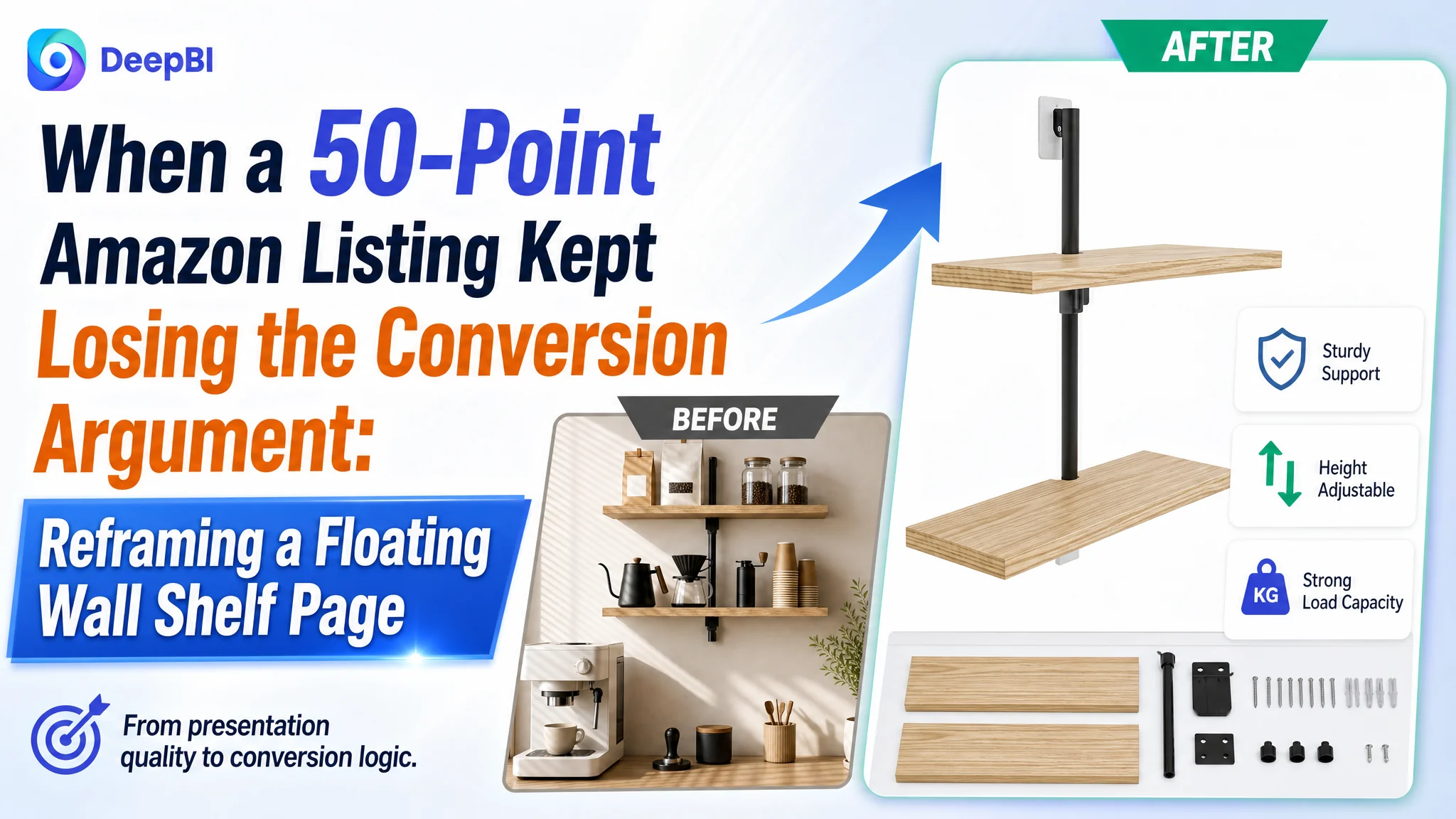
When a 50-Point Amazon Listing Kept Losing the Conversion Argument: Reframing a Floating Wall Shelf Page

When a 50-Point Amazon Listing Kept Losing the Conversion Argument: Reframing a Floating Wall Shelf Page

This case study examines how a US Amazon seller reframed a two-tier floating wall shelf Listing after a 50-point evaluation revealed weak conversion capacity. Although the product had clear functional differences, the page left shoppers to interpret its structure, adjustable design, capacity, materials, installation options, and fit in real homes. The optimization moved product structure and key options forward, made capacity and materials more visible, and used A+ content to connect features with household scenarios. It also highlights why improving page clarity and reducing uncertainty should come before sending more paid traffic.

Marketing Automation Expert

DeepBI

Marketing Automation Expert
2026-08-06
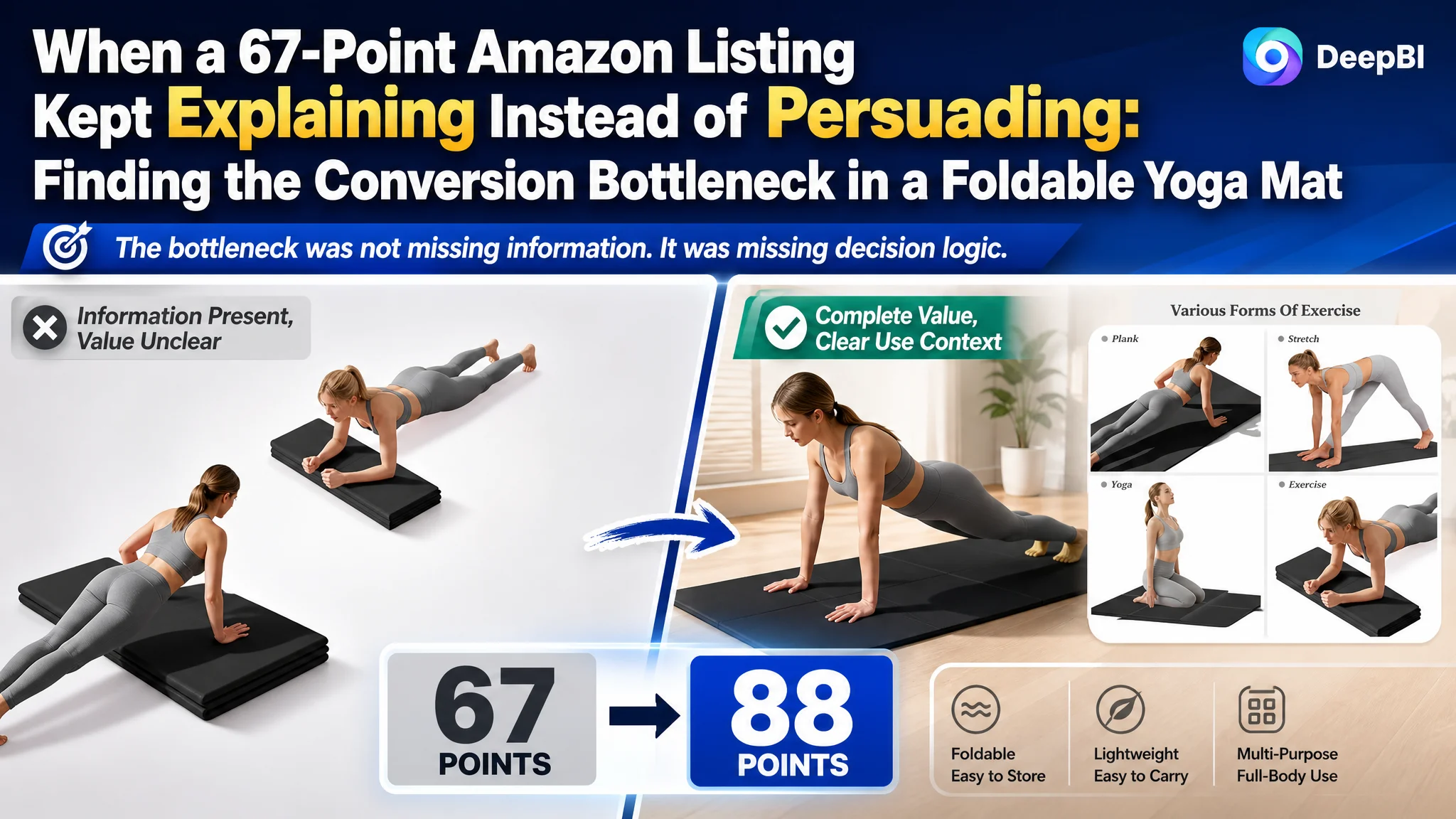
When a 67-Point Amazon Listing Kept Explaining Instead of Persuading: Finding the Conversion Bottleneck in a Foldable Yoga Mat

When a 67-Point Amazon Listing Kept Explaining Instead of Persuading: Finding the Conversion Bottleneck in a Foldable Yoga Mat

This case study examines how a 67-point Amazon Listing for a foldable yoga mat contained specifications, usage images, and material information but still struggled to build conversion confidence. DeepBI’s comparison identified a weakness in the page’s sales logic: the foldable design was not clearly differentiated from a conventional rolled mat, visual proof did not establish trust, and product facts were not connected to real-life use. The optimization therefore rebuilt the sequence across the Amazon title, main image, bullet points, and A+ content instead of refining isolated Listing elements.

AI Specialist

DeepBI

AI Specialist

2026-08-05
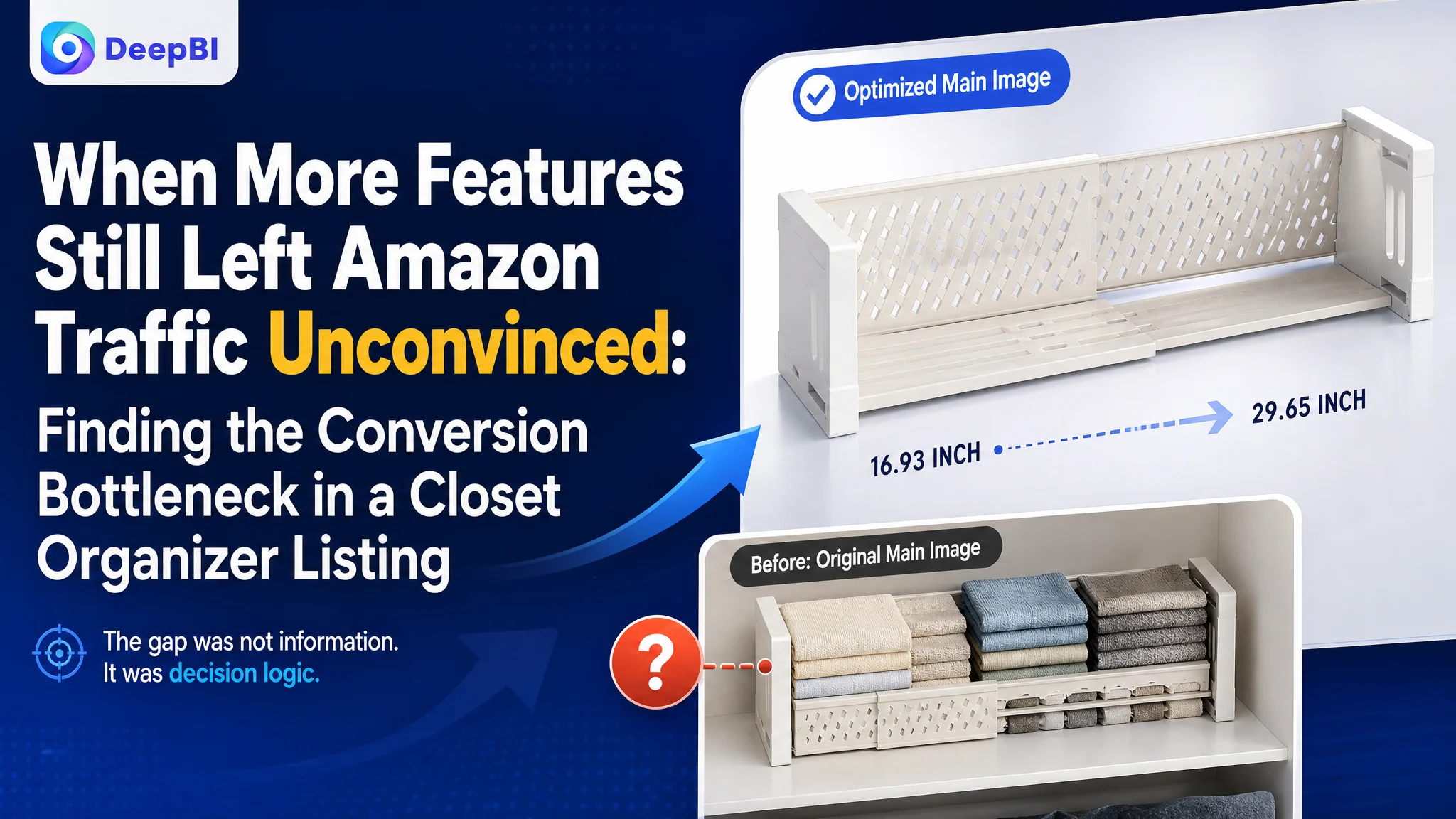
When More Features Still Left Amazon Traffic Unconvinced: Finding the Conversion Bottleneck in a Closet Organizer Listing

When More Features Still Left Amazon Traffic Unconvinced: Finding the Conversion Bottleneck in a Closet Organizer Listing

This case study examines an Amazon seller’s expandable metal closet organizer listing that trailed a comparable product despite presenting useful features including telescoping design, 44-pound load capacity, stackable structure, and multiple use cases. DeepBI identified a conversion bottleneck: shoppers had to connect details about fit, the two-pack, stability, and everyday storage needs themselves. The revised direction rebuilt the page’s decision logic through clearer visual communication, configuration verification, dimensions, technical proof, multi-room use cases, and Before/After problem resolution rather than simply adding more functional information.

Marketing Automation Expert

DeepBI

Marketing Automation Expert
2026-08-05
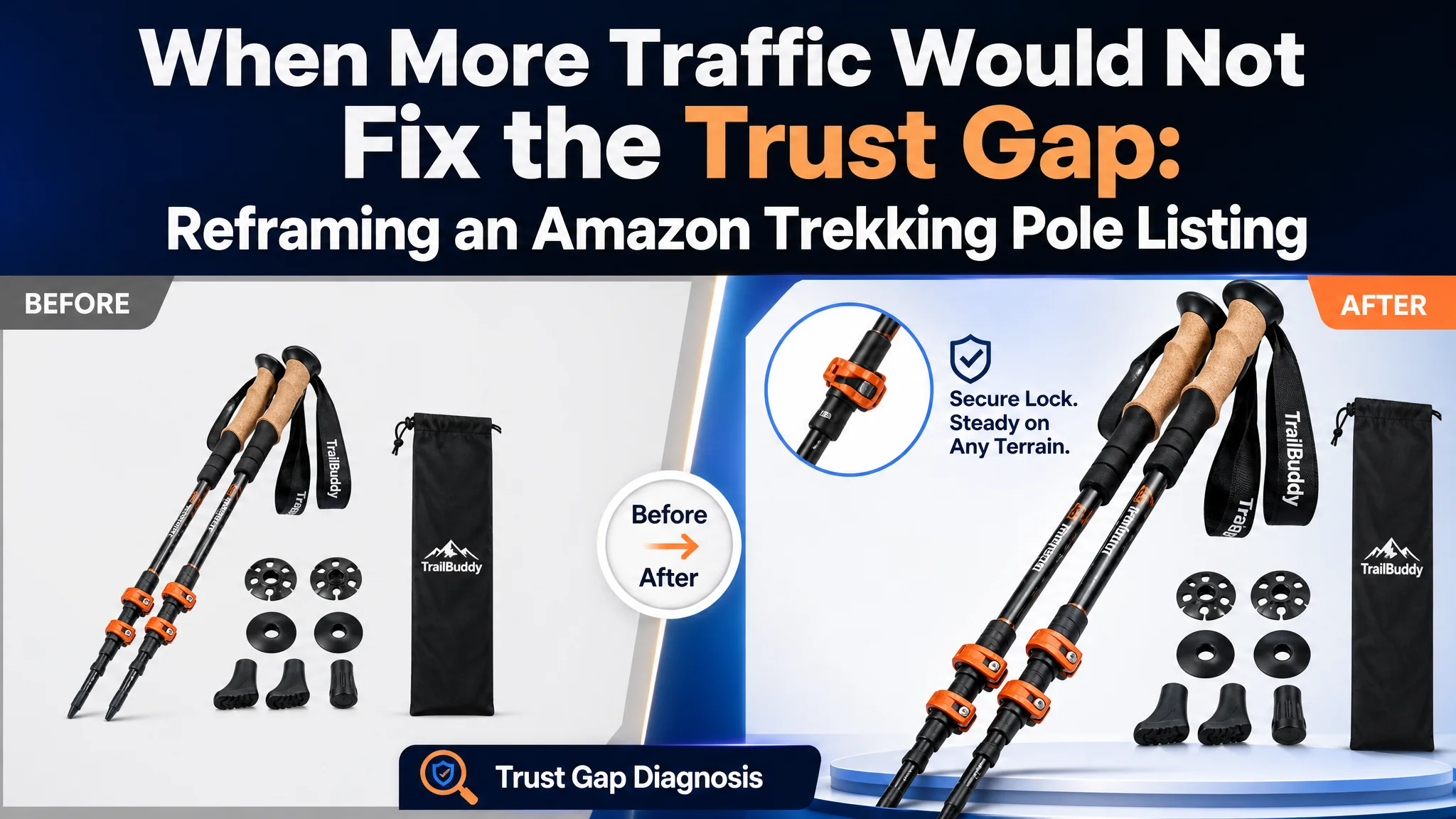
When More Traffic Would Not Fix the Trust Gap: Reframing an Amazon Trekking Pole Listing

When More Traffic Would Not Fix the Trust Gap: Reframing an Amazon Trekking Pole Listing

This case study examines an Amazon trekking pole listing that had useful product information but struggled to build purchase confidence. Although the page included a main keyword, product images, lightweight and adjustable-use messaging, ergonomic handle details, and wrist-strap information, its trust gap remained significant. A 3.6-star rating, 32 reviews, and limited visible review content contrasted with a comparable listing’s stronger review profile. DeepBI’s diagnosis redirected optimization toward safety, stability, ease of use, terrain adaptability, and credible reassurance rather than more specifications, advertising adjustments, or traffic alone.

AI Specialist

DeepBI

AI Specialist

2026-08-05
When More Sewing Details Still Could Not Close the Sale: Finding the Real Amazon Listing Bottleneck in a Handheld Sewing Machine Case

When More Sewing Details Still Could Not Close the Sale: Finding the Real Amazon Listing Bottleneck in a Handheld Sewing Machine Case

This case study examines an Amazon US handheld sewing machine Listing that included product details, accessories, fabric compatibility, operating instructions, and two power options, yet still struggled to build purchase confidence. DeepBI’s diagnosis found that the central bottleneck was not missing information, but insufficient proof of immediate household use cases such as hemming pants, repairing denim, and fixing a torn bag. With a score of 71 versus 84 for a comparable high-performing listing, the analysis highlights gaps across the title, main image, A+ content, and reviews, before increasing ad traffic.

AI Specialist

DeepBI

AI Specialist

2026-08-04
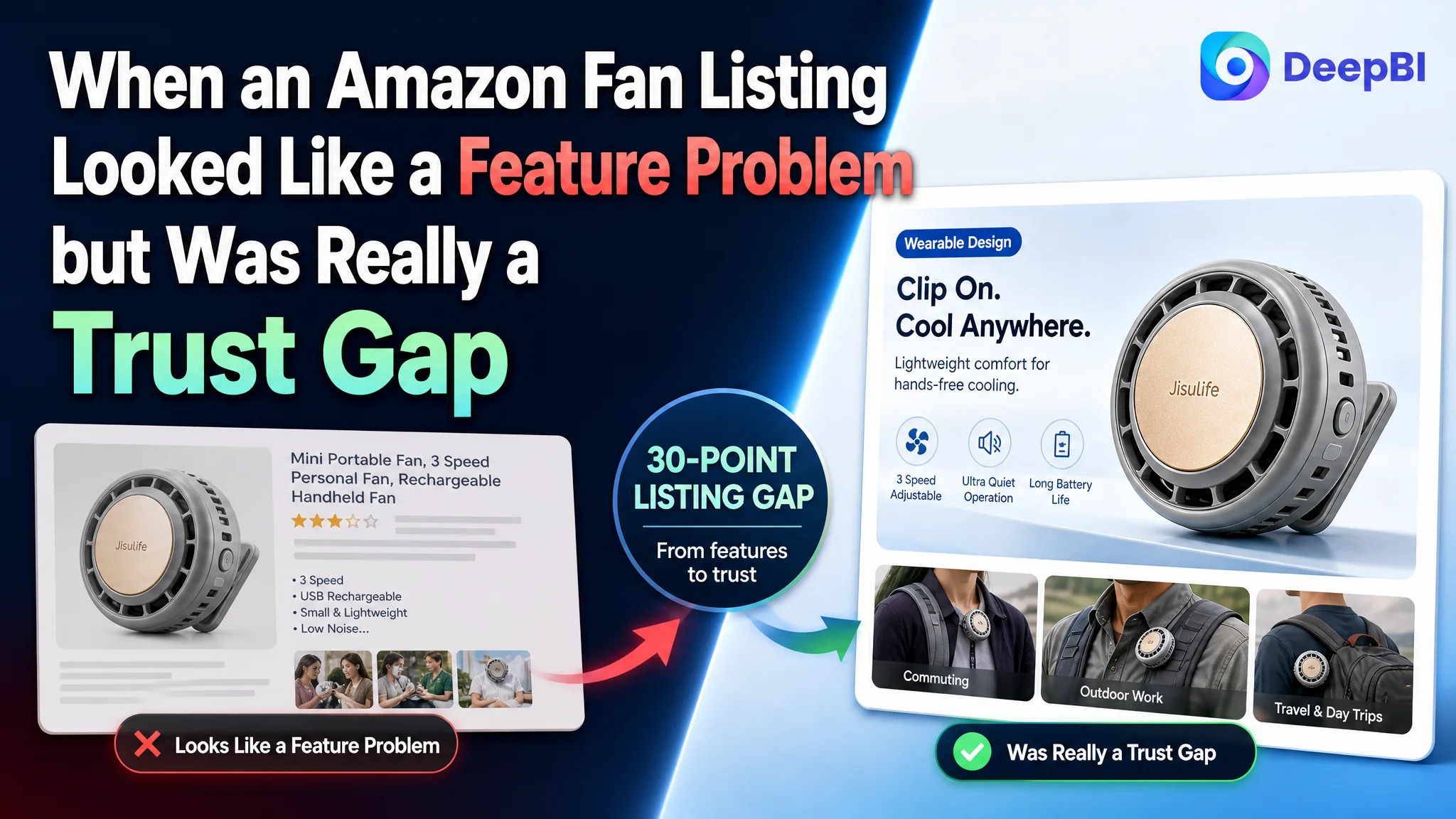
When an Amazon Fan Listing Looked Like a Feature Problem but Was Really a Trust Gap

When an Amazon Fan Listing Looked Like a Feature Problem but Was Really a Trust Gap

This case study examines why an Amazon listing for a wearable clip-on mini fan was not converting its competitive potential into buying decisions. Although the product page included information about hands-free cooling, adjustable airflow, multiple wind speeds, bladeless construction, USB-C charging, and portability, it lacked a complete persuasive story. A comparison showed a 54-versus-84 Listing score, with the largest gap in the detail section. The optimization focused on product-page conversion through clearer title messaging, more demonstrative images, usage-led bullet points, and an A+ narrative covering technical proof, wearing scenarios, safety, charging, and portability.

Marketing Automation Expert

DeepBI

Marketing Automation Expert
2026-08-04
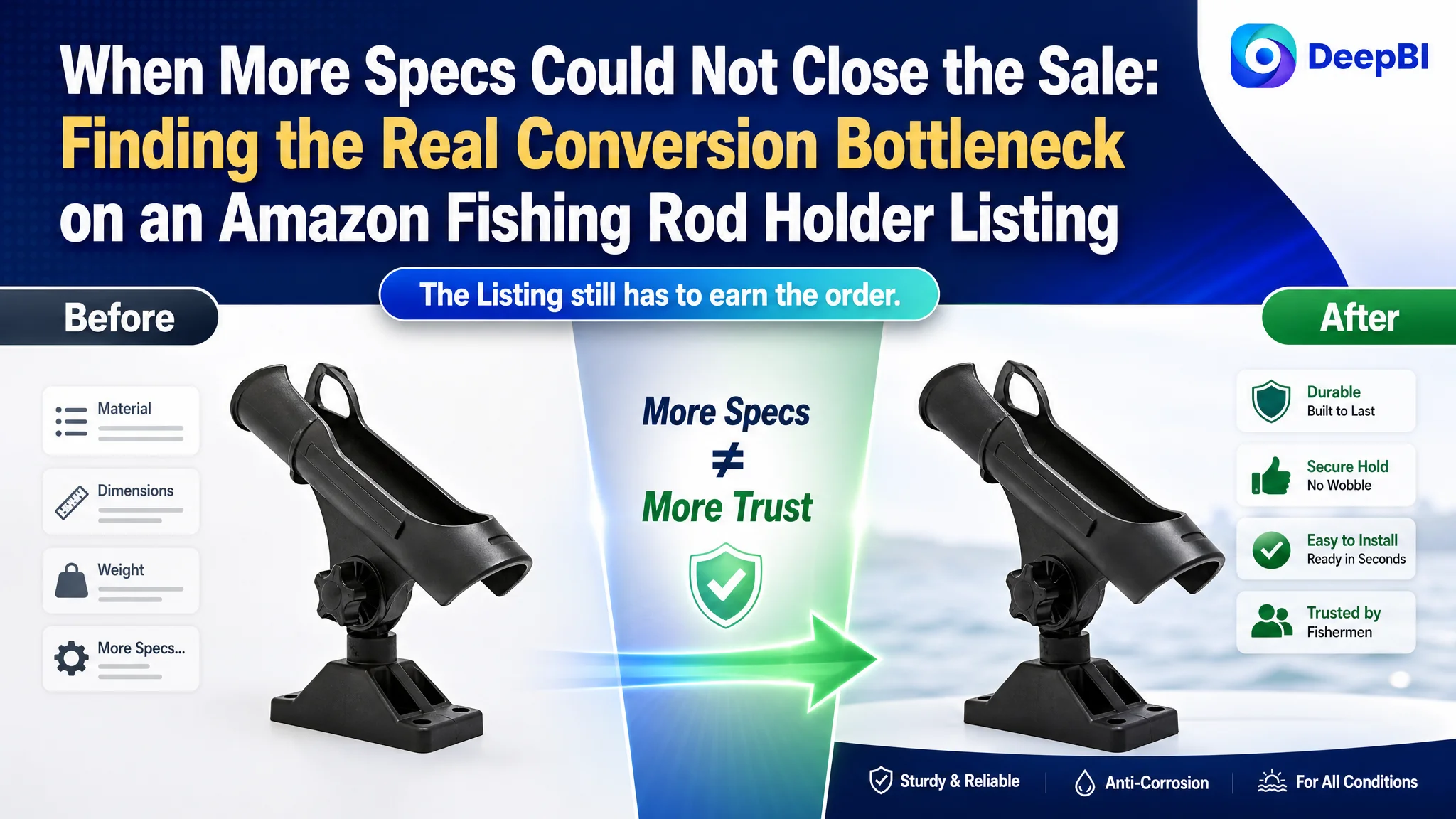
When More Specs Could Not Close the Sale: Finding the Real Conversion Bottleneck on an Amazon Fishing Rod Holder Listing

When More Specs Could Not Close the Sale: Finding the Real Conversion Bottleneck on an Amazon Fishing Rod Holder Listing

This case study examines an Amazon fishing rod holder Listing that struggled to compete at the product-page level despite efforts to add technical details, dimensions, and product functions. DeepBI’s diagnosis found a decision-making and trust gap, with the Listing scoring 66 out of 100 versus 84 for a comparable high-performing Listing. The analysis identified weaknesses in product-page detail, customer trust signals, title, and main image. Optimization focused on corrosion resistance, four-rod capacity, mounting confidence, adjustability, rod protection, and credible use in real boat environments before driving more traffic through Amazon ads.

AI Specialist

DeepBI

AI Specialist

2026-08-03
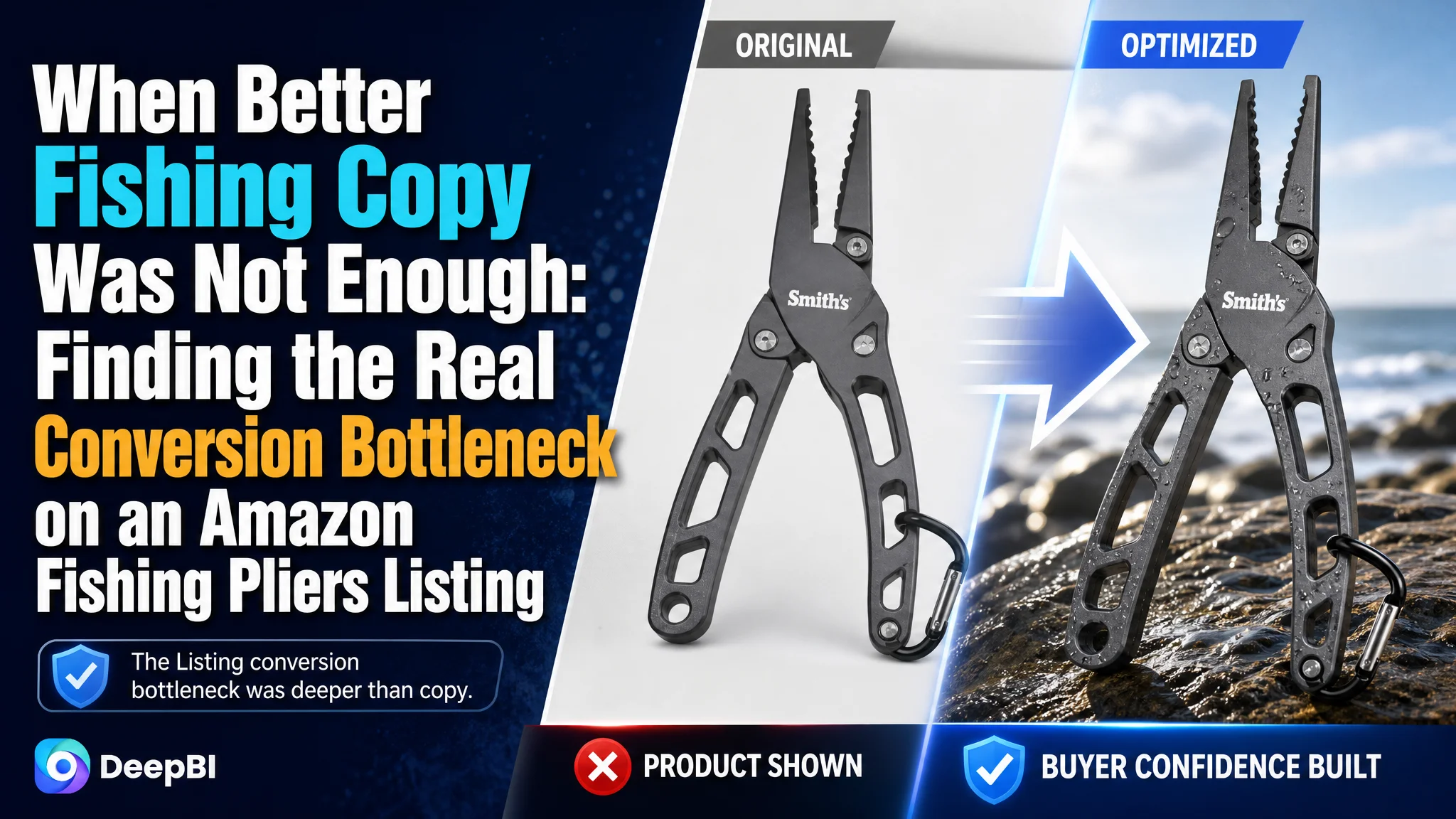
When Better Fishing Copy Was Not Enough: Finding the Real Conversion Bottleneck on an Amazon Fishing Pliers Listing

When Better Fishing Copy Was Not Enough: Finding the Real Conversion Bottleneck on an Amazon Fishing Pliers Listing

An Amazon seller’s locking aluminum fishing pliers Listing had a functional product and basic selling points, but it failed to give shoppers enough reasons to click, trust, and buy. DeepBI compared the page with a high-performing fishing pliers Listing and identified major gaps in reviews, A+ content, the main image, and title structure. The optimization focused on rebuilding decision logic through clearer product understanding, real fishing use cases, visual technical proof, portability and safety communication, and feature-to-concern connections. The case shows why sellers should assess conversion readiness before increasing Amazon ad traffic.

Marketing Automation Expert

DeepBI

Marketing Automation Expert

2026-08-03
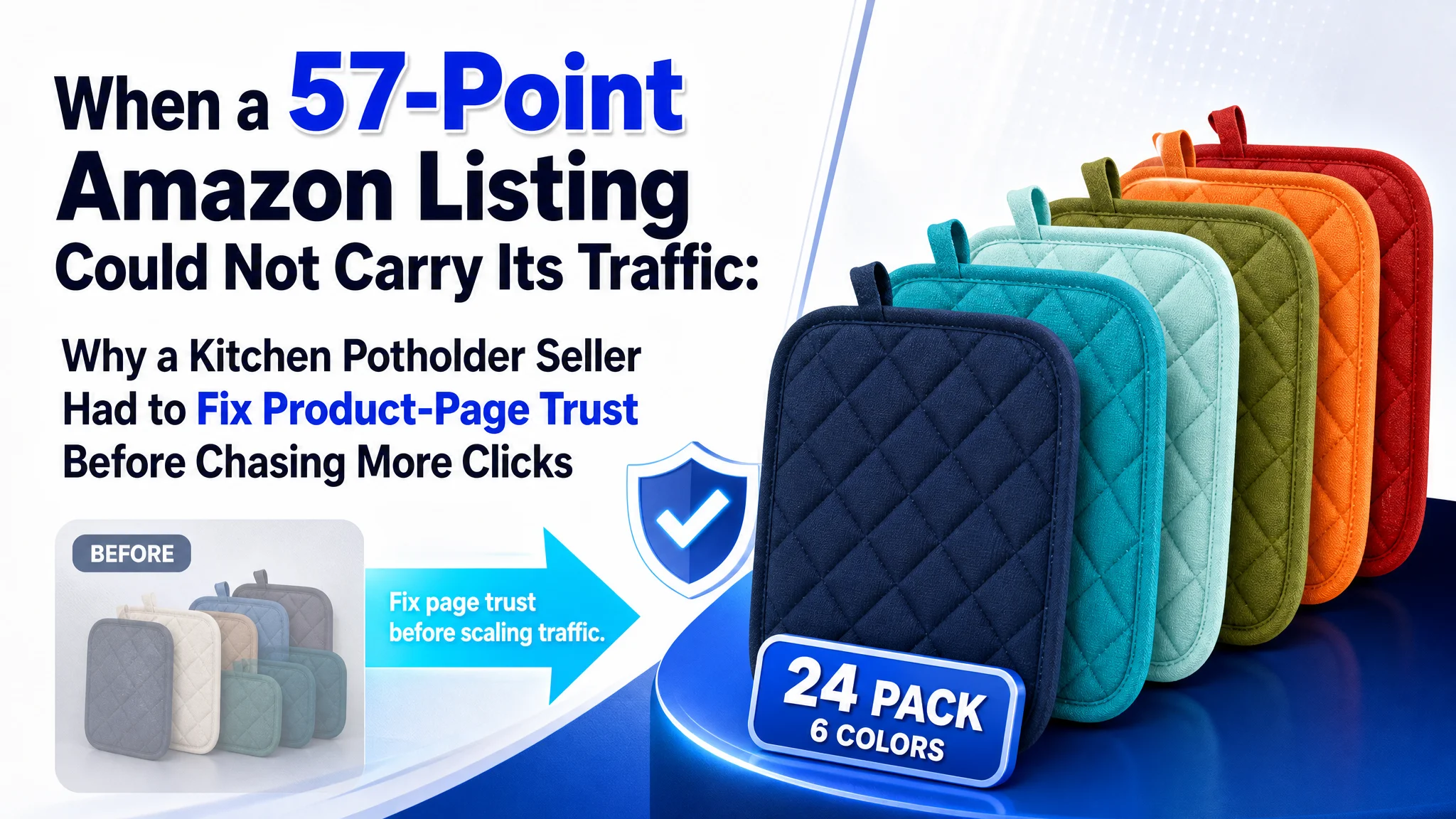
When a 57-Point Amazon Listing Could Not Carry Its Traffic: Why a Kitchen Potholder Seller Had to Fix Product-Page Trust Before Chasing More Clicks

When a 57-Point Amazon Listing Could Not Carry Its Traffic: Why a Kitchen Potholder Seller Had to Fix Product-Page Trust Before Chasing More Clicks

This case study examines how a kitchen accessories seller addressed weak Amazon product-page performance despite having a complete Listing, five bullet points, and a 24-piece multicolor potholder set. With a competitive score of 57 compared with a high-performing Listing’s 84, the seller focused on the deeper causes of the conversion gap: missing visual detail-page experience, weak review trust, and an ineffective main-image sequence. The optimization rebuilt the page’s sales logic through clearer value communication, material and heat-protection credibility, practical kitchen scenarios, structured A+ content, and advertising-readiness.

AI Specialist

DeepBI

AI Specialist

2026-08-03
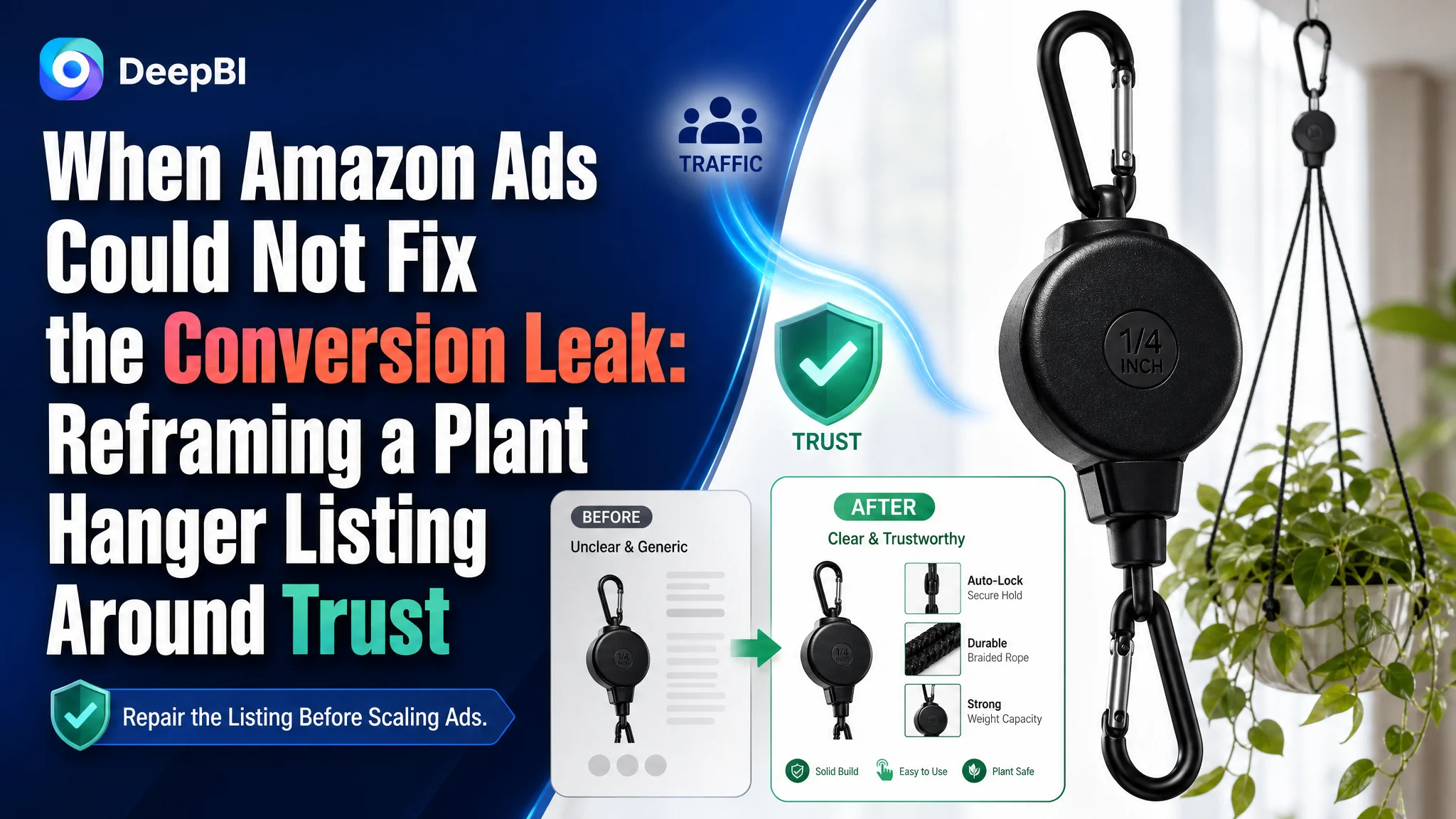
When Amazon Ads Could Not Fix the Conversion Leak: Reframing a Plant Hanger Listing Around Trust

When Amazon Ads Could Not Fix the Conversion Leak: Reframing a Plant Hanger Listing Around Trust

This case study examines how an Amazon seller of retractable plant hangers addressed a conversion problem that advertising could not solve. DeepBI compared the listing with a high-performing competitor and identified gaps in the five-point section, A+ content, product imagery, and review-driven trust. The optimization reframed the page around the buyer’s decision by clarifying the auto-lock mechanism, material and safety details, load range, and practical uses. It shows why sellers should strengthen listing logic and trust before relying on additional Amazon Ads traffic.

Marketing Automation Expert

DeepBI

Marketing Automation Expert
2026-08-02